
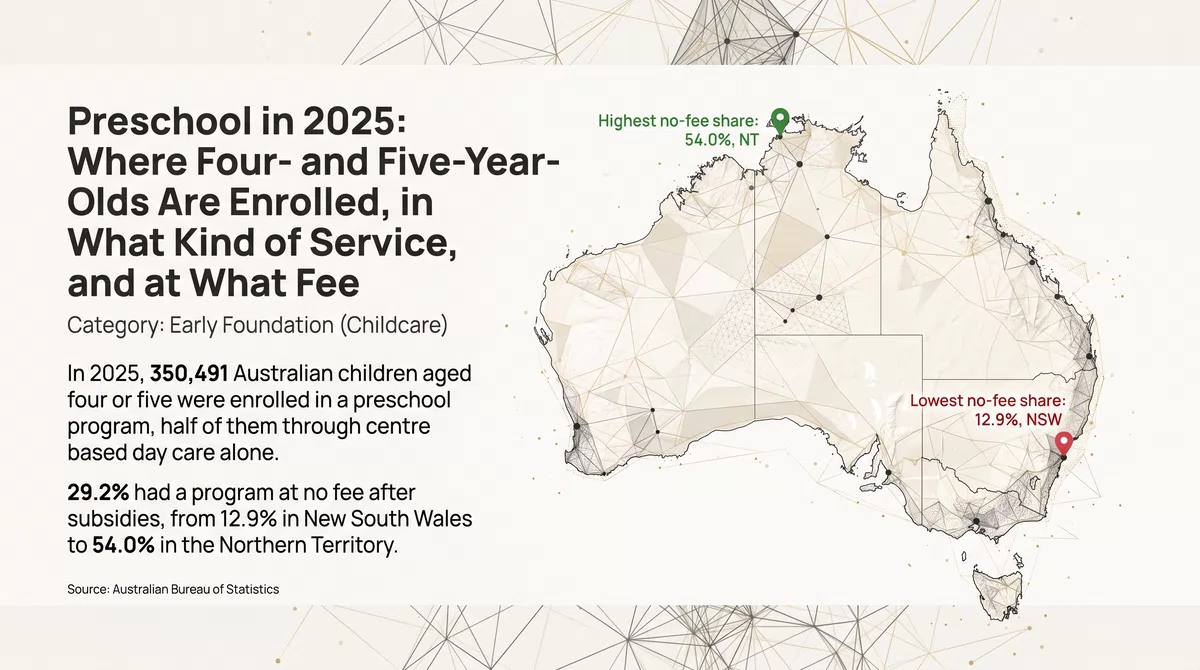

In 2025, 350,491 Australian children aged four or five were enrolled in a preschool program. Half of them, 50.8%, received it only through a centre based day care service, and 34.5% only through a dedicated preschool. Which of the two a child attends depends heavily on the state: 64.2% were in a dedicated preschool only in Western Australia and 22.9% in Queensland. So does the fee. Nationally 29.2% of enrolled children had a program that cost their family nothing after subsidies, from 12.9% in New South Wales to 54.0% in the Northern Territory.
Counts are for the collection week of 28 July to 3 August 2025, and ages are as at 1 July 2025.
What is counted
The ABS Preschool Education collection counts children enrolled in a preschool program, which it describes as a structured, play-based learning program delivered by a degree-qualified teacher, aimed mainly at children in the year or two before they start full-time school. The figures here are from the 2025 collection, taken in the week of 28 July to 3 August 2025, and cover children aged four or five at 1 July 2025. Of the 350,491 enrolled, 281,772 were four and 68,720 were five. States and territories are those of the provider. The ABS reports the total as 2.6% higher than in 2024.
A preschool program is not the same thing as child care. It can be delivered in a stand-alone or school-based preschool, or inside a centre based day care service, the kind formerly called long day care.
Where the program is delivered
Children aged 4 or 5 enrolled in a preschool program, by kind of service, Australia, 2025
APN calculation based on Australian Bureau of Statistics data: Preschool Education, 2025, Table 2 (children enrolled, by sector, state and territory, and age). Children aged 4 or 5 enrolled in a preschool program, by the kind of service delivering it, as a share of all such children. Australia.
Centre based day care is the most common setting: 178,022 children were enrolled in a preschool program there and nowhere else. Dedicated preschools had 121,046, and 51,424 children, 14.7%, were enrolled in both kinds of service.
By state and territory
Share of enrolled children in a dedicated preschool only, by state and territory, 2025
APN calculation based on Australian Bureau of Statistics data: Preschool Education, 2025, Table 2 (children enrolled, by sector, state and territory, and age). Share of enrolled children aged 4 or 5 who were enrolled only in a dedicated preschool, with the shares enrolled only in centre based day care and in both in brackets. State and territory of the provider.
The states have built preschool differently. In Western Australia 64.2% of enrolled children were in a dedicated preschool only, most of them in government preschools, and a further 25.9% attended both a preschool and a day care service; 9.9% relied on day care alone. In Queensland and New South Wales the pattern is the reverse: 70.7% and 63.8% of enrolled children received their program through centre based day care only.
The age mix differs as well. Five-year-olds were 19.6% of enrolled children nationally, but 39.5% in Tasmania and 3.2% in Western Australia.
Hours
Almost all enrolments are for 15 hours a week or more: 96.6% of enrolled children, 338,536, were enrolled for 15 hours or more, and the share was above 94% in every state and territory. 11,958 children were enrolled for fewer than 15 hours.
What families pay
Children aged 4 or 5 enrolled in a preschool program, by hourly fee after subsidies, Australia, 2025
APN calculation based on Australian Bureau of Statistics data: Preschool Education, 2025, Table 11 (children enrolled, by hourly fees charged, state and territory, and sector). Children aged 4 or 5 enrolled in a preschool program, by the hourly fee after subsidies, as a share of all such children. Australia.
The ABS reports fees as the out-of-pocket cost per hour after subsidies have been deducted. On that basis 29.2% of enrolled children had a program at no fee, and a further 44.6% paid between $1 and $4 an hour, so about 74% paid less than $5 an hour. 6.3% paid $10 an hour or more.
The setting makes a large difference. Among children enrolled only in a dedicated preschool, 75.5% had no fee. Among those enrolled only in centre based day care, 5.2% did, and the most common fee was $1 to $4 an hour (56.3% of children there).
Share of enrolled children whose preschool program carried no fee, by state and territory, 2025
APN calculation based on Australian Bureau of Statistics data: Preschool Education, 2025, Table 11 (children enrolled, by hourly fees charged, state and territory, and sector). Share of enrolled children aged 4 or 5 whose preschool program carried no fee after subsidies. State and territory of the provider.
The share paying nothing differs by state, with the mix of settings and with what each state’s preschools charge: 54.0% in the Northern Territory, 46.0% in Western Australia and 44.2% in South Australia, against 23.2% in Queensland and 12.9% in New South Wales.
City and country
By the location of the provider, 72.7% of enrolled children were in major cities, 18.3% in inner regional areas and 7.1% in outer regional areas. Remote and very remote areas together accounted for 1.8%, or 6,472 children.
Quality ratings
Preschools and day care services are assessed against the National Quality Standard by state and territory regulators. The national authority, the Australian Children’s Education and Care Quality Authority, reports in its NQF Snapshot for the second quarter of 2026 that 92% of services were rated as Meeting the National Quality Standard or higher, on data as at 1 July 2026. That figure covers all regulated services, including outside school hours care and family day care, not preschool programs alone.
What this does not show
These are enrolments, not attendance, and not a rate: the figures count enrolled children and do not say what share of all four-year-olds they are. They describe one week in winter 2025. Fees are what families pay per hour after subsidies, not what a service charges or what the program costs to provide. A child in centre based day care may be there for many more hours than the preschool program itself, and those hours and fees are outside this collection. The figures say nothing about the quality of any program.
- Australian Bureau of Statistics (Reference period: 2025) ‘Preschool Education, 2025 (Tables 1 to 27, A2)’ [data set], Preschool Education [https://www.abs.gov.au/statistics/people/education/preschool-education/latest-release], accessed 11 October 2026.
- Australian Bureau of Statistics (Reference period: 2025) Preschool Education methodology [https://www.abs.gov.au/methodologies/preschool-education-methodology/2025], ABS Website, accessed 11 October 2026.
- Australian Children’s Education and Care Quality Authority NQF Snapshot, Q2 2026 (data as at 1 July 2026) [https://www.acecqa.gov.au/nqf/snapshots], accessed 11 October 2026.
ABS material is used under a Creative Commons Attribution 4.0 International licence. Calculations, standardisations and index readings are APN’s and are not attributable to the ABS.
Figures are quoted from the publisher’s published releases and remain the property of the publisher.
Disclaimer
The analysis and information contained in this publication are for general informational and strategic purposes only and do not constitute financial, investment, legal, or any other form of professional advice. Australian Property Network is not a licensed financial advisor. Property values and market conditions can go up or down. Before making any property or investment decisions, you must conduct your own thorough research and seek independent professional advice tailored to your specific circumstances. Images are for illustrative purposes only. E.&O.E.
Findings are presented on the basis of data and evidence alone.
