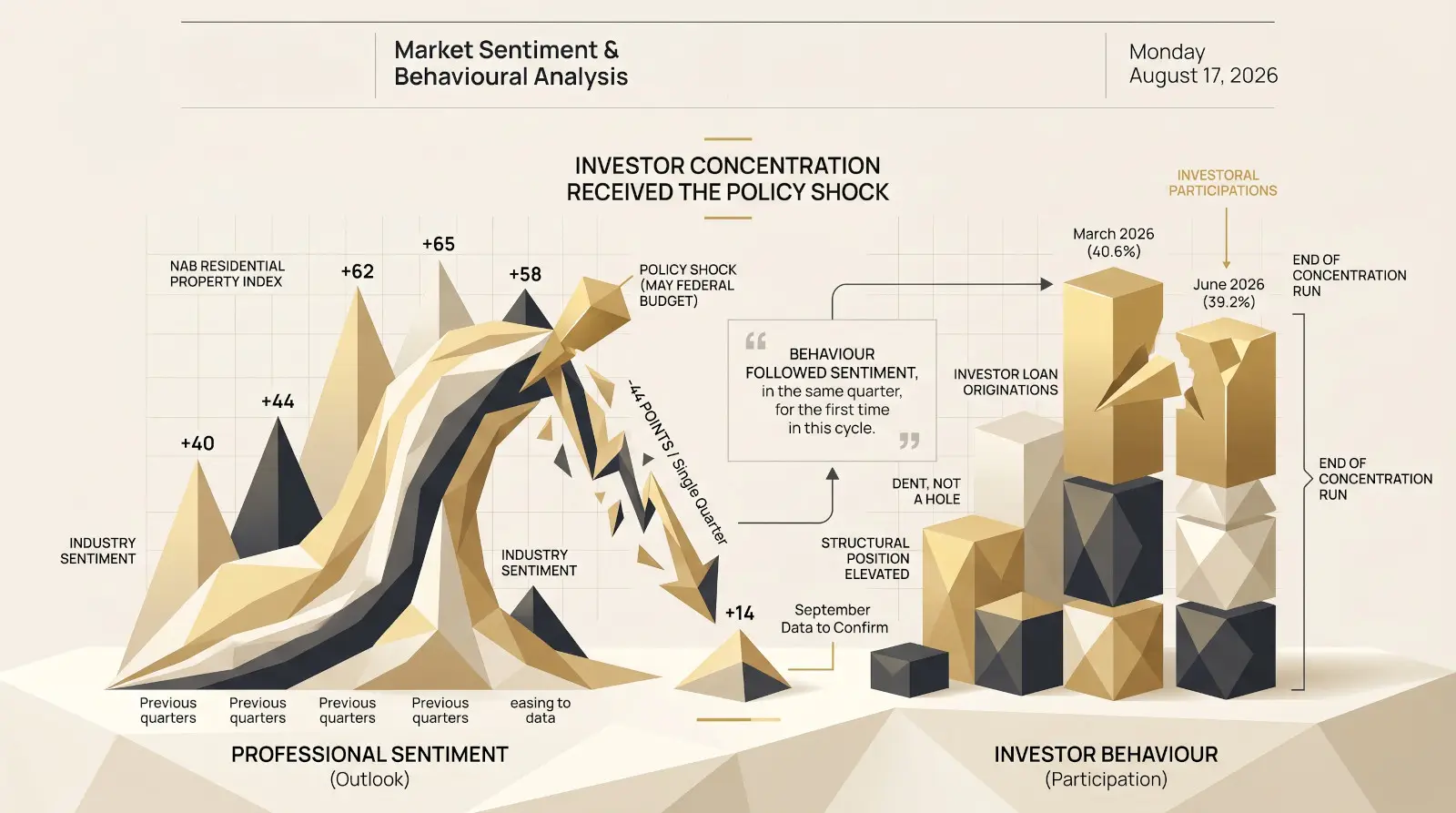

The NAB Residential Property Index — the quarterly reading of sentiment among property professionals — fell from +58 to +14 in the June quarter of 2026. In the certified series APN holds, which begins in the March quarter of 2025, nothing approaches that movement: the index climbed steadily through 2025 (+40, +44, +62, +65), eased to +58 as APRA’s debt-to-income limits activated in February, and then dropped 44 points in a single quarter. The timing is not mysterious. The June-quarter survey window followed the May Federal Budget’s announced changes to investor housing taxation — the reform event whose media framing APN has tracked as a dedicated research stream since 12 May. Industry sentiment registered the policy shock, emphatically. The question that mattered — and the reason the test below was drafted and time-stamped five days before the answer was known — was whether investor behaviour would follow investor sentiment. On 14 August, with the release of the June-quarter Lending Indicators, the answer arrived.
What had moved, and what had not
Precision about which sentiment broke matters. The NAB index measures the property industry — agents, developers, professionals closest to investor transaction flow. Household consumer sentiment, read through Household Finance & Consumer Sentiment (21240), sat at −0.04σ at its latest certified reading: flat, and flat for some time. Consumers were never optimistic in this cycle; there was no consumer euphoria to break. What broke in June is the sentiment of the cohort professionally proximate to the investor segment — immediately after policy changes aimed at that segment’s tax economics.
Against that, the certified behavioural record through the March quarter showed no break at all. Investor loan originations stood at 40.6 per cent of new lending in the March quarter of 2026 — within a quarter of a point of the December 2025 record of 40.8 per cent, the highest reading in the primary series’ seven-year history, reached after three consecutive quarterly rises through 2025 — and held there through restrictive policy settings (Interest Rates (21210) at +1.27σ by June) and through the February DTI activation. On every certified reading to that point, investor participation had been rising or holding at record share while measured sentiment was flat or falling: participation has behaved as a function of equity and market structure, not of mood. (A note on figures: the ABS’s June-quarter release re-estimated the full seasonally adjusted history of this series, as it does each quarter; the March reading was originally published at 41.0 per cent. All figures in this piece are on the current revised basis, and the revision is disclosed in the methodology note below.)
The test, as stated in advance
The two paragraphs that follow were drafted on 9 August 2026, five days before the June-quarter release, and are reproduced unchanged. The draft’s revision history is retained.
On 14 August the ABS publishes June-quarter Lending Indicators, and with it the Investor Concentration Ratio’s first post-Budget observation. APN’s standing analytical position — set out in full in the forthcoming whole-of-board analysis — is that investor concentration in this cycle is structural rather than sentimental: it is produced by the displacement of borrowing-constrained buyers in a supply-rationed market, and therefore does not require investor optimism to persist. That position now faces its harshest available test, and it is better to state the scorecard before the result than after it:
If the June quarter extends the concentration run — a fifth consecutive rise, or a hold near the record — through a 44-point fall in industry sentiment and an announced tax change, the structural reading is confirmed about as strongly as quarterly telemetry allows. If concentration falls materially, the policy channel has dominated the structural one: the Budget will have achieved through tax economics what sentiment, interest rates and the DTI caps did not, and APN’s framework will be re-examined in print, not quietly. A shallow single-quarter dip would be consistent with announcement effects and would defer judgement to September’s data. Whichever arrives, the reading will be published against this paragraph.
The result
The Investor Concentration Ratio fell to 39.2 per cent in the June quarter — a decline of 1.4 percentage points from the revised March reading, the largest single-quarter fall in the series since the June quarter of 2020, and the end of the concentration run. The certified June-quarter reading stands at +1.11σ above the series baseline. Behaviour followed sentiment, in the same quarter, for the first time in this cycle.
Read against the scorecard above, the result does not land cleanly on either pole, and it would be poor practice to pretend otherwise. It is plainly not the first branch: the run is broken, and broken hard by the standards of this series — nothing since the pandemic quarter has moved the share this much in three months. Nor is it fully the second: 39.2 per cent remains the third-highest share in the series’ seven-year history, and one quarter at a still-elevated level is not a regime reversal. The honest verdict is that the policy channel has demonstrably bitten — an announced tax change did in one quarter what interest rates, DTI caps and two years of flat sentiment did not — while the structural position survives at a reduced altitude. By the scorecard’s own middle branch, the September quarter, published in early November, is the confirming observation. If the decline extends, the framework will be re-examined in print, as promised. If the share stabilises at these levels, the structural reading will have absorbed its harshest available test with a dent, not a hole. Either way, that reading will also be published against this paragraph.
Why the distinction matters
A market whose transactional liquidity depends heavily on one cohort is exposed to policy aimed at that cohort — that much was visible in the certified data before the Budget. What the June quarter adds is evidence that the policy shock has been received and transmitted: the professionals closest to investor flow marked their outlook down by more than the entire 2025 improvement, and investor participation in new lending broke a three-year pattern in the same three months. An adjustment of this kind is policy-induced and cohort-specific — a different animal from a rate-driven or sentiment-driven downturn, with different incidence: concentrated first in the segments and geographies where investor participation is highest. Whether it is the start of a repricing of the investor position or a one-quarter announcement effect is precisely what the September data will decide, and APN’s reading of it is on the record either way.
Methodology and disclosure. All figures are certified or primary-verified readings from the APN Codex live pipeline. NAB Residential Property Index values are from certified series 76 (loaded and verified against NAB’s primary publication on 8 August 2026; the certified series begins Q1 2025, and the 44-point June-quarter fall is the largest movement within that held window — no claim is made about earlier history). Investor Concentration Ratio (21610) readings are primary-sourced from ABS 5601.0 Table 1 (June-quarter 2026 release, 14 August 2026); the ABS’s routine concurrent seasonal re-estimation in that release revised the full history of the series, and this piece adopts the current revised basis throughout — the March 2026 quarter was originally published at 41.0 per cent and stands at 40.6 per cent on the revised basis. The June-quarter reading was certified into the APN pipeline on 14 August 2026 (full-window baseline, 28 quarterly observations, Q3 2019–Q2 2026; the series is truncated at the ABS collection start and is flagged accordingly). Interest Rates (21210) and Household Finance & Consumer Sentiment (21240) are cited at their latest complete certified quarters. The February 2026 APRA debt-to-income activation and the May 2026 Federal Budget investor-housing taxation changes are cited as public-record policy events. The section headed “The test, as stated in advance” is a pre-registered conditional test drafted 9 August 2026, before the release; it is reproduced verbatim and the draft revision history is retained.
Correction note — 17 August 2026. The +1.11σ reading cited above was computed on an expanding baseline window of 28 quarterly observations, running to June 2026. APN has since ruled the frozen ANCHOR-2011-2025 baseline as the standard for this series — ending December 2025, 26 observations, μ = 32.80, σ = 5.14. On that basis the June-quarter reading is +1.24σ. The original figure is retained above as published record. The percentage figures in this piece are unaffected: the 39.2 per cent June share, the 1.4-point quarterly fall and the revised March reading of 40.6 per cent are primary ABS readings, independent of the baseline used to standardise them.