
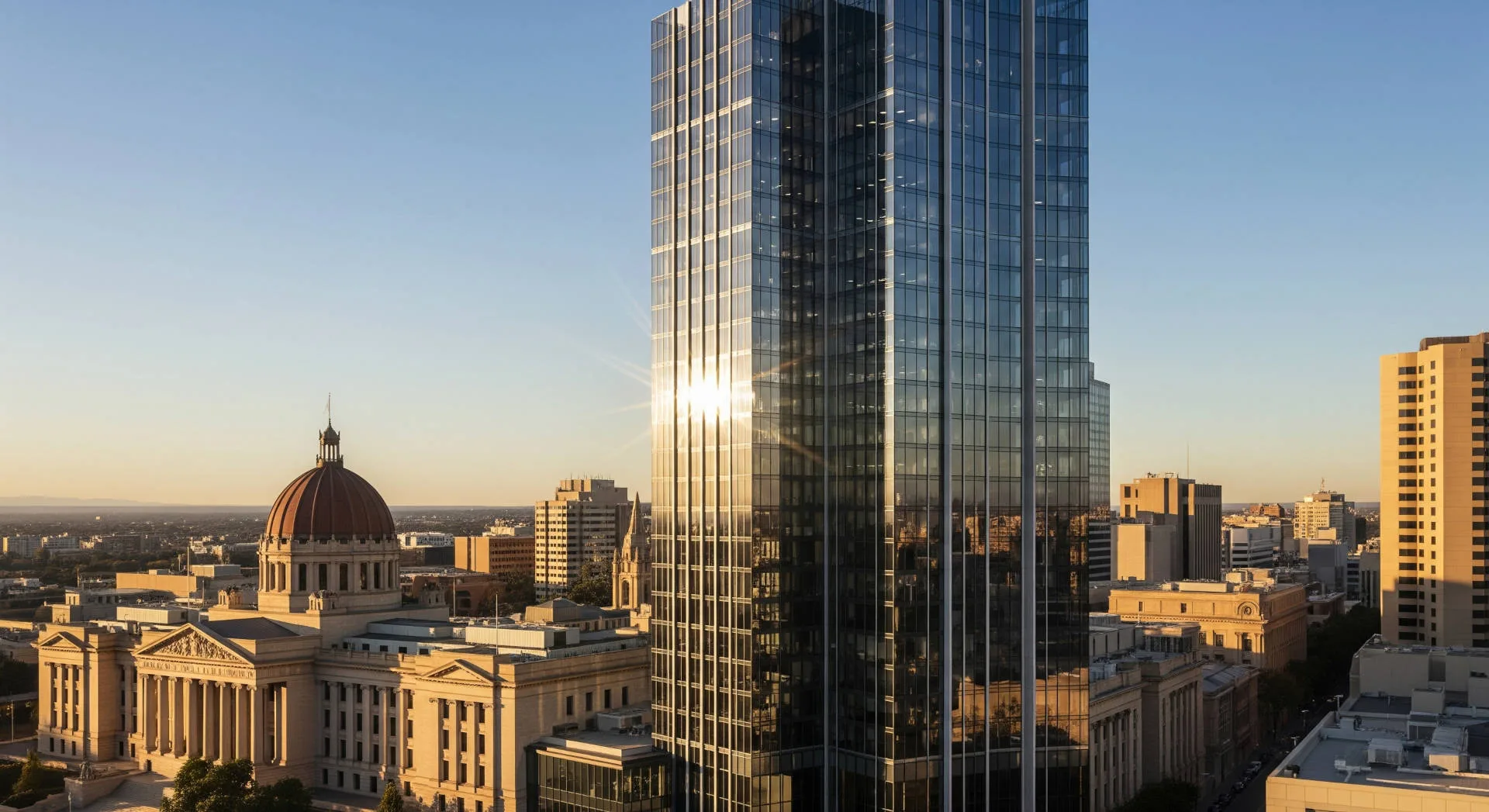

Festival Plaza Tower Two Gets Green Light Amid Heritage Debate
Walker Corporation has received planning consent from the State Commission Assessment Panel (SCAP) to construct a 38-storey office building in Adelaide’s Festival Plaza precinct, directly behind Parliament House. The development, known as Festival Tower Two, is expected to be completed in 2027-28, and will accommodate up to 5,000 office workers, according to the Australian Broadcasting Corporation (ABC).
The approval follows the completion of Walker Corporation’s 29-storey “Festival One” office tower in 2024, marking a significant step in the ongoing redevelopment of the Festival Plaza precinct. The new tower, reaching a height of 160 metres, will feature retail tenancies and outdoor dining on the ground floor, an elevated plaza on level one, commercial office space across multiple levels, and a restaurant on level 36, as reported by the ABC.
Planning and Development Analysis
The SCAP’s decision highlights the complexities of balancing urban development with heritage considerations. While the Malinauskas government strongly supported the project, Heritage SA raised concerns about the tower’s potential impact on the visual prominence of Parliament House. The SCAP ultimately determined that the project was not “seriously at variance” with the planning code, granting approval subject to nine conditions, five of which address heritage matters.
This approval sets a precedent for future developments in historically sensitive areas. Developers will need to demonstrate a commitment to mitigating heritage impacts through design adjustments and material choices. Planning Minister Nick Champion stated that the heritage conditions relate to the use of building materials that “will be used to match the features of Parliament House,” according to the ABC. The government architect and design review team were heavily involved in blending the old and the new.
The project’s approval underscores the state government’s strategic vision for the Festival Plaza precinct. The government anticipates that the influx of office workers will stimulate the local economy, providing customers for food and beverage outlets, theatres, and bars. This aligns with broader efforts to activate the plaza and enhance its vibrancy.
Potential Hurdles and Considerations
Despite the planning approval, the project has faced community opposition. A coalition of 125 South Australians, including former Labor premier Lynn Arnold, campaigned against the tower, arguing that the Festival Plaza should maintain an “open and civic in character,” according to the ABC. This opposition highlights the importance of effective community engagement strategies for developers undertaking large-scale projects in public spaces.
The approval also comes with conditions related to heritage matters, requiring careful consideration of design and materials to minimise impacts on Parliament House. Government planning officer Ben Scholes noted that Heritage SA had “not directed refusal of the application” but recommended design amendments to mitigate concerns. This suggests that ongoing collaboration with heritage authorities will be crucial throughout the development process.
Implications for Property Professionals
This development provides several key takeaways for property professionals:
- Development Feasibility: The project demonstrates the feasibility of large-scale commercial developments in Adelaide’s central business district (CBD), despite heritage constraints.
- Planning Risk: Developers should anticipate potential community opposition and heritage concerns when proposing projects in historically significant areas.
- Community Engagement: Proactive and transparent community engagement is essential for mitigating opposition and securing project approvals.
- Supply Pipeline Impact: The addition of 47,000 square metres of office space will impact the Adelaide CBD office market, potentially influencing rental rates and vacancy levels.
- Precedent Setting: The SCAP’s decision sets a precedent for balancing development aspirations with heritage preservation in South Australia.
The Festival Tower Two project represents a significant investment in Adelaide’s CBD and is expected to rank among Adelaide’s tallest buildings upon completion, eclipsing the current tallest building, Frome Central Tower One, which stands at 138 metres. The ABC reports that early works are underway behind Parliament House to prepare for construction, which includes 1,354 car parking spaces.
The redevelopment of the Festival Plaza precinct began in 2014 when Walker Corporation partnered with the state government to redevelop the Festival Plaza car park, followed by a public-private partnership to upgrade the public realm, according to the ABC. The approval of Festival Tower Two marks a further milestone in this long-term urban renewal project.
This article is based on a report from www.abc.net.au titled “Second Festival Plaza tower receives planning approval despite heritage concerns”. You can find the original article here: https://www.abc.net.au/news/2025-06-12/second-festival-tower-planning-approval/105409514
Given the acknowledged heritage concerns and the precedent set by this approval, how can future developments in historically sensitive areas better integrate community values and long-term cultural preservation alongside economic development goals?
Disclaimer
The information contained in this article is for general informational purposes only and does not constitute financial, investment, or legal advice. The Australian Property Network (APN) is not a licensed financial advisor. The content is based on data from third-party sources and is provided without any warranty as to its accuracy, currency, or completeness. Property values can go down as well as up. Before making any property or investment decisions, you should conduct your own research and consider seeking independent professional advice tailored to your specific circumstances.
