
Net-Zero Transition is a Singular Opportunity to Reverse Plunge in Economic Complexity (ECI)
APN ANALYSIS: A-251030-AUS46
Executive Summary
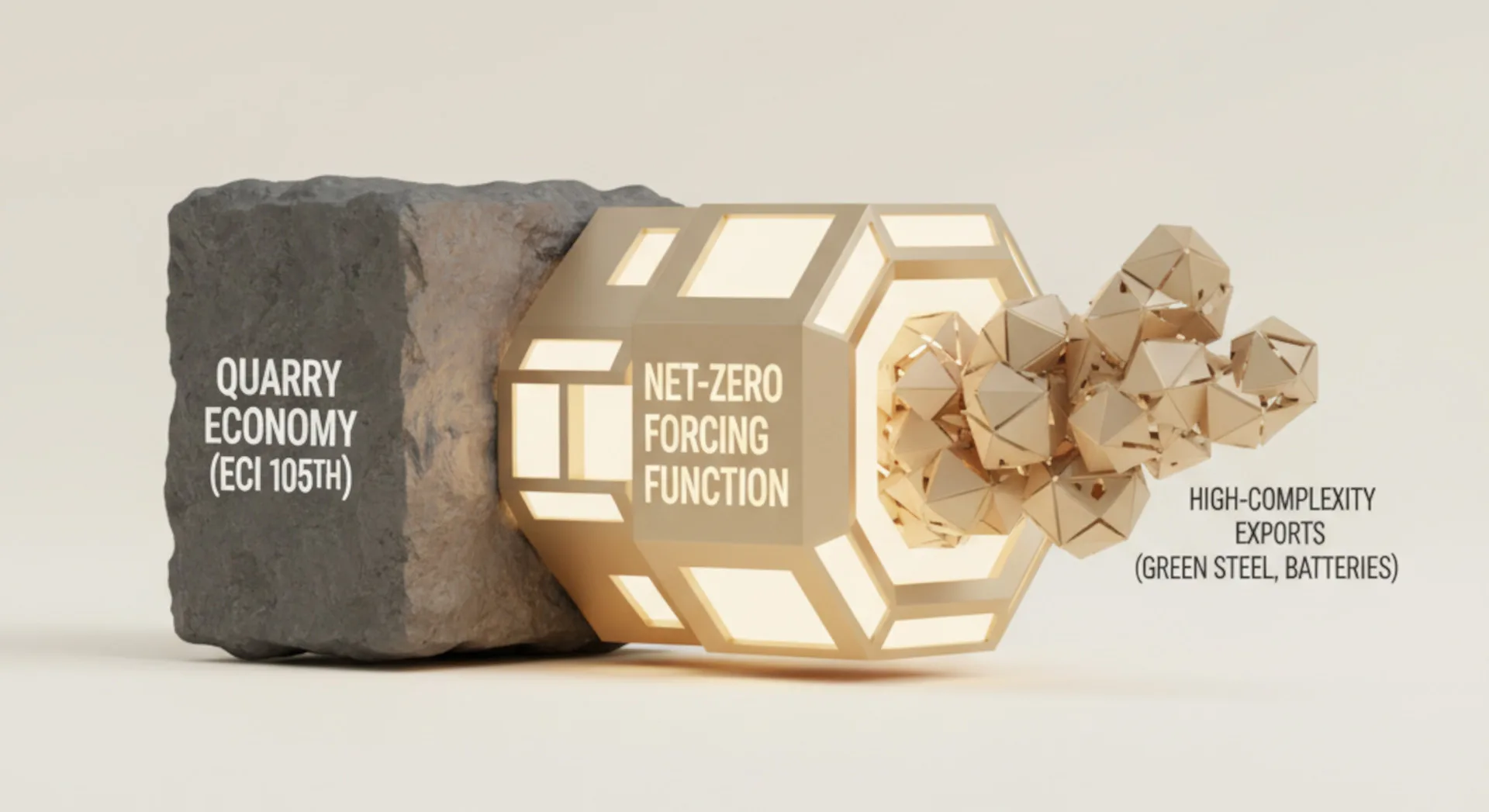
Australia’s collapse to 105th on the Harvard Economic Complexity Index (ECI), last in the Organisation for Economic Co-operation and Development (OECD), confirms a structural “quarry economy” failure. This over-reliance on low-complexity exports (45% from iron ore, coal, and gas) has created a deep industrial malaise.
The global net-zero transition is now the singular, generational forcing function that can reverse this decline. A Project Overlord-level industrial strategy, leveraging Australia’s unique co-location of renewable energy and mineral wealth, is required to build new, high-complexity export value chains (e.g., $16.9B batteries, $65B green steel) and break the inertia of the old model.
Background & Strategic Context
This national economic challenge is a foundational thesis, and its strategic implications are best understood through our core intelligence frameworks:
State-Led Forcing Function (Project Overlord): The irreversible global demand signal from net-zero commitments acts as the primary Project Overlord forcing function. This is the only market force powerful enough to break the political and capital inertia of the lucrative, but structurally detrimental, “quarry economy.” This transition requires a deliberate, state-led industrial strategy to build new, high-value industrial ecosystems.
Breaking the Incumbent Model (The Wealth Funnel): The “quarry economy” is a form of The Wealth Funnel, reinforcing a low-complexity model that benefits established incumbents. The net-zero transition is a direct challenge to this, offering a path to diversify the economy, move up the value chain, and bridge the “commercialisation chasm” that has previously failed to translate world-class research into high-value exports.
New Infrastructure Pipeline (APN Future Development Pipeline Index™ (24400)): This transition represents the largest potential positive input to the APN Future Development Pipeline Index™ (24400) in a generation. It requires a massive physical footprint, including an estimated 1,200 sq km for the new energy system, and will trigger a wave of high-value industrial and logistics development in designated Renewable Energy Zones (REZs) and Hydrogen Hubs.
Deconstruction of the Source Event
This deconstruction is based on an internal APN intelligence briefing. The key facts are:
- Australia’s Economic Complexity Index (ECI) ranking has collapsed from 64th (2003) to 105th (2023), last in the OECD.
- The economy is over-reliant on low-complexity exports: Iron Ore, Coal, and Natural Gas account for 45% of total exports.
- The economic prize for moving up the battery value chain is estimated at $7.4 billion to $16.9 billion annually.
- Green Steel production, using green hydrogen, could generate up to $65 billion in annual export revenue.
- Australia is uniquely positioned due to the co-location of critical minerals (lithium, iron ore) with world-class, low-cost solar and wind resources.
- The transition requires a massive human capital build, with the renewable workforce needing to double to 66,000 workers by 2029.
Critical Analysis & Balanced View
The “real” story is that the success of the mid-2000s resources boom was corrosive. It reinforced the low-complexity export model, rendered complex manufacturing uncompetitive, and created a structural paradox where world-class research (4th in Research ECI) failed to translate into high-value exports.
- Commercialisation Chasm: The ECI decline is a direct result of this “commercialisation chasm.” The net-zero transition is the first viable strategy to bridge this gap by creating high-value, manufactured exports.
- Smart Export Strategy: The strategy pivots from exporting raw materials or raw electricity to exporting embodied renewables in high-value products like green ammonia, green steel, and data services (via renewable-powered data centres). This monetises the national energy advantage.
- Competitive Advantage: The unique co-location of critical minerals with abundant, low-cost solar and wind resources is Australia’s primary competitive advantage, making onshore value-adding processes (e.g., green steel) globally cost-competitive for the first time.
Balanced View: On the surface, Australia’s 105th ECI ranking is a sign of structural failure. However, the analysis reveals that the global net-zero transition is a singular, generation-defining forcing function that can reverse this. By leveraging its unique “co-location” advantage, Australia has a time-limited opportunity to pivot from a “quarry economy” to a high-complexity, industrial-value-chain leader.
Strategic Implications for Property Professionals
- For Government & Private Capital: You must prioritise and de-risk the $17 billion to $23 billion in capital investment required for refining and active materials production to capture the battery value chain.
- For Industrial & Logistics Developers: Your investment strategy must strategically align with designated Hydrogen Hubs (e.g., Pilbara, Hunter Valley, Gladstone) and Renewable Energy Zones (REZs) to service the massive physical footprint of this new economy.
- For Government & Policy (Trade): Future trade policy must be aggressively pivoted to pursue export market agreements for high-complexity, low-carbon products (green steel, ammonia), not just traditional commodities.
- For Government & Policy (Workforce): You must mandate immediate, coordinated investment in Vocational Education and Training (VET) and universities for critical occupations (electricians, chemical engineers, data scientists) to avoid a debilitating skills bottleneck.
Disclaimer
The analysis and information contained in this analysis are for general informational and strategic purposes only and do not constitute financial, investment, legal, or any other form of professional advice. The Australian Property Network (APN) is a strategic intelligence organisation and is not a licensed financial advisor.
This analysis is based on internal APN intelligence, data, and information believed to be reliable; however, APN provides no warranty as to its accuracy, currency, or completeness. Images used in this analysis are for illustrative and conceptual purposes only and may not represent real persons, properties, or events. Property values and market conditions can go down as well as up.
Before making any property or investment decisions, you must conduct your own thorough research and seek independent professional advice tailored to your specific circumstances.