
The “Force-to-Market” Mechanism
Victoria’s Vacant Residential Land Tax has been transformed from a passive revenue tool into an aggressive instrument compelling landowners to build or sell. This report tests whether the State Revenue Office’s explicit rejection of economic-hardship defences, combined with a hard February 15, 2026 notification deadline, is set to force a wave of land bank liquidations across metropolitan Melbourne.
The Victorian state taxation framework has undergone a radical and unprecedented structural evolution, fundamentally transitioning from a passive mechanism of state revenue collection into an aggressive, highly weaponised instrument of behavioural economic modification. The primary statutory vehicle driving this public policy shift is the Vacant Residential Land Tax, a levy that has been systematically expanded and relentlessly tightened to penalise speculative land banking and enforce the rapid liquidation of undeveloped, residentially capable land parcels across the state. The strategic objective of this exhaustive research investigation is to rigorously stress-test the operational validity of the Land Bank Liquidation thesis. This central thesis posits that the looming and non-negotiable February 15, 2026, statutory notification deadline will serve as a catastrophic catalyst, triggering a forced capitulation and subsequent mass liquidation among cash-strapped property developers and speculative landholders operating within the metropolitan Melbourne property market.
To properly evaluate this thesis, this report undertakes a forensic interrogation of the legislative mechanics engineered by the State Revenue Office of Victoria, applying the primary analytical framework of the APN Residual Land Value Gap and the applicable Victorian tax legislation. The core of this analysis focuses intensely on the Exemption Denial mechanism. The strategic value of this investigation lies in definitively confirming whether the State Revenue Office has explicitly eradicated the traditional, historical developer defences of economic unfeasibility, construction paralysis, and persistent financing deficits. By eliminating these systemic financial hurdles as valid exemptions for delayed construction, the state government is effectively socialising the public housing supply mandate while strictly and unforgivingly privatising the financial risk of land development onto the balance sheets of the private sector.
Furthermore, this report conducts an exhaustive, systematic audit of the progressive tax rate expansions, the rigid geographic parameters defining the newly established unimproved land catchments, and the profoundly punitive notification default penalties introduced under the recent amendments to the Taxation Administration Act 1997. The aggregation of these statutory factors creates a hostile fiscal environment where the historical developer strategy of ignoring correspondence and flying under the regulatory radar is no longer a viable corporate strategy. Deprived of the ability to use macroeconomic conditions as a defensive shield and facing compounding financial penalties that rapidly erode equity, distressed developers are being systematically forced to market. This dynamic guarantees the suppression of land valuations through what can be characterised as a distressed asset discount, validating the core mechanics of the Force-To-Market hypothesis.
The structural expansion of the Vacant Residential Land Tax represents a fundamental redefinition of what constitutes taxable residential property within the State of Victoria. Historically restricted to established dwellings within a highly limited geographic footprint, the legislative framework governing the 2025 and 2026 tax years introduces aggressive temporal, geographic, and financial parameters specifically designed to capture and penalise long-term undeveloped land holdings.
The February 2026 Notification Deadline
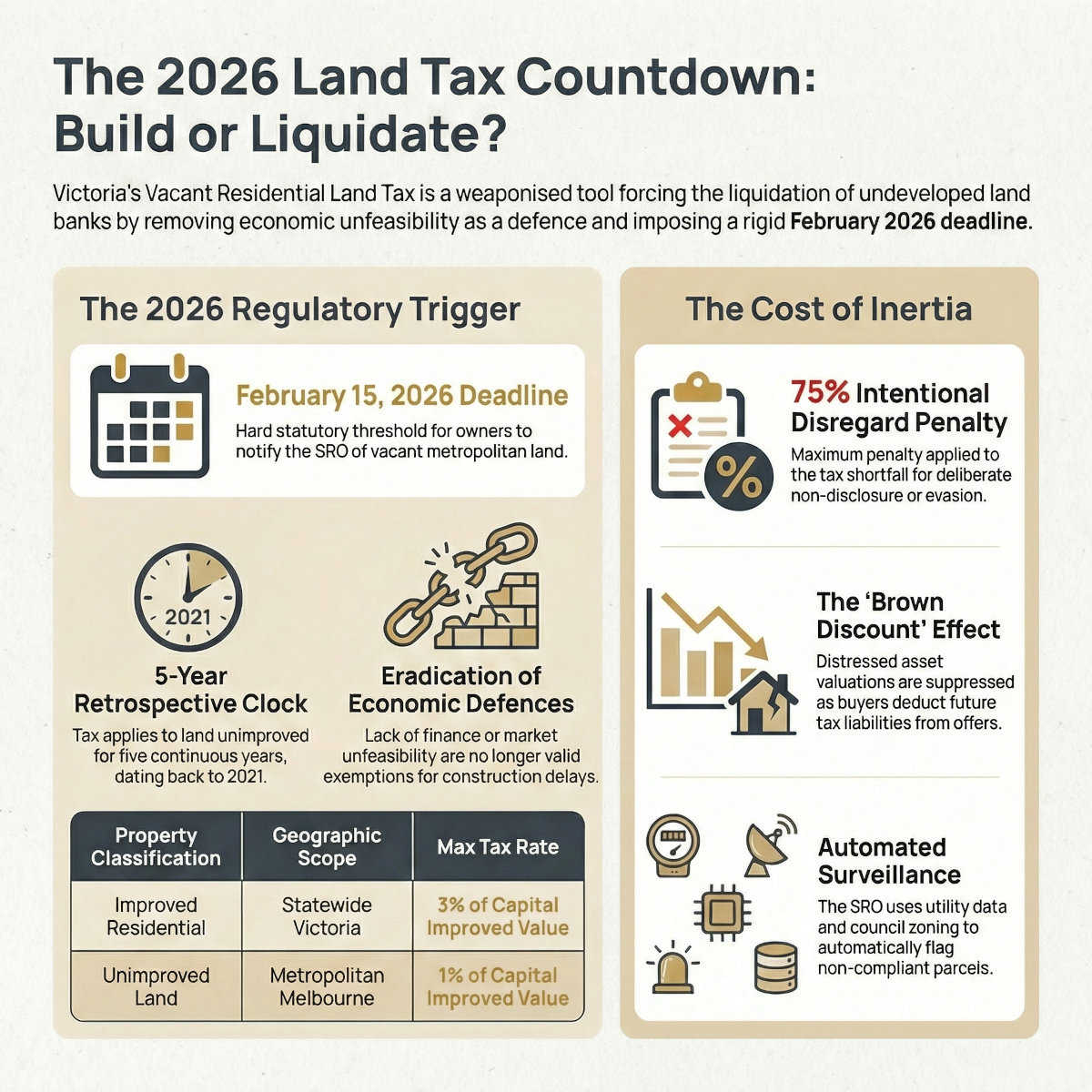
The entire statutory mechanism enforcing the Vacant Residential Land Tax compliance regime relies fundamentally on a proactive, taxpayer-initiated notification framework. The legislation mandates that property owners possessing residential land that meets the specific vacancy criteria during the 2025 calendar year are legally compelled to officially notify the State Revenue Office of their liability no later than February 15, 2026.1 This impending deadline represents a rigid, non-negotiable compliance threshold that carries severe financial implications for entities that fail to act.4 The State Revenue Office explicitly mandates that all notifications must be submitted exclusively through their dedicated online digital portal.1
Crucially, this mandatory notification obligation applies uniformly to all affected property owners, even if the landowner firmly believes their specific property or development site is ultimately eligible for a statutory exemption from the tax.3 This specific legislative design is not accidental; it deliberately and effectively shifts the entire burden of proof onto the taxpayer. The property owner must first proactively declare the asset, placing it permanently within the State Revenue Office data matrix, and subsequently petition the Commissioner of State Revenue for a formal exemption.3 This ensures that no potential taxable asset escapes regulatory visibility. Failure to strictly adhere to the February 15, 2026, notification deadline triggers immediate and automatic exposure to severe notification default penalties, which are calculated as a substantial percentage of the total underlying tax liability.4 For landowners who have historically missed previous deadlines, the state advises immediate notification to minimise the compounding nature of these penalty taxes, though the damage of late notification cannot be entirely erased.4
The Geographic Bifurcation
A critical strategic nuance embedded within the revised Vacant Residential Land Tax legislation is the strict bifurcation of geographic applicability, which is entirely dependent on the physical state and development status of the land in question. This creates a significant regulatory trap for investors managing geographically diverse property portfolios.
Commencing January 1, 2025, the standard application of the Vacant Residential Land Tax, which applies to improved residential land encompassing existing habitable homes, uninhabitable dwellings, and properties undergoing extended renovations, was expanded to encompass the absolute entirety of the State of Victoria.6 Prior to this expansion, the tax was safely contained within a restricted list of inner and middle-ring Melbourne municipal councils.6 The statewide application effectively closed the historical loophole where luxury holiday homes and vacant investment properties located in regional corridors, coastal towns, and peri-urban areas were completely sheltered from the vacancy tax.12 The only remaining geographic exclusions for standard improved dwellings are highly specific, narrowly defined alpine resort areas such as Mount Baw Baw, Mount Buller, Mount Hotham, Falls Creek, and, recently, expanded to include the locality of Dinner Plain.5
However, the expansion of the tax to unimproved, entirely undeveloped land operates under a distinctly different and strictly defined geographic constraint. Commencing January 1, 2026, the specific provisions penalising unimproved land apply exclusively to property situated within the 31 specified local government municipal council areas that formally constitute metropolitan Melbourne.3 Unimproved land located within regional Victoria remains excluded from these specific development-forcing provisions.5 To fall within the lethal scope of the new 2026 unimproved land provisions, the metropolitan land must be officially zoned by the local council to permit residential development, and it must not be currently utilised for, or under active, demonstrable development for, commercial or other non-residential purposes.5 The strategic trap for developers is assuming that regional land banks are entirely safe; while they are safe from the unimproved land tax, any existing structure on that regional land, even if uninhabitable, immediately exposes the asset to the statewide improved land tax provisions.
The Retrospective Five-Year Clock
The defining and most aggressive characteristic of the 2026 unimproved land tax expansion is its retrospective activation mechanism, which is designed specifically to capture and penalise historical land banking behaviour. The legislation dictates that metropolitan land becomes immediately liable for the tax if it has remained unimproved and undeveloped for a continuous period of five years or more as of December 31, 2025.7
Crucially, this five-year continuous period is calculated retrospectively by the assessing authority. This means that the State Revenue Office will evaluate the physical status and development history of the land dating back to January 1, 2021, and potentially earlier.5 Consequently, institutional land accumulators and private developers who have securely held vacant metropolitan blocks since December 2020 without commencing physical construction are immediately and unavoidably captured by the legislation upon its formal activation on January 1, 2026.5 The drafting of the law explicitly does not grant property owners a new five-year grace period commencing from the 2026 enactment date; rather, the statutory clock has already expired for long-term land banking portfolios, transforming what was previously a passive asset into an immediate and active tax liability.5 The counting of the five-year period is relentless, and unless a developer can secure a highly restrictive exemption, they are expected to be fully liable for the tax in the 2026 assessment year.21
Progressive Rates Versus the Flat Rate Cap
The financial severity of the Vacant Residential Land Tax is heavily governed by the consecutive duration of the vacancy, although the legislation applies sharply divergent rate structures depending on whether the property is classified as an improved dwelling or unimproved land.
For standard vacant residential land that possesses a habitable or currently uninhabitable structure, the State Revenue Office applies a highly aggressive, progressive, compounding tax rate calculated directly against the Capital Improved Value of the property.8 The baseline rate is punitively set at one per cent of the Capital Improved Value for the first recognised year of vacancy.8 Should the property remain vacant and unleased for a second consecutive tax year, the rate doubles, escalating to two per cent of the Capital Improved Value.8 For a third consecutive year, and for any and all subsequent years that the property remains vacant, the punitive rate reaches its maximum threshold of three per cent of the Capital Improved Value.8 For a property with a Capital Improved Value of one million dollars, this translates to an unrecoverable tax bill of ten thousand dollars in year one, twenty thousand dollars in year two, and thirty thousand dollars in year three, heavily bleeding the asset’s yield.22
Conversely, a distinct fiscal framework applies to unimproved land banks. While standard properties face the severe three per cent escalation over time, the legislation caps the tax rate for unimproved land at a flat one per cent of the Capital Improved Value.5 The progressive escalation mechanism explicitly does not apply to land that formally meets the unimproved description.5 While a one per cent flat rate may appear superficially less aggressive than the three per cent maximum applied to dwellings, it nonetheless represents a substantial, highly destructive capital drain when applied annually to multi-million-dollar institutional land banks. When this one per cent vacancy tax is aggregated with standard state land taxes, federal holding costs, compounding debt interest, and site maintenance expenses, the total carrying cost of the undeveloped asset rapidly exceeds historical capital growth rates, heavily incentivising immediate liquidation.
| Property Classification | Geographic Application Scope | Vacancy Duration Trigger | Year One Tax Rate | Year Two Tax Rate | Year Three Tax Rate |
|---|---|---|---|---|---|
| Improved Residential Dwelling | Statewide Victoria | Greater than six months | 1% of Capital Improved Value | 2% of Capital Improved Value | 3% of Capital Improved Value |
| Unimproved Residential Land | Metropolitan Melbourne (31 Councils) | Five continuous years (Retrospective) | 1% of Capital Improved Value | 1% of Capital Improved Value | 1% of Capital Improved Value |
Cumulative Liability Escalation ($2M Unimproved Land Asset)
The ultimate success of the Land Bank Liquidation thesis hinges almost entirely upon the strictness and regulatory rigidity with which the State Revenue Office defines acceptable delays in construction. Historically, property developers have heavily utilised macroeconomic volatility as a defensive shield against state taxation, frequently citing unfavourable commercial lending environments, severe construction cost inflation, labour shortages, and poor end-market feasibility as legitimate, unavoidable reasons for pausing development pipelines. The strategic vulnerability in the current macroeconomic market is the reality of the APN Residual Land Value Gap, a scenario where the escalated cost of physical construction drastically exceeds the projected end value of the developed asset, rendering projects fundamentally economically unviable to commence. The critical strategic question this section addresses is whether the state government acknowledges this commercial financial reality or ruthlessly ignores it in pursuit of revenue and housing supply.
Treasury Guidelines and Commissioner Discretion
The overarching legislation grants the Commissioner of State Revenue the specific discretionary authority to determine that unimproved land should not be considered vacant, and therefore granted an exemption from the tax, if the Commissioner is satisfied that there is an acceptable reason why physical construction has not commenced within the statutory five-year period.5 To establish the boundaries, limitations, and operational realities of this discretionary power, the Victorian Treasury released highly specific, formal operational guidelines on November 17, 2025.5 These comprehensive guidelines dictate the exact legal and physical parameters the Commissioner must utilise when evaluating a developer's formal petition for an exemption extension.5
To even qualify for discretionary relief under these guidelines, the landowner must empirically demonstrate to the assessing authority that they are genuinely, actively, and comprehensively working to commence physical construction on the land as soon as possible, but have been continuously prevented from doing so by circumstances fundamentally beyond their control.5 The acceptable factors explicitly defined by the Treasury guidelines are strictly and unyieldingly limited to physical, legal, or severe ecological barriers. Specifically, the Commissioner will consider unforeseen and unmitigable restrictions to physical site access, unexpected statutory requirements to undertake extensive and prolonged archaeological or indigenous cultural heritage analysis, the sudden and unforeseen discovery of endangered flora or fauna on the development site that halts earthworks, severe physical damage to the land caused by extreme weather events requiring lengthy remediation, or the total absence of adequate municipal infrastructure and utility connections that the developer cannot control or rectify.5 Furthermore, significant, prolonged, and documented planning disputes, legal appeals, or bureaucratic approval processes that trap the developer in an administrative quagmire may also warrant discretionary relief.5
The Economic Defence Is Explicitly Excluded
The true strategic intent and financial lethality of the legislation are decisively revealed in the specific factors that the Treasury guidelines explicitly and unambiguously exclude from the Commissioner's consideration. The formal documentation categorically states that the Commissioner's exercise of discretion will generally not be supported by factors related to commercial viability or macroeconomic conditions.5 Specifically, the guidelines explicitly rule out broader economic conditions, fluctuations in the domestic or global economy, supply chain disruptions for building materials, severe labour shortages in the construction sector, changes to the project's architectural design, and, fundamentally, lack of access to commercial finance.5
This explicit, documented denial of the economic feasibility defence is the absolute fulcrum of the Force-To-Market mechanism. By legally codifying that an inability to secure commercial lending, or a mathematically verified calculation that a project is currently unprofitable, does not constitute an acceptable reason for leaving land undeveloped, the State Revenue Office effectively and permanently severs the developer's historical ability to wait out adverse market cycles.5 The APN Residual Land Value Gap is rendered entirely and dangerously irrelevant to the state tax assessor. If the land is correctly zoned for residential use by the municipal council and is physically capable of supporting a dwelling, the state demands that it be developed, entirely irrespective of whether the developer will incur a catastrophic financial loss in doing so.5
This draconian regulatory stance creates an inescapable, self-reinforcing paradox for highly leveraged land banking entities operating in metropolitan Melbourne. If the current cost of capital and the hyper-inflation of construction materials render a proposed development unprofitable, developers cannot secure the senior debt financing required to commence building. Concurrently, because lack of financing and unprofitability are explicitly rejected by the Treasury guidelines as valid defences for delayed construction, the developer automatically incurs the unrecoverable annual one per cent Capital Improved Value tax on the unimproved land bank.5 This new, unrecoverable tax liability immediately erodes the underlying equity of the asset. As equity evaporates, it invariably triggers strict loan-to-value ratio covenants with existing creditors and mezzanine financiers, demanding immediate capital injections that the developer does not possess, thereby rapidly accelerating corporate insolvency. Deprived entirely of the ability to use economic conditions as a defensive regulatory shield, the distressed developer is forced into an immediate and highly compromised liquidation event, perfectly confirming the fundamental premise of the Land Bank Liquidation thesis.
- Economic unfeasibility — construction is currently too expensive.
- Lack of financing — inability to secure bank loans.
- Market volatility — waiting for prices to rise.
- Legal impediments — active court injunctions preventing work.
- Physical obstacles — unforeseen contamination requiring remediation.
- Active construction — land is already under development.
The Burden of Proof
For those developers attempting to claim one of the few physically or legally acceptable delays permitted by the Treasury, the bureaucratic and evidentiary threshold is severe. Landowners seeking the Commissioner's discretion cannot rely on assumptions; they must proactively submit a comprehensive application alongside their standard digital notification by the strict February 15 deadline.3 This exemption process cannot be satisfied by simply checking a box on the digital portal; it is expected to require the submission of extensive, documented, written submissions containing empirical evidence proving that the delay was unavoidable and specifically fits within the narrow ecological, infrastructural, or legal parameters permitted by the November 2025 guidelines.5
The burden of empirical proof rests entirely and heavily on the taxpayer. Any failure to provide satisfactory, irrefutable documentation results in the immediate application of the tax.9 The legislation notes that while some exemptions exist for construction delays, such as an extension of the standard two-year construction exemption up to a maximum of five years due to builder insolvency or severe legal disputes, these require intimate proof that the delay was beyond the owner's control, and the State Revenue Office scrutinises these claims intensely.15 The combination of strict evidentiary requirements and the total denial of economic defences ensures that the vast majority of standard speculative land banks will fail to secure an exemption, forcing the asset either into active, unprofitable construction or onto the open market for liquidation.
The ultimate effectiveness of any state taxation regime designed specifically to modify corporate behaviour is inextricably linked to the severity, inevitability, and psychological impact of its punitive enforcement mechanisms. Historically, property owners, speculative investors, and developers have frequently engaged in strategic non-compliance, mathematically calculating that the financial benefit of withholding information and avoiding the tax temporarily heavily outweighed the relatively mild penalties imposed if they were eventually discovered by the regulatory authority. To permanently eradicate the commercial viability of this "flying under the radar" strategy, the Victorian Government executed a comprehensive overhaul of the penalty structure within the Taxation Administration Act 1997, instituting a mathematically devastating and highly aggressive regime of notification default penalties.
The Taxation Administration Act 1997 Framework
The enforcement framework governing the Vacant Residential Land Tax operates firmly under the broader, sweeping provisions of the Taxation Administration Act 1997.12 Within this legal framework, a "notification default" is legally defined as the failure of a taxpayer to successfully inform the Commissioner of State Revenue of a taxable event within the prescribed statutory timeframe, in this specific instance, failing to officially notify the authority by February 15 that a property meets the statutory definition of vacant or unimproved residential land.12 Because the entire Vacant Residential Land Tax system is predicated upon honest self-declaration by the property owner, the state views notification defaults not as mere administrative oversights, but as severe breaches of statutory duty that undermine the integrity of the tax base.29
When a notification default is successfully identified by the state, the State Revenue Office does not merely issue a standard bill for the unpaid tax amount; it immediately imposes a compounding penalty tax calculated as a direct, unmitigated percentage of the total tax shortfall that would have been assessed had the default not occurred.12
25% — The Reasonable Care Baseline
The foundation of the penalty framework is the failure to take reasonable care provision. If the property owner is deemed to have simply failed to take reasonable care, which the State Revenue Office defines as failing to properly maintain property records, honest misinterpretation of clear statutes, failing to understand basic legal obligations, or failing to seek appropriate professional tax counsel, the baseline penalty is immediately applied at a rate of 25 per cent of the unpaid tax.12
The financial mathematics of this baseline penalty is severe. For example, a development entity owing the flat one per cent tax on a fifty-million-dollar undeveloped metropolitan land bank would generate a base tax liability of five hundred thousand dollars. A failure to notify the State Revenue Office of this liability by the February 15 deadline triggers the 25 per cent penalty, immediately adding one hundred and twenty-five thousand dollars to the bill, escalating the total single-year liability to six hundred and twenty-five thousand dollars.28 This penalty creates an immediate and heavy drag on project feasibility, wiping out highly sensitive profit margins before construction even begins.
50% — The Recklessness Uplift
However, the most significant and dangerous legislative weapon introduced in the State Taxation Acts Amendment Act 2025 is the newly codified "recklessness" penalty tier.12 Positioned mathematically and philosophically between standard administrative negligence (the 25 per cent tier) and deliberate, criminal evasion (the 75 per cent tier), the recklessness provision imposes a devastating 50 per cent penalty tax on the entire tax shortfall.12
This newly enacted amendment grants the Commissioner of State Revenue remarkably broad and subjective discretionary power to inflict financial pain.31 Under the strict reading of the statute, the 50 per cent penalty applies if the Commissioner is satisfied that the notification default was caused wholly or partly by the recklessness of the taxpayer, or crucially, by a person acting on behalf of the taxpayer, such as a legal representative, tax agent, or financial advisor.12 In the context of the highly publicised and aggressively marketed expansion of the tax to unimproved land, genuine ignorance of the new five-year retrospective rule is highly unlikely to be accepted by the state as a mere failure of reasonable care. Commercial property developers, institutional landholders, and sophisticated investors are held to a much higher professional standard. Failing to comprehensively audit a property portfolio against the new 2026 regulations, or failing to submit the required, documented written exemption applications by the deadline, will almost certainly be classified by the hostile State Revenue Office as an act of corporate recklessness.12
The introduction of the 50 per cent recklessness penalty fundamentally and permanently alters the asymmetric risk-reward matrix for property developers. The financial exposure of remaining silent is now so utterly punitive that the risk of eventual detection severely outweighs any temporary cash flow preservation gained by illegally avoiding the tax assessment.12
75% — The Intentional Disregard Ceiling
At the absolute apex of the penalty framework is the intentional disregard classification. If the Commissioner gathers compelling evidence indicating that the landowner actively, knowingly, and intentionally ignored their notification obligations to deliberately evade the tax, such as creating false paper trails of occupation or falsifying construction commencement, the penalty escalates to an extraordinary 75 per cent of the unpaid tax.12 This level of penalty is designed to be financially ruinous, ensuring that the absolute worst offenders face existential threats to their corporate solvency.
| Default Classification Category | State Revenue Office Statutory Definition | Penalty Rate Applied to Tax Shortfall |
|---|---|---|
| Failure to Take Reasonable Care | Administrative negligence, poor record-keeping, and honest misinterpretation of tax law. | 25% of Unpaid Tax Liability |
| Recklessness (Post-2025 Amendment) | Gross disregard for obvious tax obligations by the property owner or their professional agent. | 50% of Unpaid Tax Liability |
| Intentional Disregard | Calculated, deliberate evasion, fraud, and active concealment of tax liability. | 75% of Unpaid Tax Liability |
Notification Default Penalty by Classification (Example: $20,000 Base Tax)
Automated Data-Matching and Detection
The psychological and financial threat of the penalty shock is heavily amplified by the sophisticated, highly automated surveillance apparatus currently deployed by the State Revenue Office. The historical strategy of "flying under the radar" relies entirely on the assumption of regulatory blindness and bureaucratic inefficiency, an assumption that is entirely obsolete and demonstrably false in the current, modernised administrative environment.13
The State Revenue Office formally executes aggressive, automated data-matching programs designed specifically to identify undeclared vacant land and unimproved parcels.13 This intelligence-led compliance strategy continuously aggregates massive and disparate data sets from municipal councils, building permit registries, utility providers, banking institutions, and other federal and state government agencies.14 For example, to detect vacant existing dwellings, the State Revenue Office routinely cross-references property addresses with granular water and electricity consumption metrics provided directly by utility companies.14 Properties demonstrating utility usage substantially below baseline residential averages, such as daily water consumption dropping below 50 litres per day, well below the 155-litre average, are automatically flagged by the algorithm as highly probable vacancies, triggering an immediate and intrusive compliance investigation.14
For unimproved land, the detection methodology is arguably even simpler and more foolproof. By programmatically cross-referencing municipal zoning data, property land use codes (AVPCC numbers), and historical building permit applications, the State Revenue Office can instantly generate highly accurate lists of metropolitan parcels that have remained entirely devoid of structures for the requisite five-year retrospective period.7 The automation of this process ensures that developers attempting to hide unimproved land banks are virtually guaranteed to face targeted audits.
The only mechanism available to developers to reduce the financial devastation of an impending penalty is the statutory voluntary disclosure framework. If a landowner realises they are in default and proactively, voluntarily discloses this to the Commissioner prior to the commencement of any investigation, the standard penalties are heavily reduced: the 25 per cent penalty falls to 5 per cent, and the 75 per cent penalty drops to 15 per cent.25 However, if the disclosure occurs after an investigation has commenced, the reductions are minimal, rendering the strategy of waiting for an audit financially disastrous.29 Furthermore, if a taxpayer hinders an investigation or conceals information, the Commissioner possesses the sweeping authority to artificially inflate the standard penalties further, pushing the 25 per cent tier to 30 per cent and the 75 per cent tier to a devastating 90 per cent of the unpaid tax.28 This asymmetric incentive structure reinforces the state's strategic objective: compel absolute self-reporting under the persistent threat of catastrophic financial ruin.
Given the severe financial implications of the unimproved land tax, a theoretical counter-narrative frequently surfaces in strategic tax discussions, suggesting that highly capitalised developers might attempt to bypass the five-year continuous vacancy rule by executing artificial ownership transfers. The core hypothesis posits that a developer could legally transfer the title of the unimproved land to an associated nominee entity, a specially created subsidiary trust, or a friendly joint venture partner, thereby technically breaking the "continuous" chain of ownership and successfully resetting the five-year countdown clock to zero. An exhaustive analysis of the legislation and related anti-avoidance provisions reveals that this perceived loophole has been systematically anticipated and entirely neutralised by the state.
The Same-Ownership Requirement
The fundamental architecture of the unimproved land provision is undeniably contingent upon the principle of continuous ownership. The legislation explicitly and repeatedly states that the five-year vacancy period applies specifically in instances where the land has remained under the "same ownership" for the absolute entirety of that five-year duration.6 Therefore, under a plain reading of the law, a legitimate transfer of the property genuinely interrupts the continuous five-year period.7 The State Revenue Office formally acknowledges this mechanism by providing specific, codified exemptions from the Vacant Residential Land Tax for properties that changed ownership during the preceding calendar year.7
However, the critical legislative barrier to artificial corporate restructuring and nominee transfers lies in the strict wording of Section 34C(4C) of the Land Tax Act 2005. This specific statutory provision dictates that a break in the five-year continuous period is legally recognised by the Commissioner only if there is a mathematically and legally verifiable "genuine change in ownership".7
Anti-Avoidance Discretion and Structural Collapses
The rigid statutory requirement for the transfer to be classified as "genuine" operates as a definitive, impenetrable firewall against nominee loopholes, artificial trust creations, and shell-company transfers. The Commissioner of State Revenue is equipped with extensive, sweeping anti-avoidance powers and immense discretionary authority across all Victorian state taxation laws, designed specifically to combat aggressive tax planning.11 If a developer attempts to transfer a land asset to an associate, a subsidiary, or a newly minted corporate trust merely to artificially reset the vacancy clock, the Commissioner is legally empowered to aggressively investigate the underlying economic substance of the transaction, rather than merely accepting its superficial legal form.18
If the Commissioner determines, upon review, that the primary or dominant intention of the property transfer was to receive a reduction, evasion, or exemption from the Vacant Residential Land Tax, the state's anti-avoidance provisions are immediately triggered.11 In such highly scrutinised scenarios, the State Revenue Office will unilaterally collapse the transaction for taxation purposes, formally rule that a "genuine change in ownership" did not legally occur, and impose the compounding tax liability seamlessly across the two associated entities as if the transfer never transpired.18
Furthermore, transferring property between associated entities is not a costless exercise; it incurs prohibitive land transfer duties (commonly known as stamp duty), which in Victoria are calculated at premium rates for commercial entities, rendering the artificial transaction mathematically self-defeating and deeply unprofitable before the land tax penalty is even applied.12 The state has already demonstrated a clear willingness to aggressively tighten ownership loopholes across the broader property tax system to prevent structural evasion. For instance, the previously exploited holiday home exemption, which historically allowed properties held safely in corporate and trust structures to avoid the vacancy tax, was strictly amended by the legislature, denying the exemption entirely for properties acquired by trusts and companies after November 28, 2023.5 This signals a legislative environment that is deeply and aggressively hostile to complex ownership structures engineered primarily for state tax avoidance.12
The Brown Discount and Distressed Asset Valuation
Because internal shuffling between associated entities fundamentally fails to reset the tax clock due to the severe anti-avoidance provisions and lack of a "genuine" change in ownership, the only legally viable method for a distressed developer to escape the compounding, equity-destroying tax liability is to execute a genuine sale to a completely independent third party on the open market.18 This dynamic forms the ultimate, unavoidable conclusion of the Force-To-Market mechanism.
When the distressed developer attempts to offload the unimproved land bank to the open market to cure their tax liability, the prospective independent purchaser conducts rigorous due diligence. The incoming buyer immediately recognises that unless they possess the massive immediate capital and logistical capability to commence physical construction swiftly upon acquisition, the land will trigger the Vacant Residential Land Tax upon them as the new owner, or shortly thereafter, depending on the precise application of the change-in-ownership exemption timeline.7 Consequently, the open market will absolutely not pay a premium, or even historical market value, for the asset.
The transaction is inevitably subjected to what can be defined in valuation terms as a "Brown Discount." Under this financial model, the gross sale price of the land is systematically and ruthlessly reduced by the buyer by the Net Present Value of the impending statutory tax liabilities, the associated holding costs, and the risk premium of dealing with the State Revenue Office. The incoming buyer absorbs the tax risk, but only after forcing the distressed seller to completely capitulate on the valuation, wiping out the seller's initial equity. The total inability to use a nominee loophole to hide the asset directly guarantees that the property must face the true, brutal liquidity of the open market. This perfectly fulfils the state government's overarching strategic objective of severely penalising speculative land hoarders and permanently suppressing the speculative pricing premiums historically attached to undeveloped residential acreage in Victoria.
Nominal Value vs. Effective Value After Accumulated VRLT Liability
Effective Value = Nominal Value − Accumulated VRLT Liability
The empirical data extracted from the exhaustive analysis of the 2025 and 2026 Victorian legislative amendments unequivocally validates the core mechanics of the Land Bank Liquidation thesis. The Victorian Government has successfully engineered a hostile, inescapable taxation environment where the traditional defensive postures adopted by property developers are legally void, administratively rejected, and financially catastrophic.
First and foremost, the State Revenue Office has explicitly and formally eradicated economic unfeasibility, poor macroeconomic market conditions, and lack of commercial financing as valid grounds for delaying construction.5 The APN Residual Land Value Gap is purposefully ignored by the state; if the land is zoned for residential use and can be built upon physically, it must be built upon, or the owner faces a compounding, unrecoverable one per cent annual penalty on the Capital Improved Value.5
Second, the statutory mechanism enforcing this policy, the immovable February 15, 2026, notification deadline, is heavily fortified by an aggressive, punitive penalty framework.1 The introduction of the 50 per cent penalty uplift specifically for "recklessness" permanently alters the risk calculus for highly capitalised landowners.12 Relying on the State Revenue Office's inability to detect unimproved land is a mathematically flawed and dangerous strategy, given their deep integration of utility consumption data, municipal zoning cross-referencing, and highly automated data-matching algorithms designed to hunt non-compliance.14
Finally, the strict legislative requirement for a "genuine change in ownership" governed by Section 34C(4C) of the Land Tax Act 2005 effectively neutralises the theoretical nominee transfer loophole.7 Developers cannot artificially hide assets within subsidiary corporate structures to fraudulently reset the five-year vacancy clock, as strict, overarching anti-avoidance provisions empower the Commissioner to collapse such transactions and impose the tax regardless.18
Consequently, developers holding unimproved, residentially capable land in metropolitan Melbourne without the immediate financial capacity to commence construction have only one viable exit path: independent market liquidation at a heavily discounted rate. This forced capitulation guarantees a significant surge of distressed land inventory entering the metropolitan market throughout late 2025 and early 2026, driven not by organic market fundamentals, but by the unavoidable, punitive gravity of the expanded Vacant Residential Land Tax.
Strategic imperative: the February 15, 2026 deadline creates a binary outcome for land bankers — construct or liquidate. The cost of inertia is no longer zero: it is punitive, and the Force-to-Market mechanism is now fully operational.
- Vacant residential land tax | State Revenue Office, accessed February 2026, https://www.sro.vic.gov.au/owning-property/vacant-residential-land-tax
- Times of India 25 11 2025 | PDF - Scribd, accessed February 2026, https://www.scribd.com/document/954705047/times-of-india-25-11-2025
- VRLT notifications due soon – what do Victorian landowners need to do next?, accessed February 2026, https://www.russellkennedy.com.au/insights-events/insights/vrlt-notifications-due-soon-what-do-victorian-landowners-need-to-do-next
- Make a vacant residential land tax notification | State Revenue Office, accessed February 2026, https://www.sro.vic.gov.au/owning-property/vacant-residential-land-tax/make-vacant-residential-land-tax-notification
- Navigating Vacant Residential Land Tax changes: What's different ..., accessed February 2026, https://www.pitcher.com.au/insights/navigating-vacant-residential-land-tax-changes-whats-different-and-needs-action-for-2026/
- Vacant Residential Land Tax changes – some questions answered - Legal Practitioners' Liability Committee, accessed February 2026, https://lplc.com.au/resources/lplc-article/vacant-residential-land-tax-changes-some-questions-answered
- Understanding vacant residential land tax | State Revenue Office, accessed February 2026, https://www.sro.vic.gov.au/owning-property/vacant-residential-land-tax/understanding-vacant-residential-land-tax
- Vacant residential land tax (current rates) - State Revenue Office, accessed February 2026, https://www.sro.vic.gov.au/about-us/rates-and-statistics/current-rates/vacant-residential-land-tax-current-rates
- Land banking under fire: VRLT expands to undeveloped sites from 2026 - Grant Thornton, accessed February 2026, https://www.grantthornton.com.au/insights/client-alerts/land-banking-under-fire-vrlt-expands-to-undeveloped-sites-from-2026/
- Vacant residential land tax (VRLT) changes in 2026 - Macpherson Kelley, accessed February 2026, https://mk.com.au/vacant-residential-land-tax-vrlt-changes-coming-early-2026/
- Real Estate Recap: 16 – 20 December 2024 | Practical Law, accessed February 2026, https://uk.practicallaw.thomsonreuters.com/w-045-4054?transitionType=Default&contextData=(sc.Default)
- Sladen Snippet - New Victorian Penalty Tax regime to hit taxpayers ..., accessed February 2026, https://sladen.com.au/news/2025/6/10/sladen-snippet-new-victorian-penalty-tax-regime-to-hit-taxpayers
- Navigating Victoria's 2026 land tax environment - SW Accountants & Advisors, accessed February 2026, https://www.sw-au.com/insights/article/navigating-victorias-2026-land-tax-environment/
- Changes to Victoria's Vacant Residential Land Tax System - RSM Global, accessed February 2026, https://www.rsm.global/australia/insights/tax-insights/changes-victorias-vacant-residential-land-tax-system
- Exemptions from vacant residential land tax | State Revenue Office, accessed February 2026, https://www.sro.vic.gov.au/owning-property/vacant-residential-land-tax/exemptions-vacant-residential-land-tax
- Changes to state taxes December 2024 | State Revenue Office, accessed February 2026, https://www.sro.vic.gov.au/about-us/news-and-events/news/changes-state-taxes-december-2024
- VRLT , Key changes in 2026 | Leading SMSF Law Firm, accessed February 2026, https://www.dbalawyers.com.au/ato/vrlt-key-changes-in-2026/
- Government announces expansion of vacant residential land tax in ..., accessed February 2026, https://www.sw-au.com/insights/article/government-announces-expansion-of-vacant-residential-land-tax-in-victoria/
- Taxing times – Victoria prohibits apportionment of land tax and windfall gains tax, accessed February 2026, https://jws.com.au/what-we-think/taxing-times-victoria-prohibits-apportionment/
- Victorian Property Owners: SRO Notifications Due 15 January 2026 - HLB Mann Judd, accessed February 2026, https://hlb.com.au/victorian-property-owners-sro-notifications-due-15-january-2026/
- Vacant Residential Land Tax in Victoria: essential information and new rules for unimproved land - Pitcher Partners, accessed February 2026, https://www.pitcher.com.au/insights/vacant-residential-land-tax-in-victoria-essential-information-and-new-rules-for-unimproved-land/
- Vacant Residential Land Tax in Victoria: Changes From 1 January 2025 - Velocity Legal, accessed February 2026, https://www.velocitylegal.com.au/blog/reminder---vacant-residential-land-tax-in-victoria-will-be-expanding-from-1-january-2025
- Updates to Vacant Residential Land Tax in Victoria - AFS & Associates, accessed February 2026, https://www.afsbendigo.com.au/updates-to-vacant-residential-land-tax-in-victoria/
- Notification default | State Revenue Office, accessed February 2026, https://www.sro.vic.gov.au/about-us/laws-legal-cases-and-rulings/rulings/notification-default
- New Penalty Tax for Recklessness , Harwood Andrews Lawyers Geelong and Melbourne, accessed February 2026, https://harwoodandrews.com.au/news-ha/2025/7/15/new-penalty-tax-for-recklessness
- Alert Digest No. 8 of 2025 - Parliament of Victoria, accessed February 2026, https://www.parliament.vic.gov.au/4a595b/globalassets/committee-publication-record-documents/committee-36/publication-346/alert-digest-no-8-of-2025.pdf
- Victoria: Issuance of 2025 land tax assessments - taxathand.com., accessed February 2026, https://www.taxathand.com/article/38522/Australia/2025/Victoria-Issuance-of-2025-land-tax-assessments
- Interest and penalty tax - State Revenue Office, accessed February 2026, https://www.sro.vic.gov.au/about-us/laws-legal-cases-and-rulings/rulings/interest-and-penalty-tax-4
- Penalty tax and interest | State Revenue Office, accessed February 2026, https://www.sro.vic.gov.au/about-us/compliance/penalty-tax-and-interest
- Interest and penalty tax | State Revenue Office, accessed February 2026, https://www.sro.vic.gov.au/about-us/laws-legal-cases-and-rulings/rulings/interest-and-penalty-tax-6
- 'Reckless' Victorians to gear up for 50% penalty tax | Accounting Times, accessed February 2026, https://www.accountingtimes.com.au/tax/reckless-victorians-to-gear-up-for-50-penalty-tax
- Victorian tax amendments , significant key changes - Rigby Cooke Lawyers, accessed February 2026, https://www.rigbycooke.com.au/victorian-tax-amendments-significant-key-changes/
- New Changes to Victorian State Taxes: State Taxation Acts Amendment Act 2025, accessed February 2026, https://www.pitcher.com.au/insights/victorian-state-budget-2025-26-state-taxation-acts-amendment-act-2025/
- July 2025 - Tax Update, accessed February 2026, https://www.taxinstitute.com.au/content/dam/thetaxinstitute/resources/monthly-tax-insights/2025/July%202025%20Tax%20Update.pdf.coredownload.pdf
- Detecting non-compliance and investigations - State Revenue Office, accessed February 2026, https://www.sro.vic.gov.au/about-us/compliance/detecting-non-compliance-and-investigations
- Compliance Strategy - State Revenue Office, accessed February 2026, https://www.sro.vic.gov.au/about-us/our-organisation/strategies-and-policies/compliance-strategy
- Vacant residential land tax – act now or get a bill from the SRO - Webb Martin Consulting, accessed February 2026, https://webbmartinconsulting.com.au/tax-news/vacant-residential-land-tax-act-now-or-get-a-bill-from-the-sro/
- How Victorians Are Dodging Millions in Vacant Residential Land Tax - Hayton Kosky, accessed February 2026, https://haytonkosky.com.au/how-victorians-are-dodging-millions-in-vacant-residential-land-tax/
- Victoria's new commercial and industrial property tax - Pitcher Partners, accessed February 2026, https://www.pitcher.com.au/insights/victorias-new-commercial-and-industrial-property-tax/
