
APN Research Brief: ASIC’s $225B Private Credit Valuation Crackdown
The Australian private credit market, now valued at an estimated $224-$225 billion, has become a systemically critical source of finance for the nation’s commercial real estate and corporate development pipeline. This report tests whether ASIC’s newly aggressive litigation posture will force a wave of independent revaluations, loan-to-value breaches, and technical defaults across the mid-tier private credit sector.
The Australian private credit market, currently estimated to have an aggregate valuation of $224-$225 billion, has undergone a structural transformation over the past 5 years.1 Transitioning from a peripheral, highly specialised funding alternative into a systemically critical pillar of the domestic commercial real estate and corporate development pipeline, this sector now operates as the primary liquidity engine for segments of the economy previously serviced by traditional banking institutions.3 Driven by the protracted retrenchment of Authorised Deposit-Taking Institutions, a retreat necessitated by stringent prudential capital constraints enforced by the Australian Prudential Regulation Authority, and catalysed by a sustained domestic housing undersupply, private credit vehicles now fund an estimated 16% of all commercial real estate lending and 12% of broader business loans across the national economy.2 However, the precipitous expansion of this loosely regulated shadow liquidity pool has inevitably triggered a proportional and hostile escalation in federal regulatory scrutiny.
This comprehensive research report executes a rigorous stress test of the thesis that the Australian Securities and Investments Commission, as the primary corporate regulator, has undertaken a definitive and aggressive strategic pivot from passive sector surveillance to an active, punitive litigation posture directed squarely at the $225 billion private credit ecosystem.1 The analytical framework governing this assessment centres on the Regulatory Velocity Multiplier, a framework for modelling the speed, friction, and compounding impact of sudden regulatory enforcement actions on capital liquidity and origination velocity.
The central strategic hypothesis dictates that the regulator’s newly publicised litigation appetite will systematically force boutique and mid-tier private non-bank lenders to abandon their highly flexible, internally generated Director’s Valuations in favour of stringent, independent Bank-Grade valuation standards.6 In a macroeconomic environment characterised by elevated interest rates, specifically following the Reserve Bank of Australia’s decision in February to raise the official cash rate from 3.60% to 3.85%, and compressed property capitalisation rates, the sudden imposition of institutional-grade valuation mechanics threatens to expose deep, systemic overvaluations within existing loan books.1
The strategic value of this investigation lies in tracking precisely how this Valuation Disconnect will operate in commercial practice. If private lenders are legally or procedurally compelled to mark-to-market using current, independent appraisals rather than outdated 2024 valuations, a cascading wave of Loan-to-Value Ratio breaches will result.6 This mechanical fracture will trigger widespread technical defaults across the mid-tier development sector, freezing construction pipelines and destroying equity buffers.9
Through a forensic examination of primary regulatory communications, parliamentary transcripts, legislative interventions, and market enforcement data generated throughout late 2025 and early 2026, this analysis deconstructs the 4 primary dimensions of the regulatory crackdown. The synthesised evidence indicates that the regulatory gravity currently exerting force upon the private credit sector is not merely rhetorical positioning or political theatre. Rather, it is a fully funded, structurally entrenched litigation campaign designed to permanently close wholesale capital loopholes and enforce baseline institutional governance without triggering an uncontrolled, systemic liquidity crisis.
REGULATORY GRAVITY
Private Credit Liquidity vs. Enforcement Risk in 2026
Market Size
$225B
RBA Cash Rate
3.85%
Investigations
+100%
The Macro Stress Test
The Australian private credit sector has exploded to an estimated $225 Billion valuation. However, this growth is now colliding with a hardened economic reality.
The Liquidity Squeeze
The 25 basis point hike in February acts as a force multiplier. Borrowers previously servicing debt comfortably are now facing higher repayments, while the underlying asset values face downward pressure.
Why It Matters
Higher rates expose “zombie” loans. When combined with ASIC’s demand for fresh valuations, lenders can no longer “extend and pretend.”
The Litigation Pivot
ASIC has shifted from passive surveillance to active litigation. Senate testimony confirms a doubling of new investigations.
Report 814: The Target List
Three critical failures identified by ASIC that auditors are now hunting for.
Inconsistent Valuations
Lenders relying on outdated “Director’s Valuations” to avoid recognising LVR breaches.
Opaque Fee Structures
Hidden fees that erode investor returns, risking DDO breaches and Stop Orders.
Conflicts of Interest
Related party transactions where lender, valuer, and developer share beneficial owners.
The Valuation Disconnect
ASIC Audit
Flags “Stale” Valuation
Forced Re-Val
Independent “Bank Grade”
LVR Breach
Asset Value Drops
Technical Default
Funding Frozen
The Wholesale Squeeze
Treasury reforms propose raising the net asset threshold significantly to account for inflation.
Currently, an investor with $2.5M in net assets qualifies as “Wholesale.” The proposal (lead figure $4.5M) targets “bracket creep.”
Strategic Outlook: 2026
The convergence of the RBA’s 3.85% cash rate and ASIC’s “Litigation Pivot” creates a perfect storm. While major players (“Too Big to Fail”) may weather the storm, mid-tier lenders relying on opaque valuations face immediate existential risk. The era of “Shadow Liquidity” is ending.
This initial analysis requires a forensic, primary-source audit of recent regulatory communications to determine whether the stated intent to pursue punitive enforcement represents a genuine tactical pivot or merely performative administrative rhetoric. An exhaustive interrogation of the regulator’s November 2025 media releases, culminating in the February 11, 2026, opening statements to the Senate Economics Legislation Committee, provides unequivocal empirical evidence of a highly aggressive, well-resourced escalation in the federal regulatory posture.5
Validating The Quantitative Enforcement Metrics
The foundational assertion that the regulator has doubled its investigative volume is robustly supported by primary-source data and sworn parliamentary testimony. During the opening statement to the Senate Economics Legislation Committee on February 11, 2026, and in synchronised communications reflecting on the operational performance of the preceding 12 months, Chair Joe Longo and Deputy Chair Sarah Court explicitly, repeatedly, and unequivocally stated that the agency has successfully doubled the number of new investigations and nearly doubled the number of new matters filed in federal court jurisdictions.5
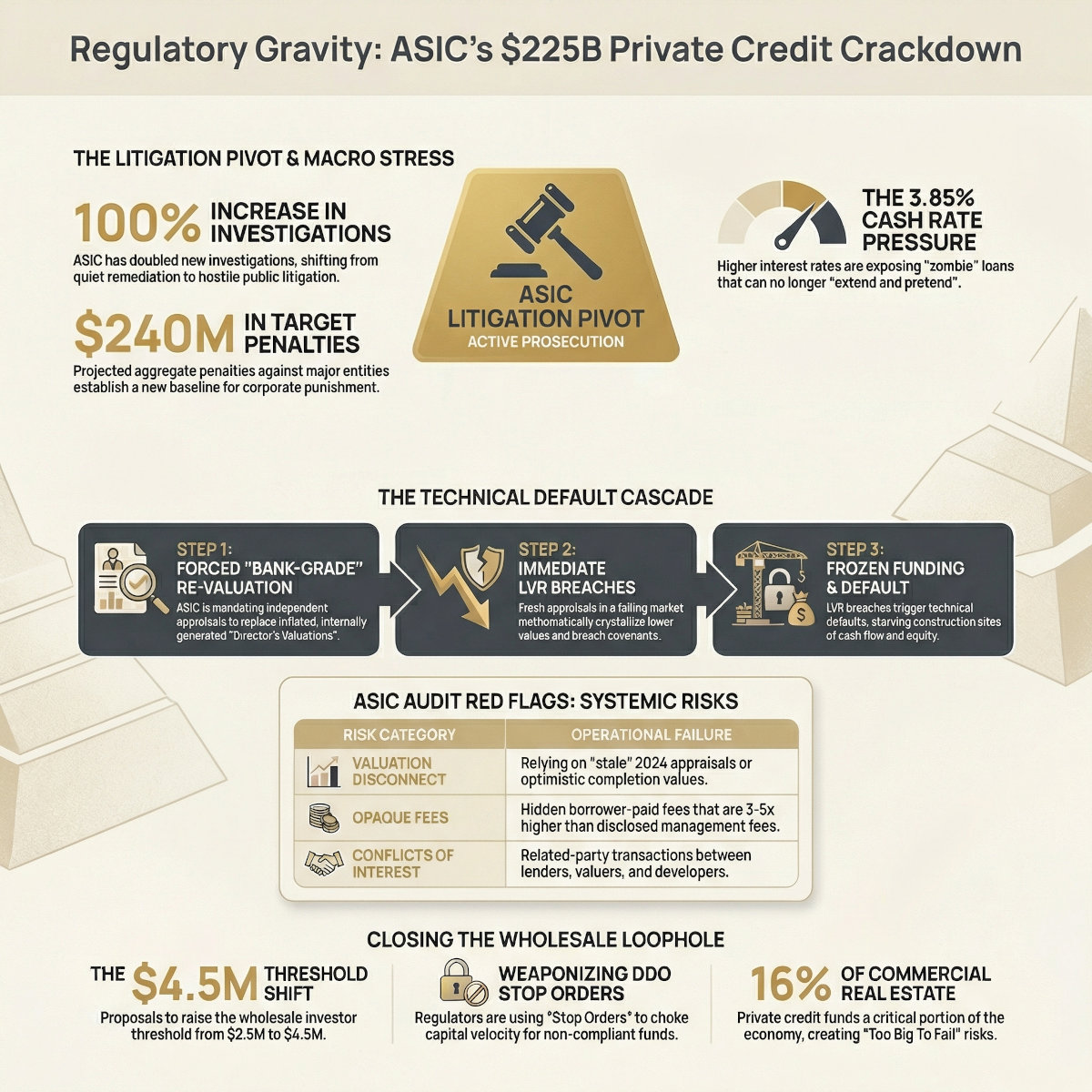
This quantitative leap in enforcement velocity is further supported by broader operational reports indicating a 50% increase in total investigations, a near 20% increase in new civil enforcement proceedings, and the completion of over 800 targeted surveillance operations.12 The tactical shift from cooperative compliance negotiation to hostile, deterrence-based litigation is most starkly highlighted by the sheer scale of the financial penalties currently being pursued by the regulator’s enforcement divisions. The regulator is presently seeking a projected aggregate of $240 million in civil penalties across 4 separate proceedings against a single major tier-1 banking entity, Anz, for widespread, systemic misconduct.5 If finalised and approved by the Federal Court, this action will mark the absolute largest aggregate civil penalty outcome ever reported in the agency’s operational history for a single financial year period.5
Concurrently, the regulator has secured substantial penalties in related financial services sectors, including a $23.5 million penalty against the superannuation trustee Cbus for systemic processing failures, and has achieved historic criminal outcomes, such as a 14-year prison sentence imposed by the Supreme Court of Western Australia following a complex criminal investigation.5 These monumental enforcement outcomes demonstrate a clear, philosophical abandonment of the historical compliance arm ideology, whereby massive corporations were previously permitted to quietly remediate operational issues behind closed doors without facing severe judicial scrutiny or public reputational damage.5 The enforcement posture is now explicitly and unapologetically punitive, designed to generate highly visible, financially devastating deterrents across all capital markets.
Focus Areas And Development Sector Phoenixing Typologies
The regulatory blitz currently underway is not a broad, untargeted sweep; it is a highly calibrated operation targeting specific structural vulnerabilities. A granular examination of the stated 2026 enforcement priorities confirms the deliberate inclusion of unlawful practices that seek to evade small-business creditors.11 This exact, highly specific phrasing points directly to the systemic targeting of illegal phoenixing activity, heavily concentrated within the construction, property development, and contracting sectors.16
Illegal phoenixing, the calculated process whereby development entities and construction firms are deliberately placed into liquidation to abandon crushing liabilities to subcontractors, tradespeople, and the federal taxation office, before the underlying physical assets and operational contracts are seamlessly transferred to a clean, debt-free corporate vehicle controlled by the exact same directors, is intrinsically and inextricably linked to financial distress within the private credit supply chain. As wholesale funding costs rise and mid-tier property developers face acute liquidity constraints driven by stagnant sales and escalating material costs, the commercial temptation to utilise sophisticated phoenixing structures increases exponentially.
By explicitly listing this precise behaviour as an enduring, high-level enforcement priority for 2026, placed deliberately alongside poor private credit practices, the regulator is transparently signalling a synchronised, multi-front attack.11 They intend to prosecute both the non-bank lenders facilitating these opaque, highly leveraged capital structures and the development borrowers actively utilising them to evade legitimate commercial liabilities.
| Strategic Enforcement Metric | Validated Primary Data Point | Macroeconomic And Strategic Implication |
| Investigatory Volume | Doubled the volume of new investigations over the preceding 12 months.5 | Signals a permanent, structural expansion of federal investigatory bandwidth and capability. |
| Judicial Court Filings | Nearly doubled the volume of new matters filed in federal and supreme courts.5 | Confirms a definitive transition from quiet remediation to active, hostile public litigation. |
| Civil Enforcement Velocity | Documented 20% increase in new civil enforcement proceedings.12 | Demonstrates a distinct willingness to bypass enforceable undertakings in favour of prosecution. |
| Specific Priority Phrasing | Explicit targeting of unlawful practices seeking to evade small business creditors.16 | Confirms a targeted, highly resourced focus on construction and development sector phoenixing. |
| Maximum Penalty Threshold | Projected aggregate $240 million penalty pursued across 4 proceedings against a single tier-1 banking entity.5 | Establishes a terrifying new baseline for corporate financial punishment and compliance risk. |
The Q4 And Q1 Civil Penalty Trap Assessment
This analysis specifically tested whether the regulator filed 50 or more new civil penalty cases within the private credit sector during Q4 2025 and Q1 2026. Following an exhaustive review of the available regulatory data, press releases, and parliamentary testimony, this specific metric yields a Nil Return.
While the data confirms that the regulator released more than 50 public submissions in response to its discussion paper on private markets, and whilst broader enforcement metrics confirm a 50% increase in overarching investigations and a near 20% increase in new civil enforcement proceedings across the total regulatory spectrum, there is no empirical evidence to support the existence of 50+ discrete civil penalty filings specifically restricted to private credit operators within that exact 6-month window.12 Instead, regulatory friction in this specific sector is currently concentrated at earlier enforcement stages. The regulator is heavily utilising administrative tools, specifically Design and Distribution Obligations interim stop orders, rather than active Federal Court civil litigation to immediately disrupt non-compliant private credit offerings.19
However, the absence of this specific, highly concentrated cluster of private credit lawsuits does not negate the reality of the blitz. The compounding volume of overarching court activity, the record-breaking penalties secured in adjacent financial sectors, and the explicit elevation of private credit to a top-tier enforcement priority guarantee that private credit operators will inevitably be captured within this vastly expanded surveillance and litigation net over the coming 24 months.5 The litigation pivot is not tough talk; it is a fully operationalised regulatory reality.
The highly anticipated publication of Report 814, titled Private Credit In Australia, in September 2025, serves as the foundational architectural blueprint for the current and escalating regulatory blitz.6 Rather than functioning as a mere observational macroeconomic study, Report 814 operates as a targeted, comprehensive indictment of the prevailing operational and governance standards permeating the $225 billion shadow banking sector.1 An exhaustive analysis of this document validates the specific Red Flags that will serve as the primary, inescapable litigation vectors for the regulator’s enforcement divisions throughout 2026 and beyond.
Deconstructing The Core Structural Red Flags
The extensive regulatory investigation, which surveyed a broad cross-section of retail and wholesale funds, isolated 3 fundamental areas of systemic, deeply entrenched vulnerability: highly inconsistent valuation methodologies, chronically opaque fee and remuneration structures, and prevalent, unmanaged conflicts of interest.6
The Valuation Disconnect represents the most critical and systemically dangerous finding within the entire report. The surveillance operations revealed that the structural adequacy of valuation governance across the private credit sector is alarmingly deficient.6 Numerous private credit funds rely entirely upon internal valuation processes, executed by the exact same credit staff or deal teams whose personal remuneration and performance bonuses are directly dependent upon inflating those specific asset values.6 This reliance upon internal Director’s Valuations without any rigorous, independent external review creates a massive, systemic conflict of interest.6
The actual mathematical methodology driving these valuations is frequently manipulated and heavily skewed toward masking underlying credit risk. For example, in the high-risk realm of real estate construction lending, private funds frequently quote Loan To Value Ratios based on the hypothetical, highly optimistic completion value of a development project rather than its actual, current cost.6 Furthermore, commercial real estate valuations are frequently calculated by managers using gross rent metrics rather than net effective rent, which conveniently ignores massive tenant incentives, rent-free periods, and capital expenditure requirements, effectively artificially inflating the collateral value and severely depressing the stated risk profile presented to investors.6 Consequently, despite heavy, concentrated exposure to sub-investment grade credit and the historically volatile commercial construction sector, several major funds brazenly reported 0 operational impairments, a statistical and mathematical anomaly that fundamentally contradicts all major rating agency expectations for loans of such a distressed nature.6
The secondary red flag isolated by the regulator involves the deliberate obfuscation of true capital costs and the aggressive capture of hidden margins. Report 814 explicitly identified that non-disclosed remuneration, derived quietly from borrower-paid upfront fees, default penalties, and layered net interest margins, can be 3 to 5 times higher than the publicly disclosed fund management base fees, which typically appear benign, ranging merely from 0.25% to 2.0% per annum.6
More concerning from a strict regulatory and fiduciary perspective is the rampant use of Special Purpose Vehicles to capture and hide massive net interest margins.6 Fund managers frequently interpose these complex corporate vehicles directly between the end retail or wholesale investor and the ultimate commercial borrower. The Special Purpose Vehicle lends capital to the borrower at a significantly higher interest rate than the yield that is ultimately passed back to the fund’s investors, thereby allowing the fund manager to quietly retain the excess interest margin without providing transparent, quantified disclosure of this massive profit extraction.6
The 3rd critical red flag highlights the incestuous, highly conflicted nature of mid-tier private credit origination and management. The regulator observed widespread, deeply concerning related-party transactions, where high-risk loans are casually issued to affiliated property developers, or toxic debt is quietly shifted between different funds managed by the exact same corporate group without any robust, independent governance or external valuation oversight.6 Additionally, severe, almost unmanageable conflicts arise when a 1 credit manager simultaneously holds multiple tranches of the exact same capital stack, such as holding the senior debt, the mezzanine debt, and the equity positions in the exact same commercial borrower.6 This multi-tranche exposure severely compromises the manager’s fiduciary duty and decision-making clarity if the borrower subsequently enters acute financial distress, as actions taken to protect the senior debt may instantly wipe out the equity investors within the same manager’s ecosystem.6
| Regulatory Red Flag Category | Identified Operational Deficiency | Consequential Enforcement Implication |
| Valuation Disconnect | Reliance on internal Director’s Valuations and the use of gross rent and completion value metrics.6 | Regulator will mandate Bank-Grade independent valuations, exposing massive, hidden portfolio impairments. |
| Opaque Remuneration | Hidden borrower fees and Special Purpose Vehicles used to capture undisclosed net interest margins.6 | Regulator will enforce total fee quantification, destroying the lucrative shadow margin model of boutique lenders. |
| Conflicts Of Interest | Widespread related-party lending and multi-tranche capital stack exposures managed by single entities.6 | Regulator will mandate strict, independent board oversight, dramatically increasing operational and compliance costs. |
The Mechanics Of The Technical Default Cascade
The overarching strategic implications of these regulatory red flags, particularly the intense focus on the Valuation Disconnect, directly and undeniably validate the core mechanics of the Regulatory Velocity Multiplier thesis. If the federal regulator successfully enforces strict, unyielding adherence to independent, Bank-Grade quarterly valuations across the entire sector, the foundational mathematics that have artificially propped up the mid-tier private credit ecosystem will instantly fracture.
When a private non-bank lender can no longer legally or procedurally accept a highly optimistic Director’s Valuation, or rely upon an outdated, pre-inflation 2024 appraisal to satisfy their compliance audits, they must immediately commission a fresh, completely independent assessment from a tier-1 valuation firm. In a falling commercial property market, a market severely exacerbated by sustained, punishingly high interest rates following the Reserve Bank of Australia’s critical decision in February to hike the official cash rate to 3.85%, these independent, unconflicted valuations will inevitably and mathematically crystallise significantly lower underlying asset values.1
The mechanical, step-by-step flow of this specific financial risk is precise, inescapable, and lethal to undercapitalised developers. Documented historical precedents, including detailed transcripts submitted to parliamentary economics committees, highlight exact scenarios where updated, independent valuations from top-tier firms drastically reduced commercial land values.8 This sudden reduction in the denominator immediately and mathematically places the commercial borrower’s funding facility in severe breach of the allowable Loan To Value Ratio covenant.8
Upon officially breaching the Loan To Value Ratio covenant, the private lender is legally and contractually obligated, or forced by the strict parameters of their own internal fund risk mandates, to instantly declare a formal technical default.8 Consequently, the lender will immediately refuse any further construction drawdown requests, starving the development site of cash flow, and will aggressively impose punitive, hyper-inflated default interest rates upon the borrower.8
By deliberately targeting inconsistent valuation practices, the corporate regulator is effectively and surgically stripping away the opaque accounting camouflage that has historically protected hundreds of subprime development loans. The sudden, forced imposition of accurate mark-to-market accounting will mechanically force lenders to breach their own commercial borrowers, setting off a catastrophic, unstoppable chain reaction of technical defaults across the entire mid-tier construction sector, even in instances where there has been absolutely no actual, material change in the underlying developer’s fundamental day-to-day cash-flow position.9 This is the Regulatory Velocity Multiplier acting as a destructive force on inflated capital structures.
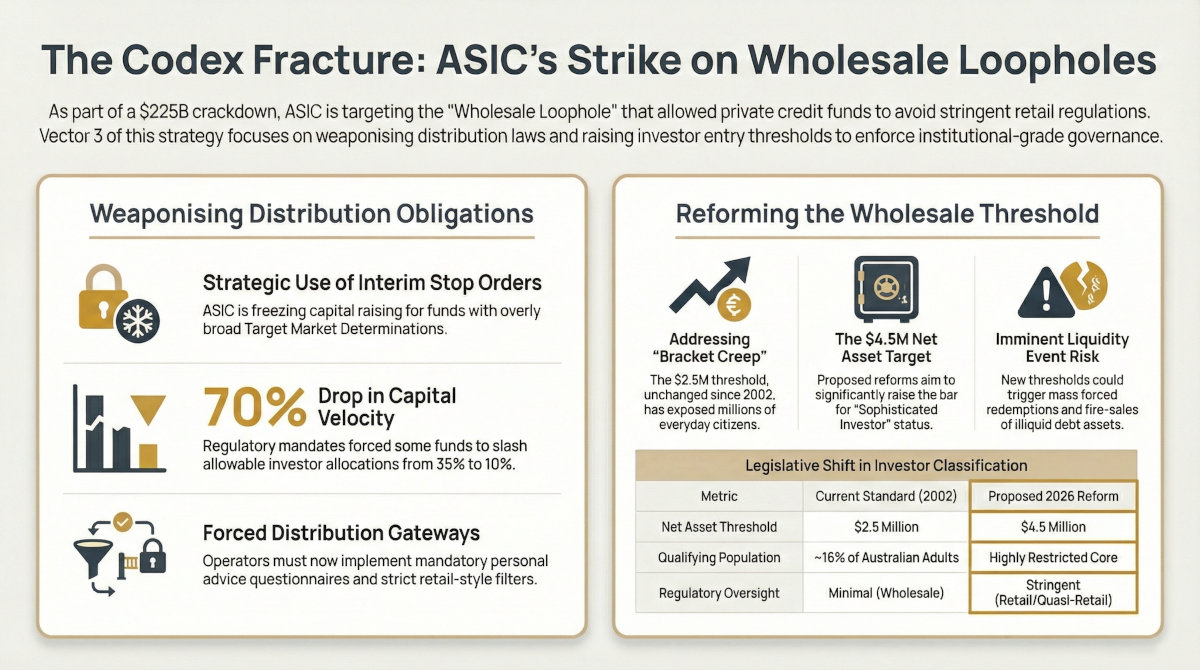
This section investigates precisely how the federal regulator is actively and aggressively manoeuvring to permanently close the historical jurisdictional loopholes that have effectively insulated the vast majority of the private credit sector from stringent retail consumer protection laws. The entire Australian private credit operational model has, for decades, heavily relied upon the widespread application of the Wholesale Investor classification to deliberately bypass the rigorous disclosure, structural liquidity, and stringent governance mandates that are legally applied to standard retail financial products. However, recent, highly aggressive regulatory actions indicate that this protective firewall is being systematically dismantled block by block.
Weaponising The Design And Distribution Obligations
The Design and Distribution Obligations legislative framework was originally drafted and implemented to ensure that complex financial products are appropriately targeted and restricted to suitable retail consumers, mandating the creation of a highly specific Target Market Determination document. Historically, wholesale funds operated almost entirely beyond the jurisdictional reach of these obligations. However, the regulatory surveillance mapping indicates a definitive, highly aggressive tactical shift: the regulator is now actively weaponising these obligations to ruthlessly police the porous, often manipulated boundary between retail and wholesale capital.
Between late 2025 and early 2026, the regulator deployed its lethal interim stop order powers with devastating commercial effect against some of the most prominent private credit operators in the country. Interim stop orders were aggressively issued against massive funds, including the La Trobe Us Private Credit Fund, the La Trobe Australian Credit Fund, and the Reli Capital Mortgage Fund.23 The foundational regulatory justification for these sudden stop orders was the specific determination that the funds’ Target Market Determinations were dangerously broad and legally defective.23 The regulator argued that the documents suggested entirely inappropriate portfolio allocations for investors, completely failing to account for the extreme underlying liquidity risks, the opacity of the valuations, and the highly sub-investment-grade nature of the targeted private credit assets.23
To have these commercially paralysing stop orders revoked and resume capital raising, operators were forced into humiliating, highly public, and commercially restrictive concessions. La Trobe Financial, managing billions in assets, was legally required to drastically amend its Target Market Determination to severely reduce the percentage of an investor’s total investable assets considered appropriate for allocation into the fund, actively cutting the allowable threshold from 35% down to a maximum of just 10%.23 Furthermore, the regulator forced the implementation of new, mandatory personal advice questionnaires and distribution gateways for retail clients.23
This sequence of events represents the literal, real-world operationalisation of the Regulatory Velocity Multiplier. By violently choking the primary distribution channels through Design And Distribution Obligations stop orders, the regulator drastically increases the friction, compliance burden, and overall cost of capital acquisition for the fund manager. If a private credit fund can suddenly only capture 10% of an investor’s total wallet rather than 35%, the mathematical velocity of inbound liquidity drops by more than 2/3.23 This effectively starves open-ended private credit funds of the fresh, constant flow of capital required to mask underlying portfolio deterioration, fund ongoing construction drawdowns, and seamlessly service rising investor redemption requests.7
Reforming The Wholesale Investor Threshold
Operating in parallel to the highly tactical, surgical use of interim stop orders, a much broader, permanent legislative mechanism is currently being prepared by the federal government to close the wholesale loophole entirely. The fundamental financial criteria required for an individual to legally qualify as a sophisticated or wholesale investor, specifically the $2.5 million net asset threshold, has remarkably not been adjusted for inflation or market growth since 2002.29 Consequently, due to more than 2 decades of massive property market inflation, wage growth, and general bracket creep, an estimated 16% of the entire Australian adult population, representing over 3 million consumers, now technically qualifies as wholesale investors.29 This statistical anomaly essentially strips millions of everyday citizens of critical retail consumer protections, exposing them to highly complex, illiquid shadow banking products.
The impending 2026 federal reforms to the wholesale investor test severely threaten to sever a vital, beating artery of private credit funding. While some advocacy groups and industry bodies initially proposed massively raising the net asset threshold from $2.5 million to $5 million, current Treasury reviews and government discussions are focusing on a more moderate increase to $4.5 million.31
If this dramatically elevated threshold is implemented into law without the inclusion of permanent, robust grandfathering provisions to protect existing investors, private credit funds will face a catastrophic, immediate liquidity event. Existing investors who suddenly and legally revert to retail status overnight would be strictly prohibited from reinvesting distributions or injecting fresh capital into wholesale-only credit vehicles.32 Furthermore, funds may be legally forced to execute mass, unplanned redemptions to forcefully excise non-compliant retail capital from their wholesale pools, triggering a fire-sale of illiquid commercial real estate debt assets.32
The regulatory agenda is explicit, uncompromising, and highly public: operators must urgently implement proportionate, institutional product governance and strict distribution controls even for wholesale offerings that reach quasi-retail audiences.7 The deliberate weaponisation of stop orders and the impending, severe threshold reforms clearly indicate that the golden era of regulatory arbitrage, whereby massive amounts of retail capital are cheaply harvested under outdated wholesale exemptions to blindly fund high-risk, sub-prime development debt, is decisively and permanently ending.
While the strict mathematical inevitability of the Regulatory Velocity Multiplier points directly toward a future characterised by widespread, systemic technical defaults across the property sector, a rigorous, intellectually honest threat assessment must carefully account for the macroeconomic Counter-Narrative. The critical hypothesis examined in this section asks whether the Australian private credit sector has simply grown far too systemically important for the regulator to crush. If the federal regulator enforces its new, punitive mandate too violently, it risks fundamentally destabilising the exact financial architecture and economic engine it theoretically seeks to protect.
The Macroeconomic Scale Of The Shadow Banking Ecosystem
The empirical macroeconomic data supporting the Too Big To Fail hedge is substantial, deeply entrenched, and impossible to ignore. The Australian private credit market is no longer a fringe, alternative asset class utilised solely by high-net-worth speculators; it is now a foundational, load-bearing component of the national economic infrastructure. With total Assets Under Management expanding by a robust 9% year-on-year to reach a staggering $224 billion to $225 billion, the sector’s growth trajectory remains explosive, with pure direct corporate lending alone projected to increase from $100 billion to upwards of $154 billion by 2026.1
Crucially, from a systemic risk perspective, private credit currently provides an estimated 16% of all commercial real estate lending and 12% of all broader corporate and business loans across the entire country.2 In the context of a chronic, highly politicised national housing undersupply, which experts project will reach a devastating shortfall of 260,000 dwellings by 2029, and traditional tier-1 Authorised Deposit-Taking Institutions continuing their long-term retreat from complex, high-risk construction finance due to punitive Basel capital constraints, private credit is effectively single-handedly keeping the Australian property development pipeline operational.2
Furthermore, the market is already heavily consolidated at the institutional apex. The regulatory surveillance operations actively reviewed giant industry participants such as Metrics Credit Partners and La Trobe Financial, which collectively manage well over $50 billion in assets, alongside massive global institutional entrants like Kkr.24 These entities manage pools of capital so vast that any regulatory action that inadvertently triggers a run on their funds would echo disastrously throughout the entire Australian financial system.
The Pragmatic Enforcement Strategy And Market Bifurcation
Given this deep systemic integration into the real economy, the Counter-Narrative posits that the regulator simply cannot afford to engineer a hard landing for the sector. Aggressively crushing the private credit market through overzealous litigation would immediately freeze commercial construction financing, severely exacerbate the national housing crisis, and trigger a cascading, uncontrollable series of insolvencies across the contracting, development, and building supply ecosystems.
The primary public communications originating from the highest levels of the regulatory leadership actively support this pragmatic, highly calculated interpretation of their strategy. In releasing the damning findings of Report 814, the regulatory leadership explicitly and carefully acknowledged the immense economic value of the sector, clearly stating that private credit, when done well, is highly beneficial for the broader Australian economy, perfectly complements the heavily regulated traditional banking system, and fills absolutely vital commercial funding gaps.22 The ultimate objective, as articulated repeatedly by the Chair in various forums, is to ensure that domestic capital markets remain highly efficient, strong, and globally competitive, explicitly noting a federal desire to remain backers, not blockers of investment and capital innovation.36
| Systemic Economic Indicator | Verified Market Data Point | Macroeconomic Reality And Enforcement Restraint |
| Aggregate Market Size | $224 billion to $225 billion Total Scale.1 | Represents a systemic, irreplaceable pillar of the domestic credit supply that cannot be dismantled. |
| Sector Dominance | Commands 16% of total Commercial Real Estate Debt.2 | Absolutely critical to maintaining baseline construction viability during a historic housing shortage. |
| Institutional Scale | Top managers (Metrics, La Trobe) control over $50 billion in Aum.24 | Leading funds possess distinct Too Big To Fail characteristics, mandating regulatory caution. |
| Stated Regulatory Stance | Acknowledged as a vital, necessary complement to traditional banks.22 | Enforcement operations will strictly aim for operational compliance, not total market destruction. |
Therefore, the application of the regulatory blitz will almost certainly be highly bifurcated. The major, institutional-grade non-bank lenders, entities such as Qualitas, Centuria, and Metrics Credit Partners, already possess the massive balance sheet resilience, the highly complex, independent governance frameworks, and the institutional capital backing required to comfortably absorb the massive impending compliance uplift. These massive entities will be utilised cooperatively by the regulator as the gold standard benchmark for good practice in the sector.
Conversely, the lethal, unyielding force of the regulatory gravity will be directed with extreme prejudice at the mid-tier, sub-institutional, and boutique private credit operators. It is these smaller, highly aggressive funds, those desperately reliant on unsophisticated retail capital laundered through outdated wholesale threshold exemptions, utilising highly opaque Special Purpose Vehicles to strip margins, and surviving entirely on artificially inflated internal Director’s Valuations of deeply distressed commercial construction assets, that will bear the absolute brunt of the civil penalty filings and paralysing Design And Distribution Obligations stop orders.6
By surgically and ruthlessly removing the most deeply compromised, undercapitalised mid-tier players from the board, the regulator can successfully enforce a systemic, sector-wide flight to quality. This strategy will force massive industry consolidation, wherein the Too Big To Fail entities quietly absorb the viable, performing loan books of the failing boutique funds at a discount, thereby effectively sterilising the contagion risk, punishing bad actors, and cleaning up the sector without accidentally crashing the broader commercial construction pipeline.
This exhaustive investigation into the Regulatory Gravity thesis yields a definitive, unequivocal validation of the core strategic hypothesis outlined at the outset of this analysis. The Australian private credit sector, having swelled to a staggering $225 billion, is currently undergoing a violent, forced transition from a freewheeling era of unpoliced regulatory arbitrage into a rigid, highly scrutinised paradigm of institutional compliance. The evidence synthesised across the four analysis sections confirms beyond a doubt that the sudden, mandated imposition of massive institutional governance costs will fundamentally, irrevocably alter the liquidity profile of the entire shadow banking market.
First, the litigation pivot is a documented, structural reality. The literal doubling of active investigations and the highly aggressive pursuit of massive, record-breaking civil penalties across the financial spectrum confirm that the regulator has the operational bandwidth, the federal funding, and the political mandate to pursue extremely punitive enforcement against non-compliant corporate entities.5 While the specific test of 50+ private credit cases in a single quarter yielded a Nil Return, the overarching trajectory of a 20% increase in civil enforcement proceedings guarantees massive incoming friction for the sector.12
Second, the deeply ingrained Valuation Disconnect, perfectly highlighted and deconstructed in Report 814, provides the exact mechanical trigger required to activate the Regulatory Velocity Multiplier. By publicly identifying internal valuations, gross rent assumptions, and completion-value Loan To Value Ratios as systemic, unacceptable red flags, the regulator has clearly telegraphed its primary line of attack.6 The enforced, non-negotiable transition to independent, rigorous mark-to-market appraisals in a sustained high-interest-rate environment, driven by the February cash rate hike to 3.85%, will mechanically generate an avalanche of Loan To Value Ratio breaches.1 This will force private lenders to trigger aggressive technical defaults against mid-tier developers, stripping equity and seizing assets regardless of the borrower’s immediate cash-flow status.8
Third, the deliberate, highly tactical closure of the wholesale loophole via the weaponisation of Design And Distribution Obligations stop orders, combined with the impending, severe elevation of the sophisticated investor asset threshold to $4.5 million, will severely constrain the inbound velocity of fresh capital.31 Funds that have historically relied on quasi-retail money to continuously refinance toxic, distressed assets will face acute, terminal liquidity shortages, rendering them utterly incapable of meeting sudden redemption requests or funding ongoing, critical construction drawdowns.7
Ultimately, while the immense macroeconomic significance of the private credit sector provides a highly effective protective hedge against total, systemic market annihilation, it offers absolutely no safe harbour for the boutique and mid-tier operators currently relying on opaque accounting, hidden margin capture, and aggressive capital stacking. The regulatory gravity currently descending upon the sector is inescapable; it will mathematically crush the undercapitalised mid-tier, force a massive wave of opportunistic asset consolidation by the mega-funds, and irrevocably mandate strict, Bank-Grade transparency across the entirety of the Australian shadow banking ecosystem.
- Private credit market to grow in 2026 but with greater regulation – AdviserVoice, accessed February 2026, https://www.adviservoice.com.au/2026/02/private-credit-market-to-grow-in-2026-but-with-greater-regulation/
- Why Real Estate Private Credit Is Becoming a Strategic Allocation – Investor Daily, accessed February 2026, https://www.investordaily.com.au/why-real-estate-private-credit-is-becoming-a-strategic-allocation/
- AUSTRALIAN PRIVATE DEBT MARKET REVIEW 2025 – Alvarez & Marsal, accessed February 2026, https://www.alvarezandmarsal.com/sites/default/files/2025-11/A%26M%20Australian%20Private%20Debt%20Report%202025_0.pdf
- Australia’s Booming Private Credit Market: Growth, Challenges, and the Future | Broadridge, accessed February 2026, https://www.broadridge.com/article/asset-management/australias-booming-private-credit-market-growth-challenges-and-the-future
- Supplementary Budget Estimates Senate Economics Legislation Committee, Opening Statement, 3 December 2025 | ASIC, accessed February 2026, https://www.asic.gov.au/about-asic/news-centre/speeches/supplementary-budget-estimates-senate-economics-legislation-committee-opening-statement-3-december-2025/
- REP 814 Private credit in Australia – ASIC, accessed February 2026, https://download.asic.gov.au/media/z2tnnasb/rep814-published-22-september-2025.pdf
- A crackdown on private credit: what ASIC’s latest surveillance means for lenders, borrowers and investors – Ironbridge Legal, accessed February 2026, https://ironbridgelegal.com.au/a-crackdown-on-private-credit-what-asics-latest-surveillance-means-for-lenders-borrowers-and-investors/
- Chapter 7 – Parliament of Australia, accessed February 2026, https://www.aph.gov.au/Parliamentary_Business/Committees/Senate/Economics/Completed_inquiries/2010-13/postGFCbanking/report/c07
- Shareholder-Creditor Conflict and the Resolution of Financial Distress | The Review of Corporate Finance Studies | Oxford Academic, accessed February 2026, https://academic.oup.com/rcfs/article/14/3/804/7639397
- Selling Stockholders – SEC.gov, accessed February 2026, https://www.sec.gov/Archives/edgar/data/2019793/000149315225025858/form424b3.htm
- 25-273MR ASIC announces 2026 enforcement priorities | ASIC, accessed February 2026, https://www.asic.gov.au/about-asic/news-centre/find-a-media-release/2025-releases/25-273mr-asic-announces-2026-enforcement-priorities/
- Clifford Chance – International Regulatory Update 20 – 24 October 2025, accessed February 2026, https://www.cliffordchance.com/content/dam/cliffordchance/briefings/2025/10/IRU-20-24-October-2025.pdf
- Media releases – ASIC, accessed February 2026, https://www.asic.gov.au/newsroom/media-releases/
- The power and purpose of enforcement – ASIC, accessed February 2026, https://www.asic.gov.au/about-asic/news-centre/speeches/the-power-and-purpose-of-enforcement/
- ASIC announces 2026 enforcement priorities | Global Regulation Tomorrow, accessed February 2026, https://www.regulationtomorrow.com/au/asic-announces-2026-enforcement-priorities/
- ASIC enforcement priorities, accessed February 2026, https://www.asic.gov.au/about-asic/asic-investigations-and-enforcement/asic-enforcement-priorities/
- Financial Services: Regulatory Recap – Week commencing 17 November 2025, accessed February 2026, https://www.gtlaw.com.au/insights/financial-services-regulatory-recap-week-commencing-17-november-2025
- ASIC enforcement priorities: 2026 vs 2025 | RSM Australia, accessed February 2026, https://www.rsm.global/australia/insights/asic-enforcement-priorities-2026-vs-2025
- Funds Update – 26 September 2025 | Herbert Smith Freehills Kramer | Global law firm, accessed February 2026, https://www.hsfkramer.com/notes/fsraustralia/2025-posts/funds-update-26-september-2025
- Valuation as a Regulatory Test: What ASIC’s 2025 Reviews Mean for Fund Managers, accessed February 2026, https://www.spglobal.com/market-intelligence/en/news-insights/research/2025/11/valuation-as-a-regulatory-test-what-asic-2025-reviews-mean-for-fund-managers
- ASIC issues update on public and private markets | Global Regulation Tomorrow, accessed February 2026, https://www.regulationtomorrow.com/au/asic-issues-update-on-public-and-private-markets/
- Australia’s private credit sector: ASIC’s REP 814 signals the need for higher standards, accessed February 2026, https://www.claytonutz.com/insights/2025/september/australia-s-private-credit-sector-asics-rep-814-signals-the-need-for-higher-standards
- 25-205MR ASIC issues DDO stop order against La Trobe US Private Credit Fund, accessed February 2026, https://www.asic.gov.au/about-asic/news-centre/find-a-media-release/2025-releases/25-205mr-asic-issues-ddo-stop-order-against-la-trobe-us-private-credit-fund/
- Report REP 820 Private credit surveillance: retail and wholesale funds – ASIC, accessed February 2026, https://download.asic.gov.au/media/q42bgduw/rep820-published-5-november-2025.pdf
- ASIC hits La Trobe with interim stop order – Financial Newswire, accessed February 2026, https://financialnewswire.com.au/funds-management/asic-hits-la-trobe-with-interim-stop-order/
- ASIC probes private debt, plays stop cards – Investment News NZ, accessed February 2026, https://investmentnews.co.nz/investment-news/asic-probes-private-debt-plays-stop-cards/
- ASIC cracks down with fourth private credit interim stop order – Money Management, accessed February 2026, https://www.moneymanagement.com.au/asic-cracks-down-fourth-private-credit-interim-stop-order/
- What We’re Watching: Responding to ASIC’s surveillance, accessed February 2026, https://www.challengerim.com.au/what-were-watching-responding-to-asics-surveillance/
- Conflicted selling fees are back, and it’s game on – Morningstar Australia, accessed February 2026, https://www.morningstar.com.au/funds/conflicted-selling-fees-are-back-and-its-game-on
- Edition 452, 1 April 2022 – Firstlinks, accessed February 2026, https://www.firstlinks.com.au/uploads/newsletters/2022/Firstlinks_Edition_452_01042022.pdf
- FSC backs increased sophisticated investor threshold, accessed February 2026, https://www.investordaily.com.au/fsc-backs-changes-to-sophisticated-investor-test/
- Media Release: Fine-Tuning of Investor Test Required to Protect Consumers, accessed February 2026, https://fsc.org.au/news/media-release/fine-tuning-of-investor-test-required-to-protect-consumers
- Any wholesale investor changes ‘must include grandfathering’: FSC – IFA, accessed February 2026, https://www.ifa.com.au/any-wholesale-investor-changes-must-include-grandfathering-fsc/
- Open for opportunity: Taking charge of the future of our financial markets – ASIC, accessed February 2026, https://www.asic.gov.au/about-asic/news-centre/speeches/open-for-opportunity-taking-charge-of-the-future-of-our-financial-markets/
- MIU – Issue 171 – September 2025 – ASIC, accessed February 2026, https://www.asic.gov.au/about-asic/corporate-publications/newsletters/market-integrity-update/miu-issue-171-september-2025/
- Financial Services: What’s Up January 2026 – Dentons, accessed February 2026, https://www.dentons.com/en/insights/articles/2026/january/16/financial-services-whats-up-january-2026
