
The Architecture of Belonging: How Five Simultaneous Structural Pressures Are Rewriting the Social Capital of Australian Residential Property
Five simultaneous structural pressures are creating compound stress on the social fabric that underpins Australian residential property values. The most acute risk is a rise in housing insecurity and potential demographic displacement, detected as a live threat by the APN Acute Vulnerability Index™.
This publication constitutes a formal independence declaration, affirming that all findings, metric computations, and structural deductions established herein are derived exclusively from verified Tier-1 institutional data. No commercial influence, algorithmic bias, or unverified qualitative sentiment has been permitted to influence the analytical outputs. The integrity of the data architecture is preserved through an uncompromising reliance on certified mathematical constants, ensuring that the resulting strategic intelligence remains structurally insulated from cyclical market narratives.
The APN Codex framework operates as a dual-layered architectural chart of accounts, designed to systematically quantify both empirical market realities and structural policy consequences. The 21000 Series serves as the objective data ingestion layer, capturing raw, unadjusted data from official institutional endpoints — the Reserve Bank of Australia, the Australian Bureau of Statistics, APRA, and ASIC — to establish fixed mathematical baselines. The 24000 Series houses APN’s proprietary indices, which function as analytical lenses to translate empirical baseline deviations into quantifiable market frictions, regulatory vulnerabilities, and asymmetric capital constraints.
This publication addresses the operative analytical question of the APN Social Capital Index™ (Node 24100) and its six constituent sub-nodes: what structural conditions are currently acting upon the social fabric of Australian residential localities, and where is the system pointing as the primary concentration of emerging risk? The analysis draws on the verified 2026 Delta-Analysis matrix, which documents five confirmed active deviations from the certified 15-year baseline concluding December 2025, and maps these deviations through the APN causal pathway architecture to their downstream consequences within the 24100 branch.

Property analysis has historically operated on a two-dimensional plane: price and yield. The APN Social Capital Index™ (24100) was constructed on a different premise — that the long-term economic viability of any residential location is determined not by its current price point but by the strength and resilience of its underlying social architecture.
The index integrates five structural pillars into a composite score: social cohesion, safety and security perception, human capital and education access, lived amenity and physical connectivity, and climate resilience. These pillars are not qualitative descriptors. Each is assigned a discrete sub-node with its own data architecture, measurement methodology, and input feeds drawn from the 21000 Series objective data layer.
The six nodes of the 24100 branch are as follows:
24110 APN Bedrock™ measures social cohesion — the stability of the resident base, homeownership rates, labour market participation, fiscal stress levels, and the multi-dimensional socio-economic standing of a locality. Bedrock operates on the validated premise that cohesive communities generate positive externalities that directly sustain and increase property values over time. High residential mobility, by contrast, is treated as a material liability.
24120 APN Sentinel™ measures physical safety and security perception, operating on the core analytical thesis that property markets price in the subjective perception of safety as powerfully as the statistical reality of it. Sentinel tracks violent crime frequency, property crime, civic engagement as a social antidote, housing security and demographic transience, and concentrated indicators of social stress that precede displacement events.
24126 APN Acute Vulnerability Index™ sits within the Sentinel pillar as its most concentrated risk instrument. It measures the acute markers of socio-economic stress and housing insecurity that function as lead indicators of demographic displacement — the point at which structural pressure has moved from systemic to localised and measurable.
24130 APN Meridian™ measures the education value of a location, tracking both the objective academic performance of local institutions and the market’s willingness to price access to them into residential asset values. Meridian distinguishes between a theoretical education premium — derived from proximity to a well-regarded school — and a realised premium that is adjusted for administrative risks, including enrolment capacity constraints and boundary changes.
24140 APN Agora™ measures the richness of the lived experience: walkability, social infrastructure density, public transport utility, digital connectivity, green space access, and proximity to essential daily services. Agora quantifies the amenity premium that major infrastructure investment generates and tracks how that premium is sustained or eroded over time.
24150 APN Substrate™ measures physical climate resilience — flood and bushfire exposure, insurability, geological stability, and ecological potential. Substrate treats climate risk not as an ESG category but as a material financial variable, identifying which locations will attract a structural safety premium and which face regulator-induced devaluation.
These six nodes are not independent. They interact. A locality under Bedrock stress will, over time, generate Sentinel deterioration. Sentinel deterioration suppresses Meridian premiums. Meridian and Agora erosion reduce the social infrastructure inputs that Bedrock depends on. The 24100 branch is a system, and systems respond to compound pressure differently than individual components do.
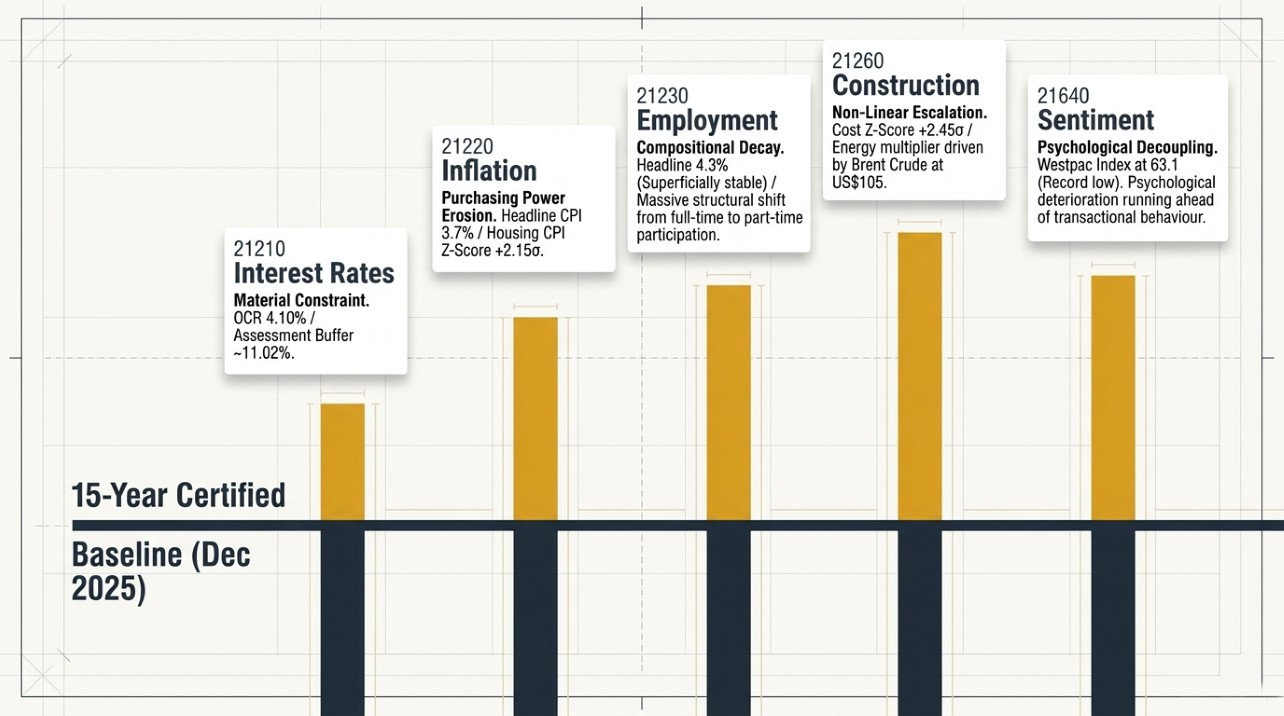
The APN Delta-Analysis matrix documents the verified structural distance between the certified 15-year baseline ending December 2025 and the current operating environment. As of Q1 2026, five nodes within the 21000 Series are recording active deviations from baseline, conditions materially outside historical norms that are transmitting structural pressure downstream into the 24000 Series indices.
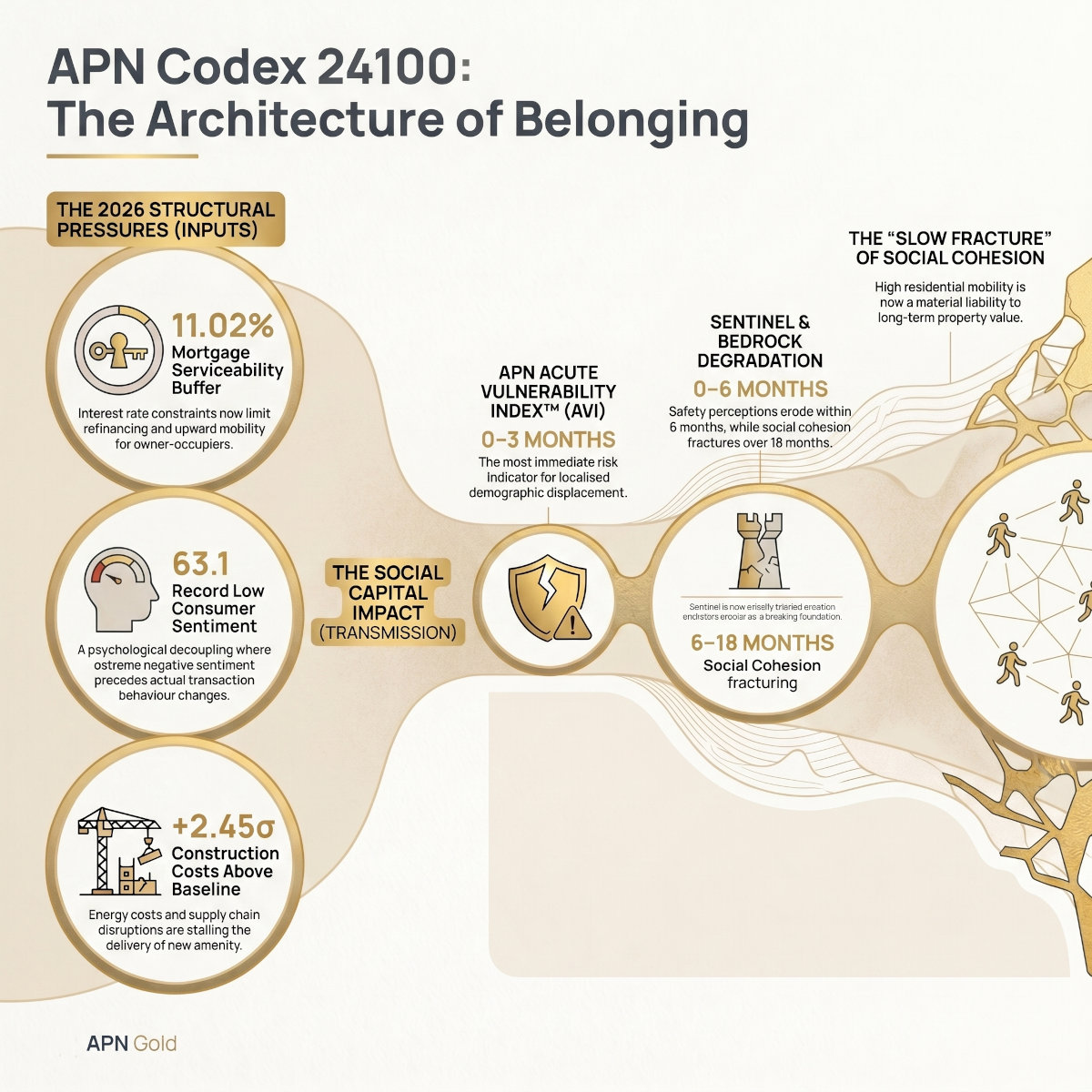
21210 Interest Rates — Material Constraint [ACTIVE] The RBA Official Cash Rate reached 4.10% on 18 March 2026, following two upward adjustments from the terminal Q4 2025 baseline of 3.60%. The practical consequence for the residential market is a theoretical mortgage serviceability assessment rate approaching 11.02% under standard APRA buffer methodology. This does not merely constrain new entrants. It structurally limits the refinancing capacity of existing mortgage holders, suppresses upward mobility within the ownership market, and accelerates the displacement of marginal owner-occupiers toward the rental sector.
21220 Inflation — Purchasing Power Erosion [ACTIVE] Headline CPI reached 4.6% in the 12 months to March 2026 — up from 3.7% in February and the highest annual reading since September 2023 — against a certified Inflation (21220) reading of +2.1049σ above the 15-year baseline (Q2 2026). Housing inflation, the highest-weighted CPI group, recorded 6.5% annually. Electricity costs are 25.4% higher than 12 months ago, following the expiry of Commonwealth and State government rebates. The March monthly movement of 1.1% was substantially driven by a 32.8% rise in automotive fuel prices, reflecting Middle East supply chain disruption; the trimmed mean held at 3.3% annually, confirming the underlying inflation trajectory remains structurally persistent, independent of the fuel component. Non-discretionary household costs — energy, insurance, maintenance, and rates — are escalating at a rate structurally decoupled from wage growth. The real purchasing power of households within the residential market is contracting even where nominal income has not declined.
21230 Employment & GDP — Compositional Decay [ACTIVE] The national unemployment rate reached 4.3% in March 2026, up from 4.09% in December 2025. The more significant analytical signal is compositional: the transition from full-time to part-time labour participation, which leaves headline employment metrics superficially stable while the income consistency and borrowing capacity of affected cohorts deteriorate materially. For the purposes of mortgage serviceability assessment, a part-time income structure is a structurally different instrument to a full-time equivalent.
21260 Construction Costs — Elevated, Energy-Compounded [ACTIVE] Construction cost pressures, with a certified reading of +1.3708σ above baseline (Q1 2026; recertified on a repaired insolvency input, a measurement change rather than a change in conditions), are being compounded by energy cost escalation driven by geopolitical supply chain disruption in late February 2026, with Brent crude at US$105 per barrel as at April 2026. Energy functions as an indiscriminate inflationary multiplier across the construction supply chain — affecting materials, logistics, plant operation, and subcontractor margins simultaneously. The practical consequence is that the physical delivery of new residential supply is constrained not merely by planning and finance, but by the fundamental economics of construction.
21640 Consumer & Business Sentiment — Psychological Decoupling [ACTIVE] The ANZ-Roy Morgan Consumer Confidence Index recorded 63.1 in the week of 24 March 2026 — the lowest reading in the index’s history since 1972, below the March 2020 low of 65.3. The node’s certified composite reading at the end of 2025 was −0.0445σ, close to its 15-year mean; the March 2026 contraction sits well below that baseline. The analytical complexity here is the documented decoupling between reported sentiment and observed transaction behaviour: volumes have not contracted proportionally to the sentiment reading, creating a fragile market condition where psychological deterioration is running ahead of behavioural response.
The five active deviations do not impact every 24100 node equally. The APN causal pathway matrix documents the transmission routes, strength of relationship, and estimated lag between input and manifestation for each node pair. The following summarises the primary pathways under current conditions.
Bedrock (24110): The Slow Fracture
Bedrock is the most structurally fundamental of the 24100 nodes, and its response to the current input conditions is characterised by its lag rather than its immediacy. The primary transmission pathway into Bedrock runs through the interaction of interest rate constraint (21210), inflation (21220), and employment compositional decay (21230).
The mechanism is tenure destabilisation. Owner-occupancy is the foundational input to Bedrock’s social cohesion score. When elevated assessment rates (approaching 11.02%) structurally prevent owner-occupier cohorts from refinancing or transacting upward, the market segments: established owners are held in place by equity, while new entrants and marginal existing holders are progressively excluded from ownership. The rental sector absorbs the displacement. High residential mobility — what Bedrock registers as a material liability — increases. The cohesion score deteriorates not because communities break down, but because the economic mechanism that sustains ownership-based stability is under structural constraint.
The estimated lag for current 21210/21220/21230 inputs to manifest in measurable Bedrock deterioration is 6–18 months. The 2026 active deviations are setting conditions that will register in Bedrock metrics through late 2026 and into 2027.
Sentinel (24120): The Fast-Acting Signal
Sentinel responds to the current input conditions on the shortest timeframe of any 24100 node. The primary transmission pathway is the convergence of consumer sentiment at record lows (21640), employment compositional decay (21230), and interest rate constraint (21210).
Sentinel’s core analytical thesis — that markets price in the perception of safety as powerfully as its statistical reality — makes it uniquely sensitive to psychological inputs. At a consumer sentiment reading of 63.1, the psychological preconditions for elevated Sentinel pressure are structurally present. The mechanism is not that crime increases directly because sentiment deteriorates. It is that the social behaviours that sustain safe environments — civic engagement, community investment, discretionary spending in local economies — are themselves income and confidence-dependent. When both contract simultaneously, the foundation of Sentinel’s positive inputs weakens.
The estimated transmission lag for current inputs into measurable Sentinel deterioration is 0–6 months.
Meridian (24130): The Education Premium Under Pressure
Meridian’s exposure to the current input conditions operates through a different mechanism than Bedrock or Sentinel. The education premium — the market’s willingness to pay above median value for access to high-performing school catchments — is a confidence-dependent asset. It requires buyers with sufficient borrowing capacity to compete for catchment access, and it requires the expectation of future capital growth to justify the premium paid.
Both conditions are structurally weakened by the current input environment. Interest rate constraint (21210) reduces the pool of buyers with the borrowing capacity to compete for premium catchment access. Consumer sentiment at record lows (21640) reduces the willingness to pay a premium predicated on future growth expectations. Inflation (21220) and employment compositional decay (21230) reduce the real discretionary capacity of dual-income households — historically the primary buyers within elite catchment zones.
The Meridian transmission lag is estimated at 12–24 months. The education premium is a resilient asset — it does not evaporate quickly — but the structural inputs currently active are compressing the buyer cohort that sustains it.
Agora (24140): The Infrastructure Deficit Accumulates
Agora’s primary exposure to current conditions runs through the construction and supply chain inputs rather than the financial and sentiment inputs. The elevated construction cost environment (21260) is constraining the physical delivery of the amenity infrastructure — retail, hospitality, public facilities, transport connections — that Agora’s score depends on.
This is predominantly a pipeline-lag pathway. The Agora score at a given locality reflects the accumulated investment in social and physical infrastructure over preceding years. The 2026 construction cost environment does not immediately erode existing amenity. What it does is reduce the forward delivery of new amenity, meaning that localities dependent on pipeline projects for Agora score improvement are facing an extended delay. The estimated transmission lag is 12–36 months.
The additional input from consumer sentiment (21640) operates via a different mechanism: the commercial viability of third-place social infrastructure — cafes, local retail, hospitality venues — is income and confidence-dependent. Sustained sentiment deterioration translates into trading condition pressure for the businesses that constitute Agora’s physical infrastructure base.
Substrate (24150): Marginal Constraint, Structural Trajectory
Of the six 24100 nodes, Substrate has the most limited exposure to the current active input conditions. Its primary exposure is through construction cost escalation (21260), which constrains the delivery of climate-resilient housing stock and slows the retrofit of existing assets to improved climate resilience standards. The transmission lag is estimated at 18–36 months.
The more significant structural observation for Substrate in the current environment is directional rather than acute: the policy framework driving Substrate upward — sustainability and environmental regulations (21360) raising insurability and disclosure standards — is running ahead of the construction sector’s capacity to deliver compliant stock under the current cost and finance environment. The gap between regulatory expectation and physical delivery capacity is widening.
The APN Acute Vulnerability Index™ is the instrument within the 24100 branch where the analytical signals converge most acutely under current 2026 conditions. It is the only node in the branch where all five active Delta-Analysis deviations — 21210, 21220, 21230, 21260, and 21640 — are confirmed causal inputs, and it carries the shortest transmission lag of any 24100 node: 0–3 months.
The AVI measures the acute markers of socio-economic stress and housing insecurity that precede demographic displacement. It is not a sentiment measure or a composite of lagging indicators. It is designed to identify the conditions that exist immediately before displacement becomes measurable in population and rental data — the early-warning instrument of the Sentinel pillar.
The structural logic of the current AVI signal is as follows:
Interest rate constraint (21210) is suppressing the refinancing and transactional capacity of marginal owner-occupiers and placing sustained pressure on mortgage serviceability across middle-market ownership cohorts. Inflation (21220) is simultaneously eroding the real purchasing power of households whose nominal income has not kept pace with non-discretionary cost escalation — headline CPI at 4.6% in March 2026, the highest since September 2023, with housing inflation running at 6.5% and electricity costs 25.4% above year-ago levels following the expiry of government rebates. Employment compositional decay (21230) is reducing the income consistency of affected cohorts in ways that do not register in headline unemployment data but are material to mortgage assessment and household cash-flow stability. Construction cost escalation (21260) is constraining the supply pipeline that would ordinarily provide relief to households displaced from ownership into the rental market — meaning the receiving environment for displaced cohorts is itself under supply constraint. Consumer sentiment at record lows (21640) is compressing the discretionary and psychological resilience of households already under the structural pressures listed above.
The convergence of these five inputs into the AVI measurement domain does not produce a linear outcome. It produces a compound one. Each input, in isolation, generates moderate AVI pressure. In simultaneous combination, they interact: the household that cannot refinance (21210), whose non-discretionary costs are rising (21220), whose income has shifted to part-time (21230), who cannot access new affordable supply (21260), and whose psychological confidence is at a documented low (21640), is not under five separate pressures. It is under one compound structural condition that the AVI is specifically calibrated to detect.
The current reading of the AVI architecture is that the preconditions for concentrated demographic displacement in pressure-exposed localities are structurally present. The 0–3 month transmission lag means this is not a forecast of conditions that may emerge. It is a reading of conditions that are forming now.
The APN Social Capital Index™ branch is not signalling uniform deterioration across all six nodes. It is signalling a structured sequence of pressure transmission, with different nodes at different stages of the same underlying process.
Sentinel (24120) and the Acute Vulnerability Index (24126) are in the immediate transmission window. The inputs are live and the lag is short. Bedrock (24110) is in the early accumulation phase — the conditions are forming that will manifest in measurable cohesion deterioration over the next 6–18 months. Meridian (24130) and Agora (24140) are on longer lags, but the inputs that compress their scores are structurally active. Substrate (24150) is the most insulated node in the current environment, though the widening gap between regulatory expectation and construction delivery capacity is a structural observation worth monitoring.
The architectural significance of this finding is that the 24100 branch is functioning as designed — as a forward-looking instrument that identifies structural conditions before they register in price and transaction data. The five active 2026 inputs are not yet visible in median price movements. They are visible in the causal pathway architecture of the Social Capital branch, transmitted through the measurement instruments calibrated to detect them.
For the Australian residential market in 2026, the Social Capital signals are not a warning of contraction. They are a precise structural reading: the social architecture of residential localities — the cohesion, safety, education access, amenity, and resilience that underpin long-term asset value — is under compound structural pressure from five simultaneous input deviations, with the most acute concentration of risk measurable in the APN Acute Vulnerability Index™.
The market will price this eventually. The APN Codex architecture is designed to identify it first.
Australian Property Network — Independent Institutional Research. April 2026. All data sourced from Tier-1 institutional endpoints. No commercial influence. No unverified qualitative sentiment.
