
APN Research Brief: Budget Housing Media Information Failure
This follow-up analysis extends APN’s initial audit of Federal Budget housing-coverage into the specialist podcast, YouTube and regional broadcast ecosystems — finding that specialist podcasts reversed mainstream media’s omission of the trust-tax changes, even as public search for basic terms like “what is negative gearing” hit a 22-year high while coverage amplified alarm.
Australian Property Network operates as an independent property intelligence platform, now in its tenth year of development. The platform is self-funded and editorially independent, with no commercial affiliations, advertiser relationships, or political affiliations of any kind. This research brief does not constitute financial advice. APN’s analytical work is structured to provide informed observers with a clinical, evidence-anchored account of the property market environment; it is not a recommendation to buy, sell, or hold any asset, nor a prediction of market direction.
The APN Codex operates as a chart of accounts for macroeconomic and property risk data. The 21000 Series captures objective institutional data inputs from the Reserve Bank of Australia, the Australian Bureau of Statistics, the Australian Prudential Regulation Authority, the Australian Securities and Investments Commission, and the Australian Energy Market Operator. The 24000 Series captures proprietary derived indices. This research brief operates at the level of media-environment analysis adjacent to the 21000 Series.
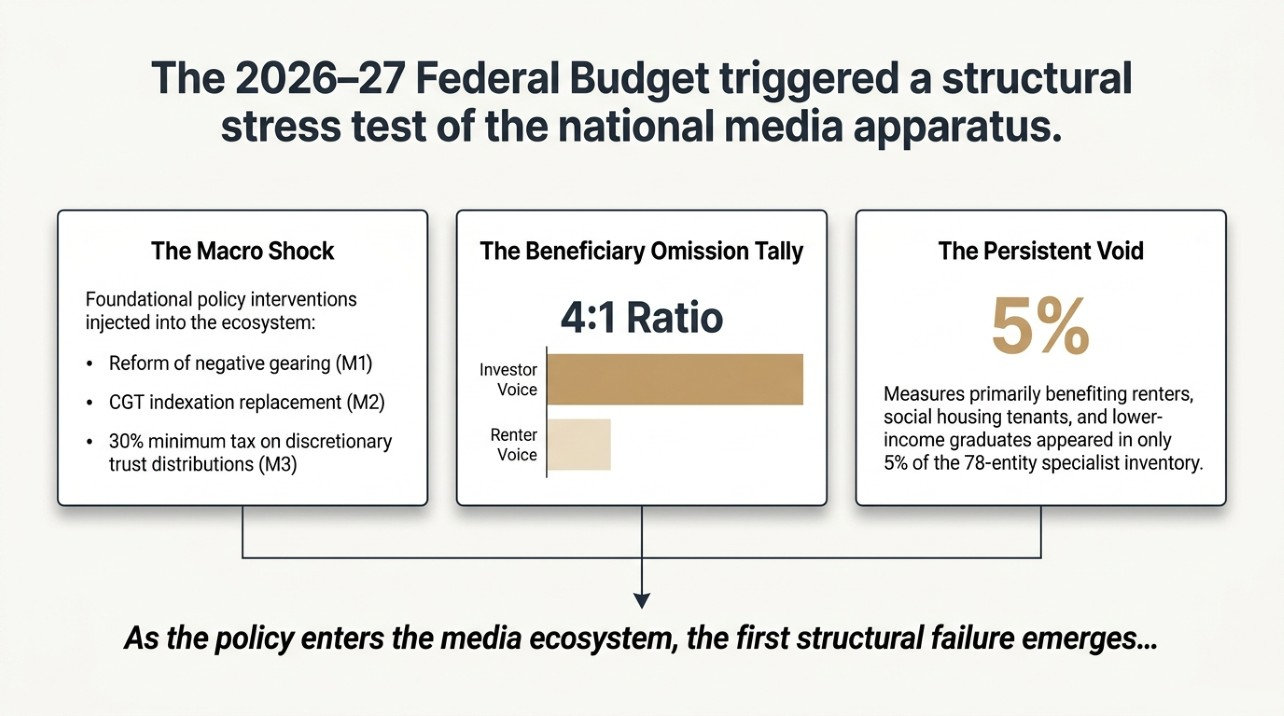
The 2026–27 Federal Budget delivered on 12 May 2026 represents the most structurally significant intervention in Australian residential property taxation since the introduction of the 50% capital gains tax discount in 1999. The twenty-five housing and property measures — anchored by the reform of negative gearing (M1), the replacement of the CGT discount with CPI indexation (M2), and the introduction of a 30% minimum tax on discretionary trust distributions (M3) — constitute a combined revenue and supply package of material consequence to the Australian property market, the household finance sector, and the communities dependent on social and affordable housing provision.
APN’s initial Federal Budget housing-coverage audit (Media Bias Analysis, published 14 May 2026) established the foundational observation of how that intervention was received, framed, and selectively reported across twelve metropolitan and national outlet categories in the immediate 72-hour post-budget cycle. Its findings — nine Tier 1 convergent findings, four Tier 1 universal omissions, a 4:1 aggregate investor-to-renter voice ratio, and systematic structural bias patterns across outlet ownership groups — constitute the national baseline against which the extended media ecosystem must be evaluated.
This follow-up analysis addresses three documented structural gaps in that initial audit’s baseline: the under-representation of regional and community outlets; the complete absence of the specialist audio and digital video ecosystems; and the limitation of the observation window to the immediate coverage cycle. This brief maps 78 additional entities across six research streams and a ten-day analytical follow-up window, and constitutes the first operational data contribution to Node 21680 (Media and Narrative Sentiment Index) following its activation on 14 May 2026. The distillation reference for this contribution is A-260522-C21680.
This analysis is the second brief in a continuing series. The series will extend to at least a third brief covering the remainder of the 12–22 May 2026 analytical window as additional research streams are completed and reviewed. Each brief in the series constitutes a discrete data contribution to Node 21680; the combined corpus of all briefs in the series will form the complete inaugural baseline observation for that node across the full ten-day post-budget window.
This analysis inventories 78 in-scope entities across six research streams (S2 through S7) covering regional print and commercial broadcast, regional public and community broadcasting, property-focused podcasts, finance and money podcasts, independent general business podcasts, and the YouTube digital video ecosystem. A temporal drift analysis (S8) maps editorial evolution across the ten-day window; a behavioural signal register (S9) documents observable consumer and practitioner responses across professional services, mortgage, platform activity, and social media layers.
The primary analytical finding is the M3 reversal. The initial audit classified M3 (Discretionary Trust Minimum Tax, +$4,470.0m) as a critical Tier 2 omission across mainstream media. This specialist podcast ecosystem registers M3 in 43% of its inventory — the single most significant divergence between the initial audit’s national baseline and this follow-up’s specialist findings. The primary significance finding — rated ELEVATED SYSTEMIC SIGNIFICANCE — is the M6 blackout in the Northern Territory and remote Western Australia: federal First Nations remote housing policy produced no dedicated, granular broadcast-level analysis from any public broadcasting outlet proximate to the communities M6 is designed to serve during the entire analytical window.
Three of the initial audit’s four Tier 1 universal omissions (M13, M16, M24) are confirmed extending at substantially the same severity across this ten-day window and six new outlet sub-categories. The beneficiary omission pattern — measures primarily benefiting renters, social housing tenants, and lower-income graduates absent from investor-oriented outlets — persists as a structural feature of the combined eighteen-category ecosystem. The 72-hour panic-to-pivot in the industry-aligned podcast cluster, the SMSF capital-flight signal as a Day +2 timed event corroborated across two independent streams, and the credential-to-reach inversion within the macro-critical YouTube cluster are the secondary analytical findings of material significance for Nodes 21620 and 21640. Fifteen falsifiable hypotheses were formally tested: thirteen supported, two partially supported, none unsupported.
The S9 behavioural signal layer, extended through a seven-set Google Trends analysis covering 35 search terms across a 22-year historical baseline, documents an information market failure of measurable scale. Australian search interest in “negative gearing” during the budget week of 12 May 2026 reached its highest recorded level since Google Trends data begins in 2004 — 4.5 times the prior maximum established during the 2016 federal election campaign. The definitional search term “what is negative gearing” recorded a 33-times multiplier against its prior baseline, constituting the primary empirical signal that the media ecosystem amplified the policy alarm without adequately supplying the explanatory information the public required. A concurrent AI-generated social media misinformation campaign — misrepresenting M2 capital gains tax changes as applying to small businesses exempt under the turnover and asset carve-outs — is confirmed in the search data, with misinformation-specific terms peaking after the budget week, indicating sustained propagation into the second week of the analytical window. A multi-source corrective response was observed in the second week of the window — Treasurer Jim Chalmers and Prime Minister Anthony Albanese characterising the campaign as misinformation; empirical modelling from Dr Tamara Wilkinson (Monash University) indicating that the average effective tax rate on capital gains for affected entities shifts from 19.3% to 21.4%; and a Guardian column by Greg Jericho integrating former Prime Minister Paul Keating’s intervention characterising the Government’s CGT changes as structurally sound — with the eventual reach of the corrective response against the campaign’s prior week of unrebutted propagation registered as a forward observation question for the H2 2026 Node 21680 reading.

Output A — Extended Outlet Category Report · Medium Significance
This report documents this outlet category architecture: the six sub-categories that constitute this extension, their structural relationship to the initial audit’s twelve baseline categories, and the combined eighteen-category ecosystem map that becomes the operative observation perimeter for Node 21680. It is a foundational reference instrument — the analytical scope against which all subsequent outputs in this brief are calibrated.
The initial audit’s twelve-category baseline
The initial audit (14 May 2026) recorded media coverage across twelve outlet categories during the 72-hour post-budget cycle. The twelve are: News Corp Australia print (Cat 1) and digital and broadcast (Cat 2); Nine Entertainment print, comprising the Sydney Morning Herald, The Age, and the Australian Financial Review (Cat 3); Seven West Media (Cat 4); the public broadcasters covering ABC, SBS, and NITV (Cat 5); independent and progressive media (Cat 6); property portals (Cat 7); property data providers (Cat 8); investor-focused property media (Cat 9); mortgage and finance media (Cat 10); industry and advocacy bodies (Cat 11); and industry-affiliated media including The New Daily (Cat 12). The initial audit’s Methodological Notes recorded that smaller and regional outlets were under-represented, that the 72-hour window captured only the immediate coverage cycle, and that the audio and video specialist layers were not in scope.
The six new sub-categories
This follow-up extends the architecture by three new category groups subdividing into six operative sub-categories. Category 13 (regional print and commercial broadcast) is observed via seven in-scope entities — the Cairns Post (News Corp regional bureau), syndicated North Queensland media, Master Builders Queensland regional digital output, 2HD Newcastle distributed across the 47-station Super Radio Network, the National Indigenous Times, the National Tribune syndicated radio channel, and the AMSANT peak-body digital output. Category 14 (regional public and community broadcasting) is observed via ten in-scope entities — six SBS Language services (including SBS Hindi, Punjabi, Mandarin, and Filipino), community radio 2SER and 4ZZZ, ABC Far North, and NITV Radio. The 15-series subdivides into property-focused podcasts (Cat 15a, approximately eighteen entries), finance and money podcasts (Cat 15b, approximately fourteen entries), independent general business podcasts (Cat 15c, approximately eleven entries), and the YouTube digital video ecosystem (Cat 15d, twenty entries arranged into three internal clusters: macro-critical, industry-aligned, and niche specialist).
The combined eighteen-category ecosystem map
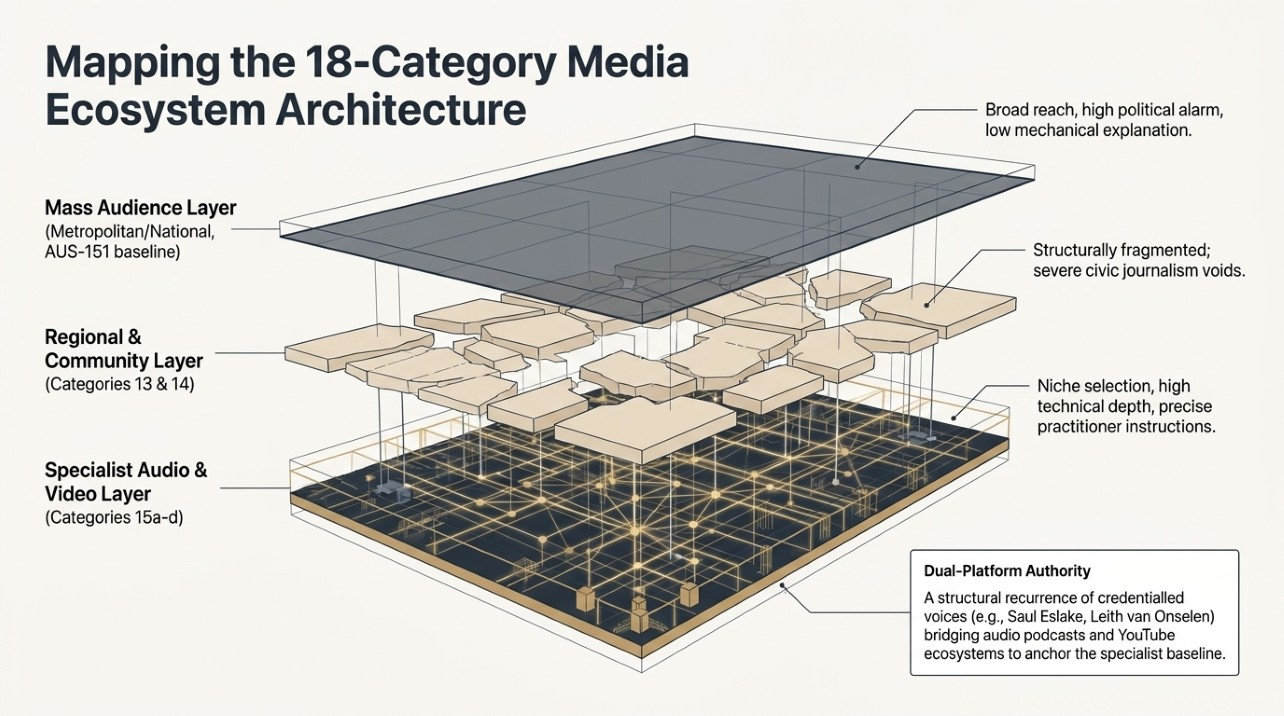
The merged architecture of the initial audit and this follow-up observes eighteen outlet categories across a combined window running from 12 May 2026 (budget night, Day 0) to 22 May 2026 (Day +10). The combined inventory examined here comprises 78 in-scope entities across all nine tabs of the master inventory, set alongside the initial audit’s corpus. The architecture operates in three structural layers: a mass-audience layer (the initial audit’s metropolitan and national categories), a regional and community layer (Cat 13–14, added in this follow-up), and a specialist audio and video layer (Cat 15a–d, added in this follow-up). Coverage patterns suggest each layer addresses a different audience cohort under different commercial, charter, or audience-self-selection conditions. The analytical implication is that no single category can be read as representative of the Australian media response taken in aggregate; the eighteen-category map functions as an inventory of distinct observation points rather than a single composite measurement.
An architecture-level observation emerging from the inventory warrants notation: several authoritative voices recur across categories, with the same individual contributing in podcast format (Cat 15a–c), in YouTube format (Cat 15d), and as guest commentary in regional broadcast (Cat 13). The dual-platform recurrence is documented in detail in Output D; in the present report it is registered as a structural feature of the specialist layer.
Named structural findings
Commercial television void. The S2 Gap Map records that WIN Television, Prime7, and Southern Cross Austereo regional television produced no original, localised budget housing content within this window. Coverage on regional commercial television was functionally identical to metropolitan national packages. The structural explanation is the consolidation of regional television operations into statewide bulletins, which has reduced the economic feasibility of community-specific budget analysis on the commercial television platform. This is registered as a named structural finding of this dataset: a former primary vehicle for regional civic journalism has ceased to function as a platform for localised federal policy analysis.
Agricultural press disconnect. The S2 Gap Map records that the dedicated agricultural press — The Land, Queensland Country Life, Stock & Land, and Weekly Times — produced no original housing-specific analysis of the 25 budget measures during the window, notwithstanding the direct relevance of M10 (skilled migrant trade assessment) and M11 (apprentice and TAFE incentives) to rural workforce housing supply. The structural explanation is editorial categorisation: the rural press treats residential housing as a metropolitan or national domain rather than as an agricultural-policy domain. This is registered as a named structural finding: the workforce-housing dimension of M10 and M11, which carries direct agricultural-sector relevance, did not penetrate the dedicated rural press during this window.
AFR pre-window editorial strategy. The S6 corrected source document and the S8 temporal-drift analysis jointly record that the Australian Financial Review’s podcast slate — Chanticleer, The Fin, Boss, Street Talk, and the AFR Property Summit — published its primary budget analysis in the pre-window period (6–11 May 2026) and pivoted to international subject matter during the actual 12–26 May window. The data indicates a forecasting-orientation editorial strategy: the premium business press treats budget night as a confirmation event rather than a discovery event. This is registered as a named structural finding distinct from a coverage absence — the AFR slate engaged with the budget substantively, but on a publishing schedule preceding the initial audit’s baseline window.
Output B — Regional Print and Broadcast Analysis · High Significance
This output synthesises the findings of this brief’s Stream 2 — regional print and commercial broadcast coverage of the 25 budget housing measures across Queensland, New South Wales, and the Northern Territory and national distribution networks. The seven in-scope entities are documented against a gap map registering three named structural absences. The analytical weight of this output rests on the structural communication finding: regional civic journalism capacity has reduced to the point at which major federal economic policy is not consistently contextualised for regional readers.
The seven in-scope entities
The S2 inventory records seven Cat 13 entities meeting the inclusion criteria during the analytical window. The Cairns Post produced three distinct original articles (14–16 May 2026) localising M1, M2, and M4 to Far North Queensland conditions. Syndicated North Queensland media carried Bob Katter’s regional commentary on M4. Master Builders Queensland’s regional digital output published a workforce-housing critique addressing M10 and M11. 2HD Newcastle, distributed via the 47-station Super Radio Network, broadcast an extended analytical segment with independent economist Saul Eslake addressing M1 and M2. The National Indigenous Times produced detailed M6 coverage at the highest analytical depth recorded in this dataset. The National Tribune syndicated a 15 May radio interview with Minister for Indigenous Australians Malarndirri McCarthy on M6 delivery. AMSANT (Aboriginal Medical Services Alliance NT) published a peak-body response linking the $144.1m clinic infrastructure allocation to remote workforce staff housing.
The WA and SA regional blackspot
Named structural finding.
This is registered as a named structural finding with direct implications for the 21330 node. Communities in the Pilbara, Kimberley, and Goldfields — including communities with significant First Nations populations — received no original local media analysis of federal housing measures bearing directly on their housing supply, workforce, or remote-community policy environment. The finding extends beyond a coverage gap into a structural observation about regional civic communication capacity in the 2026 media environment.
The M4 regional ring-fence: two outlets, two framings
The M4 ($500m regional ring-fence within the Local Infrastructure Fund) received substantive coverage from only two of the seven in-scope Cat 13 entities. The Cairns Post framed M4 as welcome but insufficient: its FNQ-specific commentary localised the $2bn infrastructure announcement against multi-year delivery lag and the structural insufficiency of the allocation for supporting affordable housing pipeline in Far North Queensland. The syndicated Bob Katter commentary framed M4 as “ridiculously low” — characterising the $500m national ring-fence as disproportionate to North Queensland’s economic output and reframing a positive federal injection as a narrative of regional disenfranchisement.
The data indicates that the M4 regional ring-fence — a measure with direct relevance to every Cat 13 outlet’s catchment — was substantively engaged by only one in-house regional bureau (Cairns Post) and one syndicated political voice. The structural inference is that M4 messaging did not penetrate the broader regional media discourse; coverage patterns suggest that the federal supply-side housing intervention most explicitly targeted at regional Australia reached its intended audience through one masthead and one MP’s syndication. In accordance with the 23000 Series Curation Protocol, Bob Katter is recorded in the inventory but is ineligible for authoritative attribution under the APN independence-signal criterion. His characterisation of the ring-fence is documented as politically positioned commentary, not as authoritative analysis.
The NIT M6 contribution
The National Indigenous Times produced the most analytically detailed M6 (First Nations Remote Housing) coverage in the entire dataset examined here. NIT mapped the $265.6m NT remote housing flow, the $100m HAFF allocation across NT, WA, QLD, and SA, and the $88m homelands allocation. NIT also platformed the First Nations Economics critique that excessive policy focus on service delivery displaces governance reform and community-owned asset development.
This finding is analytically significant when read alongside the Output C M6 blackout finding in regional public broadcasting. The data indicates that the most detailed M6 coverage in this dataset originated from a Cat 13 regional digital outlet, not from the Cat 14 public broadcasters most geographically and culturally proximate to affected communities. NIT’s coverage demonstrates that detailed M6 analysis was available within this media environment — its absence from ABC Darwin, ABC Alice Springs, and CAAMA (documented in Output C) is therefore a structural finding about the public broadcasting layer, not an artefact of policy complexity or community remoteness.
Voice and authority in the regional layer
Three 23000 Series candidates appear within the Cat 13 inventory under the operative governance framework. Saul Eslake’s appearance on 2HD Newcastle (16 May 2026, Saturday post-budget segment), distributed across the 47-station Super Radio Network, constitutes the highest single-broadcast reach for an authoritative economist in this dataset. Mr McPhee (CEO, AMSANT) provided peak-body analysis on the M6 clinic-infrastructure-to-staff-housing linkage, registering a unique analytical perspective not recorded elsewhere in the dataset. Minister Malarndirri McCarthy contributed in ministerial capacity (portfolio authority disclosed) on the M6 delivery framework.
The 2HD/SRN syndication of the Eslake segment is also significant for the H11 hypothesis (commercial radio talkback reach). The 47-station footprint represents the highest broadcast reach observed in S2; the format constraint, however, prevented the substantive engagement threshold being met at most affiliate stations. The Eslake segment is the exception, not the rule, in this regard.
Implications for the 21320 and 21330 nodes
The implications are twofold. For Node 21320 (Planning Regulations and Zoning), the WA/SA blackspot indicates that M4-related planning and infrastructure messaging did not penetrate the regional planning discourse in two states with acute housing-supply pressures. For Node 21330 (Housing Policy), the regional media architecture’s inability to consistently contextualise federal housing measures for local communities is a structural communication finding bearing on the efficacy of national-level housing policy announcements. The data indicates a regional media layer in which substantive engagement with federal housing policy is concentrated in a small number of outlets and individual reporters, and is absent across substantial geographic territories.
Output C — Regional Public Broadcasting Analysis · Elevated Systemic Significance
This output synthesises this brief’s Stream 3 — public and community broadcasting coverage across regional and multicultural Australia. The ten in-scope entities span six SBS Language services, the 2SER and 4ZZZ community radio stations, ABC Far North, and NITV Radio. The primary finding of this output — the M6 blackout in the Northern Territory and remote Western Australia — is registered at the highest significance band in this corpus.
The M6 blackout
Named primary finding: the M6 blackout in NT and remote WA.
First — NT local budget cannibalisation of editorial bandwidth. The Northern Territory’s own local budget release coincided with the federal budget cycle. NT Treasurer Bill Yan’s budget commanded the editorial bandwidth of NT public broadcasting bureaus, displacing federal M6 from local political journalism during the precise window in which national M6 messaging was active.
Second — CAAMA editorial prioritisation of immediate micro-local infrastructure decay. CAAMA’s editorial focus during the window prioritised immediate community-level concerns over abstract federal macro-policy. Community-level infrastructure issues operating on a daily and weekly horizon were editorially prioritised over a multi-year federal funding announcement, irrespective of the announcement’s structural significance for the same communities.
Third — technical archival inaccessibility of ABC Darwin and Alice Springs digital archives. The ABC Listen app archives for Darwin and Alice Springs morning broadcasts (12–16 May 2026) were inaccessible during research execution. This introduces uncertainty into the absence finding for these specific platforms: programming may have occurred but could not be verified through the available digital archive. ABC reporting was confirmed absent from digital output; the audio archive status is unverified.
These three explanations are cumulative, not alternative. The combined effect is that federal M6 policy did not penetrate the local public broadcasting dialogue in the precise geographic communities M6 is intended to serve. This is the primary finding of this brief’s Stream 3 and is registered at ELEVATED SYSTEMIC SIGNIFICANCE for its implications for the 21330 node: a federal housing policy targeting First Nations remote communities did not reach its intended audience through the public broadcasting infrastructure most proximate to those communities, during the same window in which the most analytically detailed M6 coverage in the entire dataset examined here was being produced by a Cat 13 regional digital outlet (NIT, documented in Output B).
The SBS multilingual ecosystem — pedagogical function
The S3 inventory records six SBS Language services covering the budget during the window: SBS Hindi (two episodes, including a 15 May explainer with Dr Ameeta Jain), SBS Punjabi, SBS Mandarin, SBS Filipino, and the broader SBS News digital coverage including an English-language community-voice article. Coverage patterns suggest that the SBS language services performed a function structurally distinct from translation: each service culturally contextualised the policy for communities whose relationship to the Australian housing market differs structurally from the Anglo-centric mainstream addressed by Cat 1–9.
SBS Mandarin alone, in the combined dataset spanning the initial audit and this follow-up, contextualised M7 (foreign buyer ban extension) explicitly for the Mandarin-speaking community — a demographic with structural familiarity with FIRB regulation and a direct policy-relevance interest in the M7 framing. SBS Hindi platformed Dr Ameeta Jain (Associate Professor, Real Estate and Finance) to demystify negative gearing and CGT for migrant homeowners, renters, and prospective investors. SBS Punjabi recorded an analyst caution that restricting negative gearing to new builds could constrict the secondary rental market with downstream impact on vulnerable renters. SBS Filipino linked housing supply to immigration flows via M10. The pedagogical function — explaining the mechanics, not relaying the politics — is the distinguishing structural characteristic of the SBS Language layer relative to the other categories in this brief.
Community radio: the 2SER funding crisis context
The S3 inventory records 2SER 107.3 (Sydney) and 4ZZZ 102.1 (Brisbane) as the two captured community radio stations. 2SER’s The Wire segment platformed Associate Professor Chris Martin (City Futures Research Centre, UNSW) for a structural critique of M1 and M2 reforms, arguing that the property tax changes do not resolve fundamental supply constraints. 4ZZZ’s Brisbane Line and Zedlines coverage provided youth and renter perspectives on M12 and M13 — two of the initial audit’s four Tier 1 universal omissions, captured here through a community broadcasting platform on the day of and immediately after the budget.
The 2SER funding crisis context must be registered alongside this finding. The S3 Notes / Flags record that during the analytical window, 2SER faced an institutional funding withdrawal of approximately $300,000 from Macquarie University, with the station identified as at risk of closure from July 2026. The community broadcasting sector’s capacity to serve as an independent civic journalism platform — the structural function 2SER performs in this dataset — is under acute structural pressure from institutional defunding. The analytical implication is that the community broadcasting layer captured in Stream 3 may not be reproducible in subsequent observations of Node 21680. This is a documentary fact about the sector’s capacity, not a forecast.
The Chels Hood Withey classification
The SBS News digital article (13 May 2026) included community-voice commentary from Chels Hood Withey, characterised in the article as a housing advocate from Mullumbimby. Her characterisation of investors retaining grandfathered negative gearing as “house hoarders” is recorded in the inventory as community framing. Under the 23000 Series Curation Protocol, she is classified as an ineligible source for authoritative attribution: no formal institutional role is confirmed, and her statement reflects personal renter advocacy rather than authoritative professional scope. The “house hoarders” framing is documented as community discourse — observable evidence of how the budget reforms are read by a renter constituency in an acutely affected regional market — and is not treated as authoritative analysis for this brief’s outputs.
NITV Radio: absence confirmed within scope
The S3 inventory records NITV Radio’s 15 May 2026 broadcast (8 minutes 16 seconds, Ngaire Pakai presenting) addressing the budget at general overview level, with primary focus on environmental laws and national racism inquiries. No granular M6 remote housing pipeline analysis was identified within this broadcast. This confirms that the M6 blackout finding extends to NITV Radio’s national-format programming during the window, distinct from NITV’s broader news architecture and distinct from the National Indigenous Times’ detailed Cat 13 coverage of the same measure.
Output D — Podcast and YouTube Ecosystem Synthesis · High Significance
This output synthesises the findings of this brief’s Streams 4, 5, 6, and 7 — the podcast and YouTube ecosystems analysed as distinct media layers with their own editorial architecture, audience demographics, and analytical depth. It is the primary analytical contribution of this brief to Node 21680 and the operative dataset for the H2 2026 reading of the 21620 (Market Psychology and Herd Behaviour) and 21640 (Measured Consumer and Business Sentiment) nodes.
D1 — Ecosystem architecture
The podcast ecosystem (S4, S5, S6) and the YouTube ecosystem (S7) operate as parallel but structurally distinct media layers. The podcast ecosystem comprises approximately 43 audio entries across Cat 15a property investment shows, Cat 15b finance and money shows, and Cat 15c independent general business shows. The YouTube ecosystem comprises twenty native channel entries organised into three internal clusters — macro-critical, industry-aligned, and niche specialist — by analytical position and audience composition rather than by subject focus.
The structural divergence between the two layers is not subject matter — both cover predominantly M1 and M2 — but recommendation architecture. The S7 inventory records an algorithmic divide between the macro-critical cluster (DFA, MacroBusiness, The Australia Institute, Burnout Economics, Saul Eslake) and the industry-aligned cluster (Scott Kuru, Ravi Sharma, The Follio Property Podcast, Davie Mach). The recommendation engine functions as a structural filter: a viewer engaged primarily with one cluster receives onward recommendations from that cluster, with limited algorithmic cross-pollination into the other. The data indicates that the two clusters operate in parallel rather than in dialogue, producing parallel but mutually inaccessible analytical environments within a single platform.
The dual-platform structural pattern is registered as an observation arising from the inventory: several authoritative voices recur across audio and video formats, with the same individual contributing in podcast format and in YouTube format and, in some cases, as guest commentary in regional broadcast. Stuart Wemyss appears in both Cat 15a (Investopoly) and Cat 15b (The Holistic Accountant). Davie Mach appears in both Cat 15b (Box Advisory Group podcast) and Cat 15d (Box Advisory YouTube). Ravi Sharma appears in both Cat 15b audio and Cat 15d YouTube. Leith van Onselen appears as MacroBusiness in Cat 15d and as guest on Nucleus Wealth in Cat 15c. Saul Eslake appears as a Cat 15d YouTube channel and as the featured guest on 2HD Newcastle (Cat 13, documented in Output B). Damien Klassen appears as host on Nucleus Wealth in Cat 15c and as guest on DFA in Cat 15d. The architecture of the specialist ecosystem is therefore not a population of distinct commentators arrayed across distinct platforms but a smaller population of authoritative voices propagating across multiple platforms — a structural observation with implications for the audience reach calculations in Output E and for the 23000 Series candidate density observation in Output F.
D2 — The industry-aligned cluster
Property investment podcasts (Cat 15a) and the industry-aligned YouTube cluster within Cat 15d are structurally analogous to the initial audit’s specialist property media category (Cat 9). Audiences self-select; hosts are predominantly commercial practitioners (buyer’s agents, mortgage brokers, property strategists); the editorial position on M1 and M2 is predominantly Critical or Sceptical; and beneficiary measures M12 and M13 are near-absent.
The 72-hour panic-to-pivot is documented as a timed event within this cluster. The data records that within 72 hours of the budget, the dominant narrative in this cluster shifted from alarm — “the market is crashing”, “the biggest housing reset in Australia’s history” — to arbitrage advisory — “here is how to use the grandfathering window before 1 July 2027”. The Follio Property Podcast published two reactive episodes within hours of the budget delivery (12 May “Negative Gearing Now Scrapped?”, 13 May “CGT Changed — Live Reaction”). By 14 May (Day +2) The Property Couch (Ep. 597) had reached the technical breakdown stage: a 70-minute analytical episode addressing the three-tier grandfathering structure, the mandatory valuation requirement, and the new-build carve-out, with an explicit caution against panic selling. Investopoly’s 13 May episode title — “Big tax changes, but do not panic yet” — encoded the pivot in its branding. Personal Finance with Ravi Sharma’s 13 May YouTube video specifically modelled the portfolio restructuring pathway available within the grandfathering window.
The analytical significance for Node 21620 is structurally important. The 72-hour pivot does not reduce behavioural pressure on the retail-investor cohort; it redirects that pressure into a defined transactional window. The data indicates that the specialist audio and video layer functions as a media-driven behavioural accelerator into the grandfathering window — not as a behavioural dampener. This is the analytically operative observation for the 21620 reading in H2 2026: the policy’s behavioural-response window between budget night and 1 July 2027 is being actively shaped by a specialist media layer whose dominant editorial output, within 72 hours, was a structured set of instructions for executing arbitrage within that window.
D3 — The macro-critical cluster
DFA (Martin North), MacroBusiness (Leith van Onselen), The Australia Institute (Matt Grudnoff, Greg Jericho, Ebony Bennett), Saul Eslake, and Burnout Economics (Tarric Brooker) constitute a counter-narrative cluster within Cat 15d. Their analytical frame is structurally distinct from the industry-aligned cluster: M1 and M2 reforms are characterised as necessary but insufficient; M21 (Net Overseas Migration settings) is identified as structurally neutralising the supply-side benefit of M1’s new-build carve-out; the grandfathering provision is characterised as the structural flaw undermining the policy’s equity intent.
This analytical frame is absent from the industry-aligned podcast ecosystem. M21 is recorded in only two entries in this dataset — both in this cluster (DFA and MacroBusiness). The structural inference is that the macro-critical cluster’s analytical thesis — that immigration settings are the operative supply-side variable rather than tax reform — is not propagating into the wider specialist audio environment.
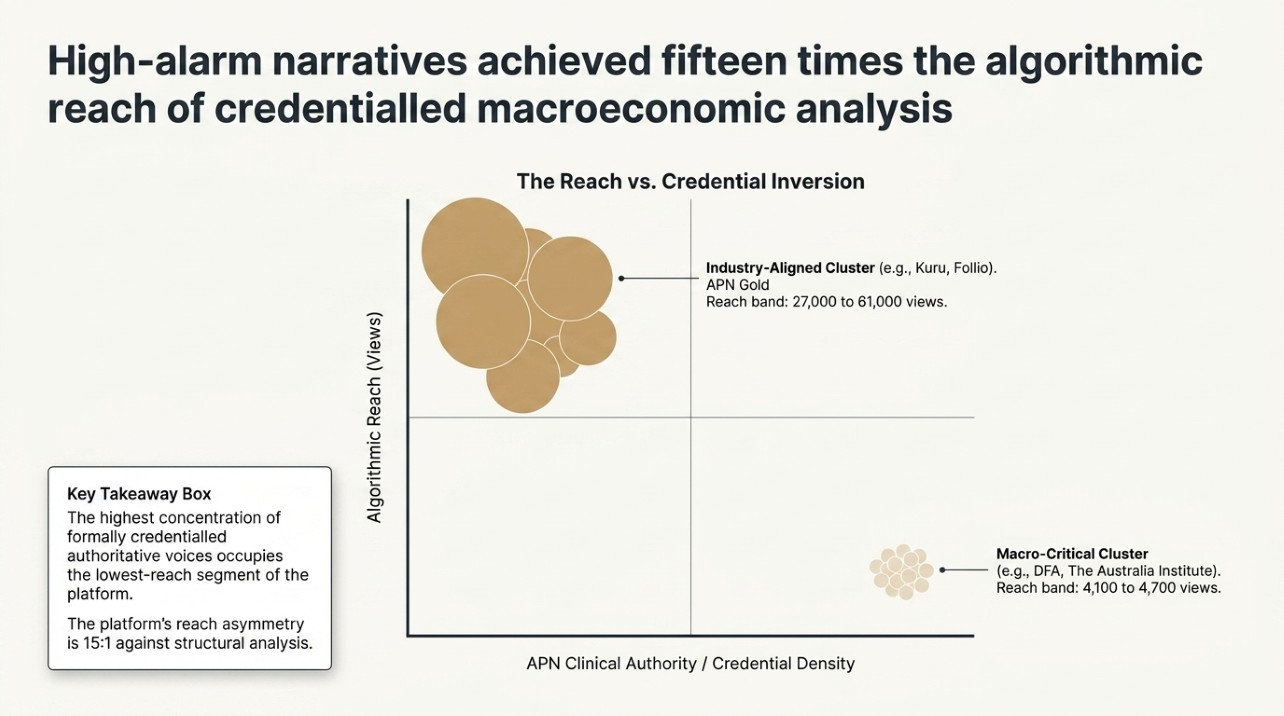
The reach asymmetry within Cat 15d is registered as an information-asymmetry finding. The macro-critical cluster’s per-budget-video reach band is 4,100 to 4,700 views (DFA combined ~4,100; The Australia Institute ~4,700). The industry-aligned cluster’s reach band is 27,000 to 61,000 views (Ravi Sharma 27,000; Aussie Explained 42,000; Scott Kuru 52,000; The Follio Property Podcast 61,000). The ratio is approximately 10:1 to 15:1 against the macro-critical analytical layer within the same platform during the same window.
An observation arising from the data warrants notation here: Burnout Economics, at approximately 29,000 views and classified within the macro-critical cluster, sits within the higher reach band notwithstanding its analytical positioning. The same is true of Aussie Explained at approximately 42,000 views. The data indicates that the reach asymmetry tracks register and framing — supply-scarcity, vacancy framing, structural alarm — rather than analytical position per se. The reach asymmetry is not a clean bimodal distribution; it tracks the framing axis rather than the cluster axis. For Node 21680, this is a structural feature of the platform requiring documentation in the baseline.
D4 — M3 as the significant podcast departure from the initial audit’s patterns
The initial audit classified M3 (Discretionary Trust Minimum Tax) as a critical Tier 2 omission in mainstream media. M3 was the largest single revenue-generating mechanism in the housing measure set (+$4,470.0m) and the retail-investor demographic most affected was largely unaware of it from mainstream coverage.
The specialist podcast ecosystem materially reverses this pattern. M3 is recorded in 18 entries in this dataset — 43% of the in-scope inventory — overwhelmingly from specialist accounting, SMSF, financial planning, and high-end property advisory shows. The Holistic Accountant (Wemyss) published the 11%-to-8.4% internal-rate-of-return modelling on Day +2. Investopoly addressed the 30% trust minimum tax and the corporate-beneficiary effective rate (up to approximately 60%) on Day +1. KPMG Tax Now, With Interest (CPA Australia), TaxVibe (The Tax Institute), and the SMSF Adviser Show each registered substantive M3 coverage. Box Advisory Group, Blue Chip SMSF, and Grant Abbott all surfaced the SMSF repositioning analysis around M3 on Day +2.
The structural explanation is audience demographics. The initial audit’s Tier 2 omission in mainstream media is driven by a general audience for whom the trust taxation provisions are mechanically inaccessible. The specialist podcast ecosystem’s audience — accountants, financial advisers, SMSF practitioners, and high-end retail investors — is precisely the cohort most exposed to M3. The trust taxation omission in mainstream media does not extend to the specialist practitioner audio ecosystem. This is the single most analytically significant divergence between the initial audit’s national baseline and this follow-up’s podcast-ecosystem findings.
For the 21680 baseline, this is a structural observation about the architecture of the Australian media environment: a policy provision can be a critical mainstream omission and simultaneously a centre of analytical activity within a specialist audio layer reaching the precise demographic most affected — without either layer operating in awareness of the other. This is a feature of the eighteen-category ecosystem map documented in Output A; the present finding is its first empirically documented instance for a specific policy measure.
Closing observation: the 35,000-homes counter-narrative propagation
The S8 temporal-drift analysis records that the initial audit’s “35,000 fewer homes” counter-narrative — identified in the national baseline as the dominant industry counter-narrative deployed by REIA, HIA, and MBA — was the first substantive analytical claim deployed in this podcast ecosystem, appearing within the first 24 hours across multiple shows. The data indicates that the national-baseline counter-narrative propagated into the specialist audio layer at the same temporal speed as it propagated into mainstream commercial coverage. This is a convergent finding between the initial audit and this follow-up: the dominant industry framing of M1 and M2 reached both the mass-audience and specialist-audience layers within the same 24-hour window, suggesting a structurally efficient industry-narrative transmission channel operating across category boundaries.
D5 — Day +8 to Day +10 maturation
The Day +8 to Day +10 segment of the analytical window evidences a structural maturation in the specialist audio and video discourse across both the industry-aligned and macro-critical clusters documented in D2 and D3. The maturation pattern is observable in the dataset and is registered here as a position evolution from the early-window architecture.
Within the industry-aligned cluster, The Property Couch Ep 598 (21 May 2026; Ben Kingsley and Bryce Holdaway with David Robertson, Chief Economist at Bendigo and Adelaide Bank, and Evan Lucas, Head of Strategy at InvestSMART and author of Mind over Money) introduces credentialled macroeconomic framing in place of the Day +2 arbitrage advisory mode documented in D2. Robertson contributes two named analytical interventions. The “Hammer vs Chisel” framing characterises macroeconomic tax reform as a blunt instrument applied to a precision market recalibration task. The “Magic 5-Year Myth” — the assumption that negatively geared properties uniformly transition to cashflow-positive within five years — is dismantled with reference to long-term price drivers anchored in supply deficits, infrastructure delivery, and migration settings. Robertson positions M1 and M2 as frictional rather than market-defining within this framing. Smart Property Investment’s 20 May episode with Natalia Clack (Founder, Easy Super) formally positions Self-Managed Superannuation Funds as the operative defensive structure against the new individual M1 and M2 settings, on the basis that complying super funds retain a 10% effective CGT rate (15% accumulation rate combined with the one-third CGT discount). The episode also maps the compliance and regulatory burden alongside the structural advantage, including intersections with the proposed Division 296 tax. Smart Property Investment’s 21 May follow-up addresses retail-investor paralysis, observes sophisticated and institutional capital positioning while retail capital is paused, and frames the budget cycle as accelerating a two-tier market structure. The cluster’s editorial output across this segment therefore extends the Day +2 SMSF capital-flight signal documented in D2 into a formal advisory codification, rather than maintaining the arbitrage advisory mode of the panic-to-pivot week.
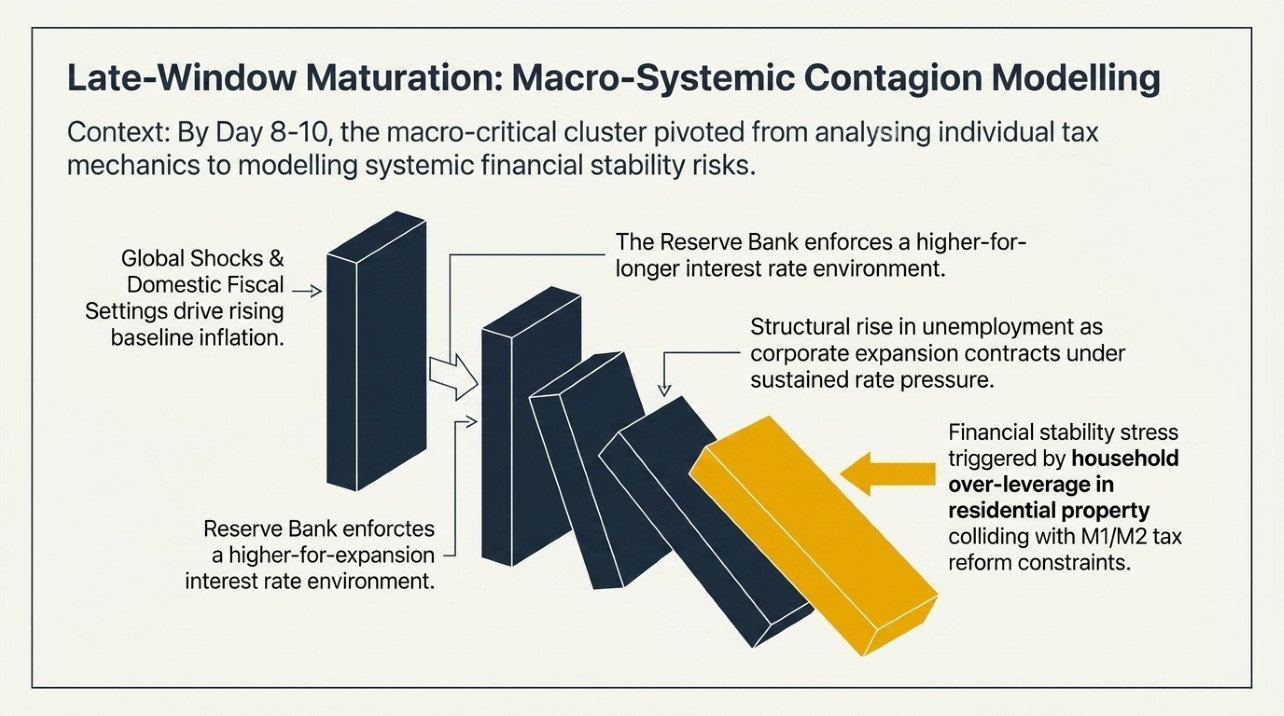
Within the macro-critical cluster, the DFA episode of 20 May 2026 (Martin North with Leith van Onselen) examines the thesis that the 30-year Australian housing super-cycle has reached its terminal phase. Van Onselen references ABS housing finance data: the value of new housing loan commitments fell 3.8% in the March quarter, with declines in both owner-occupier and investor segments, alongside weaker housing price growth and multi-year low auction clearance rates in Sydney and Melbourne. Van Onselen also observes that approximately 60% of apartments are renter-occupied compared with 20% of detached houses, making the interplay between population growth and high-density dwelling supply the principal rent-growth determinant. The DFA episode of 21 May introduces the “Four Dominos of Inflation” framework, elevating the cluster’s analytical layer from individual taxpayer impact to systemic financial stability modelling. The Australia Institute’s Dollars & Sense podcast of 21 May (Greg Jericho and Angus Blackman) integrates former Prime Minister Paul Keating’s intervention — characterising the Government’s CGT changes as “Structurally Sound” with reference to the 1999 Howard-era CGT framework — and contrasts the projected $3.6 billion in revenue over five years from the housing tax reforms with the modelled $17 billion annual revenue projection from a 25% gas export tax.
The closing structural inference is that the analytical layer of the specialist ecosystem migrated from policy-mechanism critique in the early window to macro-systemic framing in the late window, across both clusters. Within the industry-aligned cluster, the Day +8 to Day +10 segment displaces arbitrage advisory with credentialled macroeconomic framing and formal SMSF defensive-structure codification. Within the macro-critical cluster, the same segment displaces individual-taxpayer impact analysis with systemic financial-stability modelling. This combined maturation is the operative input to the corrective-response register documented in Output E: the late-window analytical environment in which the multi-source corrective response was lodged is structurally distinct from the early-window environment in which the misinformation campaign was first propagated.

Output E — Behavioural Signal Analysis · High Significance
This output synthesises this brief’s Stream 9 (the Behavioural Signal Layer Register) and the Stream 7 YouTube reach data documented in Output D. It identifies observable consumer and practitioner behavioural responses that correlate with or diverge from the editorial positions recorded across this inventory. The data indicates a structurally bifurcated behavioural response: sophisticated practitioner-led restructuring activity in the professional services layer; constrained capacity at the household-finance layer; and a community consensus on the AusFinance forum that the dominant retail-investor response will be inventory retention rather than disposal.
Macroprudential context
The behavioural signals registered within the 12–22 May 2026 window must be interpreted alongside two compounding macroprudential constraints operating simultaneously with the budget measures. The Reserve Bank of Australia executed a 25 basis-point cash-rate increase on 5 May 2026, lifting the cash rate to 4.35% — the third 2026 hike, cumulative tightening of 75 basis points since January. The Australian Prudential Regulation Authority’s 20% supervisory limit on high-DTI loans (loans at 6x debt-to-income or higher) has been operative from 1 February 2026. These are not budget measures, but the data indicates they materially alter the behavioural response to M1, M2, and M3 by reducing the available borrowing-capacity headroom against which any individual response is calibrated. The combined effect is a household borrowing-capacity reduction of approximately $54,000 from January to May 2026 (Cotality / Property Investment Professionals data). This is the operative environment within which the three named behavioural signals are observed.
Signal 1 — Professional services restructuring pivot
Named behavioural signal: the professional services restructuring pivot.
This is a convergent finding across two streams in this brief. The S8 temporal-drift analysis documents Day +2 as the peak analytical volume in this podcast ecosystem, with the SMSF capital flight narrative crystallising simultaneously across Grant Abbott, Blue Chip SMSF, Wealthlab, Box Advisory Group, and The Holistic Accountant. The S9 professional services signal — Clayton Utz and William Buck registering inquiry spikes on the same date — corroborates the same 48-hour pivot from independent measurement. Two streams measuring different populations register the same timed event. The SMSF capital-flight signal is therefore registered as a convergent finding across S8 (specialist audio publication peak) and S9 (independent professional services inquiry data) — a cross-stream confirmation that distinguishes the signal from a single-stream observation.
Signal 2 — The lock-in effect
Named behavioural signal: the lock-in effect.
The analytical implication is that the dominant community expectation diverges from the dominant industry-aligned podcast narrative. The industry-aligned Cat 15a–c shows in the panic-to-pivot week predicted, and then advised on, imminent retail-investor exit activity to be timed before 1 July 2027. The r/AusFinance community consensus is that the structurally dominant response will be inventory freeze rather than sell-off. These are mutually inconsistent observable predictions of the same retail-investor cohort’s behaviour. The 21620 reading in H2 2026 will operate as the empirical resolution between them.
A simultaneous observable warrants notation as a tension within the dataset itself: the Cotality / CoreLogic May 2026 data records median vendor discount expanding to -3.1%, indicating sellers adjusting expectations downward across combined capitals. The vendor-discount data and the lock-in community consensus are simultaneous observations pointing in different directions — both empirical, neither resolved within the analytical window. The data indicates that the retail-investor cohort’s behavioural response remains structurally undetermined at the close of this window.
Signal 3 — The platform activity bifurcation
Named behavioural signal: the platform activity bifurcation.
Within the constraint above, the data indicates a structural bifurcation between the largest capital-city markets (contracting) and the mid-sized capitals (surging). The structural inference, available within the macroprudential context section, is that the constrained borrowing-capacity environment is driving a capital flight to purchasing power: leveraged investor capital is moving from the high-price markets where the borrowing-capacity constraint is binding into markets where the same nominal capital reaches further. Whether this dynamic persists post-budget is an open question for subsequent observation windows; the data does not yet support a directional finding for the post-budget effect specifically.
The YouTube reach asymmetry
The Output D reach data — industry-aligned alarm-register videos at 51,000 to 61,000 views; macro-critical analytical-register videos at 4,100 to 4,700 views — is integrated here as the audience-reach asymmetry signal. The data indicates that the audience reach achieved by alarm-register content within the analytical window was approximately 10 to 15 times the reach achieved by structural-analytical content within the same platform. Aussie Explained, at approximately 42,000 views with a macro-critical classification and a supply-scarcity framing, sits between the two reach bands and indicates that the asymmetry tracks register and framing rather than analytical position per se. For Node 21620, this is the operative platform observation: the behavioural signals generated by the YouTube ecosystem within the analytical window were dominated, in reach terms, by alarm-register content followed by arbitrage advisory content, both originating in the industry-aligned cluster.

Information market failure — the Google Trends signal layer
The S9 behavioural signal layer was extended through a seven-set Google Trends analysis covering 35 search terms across a 22-year historical baseline (2004–2026) and a 12-month weekly resolution series. The data constitutes the most direct available measure of public information demand during the analytical window.
The headline signal is a 22-year historical anomaly. Australian search interest in “negative gearing” during the budget week of 12 May 2026 reached index 100 — the highest recorded level since Google Trends data begins in 2004. The prior maximum, index 22, was established in February 2016 during the Shorten Labor negative gearing policy announcement. The 2026 budget delivery produced a public search engagement event 4.5 times the prior 22-year maximum.
The information market failure finding rests on two layers of evidence. The first layer is a supply gap: the definitional search term “what is negative gearing” recorded a 33-times multiplier against its prior baseline, peaking at index 100 in the budget week. A public encountering a major policy announcement and turning to search engines to understand the basic mechanics of the measure at the centre of that announcement is a direct signal that the media ecosystem amplified the alarm without adequately supplying the explanatory information. The term “CGT indexation Australia” — the specific replacement mechanism for the 50% CGT discount — recorded a 28-times multiplier against its near-zero prior baseline, confirming that the mechanics of M2 were not adequately explained despite widespread coverage of M2’s existence. The term “negative gearing new properties only” — the new-build carve-out at the centre of M1 — remained at index 3, indicating the carve-out was not understood by or communicated to the searching public.
The second layer is active misinformation injection. A social media campaign using AI-generated content misrepresented the M2 capital gains tax changes as applying to small businesses that are in fact fully exempt under the carve-outs for businesses with turnover under $2 million or assets under $6 million. Its reach is confirmed in the Google Trends data: “small business capital gains tax” recorded a 5.9-times multiplier, and “CGT small business exemption” — a correction-seeking term — recorded an 11.8-times multiplier. Both terms peaked in the week after budget delivery rather than on budget night, confirming that the misinformation campaign was actively propagating into the second week of the window as the initial budget reaction was decaying. A Northern Territory geographic outlier is also confirmed in the state-level data: “negative gearing” search interest in the NT registered index 8 against index 100 for all other states and territories — a pattern consistent with the S3 M6 blackout finding.
The combined Google Trends data establishes that the information market failure documented here is not a characterisation but a measurable structural observation: the public demanded information that the media ecosystem did not adequately supply, and the resulting vacuum was partially filled by misinformation.
The corrective response register
The Google Trends signal layer documents the propagation of the misinformation campaign through to its first-week peak. The campaign vector is observable in the source material. The principal propagation vehicle was an open letter signed by “40 business owners under 40”, amplified through political opposition channels and aligned commentary outlets. Shadow Treasurer Tim Wilson became the principal political legitimiser of the campaign via a National Press Club address, deploying a specific case study — “Sienna”, a teenage founder of a skincare company — and claiming a 47% effective tax rate on eventual sale. The campaign’s mathematical structure rested on the assertion that a start-up’s near-zero initial cost base under the new indexation mechanism produces effectively zero tax relief, placing the full capital gain in the highest personal income tax bracket. Under the 23000 Series Curation Protocol, Wilson is recorded under the documentation register only — as the principal political legitimiser of the campaign vector — and is ineligible for authoritative attribution under the APN independence-signal criterion. The “Sienna” case study is documented as the campaign’s central illustrative device, not as authoritative analysis.
The corrective response register populated across the second week of the analytical window (20–22 May 2026), distributed across four institutional layers. Treasurer Jim Chalmers (20 and 21 May, public statements) characterised the campaign as misinformation and addressed the Wilson case study by identifying the omission of the small business CGT carve-outs — turnover under $2 million, assets under $6 million, the 50% active asset discount preserved — and restated that businesses below these thresholds remain fully eligible for the existing small business CGT concession suite. Prime Minister Anthony Albanese (21 May) characterised the campaign as a coordinated political effort. Dr Tamara Wilkinson (corporate tax academic, Monash University; 21 May) released empirical modelling indicating that the average effective tax rate on capital gains for affected entities shifts from 19.3% to 21.4% — an incremental upward adjustment — and contextualised the M2 changes against concurrent corporate offset measures, including permanent instant asset write-offs, expanded R&D incentives, and loss refundability provisions. Greg Jericho (The Guardian, 21 May) published an independent commentary column dismantling the “death tax” framing and the broader characterisation of the budget as harmful to entrepreneurial activity.
Within the same window, the Australia Institute’s Dollars & Sense podcast (21 May, Greg Jericho and Angus Blackman) integrated an intervention from former Prime Minister Paul Keating. Under the ministerial eligibility ruling, Keating is eligible for attribution as a former Prime Minister and former Treasurer drawing on ministerial expertise (former ministerial role disclosed). Keating’s statement — characterising the Government’s CGT changes as “Structurally Sound” with reference to the 1999 Howard-era CGT framework as the structural catalyst for the subsequent house-price expansion — is recorded observably and limited to that framing. The same episode also contrasted the projected $3.6 billion in revenue over five years from the housing tax reforms with the modelled $17 billion annual revenue projection from a 25% gas export tax.
Both the campaign and the corrective response are observable within the analytical window. The campaign’s principal propagation occurred in the first week, evidenced by the peak in misinformation-specific search terms in the week of 18 May documented in the preceding subsection. The corrective response concentrated in the second week (20–22 May), after the campaign’s first-week peak. The relative eventual reach of the corrective response against the campaign’s prior week of unrebutted propagation is a forward observation question for the H2 2026 Node 21680 reading. The data does not yet support a directional finding on whether the corrective response will close the information market failure documented in the Google Trends signal layer.
Macro-systemic contagion modelling
A closing observation arises from the late-window position of the macro-critical cluster documented in Output D3. The cluster’s editorial output across Day +8 to Day +10 evidences a structural pivot from policy-mechanism critique to macro-systemic contagion modelling. The Digital Finance Analytics (DFA) episode of 21 May 2026 introduces a “Four Dominos of Inflation” framework: first, rising inflation from global shocks and domestic fiscal settings; second, the RBA enforcing a higher-for-longer interest rate environment; third, a structural rise in unemployment as corporate expansion contracts; and fourth, financial stability stress driven by household over-leverage in residential property. The framework migrates the cluster’s analytical layer from the policy-mechanism focus of the early window to a systemic financial-stability framing.
Concurrently, The Property Couch Ep 598 (21 May; Ben Kingsley and Bryce Holdaway, with David Robertson, Chief Economist at Bendigo and Adelaide Bank, and Evan Lucas, Head of Strategy at InvestSMART and author of Mind over Money) and the DFA episode of 20 May (Martin North with Leith van Onselen) position dwelling supply, infrastructure delivery, and M21 Net Overseas Migration settings as the operative long-term price drivers, with M1 and M2 characterised as frictional rather than market-defining. Robertson introduces the “Hammer vs Chisel” framing — macroeconomic tax reform as a blunt instrument applied to a precision recalibration task — and dismantles the “Magic 5-Year Myth”, the assumption that negatively geared properties uniformly transition to cashflow-positive within five years. Van Onselen references ABS housing finance data: the value of new housing loan commitments fell 3.8% in the March quarter, with declines in both owner-occupier and investor segments, alongside weaker housing price growth and multi-year low auction clearance rates in Sydney and Melbourne.
For the H2 2026 Node 21620 (Market Psychology and Herd Behaviour) reading, the structural inference is that the late-window analytical layer of the macro-critical cluster migrated from policy-mechanism critique to systemic-risk modelling within this window. The cluster’s analytical centre at Day +10 is a financial-stability framework rather than an M1 / M2 policy-mechanism focus. This is registered as a position evolution within the macro-critical cluster — observable in the dataset, with implications for how the 21620 reading is calibrated against the cluster’s editorial output in the second half of 2026.
Composite reading for 21620 and 21640
The composite behavioural reading is structurally bifurcated. At the practitioner layer (Clayton Utz, William Buck, the SMSF-specialist podcast cluster), the data indicates a Day +1 / Day +2 restructuring pivot of operational significance. At the household-finance layer (broker channel, refinancing inquiries, rentvesting serviceability), the data indicates capacity-preservation activity within a binding macroprudential constraint. At the retail-investor cohort layer, the dominant community thesis diverges from the dominant industry-narrative prediction, with both observables present in the dataset and neither resolved within the window. The 21620 reading in H2 2026 will operate as the empirical resolution between these competing observable predictions. The 21640 reading is conditioned by the same bifurcation: practitioner-layer sentiment may register restructuring-driven activity even where household-layer sentiment is constrained by serviceability conditions.

Output F — Voice and Amplification Extension · Medium Significance
This output extends the initial audit’s voice and amplification audit to this podcast and YouTube ecosystem. The initial audit’s baseline established a 4:1 aggregate investor-to-renter voice ratio across the Australian media landscape (8:1 in News Corp print; 6:1 in property portals; approximately 1:1 in public broadcasters — the highest representational equity of any category in the initial audit). The specialist audio and video layers examined here cannot directly replicate the initial audit’s voice-ratio metric, because the ecosystems concerned are niche-selected audiences rather than general audience platforms.
The comparator instrument: editorial position distribution
The S1 methodology bridge confirms that for these podcast and YouTube ecosystems the operative comparator is editorial position distribution (Critical / Sceptical / Analytical-neutral / Supportive) rather than direct voice-ratio replication. The position distribution recorded across this inventory indicates a concentration of Critical and Sceptical positions in Cat 15a (property-focused podcasts), consistent with the investor-aligned audience composition of that sub-category; a concentration of Supportive positions in Cat 15c (general business and economics podcasts, particularly The Australia Institute network and the Schwartz Media 7am output) and in selected Cat 14 public broadcasting (4ZZZ, the SBS Punjabi and Filipino services); and an Analytical-neutral middle band concentrated in Cat 15b (finance and money podcasts) and parts of Cat 15c.
The structural inference is that the initial audit’s voice-ratio finding is preserved by audience-cohort logic in this specialist layer: outlets reaching an investor-aligned audience produced predominantly investor-aligned positions; outlets reaching a renter, equity, or first-home-buyer-aligned audience produced predominantly equity-aligned positions. The initial audit’s 4:1 aggregate ratio does not extend cleanly into this follow-up’s specialist layer because that layer is not aggregate. Within each sub-category, the directional asymmetry persists.
The 23000 Series candidate distribution
Twenty-four 23000 Series candidates are confirmed across this dataset under the S1 register (seventeen from the original S1 register; seven added by the Final Window pass on 22 May 2026). The distribution is structurally significant. The macro-critical YouTube cluster (Cat 15d) records the highest density of formally credentialled authoritative voices — Martin North (DFA), Leith van Onselen (MacroBusiness), Saul Eslake (independent economist), Matt Grudnoff and Greg Jericho (The Australia Institute). This cluster also records the lowest reach band within Cat 15d (4,100 to 4,700 views per budget video, documented in Output D). The data indicates that the highest concentration of formally credentialled authoritative voices in this dataset occupies the lowest-reach segment of the platform on which it operates. This is registered as an observation about this specialist ecosystem: credential and reach are inversely distributed within Cat 15d.
The remaining candidates distribute across several analytical layers. At the mainstream property podcast layer (Cat 15a), David Robertson (Chief Economist, Bendigo and Adelaide Bank) and Evan Lucas (Head of Strategy, InvestSMART; author, Mind over Money) are recorded via The Property Couch Ep 598, extending the credentialled-voice density into the mainstream property podcast layer for the first time in this dataset. At the specialist accounting and tax practitioner layer, Stuart Wemyss, Aaron Dunn, John Storey, Gavan Ord, Chris Richardson, and Damien Klassen are recorded; Natalia Clack (Founder, Easy Super, via Smart Property Investment) extends the SMSF and superannuation practitioner layer within this band. At the academic layer, Dr Ameeta Jain (via SBS Hindi) and Associate Professor Chris Martin (via 2SER) are joined by Dr Tamara Wilkinson (corporate tax academic, Monash University; via the Output E corrective response register, extending the Cat 15d misinformation register documented in that output). At the ministerial layer, Treasurer Jim Chalmers, Senator Katy Gallagher, and Minister Malarndirri McCarthy from the original S1 register are extended by the Hon Andrew Giles MP (Minister for Skills and Training; via the S3 2SER interview on operationalisation of M10 and M11) and the Hon Anthony Albanese MP (Prime Minister of Australia; via the Output E corrective response register) — political role disclosed in all cases under the ministerial eligibility ruling. At the historical-expertise layer, the Hon Paul Keating (former Prime Minister and former Treasurer; via the Australia Institute Dollars & Sense episode of 21 May) is recorded with former ministerial role disclosed, and the attributed statement is limited to the “Government CGT Changes — Structurally Sound” framing referencing the 1999 CGT framework. The peak-body layer is recorded via Mr McPhee (CEO, AMSANT). Sub-ministerial political figures (Katter, Waters) are recorded in the inventory but are ineligible for authoritative attribution under the APN independence-signal criterion. Shadow Treasurer Tim Wilson is recorded under the documentation register only — as the principal political legitimiser of the misinformation campaign vector documented in Output E — and is ineligible for authoritative attribution under the same criterion. Veronica Morgan and Helen Tarrant (Cat 15d entries) are excluded from authoritative attribution pending independent verification of their window-period episodes.
The superannuation sector — silence not replicated
The initial audit’s baseline identified the superannuation sector’s strategic silence on the institutional exemption from M1, M2, and M3 as one of the three most analytically significant strategic silences across the initial audit’s corpus. Industry Super Australia and the institutional advocacy bodies did not publicly engage the structural material advantage their members retained over retail capital under the new framework. The initial audit recorded this as a strategic communication choice in the institutional sector.
This specialist podcast ecosystem materially reverses this silence. Multiple SMSF-specialist and accounting-specialist shows — Grant Abbott, Blue Chip SMSF, Wealthlab, the SMSF Adviser Show (Aaron Dunn), and supporting analysis from Box Advisory Group and The Holistic Accountant — explicitly highlighted that superannuation taxation (15% accumulation; 10% with internal CGT discount) appears exempt from the new 30% minimum floors applied to personal CGT and family trusts under the budget framework. The structural inference is that the strategic silence observed in the initial audit’s institutional layer does not extend to this specialist practitioner layer: the practitioner ecosystem actively communicated the differential treatment to its specialist audience as a structural opportunity, in the form of SMSF repositioning advisory.
This is registered as a structural observation about this specialist ecosystem: the institutional silence on the superannuation exemption from M1, M2, and M3 was not preserved across the practitioner audio layer. The same exemption that the institutional sector did not publicly communicate is the operative basis for the SMSF capital-flight signal documented in Outputs D and E.
Composite reading
This specialist layer preserves the initial audit’s representational asymmetry through audience-cohort segmentation rather than through aggregate-level voice ratio. The 23000 Series candidate density is concentrated in the lowest-reach segment of Cat 15d, producing an inverse relationship between credential and reach within that category. The institutional-sector silence on the superannuation exemption documented in the initial audit was not replicated in this follow-up’s practitioner audio layer.
Output G — Omission Architecture Extension · High Significance
This output extends the initial audit’s omission inventory to this outlet category set, identifying which of the initial audit’s omission patterns persist across the extended temporal window and the new category groups, which are reversed, and which new omissions emerge. The Vector M Matrix is the structural foundation; the initial audit’s own Omission Architecture section is the comparator baseline.
Tier 1 universal omissions: three confirmed extending
The initial audit’s baseline identified four Tier 1 universal omissions — measures absent from substantive coverage across all six outlet classifications from the initial audit: M13 (A Better Deal for Renters), M14 (Help to Buy Status Update), M16 (Community and Active Transport Infrastructure), and M24 (Strengthening Financial Regulation Oversight).
The Vector M Matrix records that three of these four — M13, M16, and M24 — are absent from the entire podcast and YouTube inventory examined here. M13 appears in only two entries in this dataset, both in Cat 14 community broadcasting (4ZZZ Brisbane Line; ABC Far North contextual observation), with no substantive treatment in the Cat 15 audio and video ecosystem. M16 and M24 are confirmed entirely absent across the 78-entity inventory. M14 appears in one Cat 15a entry (The Real Estate Podcast / Equilibria Finance) at minimal coverage depth.
This is registered as a convergent finding between the initial audit and this follow-up. The initial audit’s four Tier 1 universal omissions — measures absent from the immediate-cycle mainstream coverage of twelve outlet categories — extend at substantially the same severity across this ten-day window and the six new sub-categories. The structural inference is that these measures are absent from the operative public discourse on the budget housing measures within the Australian media environment, not from a specific outlet category or coverage cycle. The temporal-window and category-set extensions carried out here do not surface latent coverage that the initial audit’s baseline missed; they confirm the initial audit’s finding under broader observational conditions.
Tier 2 sector omissions: M3 reversal documented in detail
The initial audit’s Tier 2 classification — measures substantively covered in some categories and absent in others — encompassed M3 (Discretionary Trust Minimum Tax), M5 (Youth Community Housing), M6 (First Nations Remote Housing), M8 (NCC modernisation), M9 (Environmental approvals acceleration), M12 (CRA boost), and M22 (FIRB streamlining).
M3 reversal — registered finding. The initial audit’s baseline classified M3 as a critical Tier 2 omission. M3 was structurally absent from property specialist media and minimally referenced by industry advocacy bodies, notwithstanding its position as the largest single revenue-generating mechanism in the housing measure set (+$4,470.0m). The data indicates the retail-investor demographic most affected by M3 remained largely unaware of it through the initial audit’s mainstream coverage cycle.
This podcast ecosystem materially reverses this pattern. M3 appears in 18 entries in this dataset — 43% of the in-scope inventory — overwhelmingly from specialist accounting (KPMG Tax Now, With Interest / CPA Australia, TaxVibe / The Tax Institute), SMSF practice (SMSF Adviser Show, Grant Abbott, Blue Chip SMSF, Wealthlab, Box Advisory Group), financial planning (The Holistic Accountant, Investopoly), and high-end property advisory (Pizza and Property, In Focus / The Adviser Podcast Network). The mainstream media Tier 2 omission of M3 does not extend to the specialist podcast ecosystem.
The structural inference is documented in detail in Output D Section D4: the trust taxation provisions reached the precise retail-investor demographic most affected by them through specialist audio and video channels, notwithstanding their absence from mass-market coverage. This is the single most analytically significant divergence between the initial audit’s baseline and this follow-up’s findings: a Tier 2 omission in mainstream media is simultaneously a centre of analytical activity within a specialist audio layer reaching the affected audience.
Other Tier 2 omissions — minimal coverage persists. M5 appears in one entry in this dataset (She’s On The Money). M6 coverage is documented in Output B (NIT) and Output C (M6 blackout finding); within Cat 15 audio and video, M6 appears in only one entry (KPMG Tax Now contextual reference). M8 appears in two entries (Smart Property Investment, The Good Builder). M9 is entirely absent from this inventory. M12 appears in two Cat 14 community broadcasting entries (4ZZZ, ABC Far North) and is absent from Cat 15. M22 appears in one entry (KPMG Tax Now). The initial audit’s Tier 2 omission pattern persists at substantially the same severity across this inventory for all Tier 2 measures other than M3.
The beneficiary omission pattern: structural persistence
The initial audit’s baseline identified the beneficiary omission pattern as a structural rather than incidental feature: measures primarily benefiting renters (M12, M13), social housing tenants (M5, M6), and lower-income graduates (M20) were consistently less covered by commercial outlets than measures affecting investors (M1, M2, M3).
This inventory confirms and extends this finding. Measures primarily benefiting renters, social housing tenants, and lower-income graduates collectively appear in four entries in this dataset, across the 78-entity inventory — approximately 5% coverage rate. All four entries are concentrated in Cat 13 regional digital (NIT, AMSANT) and Cat 14 public and community broadcasting (4ZZZ, ABC Far North). The measures most relevant to renter, social-housing, First Nations remote, and lower-income graduate cohorts were covered by the categories in this dataset least consumed by the investor demographic, and absent from the categories most consumed by investors.
This is registered as a structural persistence finding: the beneficiary omission pattern extends from the initial audit’s mainstream media observation (immediate 72-hour cycle) to this podcast ecosystem (ten-day analytical follow-up window), preserving its directional structure under both temporal extension and category-set extension. The initial audit’s finding that specialist property media defines “the housing market” as the private transactional property market — excluding interventions that do not generate transaction yield — is confirmed and extended: this specialist podcast and YouTube ecosystem makes the same definitional exclusion.
M21 — the macro-critical cluster’s distinctive contribution
M21 (Net Overseas Migration settings) appears in two entries in this dataset, both in the macro-critical YouTube cluster (DFA, MacroBusiness). The data indicates that the analytical frame connecting immigration settings to housing supply as a structural variable in the equity intent of M1 and M2 is concentrated in this single cluster and absent from the rest of this ecosystem. The initial audit’s baseline identified an analogous pattern in SBS coverage — the only outlet category in the initial audit to elevate M21 as a housing demand variable rather than a culture-war signal. The macro-critical YouTube cluster performs structurally the same analytical function within Cat 15d as SBS performs within Cat 5. Two different categories, two different audiences, the same M21 analytical frame.
Composite reading
The initial audit’s omission architecture extends substantially intact across this ten-day window and the six new sub-categories, with one significant reversal (M3 in the specialist podcast ecosystem) and one structural extension (the macro-critical YouTube cluster as the equivalent of SBS in the M21 analytical frame). The Tier 1 universal omissions are confirmed as universal across the eighteen-category combined ecosystem. The beneficiary omission pattern persists at the structural level.
Output H — Hypothesis Testing Register · High Significance
H1 — Regional commercial media produced materially less original budget housing content than metropolitan commercial media. SUPPORTED. S2 records the WA/SA blackspot, the commercial television void (WIN, Prime7, SCA), and the agricultural press disconnect.
H2 — Regional public broadcasting produced editorial positions on M1/M2 materially different from the mainstream metropolitan baseline. SUPPORTED. SBS multilingual services, 2SER (Chris Martin, UNSW), and 4ZZZ produced renter, migrant, and equity-framed coverage absent from Cat 1–9.
H3 — The podcast ecosystem’s editorial position distribution on M1/M2 is more concentrated in the Critical / Sceptical range than the initial audit’s national baseline. SUPPORTED for Cat 15a; PARTIALLY SUPPORTED for Cat 15b / 15c; INCONCLUSIVE for the Cat 15d macro-critical cluster, whose Supportive policy positioning sits opposite to the industry-aligned cluster within the same category.
H4 — The initial audit’s Tier 1 universal omissions (M13, M14, M16, M24) persist across the podcast and YouTube ecosystem. SUPPORTED. Three of four (M13, M16, M24) are absent from the entire inventory examined here; M14 appears in one entry.
H5 — M6 coverage was absent from the public broadcasting outlets most proximate to affected communities. SUPPORTED. The M6 blackout in NT and remote WA is registered as the primary finding of Output C.
H6 — Editorial position distribution diverges materially between the macro-critical YouTube cluster and the industry-aligned podcast cluster on M1/M2. SUPPORTED. Macro-critical cluster is Supportive on direction and Sceptical on sufficiency; industry-aligned cluster is Critical or Sceptical.
H7 — The 72-hour pivot from alarm to arbitrage advisory constitutes a media-driven behavioural accelerator for the grandfathering window. SUPPORTED. Day +2 timed event documented in Output D (D2) and corroborated by S9 professional services inquiry data on the same date.
H8 — M3 coverage in the specialist podcast ecosystem materially exceeds its Tier 2 classification in the initial audit. SUPPORTED. M3 appears in 18 entries in this dataset (43% of inventory) versus its Tier 2 mainstream-omission classification in the initial audit.
H9 — The SMSF capital flight signal represents a coordinated practitioner advisory response that emerged on Day +2. SUPPORTED. Simultaneous identification across five specialist channels within the same 24-hour window, corroborated by Clayton Utz and William Buck inquiry data as a convergent S8 / S9 finding.
H10 — The SBS multilingual ecosystem produced analytically distinct M7 framing not found in any other stream of this brief. SUPPORTED. SBS Mandarin is the only outlet across both the initial audit and this follow-up to contextualise M7 for the affected demographic.
H11 — Commercial radio talkback produced shorter-form but higher-reach coverage than the specialist podcast ecosystem. PARTIALLY SUPPORTED. The 2HD / SRN 47-station Eslake segment provides the highest broadcast reach in S2; format constraints prevented the 10-minute threshold being met at most other commercial radio outlets.
H12 — The agricultural press did not cover housing measures relevant to rural workforce supply (M10, M11). SUPPORTED. Registered as a named structural finding in Output A.
H13 — The initial audit’s amplification asymmetry persists in the podcast ecosystem. SUPPORTED directionally. Renter-focused measures (M12, M13) are near-absent from investor-oriented Cat 15a–b outlets; the 4:1 metric is not directly replicable but the directional asymmetry persists through audience-cohort logic (Output F).
H14 — The macro-critical YouTube cluster’s analytical reach is materially lower than the industry-aligned cluster’s reach. SUPPORTED. 4,100–4,700 views vs 27,000–61,000 views; approximately 10:1 to 15:1 disparity.
H15 — The combined dataset from the initial audit and this follow-up is sufficient to constitute a replicable two-window, eighteen-category baseline for Node 21680. SUPPORTED with stated limitations. The dataset is sufficient as the inaugural baseline; known limitations documented in Output I (single budget event, two observation windows, niche-selected Cat 15 audiences, partial S9 Google Trends execution, two unverified entries).
Output I — 21680 Baseline Extension Report · Elevated Systemic Significance
This output documents the formal contribution of this brief to the empirical baseline of Node 21680 (Media and Narrative Sentiment Index — activated 14 May 2026). It states the baseline status prior to this follow-up, the structural contributions this follow-up makes across outlet categories and temporal window, the combined baseline statement at the close of this synthesis, the known limitations of the combined observation, and the forward methodological conditions under which the 21680 baseline should be updated.
Baseline status prior to this follow-up
The initial audit (14 May 2026) established the inaugural empirical content for Node 21680. The initial audit’s baseline comprises twelve outlet categories, seven independent research streams, nine Tier 1 convergent findings, four Tier 1 universal omissions, the seven-frame political characterisation taxonomy, and the 25-measure factual baseline anchored to the initial audit’s own measurement instrument. The initial audit’s observation window is the immediate 72-hour post-budget cycle (12 to 14 May 2026, Day 0 to Day +2).
The initial audit’s methodology formally registered three known limitations of the inaugural baseline at the time of activation. First, smaller and regional outlets were under-represented relative to the metropolitan and national outlet categories. Second, the 72-hour window captured the immediate coverage cycle but not the slower analytical follow-up that develops in the second and subsequent weeks post-budget. Third, the initial audit’s methodology relied on publicly available coverage rather than direct masthead access; subscriber-gated content was incompletely captured. The audio and digital video specialist layers were entirely outside scope.
This follow-up’s contributions
This follow-up (closing 22 May 2026 with this synthesis) addresses each of the three known limitations of the initial audit’s baseline through six new stream outputs.
Outlet category extension. Stream 1 documents the architecture extension to six new sub-categories — Cat 13 regional print and commercial broadcast, Cat 14 regional public and community broadcasting, Cat 15a property podcasts, Cat 15b finance and money podcasts, Cat 15c independent general business podcasts, and Cat 15d the YouTube digital video ecosystem — taking the combined baseline to eighteen outlet categories.
Regional and community layer. Streams 2 and 3 (78-entity inventory contributions) map the regional print, commercial broadcast, public broadcasting, and community broadcasting ecosystem under-represented in the initial audit’s baseline. The named structural findings of Outputs A, B, and C — the WA/SA regional blackspot, the commercial television void, the agricultural press disconnect, and the M6 blackout in NT and remote WA at ELEVATED SYSTEMIC SIGNIFICANCE — extend the initial audit’s documentation into the regional and First Nations communications environment.
Specialist audio and video layer. Streams 4 through 7 map the podcast and YouTube specialist ecosystem entirely outside the initial audit’s scope. Output D documents the primary analytical findings of this layer: the ecosystem-architecture observation; the 72-hour panic-to-pivot in the industry-aligned cluster as a Day +2 timed event with implications for Node 21620; the reach asymmetry within the YouTube ecosystem (approximately 10:1 to 15:1 between alarm-register and structural-analytical content); the dual-platform structural pattern; and the M3 reversal — the single most analytically significant divergence between the initial audit’s mainstream baseline and this follow-up’s specialist-ecosystem findings.
Temporal-window extension. Stream 8 maps the editorial drift across the ten-day analytical follow-up window (Day +3 to Day +10), captured systematically for the first time in the Node 21680 observation series. The three-phase temporal pattern (immediate alarm and reaction; peak analytical volume and pivot at Day +2; strategic consolidation at Day +3) is documented as the operative temporal architecture of the specialist media response. The Final Window pass extends the pattern from a three-phase architecture to a four-phase architecture at the close of this window: immediate alarm and reaction (Day 0 to Day +1); peak analytical volume and pivot (Day +2); strategic consolidation (Day +3); and structural maturation (Day +4 to Day +10), in which credentialled macroeconomic framing displaces arbitrage advisory within the industry-aligned cluster, formal SMSF defensive structures are codified, and macro-systemic contagion modelling emerges within the macro-critical cluster.
Behavioural signal layer. Stream 9 contributes the behavioural signal register integrating professional services inquiry data, platform activity data, social media sentiment proxies, and the YouTube view-count reach data documented in Stream 7. The convergent S8 / S9 finding — the Day +2 SMSF capital-flight signal corroborated independently by Clayton Utz and William Buck — is the primary cross-stream confirmation in this corpus.
The combined dataset examined here comprises 78 in-scope entities across the nine master inventory tabs, set alongside the initial audit’s corpus of seventeen mainstream and digital outlets, three public broadcasters, eight property and financial specialist outlets, six industry and advocacy peak bodies, and the initial audit’s seven independent research streams.
The combined baseline statement
The merged corpus of the initial audit and this follow-up constitutes a two-brief, single-event, eighteen-category empirical observation for Node 21680. It is registered as a replicable inaugural observation: the methodological and empirical content of the combined dataset is sufficient to anchor the node’s structural architecture and to provide the comparator baseline against which subsequent 21680 observations will be calibrated.
The combined dataset’s evidential weight is concentrated in three convergent findings carried at Tier 1: first, the persistence of three of the initial audit’s four Tier 1 universal omissions across this outlet category set and temporal window (M13, M16, M24 confirmed absent across the extended observation); second, the beneficiary omission pattern’s structural persistence from mainstream media into the specialist audio and video ecosystem; and third, the M3 reversal — a specialist-layer departure from the mainstream omission pattern that establishes the principle that mainstream omissions identified in the initial audit need not extend to the specialist layer, and that the eighteen-category map’s analytical layers can diverge on specific measures.
Known limitations of the combined observation
The combined baseline carries five named limitations.
Single budget event. The combined corpus observes one budget delivery, the 2026–27 Federal Budget, with high salience due to the structural similarity to the 2019 policy proposal and the largest single revenue-generating mechanism in the housing measure set being introduced in M3. Subsequent observation windows are required to confirm the structural patterns documented in the combined baseline are not artefacts of this specific budget’s policy mix and political context.
Single observation window. The combined window is 12 to 22 May 2026 (Day 0 to Day +10). Coverage drift beyond Day +10 — the post-budget analytical follow-up extending into June and beyond — is not within the combined observation.
Specialist audience self-selection. The podcast and YouTube ecosystems examined here are niche-selected audiences and do not represent the general Australian public. The Output F voice and amplification extension uses editorial position distribution as the operative comparator because the initial audit’s voice ratio cannot be directly replicated in the niche-selected layer.
S9 Google Trends extension. The S9 behavioural signal layer was extended through a seven-set Google Trends analysis (35 terms, 22-year historical baseline, 12-month weekly resolution) subsequent to the preliminary synthesis. The extended S9 data is integrated into Output E and constitutes a verified supplement to the preliminary directional indicators. The Google Trends data does not cover the full 12–22 May daily resolution; weekly resolution data is the finest granularity available for the 12-month series.
Two unverified Cat 15d entries. Veronica Morgan (Good Deeds Property Buyers) and Helen Tarrant (UniKorn Commercial Property) appear in the S7 inventory as window-period activity, but specific episode titles, durations, and view counts are unconfirmed. These entries are documented and excluded from authoritative attribution in any output of this brief.
Forward methodological conditions for baseline update
The 21680 baseline should be updated under three methodological conditions.
Next significant policy event. Legislative introduction of M1 and M2 (anticipated in the 2026–27 parliamentary cycle), APRA serviceability revisions, or RBA cash-rate decisions of magnitude sufficient to trigger a comparable media cycle.
Next federal budget cycle. The 2027–28 Federal Budget delivery, at which the combined architecture from the initial audit and this follow-up should be reapplied as the comparator instrument.
Major property-market event. Any market event during the M1, M2, and M3 implementation phases (1 July 2027 for M1 and M2; 1 July 2028 for M3) triggering a media cycle comparable to the budget cycle in intensity and scope.
Until one of these conditions obtains, the combined corpus from the initial audit and this follow-up is the operative baseline for Node 21680. The reference schema for this baseline contribution is A-260522-C21680.
This research methodology comprised nine streams covering regional print and broadcast, regional public and community broadcasting, specialist audio and digital video ecosystems, temporal drift analysis, and a behavioural signal layer. The full methodology is documented in this Stream 1 Methodology Baseline held in the APN Codex Vault.
The 23000 Series Curation and Attribution Protocol v2.0 (May 2026) governs all attributed statements. Twenty-four confirmed 23000 Series candidates are documented in the S1 Methodology Baseline (seventeen from the original S1 register; seven added by the Final Window pass on 22 May 2026). The ministerial eligibility ruling (ratified during this follow-up’s research session, 21 May 2026) governs ministerial and former-ministerial attribution. The APN Clinical Authority Register applies throughout.
All nine stream documents, the master inventory spreadsheet, and governance instruments are held in the APN Codex Vault — Node 21680 — Media & Narrative Sentiment Index — 22 May 2026
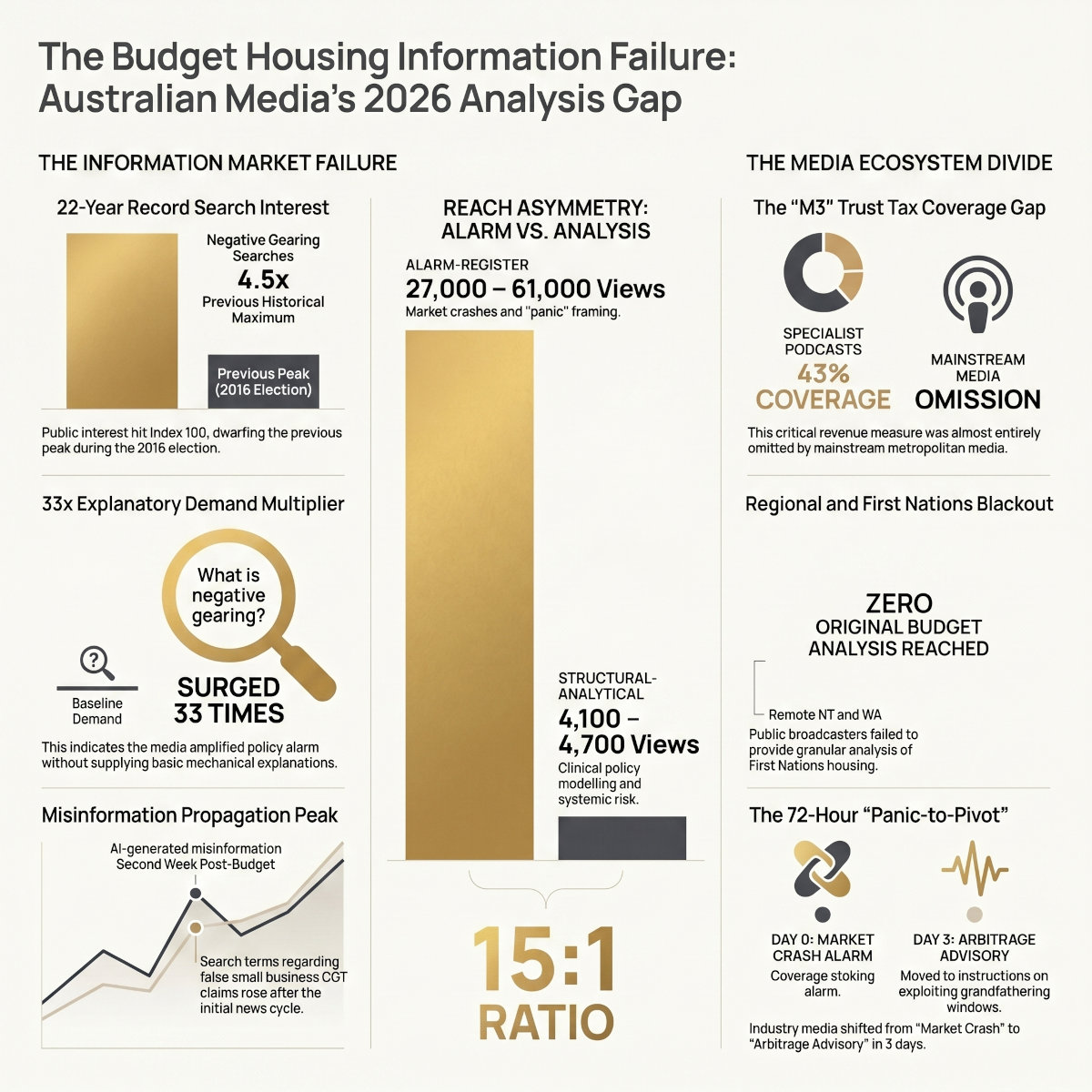
How to Cite This Brief
APN Research Brief | Published 22 May 2026 | Window: 12–22 May 2026
Primary node: 21680 — Media & Narrative Sentiment Index
Distillation reference: A-260522-C21680
Status: Certified
Disclaimer: Images are for illustrative & conceptual purposes.
