
Compound Demographic Pressures Constrain Australian Residential Asset Base
APN ANALYSIS: A-260329-AUS138691
This document is an APN Codex Distillation, a structured strategic synthesis derived from the full institutional research published under APN Codex Node 21400 Demographic Analysis (APN Aggregate Demographic Index™). The complete publication, including certified baseline calibration, subordinate node deconstructions, epoch analysis, and the full composite derivation under the ratified 30/30/25/15 weighting structure, is available at the APN Codex 21400 research page.
Executive Summary
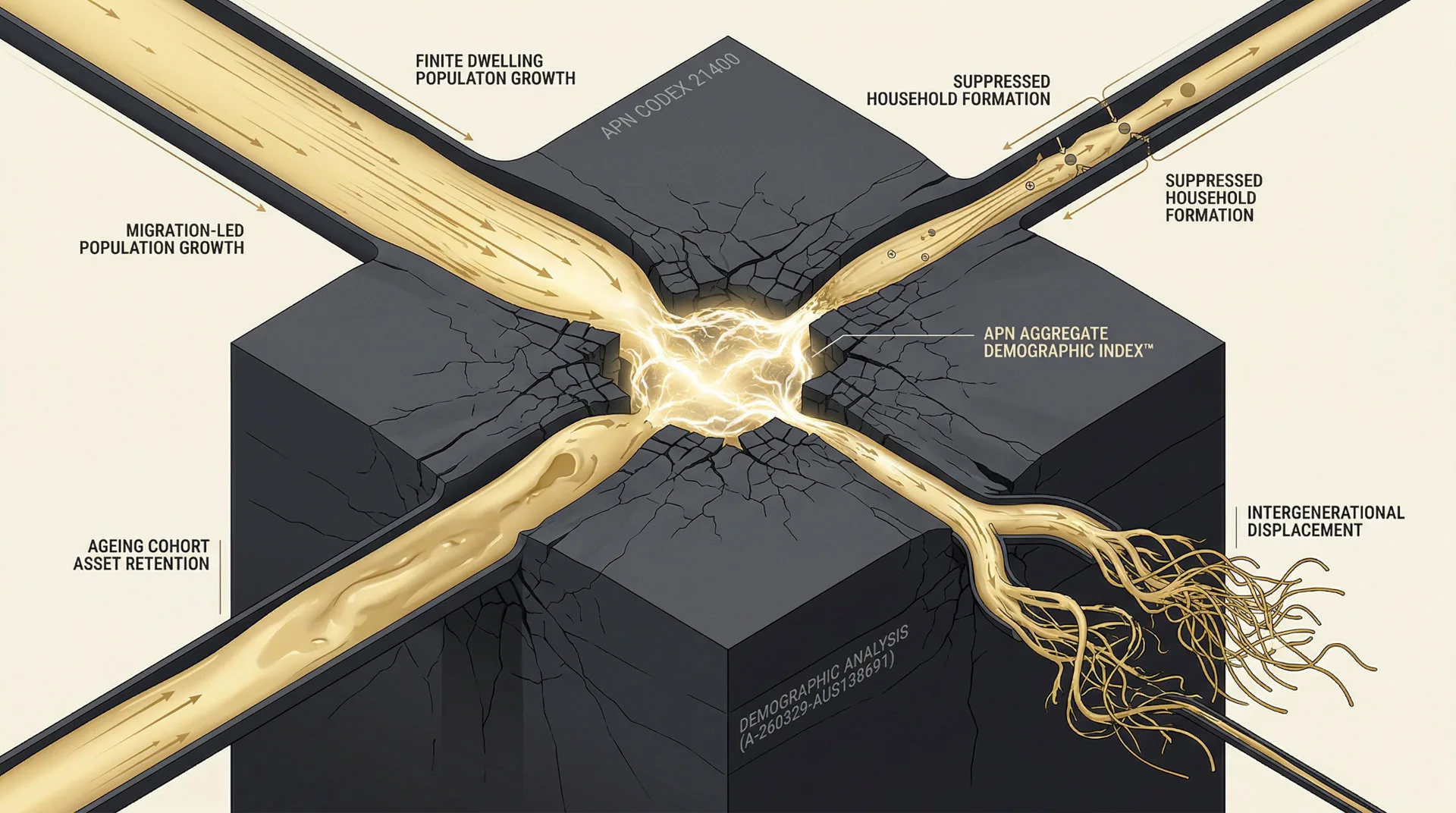
The APN Aggregate Demographic Index™ has registered a certified composite Z-Score of +1.4276σ for Q3 2025, confirming a state of sustained, compound structural pressure on the Australian residential asset base. This condition is not driven by a single factor, but by the simultaneous operation of four distinct demographic mechanics: elevated, migration-led population growth; structural asset retention by a capital-rich, ageing cohort largely insulated from monetary policy; physically and financially suppressed household formation among younger cohorts; and the resulting intergenerational displacement for a finite pool of dwellings. This confirms that the primary drivers of housing valuation and accessibility are now structural and demographic, rather than cyclical and credit-driven.
For property professionals, this analysis validates that demand-side pressures are structurally entrenched, supporting valuation resilience for established assets. The key implication is that market access for non-incumbent cohorts is mathematically constrained, a condition that increases the probability of sovereign regulatory intervention aimed at addressing supply and affordability imbalances. The primary forward risk is therefore not market-led price correction, but adverse policy shifts targeting asset owners and developers.
Background & Strategic Context
This analysis validates and calibrates APN’s core macro-thesis regarding the increasing primacy of sovereign policy over conventional market cycles. The data confirms that key segments of the demographic substrate now operate outside the effective range of monetary policy, compelling a governmental pivot towards regulatory and fiscal levers to manage market outcomes. The APN Aggregate Demographic Index™ provides the empirical evidence for why the APN Sovereign Policy Composite Index™ (SPCI) (24800) is now a critical tool for forecasting long-term asset trajectories.
A composite diagnostic (APN Aggregate Demographic Index™ (21400)): The index moves beyond simplistic population growth metrics by synthesising four distinct demographic mechanisms into a single, weighted composite score. This provides a holistic and structurally accurate measurement of the compound pressures operating on the residential asset base, revealing dynamics that are invisible when its components are viewed in isolation.
A structural anchor (Ageing Population & Housing Needs (21420)): This subordinate node measures the material impact of capital retention by the over-65 cohort. With a high rate of outright home ownership, this demographic is largely insulated from interest rate friction, forming a structural constraint on the availability of secondary market supply that monetary policy cannot easily influence.
A measure of latent demand (Household Formation Trends (21430)): The node’s near-mean terminal reading does not indicate market equilibrium. Instead, it quantifies a capacity constraint, where physical supply shortages and affordability limits are structurally preventing new households from forming. This represents a significant reservoir of latent demand, the release of which poses a kinetic risk to market stability.
Composite Index Deconstruction
This deconstruction is based on APN’s structural synthesis of the APN Aggregate Demographic Index™ (21400) at its Q3 2025 terminal point. The key facts are:
- Composite Index Reading: The APN Aggregate Demographic Index™ (21400) recorded a certified composite Z-Score of +1.4276σ, indicating elevated systemic pressure relative to its 15-year historical baseline.
- Population Growth Composition: Annual population growth of 423,600 individuals was predominantly driven by Net Overseas Migration (311,000), while the domestic natural increase sub-component is in structural contraction, registering a Z-Score of −2.0031σ.
- Asset Retention by Senior Cohorts: The Ageing Population & Housing Needs (21420) node registered +1.4666σ. RBA data confirms 61% of Australians over 60 own their homes outright, insulating this cohort from monetary policy friction and constraining secondary market supply.
- Suppressed Household Formation: The Household Formation Trends (21430) node’s near-mean reading of +0.2093σ reflects a capacity-constrained market where potential new households are structurally unable to form, rather than a lack of underlying demand.
- Intergenerational Displacement: The APN Demographic Displacement Ratio (DDR), a key metric within the Demographic Trend Analysis (21440) node, reached a Z-Score of +1.6790σ, confirming the expanding proportional claim of the over-65 cohort on the total dwelling stock.
Critical Analysis & Balanced View
The most significant second-order insight from the composite index is the identification of capacity-constrained suppression in household formation. The terminal Z-Score of +0.2093σ for the Household Formation Trends (21430) node, if viewed in isolation, would suggest a market operating at its historical average. However, the composite analysis reveals this to be a reading of structural suppression, not balanced demand. It reflects a physical and financial ceiling being hit, where latent demand from younger cohorts is unable to translate into new households. This latent demand represents a material forward risk; any easing of supply or credit constraints could trigger a rapid formation surge, as witnessed between 2021 and 2023, placing immediate and intense pressure on available inventory.
Furthermore, the analysis confirms a structural bifurcation of the market that materially reduces the effectiveness of monetary policy as a primary regulatory tool. The RBA cash rate directly impacts the borrowing capacity of younger, credit-dependent cohorts, effectively controlling their rate of household formation. Simultaneously, it has a negligible impact on the 61% of unencumbered homeowners over 60 who control a significant portion of established housing stock. This dynamic, where the central bank’s main lever only influences one side of the market, forces a pivot towards sovereign regulatory and fiscal intervention. The structural conditions identified in the index create the political and economic necessity for governments to use tools like zoning reform, land tax adjustments, and rental market regulation to address imbalances that monetary policy can no longer resolve alone.
Strategic Implications for Property Professionals
- For Developers: The bifurcated demand profile—suppressed first-home buyers and capital-rich downsizers—structurally favours premium, lower-density projects targeting the latter cohort. Feasibility for affordable, high-volume supply remains constrained, increasing project reliance on government partnerships, land releases, or direct subsidies to achieve commercial viability.
- For Investors & Asset Managers: Established residential assets in well-located metropolitan areas are likely to demonstrate continued valuation resilience, supported by entrenched structural demand and constrained supply. The primary forward risk is not market-driven price correction but adverse sovereign policy intervention (e.g., tax changes, tenancy regulation) designed to rebalance the market.
- For Valuers & Lenders: Standard cyclical models may underestimate the structural price floor in the current market. Risk assessment must increasingly factor in the insulating effect of unencumbered ownership by senior cohorts and the high probability of regulatory shifts altering market dynamics more significantly than interest rate changes.
- For Policy Analysts & Planners: The data confirms that addressing housing supply requires policies that incentivise the efficient use and release of underutilised existing stock, not just the creation of new dwellings. Pension asset test reforms and land tax frameworks are likely to be more effective structural levers than monetary policy alone.
APN Index Management
The APN Codex 24000 Series is a proprietary set of indices that translates complex market forces into measurable metrics. This section outlines how the preceding analysis validates and informs the calibration of these frameworks.
Validation: The composite conditions confirmed by this analysis, elevated population intake colliding simultaneously with suppressed household formation capability and structural asset retention, validate the current calibration of the APN Regulatory Velocity Multiplier™ (APN RVM™) (24210) as a leading indicator of sovereign regulatory intervention in the housing market.
Index Calibration: The developer pivot toward premium typologies, confirmed by the bifurcated demand composition identified in this analysis, is consistent with the current calibration of the APN Residual Land Value Gap™ (24410) and the APN Replacement Cost Gap™ (24450). The recursive feedback loop between capital-rich downsizer demand and affordable supply viability is structurally reflected in both indices.
Analytical Implication: The confirmed reduction in monetary policy transmission effectiveness, arising from the structural insulation of a dominant portion of the demographic substrate from cash rate friction, is consistent with the increasing analytical weight assigned to state-level regulatory and fiscal interventions within the APN Sovereign Policy Composite Index™ (SPCI) (24800).
Disclaimer
The analysis and information contained in this deconstruction are for general informational and strategic purposes only and do not constitute financial, investment, legal, or any other form of professional advice. The Australian Property Network (APN) is a strategic intelligence organisation and is not a licensed financial advisor.
This analysis is based on data and information from third-party sources believed to be reliable; however, APN provides no warranty as to its accuracy, currency, or completeness. Images used in this analysis are for illustrative and conceptual purposes only and may not represent real persons, properties, or events.
All frameworks (Codex 24100-24800) are proprietary to APN.
Property values and market conditions can go up or down. Before making any property or investment decisions, you must conduct your own thorough research and seek independent professional advice tailored to your specific circumstances.