

The ‘400% Spike’ Conflation: How a Regulatory Structural Adjustment and Student Inflow Created a Two-Tier Rental Market
APN ANALYSIS: A-260122-AUS135021
Executive Summary
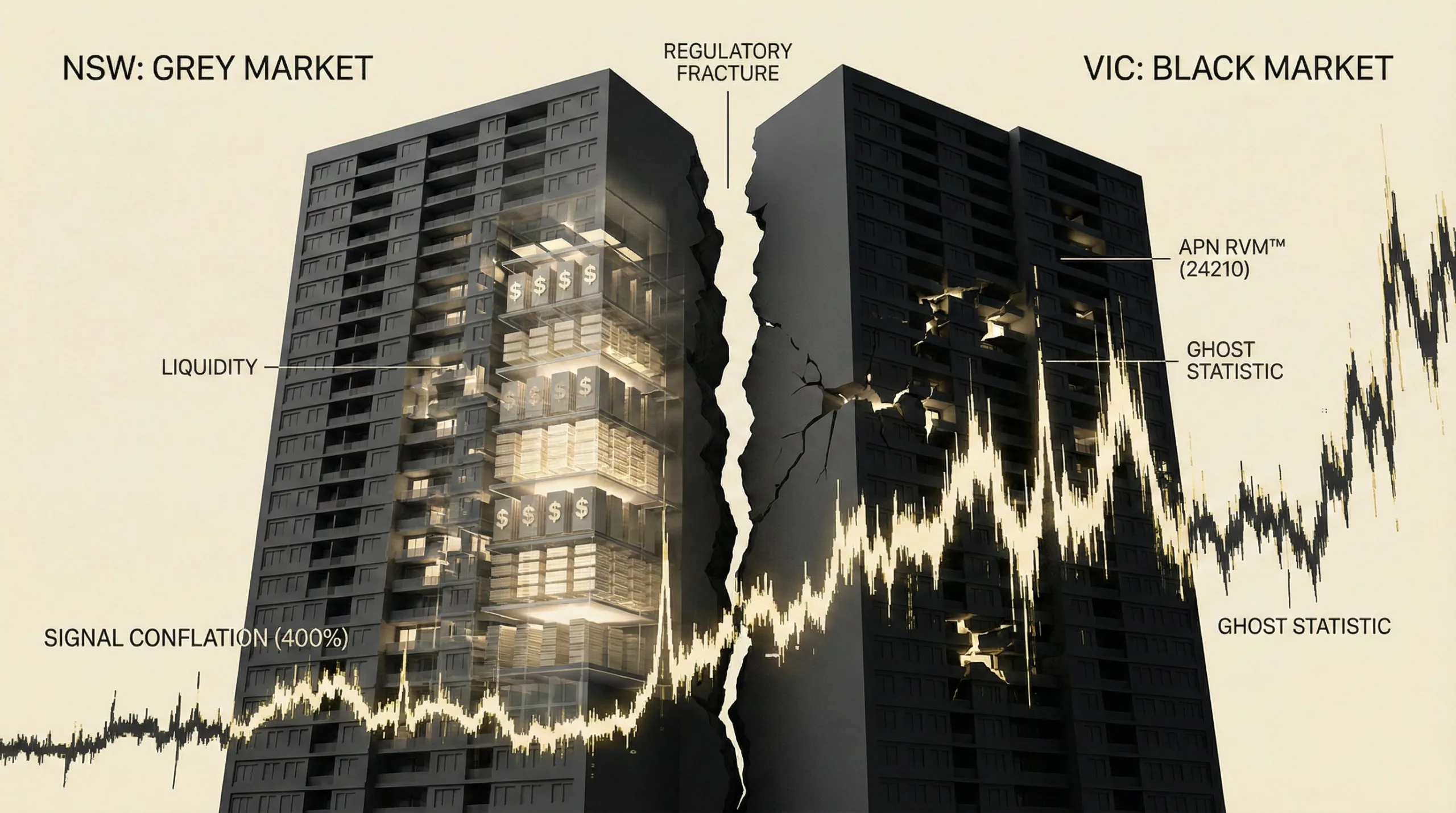
A reported 400% increase in rental “shadow bidding” is not a verifiable statistic but a “Signal Intelligence Conflation” of unrelated investor data, reports of tenant hardship, and widespread scam activity. This misinterpretation obscures the underlying structural condition: a structural adjustment in the Australian rental market, driven by divergent state laws in New South Wales and Victoria, which has created a two-tier system. NSW now operates as a legal, liquidity-driven “grey auction,” where tenants with capital can legally offer large sums of rent upfront. In contrast, Victoria’s comprehensive prohibition on all forms of bidding has resulted in the practice moving into an illicit “black market,” defined by off-book cash deals and fraudulent invoices.
For property professionals, this bifurcation creates distinct operational risks and opportunities. In NSW, success is now explicitly tied to attracting tenants with high liquidity, transforming tenant selection into a balance sheet assessment. In Victoria, agents and landlords face significant compliance risks and the potential for criminal liability, forcing a reliance on “off-book” mechanisms that undermine transparency and professional standards. Understanding this “State Split” is now an elevated requirement for valuation, risk management, and client advisory across Australia’s two largest markets.
Background & Strategic Context
This event validates and calibrates APN’s core macro-theses, demonstrating how top-down state intervention directly re-engineers market behaviour and creates stratified economic outcomes. The phenomenon is not an anomaly but a predictable consequence of policy divergence in a high-pressure environment.
The Primacy of State Intervention (APN SPCI, 24800): The divergent legislative paths of NSW (partial prohibition) and Victoria (comprehensive prohibition) provide a case study of how state-level decisions create entirely different market structures, risk profiles, and transactional mechanisms, superseding national market trends.
The Stratification of Access: The rise of the “Pre-Paid” rental model, particularly in NSW, segregates the market into those who rely on income (wages) and those who can leverage liquidity (assets). This mechanism disproportionately favours international arrivals with access to capital and structurally disadvantages local wage-earners, creating a differential in housing access.
Quantifying Regulatory Divergence (APN Regulatory Velocity Multiplier™ – APN RVM™): The “State Split” is not just a policy difference but a measurable divergence in regulatory enforcement. Victoria’s comprehensive prohibition represents a high RVM, aiming to induce a rapid systemic adjustment, whereas NSW’s framework represents a low RVM, prioritising market autonomy and creating a permissive environment for liquidity-based competition.
Deconstruction of the Source Event
This deconstruction is based on an internal APN intelligence briefing synthesising forensic data analysis, legal review, and socio-economic profiling. The key facts are:
- The ‘400% Increase’ is Unverified: Comprehensive analysis found no primary source from any official body (Tenants’ Union, REIA) confirming a 400% YoY rise in rent bidding based on empirical bond data. The figure is an unverified statistic.
- Signal Conflation is the Likely Source: The 400% figure is a likely conflation of three separate data points: a documented 400% increase in investors holding six or more negatively geared properties; a 300-400% accelerated growth in reports of tenant hardship; and a material increase in rental scam reports.
- A Regulatory Structural Adjustment Exists: As of late 2025, Victoria has legislated as a criminal offence the acceptance of unsolicited higher bids and rent in advance (above one month), creating a “black market.” In contrast, NSW law permits the acceptance of unsolicited bids and unlimited rent in advance, creating a “grey market” auction.
- Liquidity is the Driving Force: The market is being reconfigured by the inflow of ~295,000 international students in 2026, many of whom leverage significant upfront capital (required for their visa) to circumvent the need for local credit history, creating a “Pre-Paid” rental model.
Critical Analysis & Balanced View
The Australian rental market is exhibiting a paradox of transparency. Official data from NSW, for example, reports “99% compliance” in eliminating solicited bidding on public listing portals. This “Clean Skin” data creates a superficial appearance of regulatory success, yet it does not account for the “Dark Data” of off-platform negotiations. The market has bifurcated: lower-value and outer-suburban properties are seeing an increase in “underbidding” as affordability ceilings are hit, while high-demand precincts near universities and CBDs are experiencing intense, undeclared competitive bidding.
This environment has created a high-risk synergy between legitimate market pressures related to acute affordability constraint and fraudulent activity. The normalisation of large upfront cash payments—the “Cash Option”—provides effective camouflage for rental scammers. A request for 12 months’ rent in advance, which would once be a clear indicator of risk, is now perceived by tenants facing acute affordability constraints as a plausible, albeit materially constraining, requirement to secure a property. Consequently, a significant portion of the capital reported as “shadow bids” is not entering the rental market at all; it is being diverted to criminal syndicates, leaving tenants with neither capital nor tenancy.
Strategic Implications for Property Professionals
- For Agents & Property Managers: In NSW, tenant assessment must now include a “liquidity check,” prioritising applications with verifiable upfront funds. In VIC, elevated caution is required; agents must implement rigorous internal compliance to avoid criminal liability and be aware of landlords attempting “off-book” deals.
- For Investors: The regulatory environment is now a primary factor in asset allocation. NSW offers a legal pathway to maximise yield through upfront payments, favouring high-demand precincts near universities. VIC assets carry higher compliance risk and potentially suppressed official yields, with returns dependent on navigating a higher-risk “black market.”
- For Developers (PBSA): The spillover from saturated Purpose-Built Student Accommodation (PBSA) into the private market validates the business case for new PBSA developments. The government’s policy linking university caps to housing provision creates a direct incentive and potential for fast-tracked approvals.
- For Buyers’ Agents: Client advisory must now include a “rental strategy” component. For investor clients, this means analysing the regulatory arbitrage between states. For owner-occupier clients in high-demand zones, it means understanding they are competing not just with other buyers, but with a rental market that can offer landlords guaranteed, low-risk income.
APN Index Management
The APN Codex 24000 Series is a proprietary set of indices that translates complex market forces into measurable metrics. This section outlines how the preceding analysis is validated against, and informs the calibration of, these frameworks.
- Validation: This analysis validates the core tenets of the APN Sovereign Policy Composite Index™ (SPCI, 24800), demonstrating state intervention as the primary market-shaping force. It also provides validation for the thesis that the market is segregating based on liquidity versus income.
- Index Calibration: The APN Sentinel™ (24120) is recalibrated to differentiate between tenant hardship signals related to affordability and those related to fraudulent activity (scams), improving the accuracy of sentiment readings. The APN RVM™ (24210) for VIC is elevated to reflect the shift from civil to criminal penalties, while the NSW RVM remains moderate, reflecting a focus on solicitation over transaction.
- Data Capture: This analysis triggers a new data capture mandate for the APN Symbiotic Intelligence Network™ (24310) to track the prevalence of “rent in advance” offers in major metropolitan markets and to monitor anecdotal reports of “off-book” service invoices or cash payments, particularly in Melbourne.
Disclaimer
The analysis and information contained in this deconstruction are for general informational and strategic purposes only and do not constitute financial, investment, legal, or any other form of professional advice. The Australian Property Network (APN) is a strategic intelligence organisation and is not a licensed financial advisor.
This analysis is based on data and information from third-party sources believed to be reliable; however, APN provides no warranty as to its accuracy, currency, or completeness. Images used in this analysis are for illustrative and conceptual purposes only and may not represent real persons, properties, or events.
All frameworks (Codex 24100-24800) are proprietary to APN.
Property values and market conditions can go up or down. Before making any property or investment decisions, you must conduct your own thorough research and seek independent professional advice tailored to your specific circumstances.


