
The ‘Friend-Shoring’ Boom: Deconstructing the US-Australia Critical Minerals Industrial Revolution
APN ANALYSIS: A-251021-AUS01
Executive Summary
A strategic partnership between Australia and the US to secure a “friend-shored” supply chain for critical minerals represents a tectonic shift in Australia’s industrial strategy. This is not a simple trade deal; it is a geostrategically-funded mandate to move Australia from a “dig and ship” supplier to a “process and manufacture” partner in high-value materials like lithium hydroxide and separated rare earth oxides.
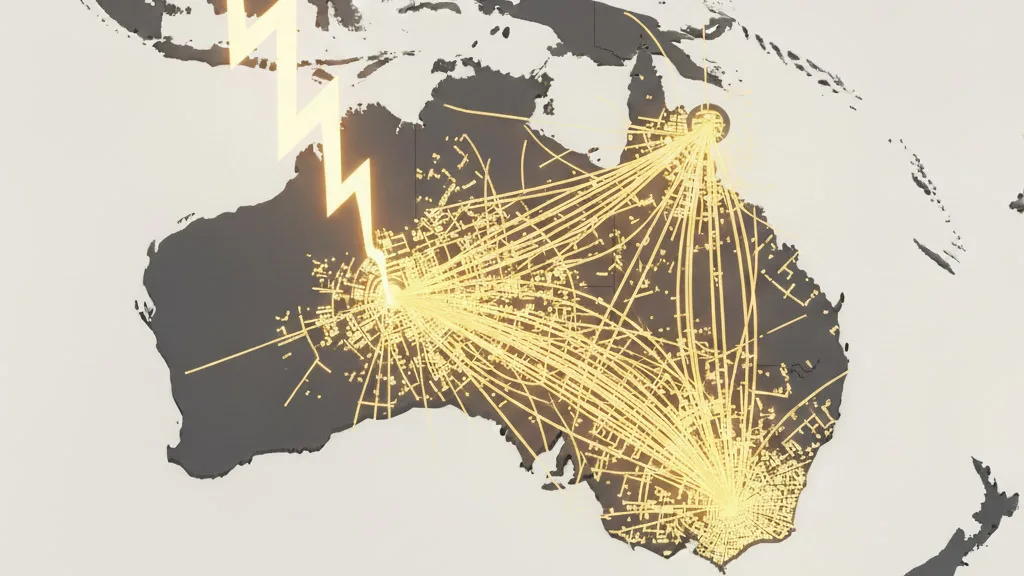
This agreement will underwrite a multi-decade industrial and property development boom, effectively creating new, specialised industrial cities in the north and west of Australia. The strategic implication is a clear directive for the property sector to pivot. The most urgent, high-value play is the strategic acquisition of industrial and residential-zoned land in the newly designated growth corridors, primarily the Kwinana-Bunbury corridor (WA) and the Darwin Middle Arm Peninsula (NT).
Background & Strategic Context
This strategic alignment is a nation-building event, and its impact on the property market is best deconstructed through our core intelligence frameworks.
A Geopolitical Directive (Project Overlord): This partnership is a textbook example of state-level intervention creating a market from scratch. This is not a market-led cycle; it is a geopolitical directive. The US, acting as a state-level partner, is using its policy (e.g., the Inflation Reduction Act) to underwrite and fund the creation of an entirely new industrial base in Australia. The goal is to de-risk its high-tech and defence supply chains, confirming the Project Overlord thesis that state power is the primary force in shaping new economic frontiers.
A New Development Frontier (APN Future Development Pipeline Index™): This report provides the exact geographic coordinates for the next multi-decade development boom. The Kwinana-Bunbury and Darwin Middle Arm corridors are now the primary, long-term drivers of land value in Australia. This validates the APN Future Development Pipeline Index’s™ core principle: that large-scale, state-backed infrastructure (in this case, processing plants and port upgrades) is the catalyst that unlocks and accelerates entire pipelines of industrial, residential, and commercial supply.
Deconstruction of the Source Event
The internal APN intelligence report provides the following verifiable strategic analysis:
-
Core Agreement: A US-Australia partnership to create a “friend-shored” high-tech and defence supply chain.
-
Strategic Goal: To elevate Australia’s “export complexity,” moving the economy from exporting raw ores to processing and manufacturing high-value materials.
-
Key Commitments:
-
Onshore Lithium Hydroxide Refining
-
Rare Earth Element (REE) Separation
-
-
Geopolitical Driver: The US need to de-risk its supply chains from Chinese dominance, using the Inflation Reduction Act (IRA) as a key funding and incentive mechanism.
-
Designated Development Corridors:
-
Kwinana-Bunbury corridor (WA)
-
Port Hedland industrial zone (WA)
-
Middle Arm Sustainable Development Precinct (Darwin, NT)
-
-
Opportunity Timeline (Phased):
-
Near-Term (0-2 yrs): Strategic land banking (industrial/residential) and approvals consultancy.
-
Medium-Term (2-5 yrs): A construction boom for industrial plants, port/rail infrastructure, and first-wave residential estates.
-
Long-Term (5+ yrs): Mature ecosystems, co-located advanced manufacturing (e.g., battery cathode production), and asset management.
-
Critical Analysis & Balanced View
The source data confirms a new, multi-decade secular growth story for the property sector. The critical insights lie in the scale and permanence of this shift.
The “Real” Story: This is Nation-Building, Not a Resources Boom. The most critical insight is that this is a “nation-building initiative masquerading as a trade deal.” This is not a cyclical commodity boom like iron ore; it is a permanent, geostrategically-funded industrial revolution. The agreement’s focus on processing and manufacturing requires a far larger, more skilled, and more permanent workforce and infrastructure footprint than a simple “dig and ship” operation.
Strategic Insight: A New, Primary Driver of Land Value. The report identifies a new, fundamental driver of property value for the next generation. “Proximity to critical mineral processing is now a primary, long-term driver of land value.” This is a fundamental re-rating of the Australian property landscape, moving the focus of long-term growth from the cyclical east-coast residential markets to these new, designated industrial and technology corridors.
Challenged Assumption: “Australia is Just a Quarry.” This assumption is now defunct. The agreement’s entire purpose is to use US capital and technology to move Australia “up the value chain.” This “elevating export complexity” is the core of the deal, meaning the high-value processing (e.g., lithium hydroxide) and separation (e.g., REEs) will now be done on-shore, creating a sticky, high-tech industrial base that will not leave.The report outlines a clear, high-conviction opportunity. The primary risk is not if this development wave will occur, it is underwritten by the US government, but timing. The 0-2 year “Land & Approvals Rush” phase is the critical window. Investors and developers who act decisively to secure strategic landholdings before the US capital is fully deployed and the plant construction is announced will be the ones who capture the majority of the value uplift.
Strategic Implications for Property Professionals
-
For Developers: The primary, long-term opportunity has pivoted from east-coast infill to large-scale industrial and residential greenfield development in the Kwinana-Bunbury and Darwin Middle Arm corridors.
-
For Investors & Land Bankers: This report is a clear directive. The “most urgent, high-value play” is the immediate acquisition of industrial-zoned land (or land suitable for rezoning) and large residential-zoned parcels on the fringes of these new, designated hubs.
-
For Valuers & Lenders: A new valuation metric has been introduced. Land in these corridors must be re-rated to reflect its new, long-term strategic value. Proximity to “critical mineral processing” is now a key, justifiable factor in feasibility and valuation models.
-
For Infrastructure Funds: This is the signal for a multi-decade pipeline of major contracts for upgrading port capacity, new rail links from mines, and new high-voltage energy transmission lines required to service the processing plants.
Disclaimer
The analysis and information contained in this deconstruction are for general informational and strategic purposes only and do not constitute financial, investment, legal, or any other form of professional advice. The Australian Property Network (APN) is a strategic intelligence organisation and is not a licensed financial advisor.
This analysis is based on data and information from third-party sources believed to be reliable; however, APN provides no warranty as to its accuracy, currency, or completeness. Images used in this analysis are for illustrative and conceptual purposes only and may not represent real persons, properties, or events.
Property values and market conditions can go down as well as up.
Before making any property or investment decisions, you must conduct your own thorough research and seek independent professional advice tailored to your specific circumstances.