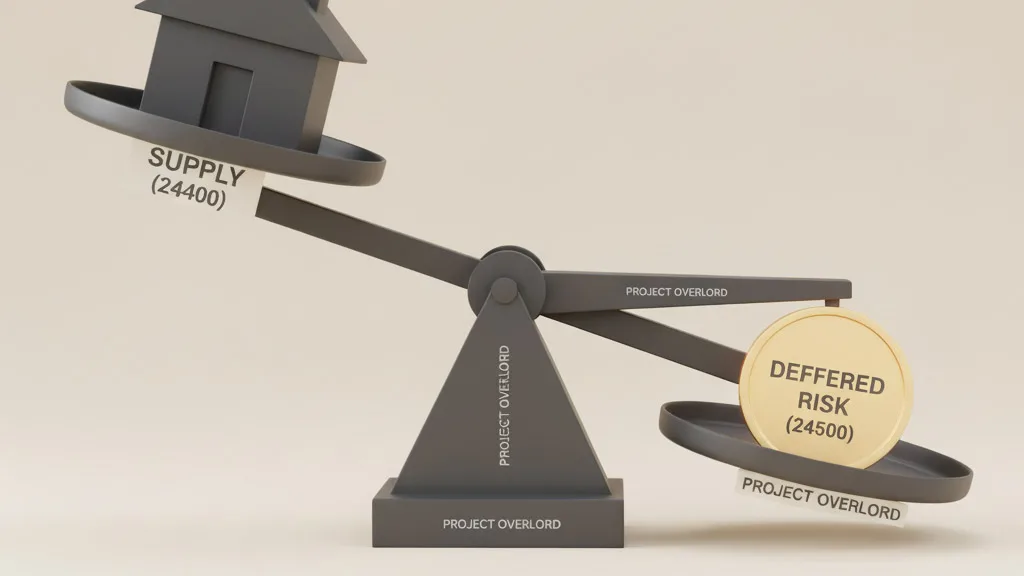

ASSA 5000: The Regulatory Forcing Function Turning Climate Risk into Auditable Financial Liability
APN ANALYSIS: A-251114-AUS012
Executive Summary
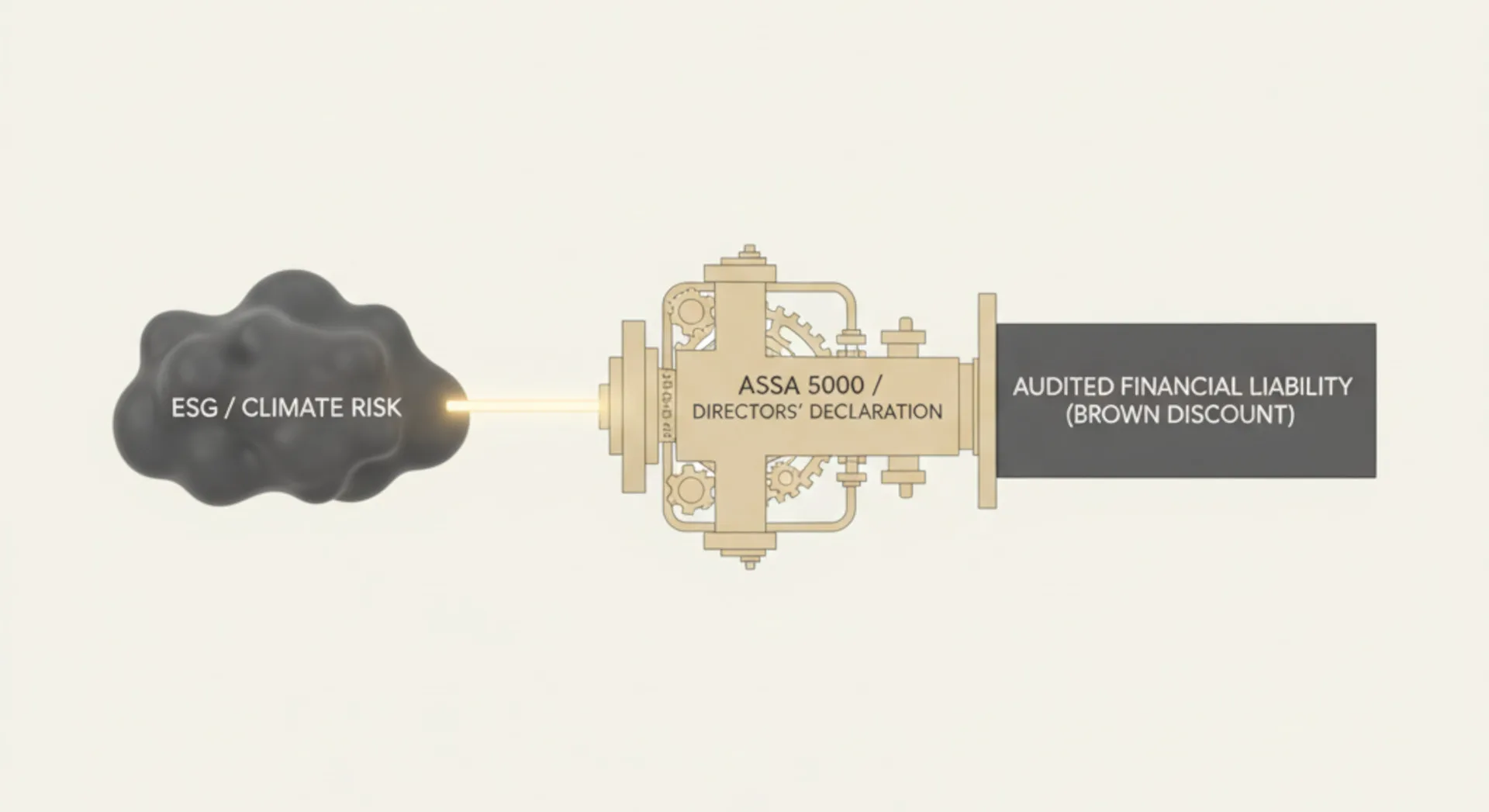
The new assurance standard, ASSA 5000, is the legally-binding enforcement mechanism for Australia’s mandatory climate reporting regime, which began on January 1, 2025. Our analysis confirms that this standard functions as a powerful APN Regulatory Velocity Multiplier™ (24210), shifting climate risk from a voluntary ESG consideration to a core, auditable corporate liability. It achieves this by forcing a “directors’ declaration,” making boards personally and legally liable for climate data.
For property professionals, this is the “forcing function” that accelerates the “Brown Discount.” From January 1, climate risk moved from a theoretical concept to a quantified, audited, and director-level financial liability published in corporate filings. This will force an immediate uplift in governance and, in the near future, will create a “Value Chain Rupture” as large firms begin demanding auditable-quality data from their entire private supply chain (tenants, suppliers, and construction firms).
Background & Strategic Context
This analysis identifies the specific, legally-binding instrument that operationalises climate risk as a financial liability, validating and accelerating our core climate and risk frameworks.
- The Enforcement Engine (APN RVM™): ASSA 5000 is a textbook APN Regulatory Velocity Multiplier™ (24210) event. It is not just another standard; it is the enforcement engine for the entire mandatory reporting regime. By arriving “early” (two years ahead of the global standard) and binding climate data to the Corporations Act, it provides the legal teeth for ASIC to enforce compliance.
- Making Liability Personal (APN Financial Climate Sensitivity™): The standard’s “fulcrum” is the new “directors’ declaration.” This is the mechanism that operationalises APN Financial Climate Sensitivity™ (24510). It elevates climate data to the same legal status as the financial balance sheet, making directors personally accountable for its accuracy and forcing an immediate, structural uplift in governance and verification.
- Forcing the ‘Brown Discount’ (APN Brown Discount™): ASSA 5000 is the “forcing function” that quantifies and accelerates the APN Regional Green Premium Uplift / Brown Discount™ (24520). By mandating that this risk be audited and published, it moves the “Brown Discount” from a theoretical, long-term market risk to an immediate, quantified, and comparable financial liability on the balance sheet, demanded by investors.
Deconstruction of the Source Event
This deconstruction is based on an internal APN intelligence briefing. The key facts are:
- The Instrument: Standard ASSA 5000 is a formal “legislative instrument” under the Corporations Act 2001.
- The Timeline: It is operative for reporting periods “beginning on or after 1 January 2025,” an “early adoption” that accelerates the global standard by nearly two years. “Group 1” entities must begin mandatory reporting from this date.
- The Liability Fulcrum: The regime legally requires the new “sustainability report” to be accompanied by a “directors’ declaration.”
- The Phased Approach: Year 1 assurance (under ASSA 5010) is “limited assurance” (a “review”) covering only “Scope 1 and 2 Emissions” and “Governance.” It explicitly excludes mandatory assurance for Scope 3, Scenario Analysis, and Transition Plans in the first year.
- The “Mirage” Safe Harbour: A 3-year “limited immunity” on forward-looking statements does not apply to actions brought by the regulator (ASIC) or criminal actions, giving the regulator full, immediate enforcement power.
Critical Analysis & Balanced View
The “real story” is that ASSA 5000 is the “forcing function” that makes climate risk an unavoidable, C-suite liability. The most critical mechanism is the “directors’ declaration,” which makes the board personally and legally accountable for climate disclosures, effectively ending the era of climate-as-PR.
The “crawl-walk-run” phased approach (starting with limited assurance on Scope 1 & 2 only) is a deliberate regulatory design. It embeds the compliance framework and legal liability immediately while giving the market time to build capacity for the more complex and impactful disclosures (like Scope 3) to come. The “safe harbour” is a “mirage” for regulatory risk; it provides no protection from ASIC, which has been given full power to enforce compliance from day one.
The most significant long-term impact is the future “Value Chain Rupture.” The locked-in requirement to eventually assure Scope 3 emissions will force “Group 1” companies (large property firms, investors, major tenants) to demand auditable, investment-grade climate data from their entire private market value chain. This will cascade mandatory reporting down to tenants, suppliers, and construction firms, whether they are legislatively covered or not.
Strategic Implications for Property Professionals
- For Boards & Directors: As of January 1, 2025, you are personally and legally liable for your firm’s climate disclosures. This forces an immediate and structural “uplift in governance and verification practices” to manage this new, auditable financial risk.
- For Valuers & Investors: The “Brown Discount” is about to accelerate. It is moving from a theoretical risk to a quantified, audited, and comparable figure in mandatory corporate filings. This will provide a clear, data-driven basis for asset repricing.
- For All Group 1 Entities: You must begin immediate preparations for the “Value Chain Rupture.” This means engaging with your private supply chain (tenants, suppliers) to build their capacity for providing the auditable data you will soon be legally required to report for Scope 3.
APN Index Management
The APN Codex 24000 Series is a proprietary set of indices that translates complex market forces into measurable metrics. This section outlines how the preceding analysis is validated against, and informs the calibration of, these frameworks.
- Validation: This analysis provides high-confidence validation that ASSA 5000 is the APN Regulatory Velocity Multiplier™ (24210) event for climate. It is the specific, legally-binding instrument that converts climate risk from an ESG concept into an auditable, director-level liability.
- Index Calibration (24510): The APN Financial Climate Sensitivity™ (24510) metric is now fully operationalised. Its value is no longer theoretical; it is the quantified, audited, and director-certified liability published in a firm’s “sustainability report” as of Jan 1, 2025.
- Index Calibration (24520): The APN Brown Discount™ (24520) metric is now calibrated to track the acceleration of repricing. We can now use these new, comparable, audited disclosures as a direct data feed to quantify the discount.
- Data Capture (24310): The APN Symbiotic Intelligence Network™ (24310) is tasked to begin tracking the future “Value Chain Rupture,” specifically monitoring Group 1 entity requirements for Scope 3 data from their private property supply chains (tenants/construction firms) as a lead indicator for new, hidden compliance costs.
Disclaimer
The analysis and information contained in this deconstruction are for general informational and strategic purposes only and do not constitute financial, investment, legal, or any other form of professional advice. The Australian Property Network (APN) is a strategic intelligence organisation and is not a licensed financial advisor.
This analysis is based on data and information from third-party sources believed to be reliable; however, APN provides no warranty as to its accuracy, currency, or completeness. Images used in this analysis are for illustrative and conceptual purposes only and may not represent real persons, properties, or events.
All frameworks (Codex 24100-24500) are proprietary to APN.
Property values and market conditions can go up or down. Before making any property or investment decisions, you must conduct your own thorough research and seek independent professional advice tailored to your specific circumstances.