
Regulatory Certainty Paradox: NCC Pause Defers Climate Liability and Accelerates Asset Devaluation
APN ANALYSIS: A-251023-AUS33
Executive Summary
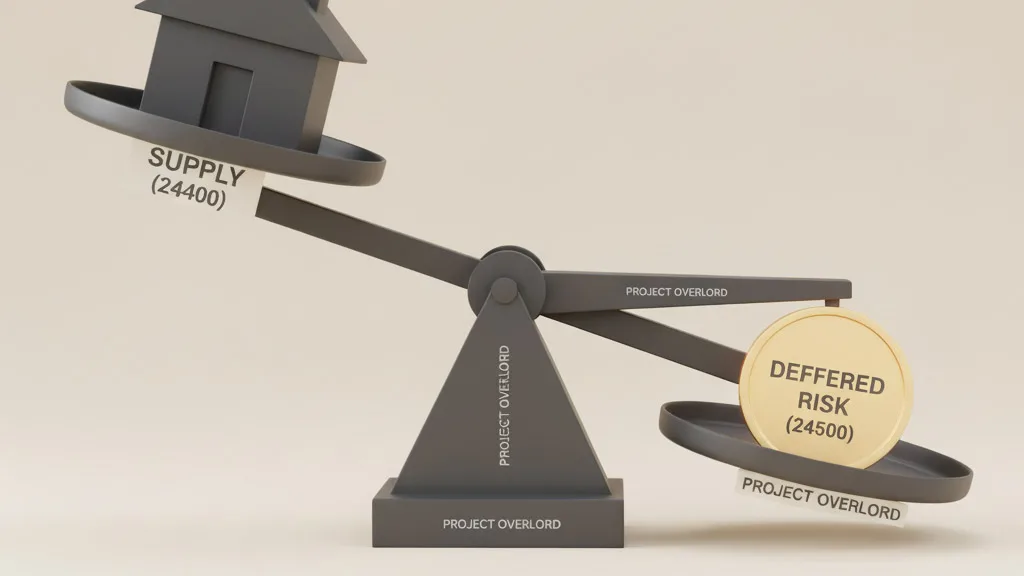
The Commonwealth’s 3.5-year pause on non-essential residential code changes to the National Construction Code (NCC) is a major Project Overlord intervention that creates a profound strategic paradox. While the pause provides short-term regulatory certainty to boost the housing supply pipeline (APN Future Development Pipeline Index™ (24400)), it does so by structurally locking in climate vulnerability for all new assets built until mid-2029.
This decision to defer critical adaptation measures, such as 8-star NatHERS, EV readiness, and mould mitigation, is an explicit trade-off. It transfers a massive, deferred financial liability onto future owners, guarantees functional obsolescence for the 2026-2029 housing cohort, and accelerates the negative trajectory of the APN Climate-Risk Asset Devaluation Index™ (24500).
Background & Strategic Context
This state-level intervention represents a fundamental conflict in national housing policy, and its strategic implications are best understood through our core intelligence frameworks:
State-Led Intervention (Project Overlord): This is a direct intervention where the state is manipulating regulatory velocity as a primary tool of economic policy. The pause is a deliberate, top-down decision to de-prioritise long-term asset resilience in favour of the immediate political and economic objective of housing supply.
Supply vs. Devaluation (24400 vs. 24500): This policy creates a direct structural conflict between two of our core proprietary indices. The pause provides tactical relief for the APN Future Development Pipeline Index™ (24400) by reducing immediate compliance costs for developers. However, it does so by magnifying the risk captured in the APN Climate-Risk Asset Devaluation Index™ (24500), as new assets will be built to a lower standard, ensuring higher long-term operational costs and accelerated obsolescence.
Deconstruction of the Source Event
This deconstruction is based on an internal APN intelligence briefing. The key facts are:
The NCC pause was formalised on October 22, 2025, by the Building Ministers’ Meeting, providing regulatory certainty until mid-2029.
The intervention was explicitly designed to boost housing supply by halting the accumulation of new compliance costs.
The pause defers critical climate adaptation measures, including any move beyond the 7-star NatHERS rating, mandatory residential EV readiness, and enhanced mould mitigation.
Projections indicate potential losses in Australian property values from deferred climate adaptation could reach $770 billion by 2090.
The immediate cost avoidance for developers is a direct transfer of liability that will manifest as inflated capital costs for future retrofitting or losses from structural degradation.
Deferred EV charging readiness alone will convert capital avoidance into future owner costs up to three times higher than home charging.
Critical Analysis & Balanced View
The “real” story here is the “Regulatory Certainty Paradox”. The short-term certainty achieved by the pause comes at the expense of a guaranteed, massive “Code Backlog” that will create an acute regulatory shock and RLV Gap spike when all deferred reforms are introduced post-2029.
Embedded Functional Obsolescence: The policy structurally embeds functional obsolescence into the 2026-2029 housing cohort. A new 7-star home built in 2028 will be immediately and demonstrably inferior to the higher standards anticipated post-2029, impacting its long-term valuation.
Aggressive Political Discount Rate: This decision is driven by an aggressive political discount rate, which systematically de-prioritises the immense, long-term financial benefits of climate resilience in favour of transient, immediate cost relief.
Physical Risk Multiplier: By deferring measures like mould prevention and waterproofing upgrades, the intervention introduces a measurable physical risk multiplier, degrading the long-term value, habitability, and insurability of new assets.
Balanced View: On the surface, this is a pragmatic supply-side intervention. However, the analysis reveals it to be a high-risk gamble that uses new housing stock as a sacrificial asset to solve a short-term political problem. By locking in climate vulnerability, the pause ensures that the 2026-2029 cohort of homes will be functionally obsolete upon completion, creating a new class of “lemon” assets and accelerating the negative trajectory of the APN Climate-Risk Asset Devaluation Index™ (24500).
Strategic Implications for Property Professionals
For Developers & Builders: The 3.5-year pause must be used to prepare for the inevitable 2029 “Code Backlog” shock. This requires immediate, strategic investment in technical training for 8-star equivalent construction methods to prevent severe industry friction when the mandates are introduced.
For Government & Policy: The pause in mandatory standards must be offset by the immediate introduction of voluntary standards and incentives (e.g., green finance, density bonuses). This is critical to mitigate the risk of building a vast portfolio of highly vulnerable, low-resilience assets.
For Investors & Valuers: Mandatory disclosure of building energy ratings at the point of sale or lease must be expedited. This is now the only mechanism to force the market to correctly price in the embedded risk differential between a 7-star asset and a superior, more resilient one.
For Future NCC Development: Future code development must be required to integrate climate risk by conducting lifecycle costing over a full 50-year asset period. This is essential to prevent the systematic discounting of long-term operational and resilience benefits that led to this policy failure.
Disclaimer
The analysis and information contained in this analysis are for general informational and strategic purposes only and do not constitute financial, investment, legal, or any other form of professional advice. The Australian Property Network (APN) is a strategic intelligence organisation and is not a licensed financial advisor.
This analysis is based on internal APN intelligence, data, and information believed to be reliable; however, APN provides no warranty as to its accuracy, currency, or completeness. Images used in this analysis are for illustrative and conceptual purposes only and may not represent real persons, properties, or events.
Property values and market conditions can go down as well as up.
Before making any property or investment decisions, you must conduct your own thorough research and seek independent professional advice tailored to your specific circumstances.