
The Stability Dilemma: Deconstructing the WA Coal U-turn and its Impact on Property Investment
APN ANALYSIS: A-250923-AUS45
Executive Summary
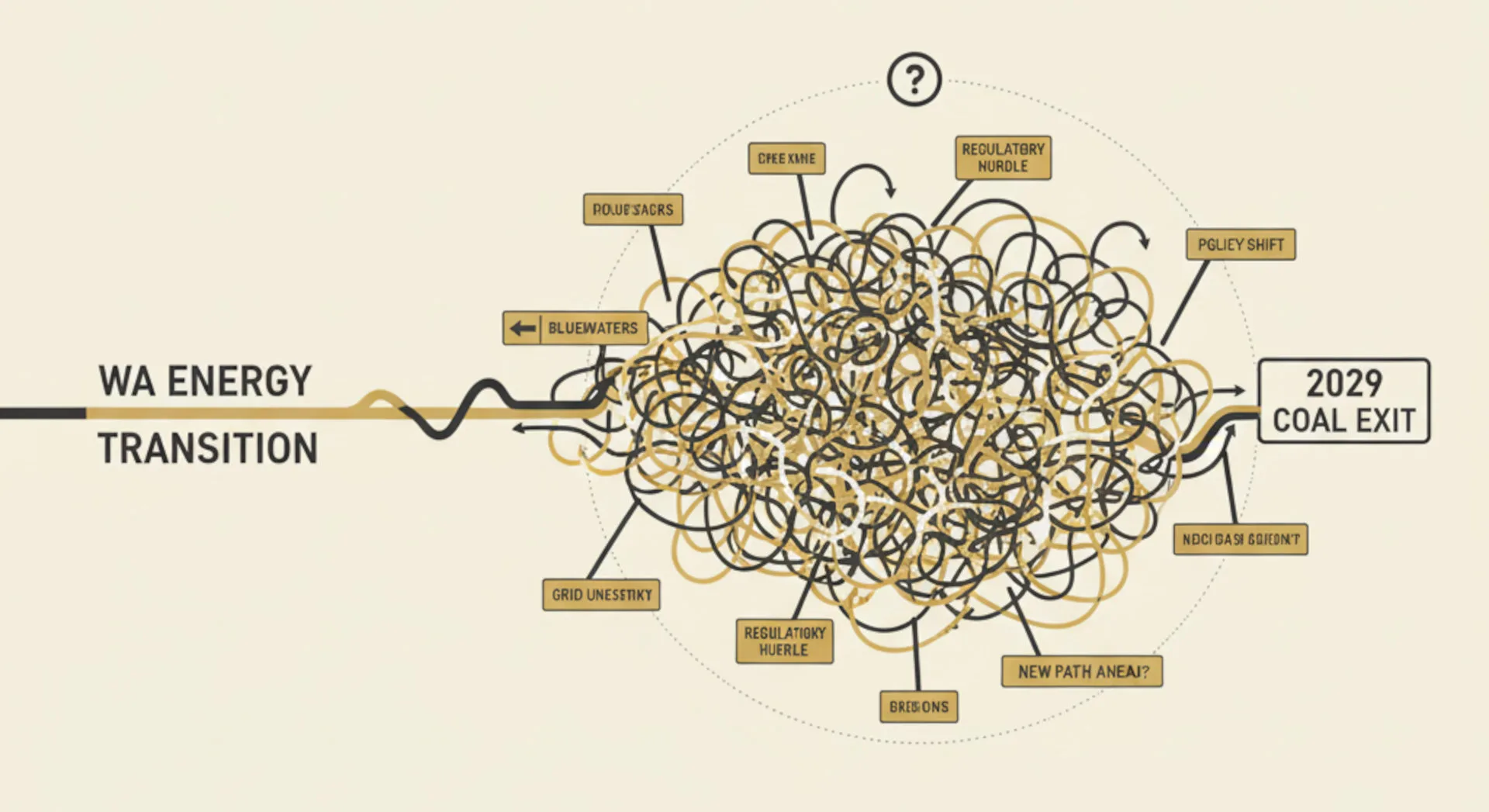
The Western Australian government’s strategy to phase out coal power by 2029 has been thrown into disarray following a critical reversal by the Australian Energy Market Operator (AEMO). As reported by ABC News, AEMO has backflipped on a decision to exclude the state’s largest privately-owned coal generator, Bluewaters, from the long-term energy market. The move, which ensures the plant’s availability beyond 2026, casts significant doubt on the government’s transition timeline and creates a new layer of uncertainty for the state’s property and investment sectors.
For property professionals, this policy ambiguity is a material risk. The key takeaway is that the perceived sovereign risk for major energy projects in WA has increased significantly. This uncertainty threatens to delay or deter the private capital required for renewable energy projects, while also complicating long-term planning for developers and owners of energy-intensive commercial and industrial assets who depend on a predictable and affordable power supply.
Background & Strategic Context
AEMO’s decision on Bluewaters is a critical event that highlights the immense difficulty of transitioning a major energy grid, with direct implications for several of our core intelligence frameworks.
- The Execution Gap (Carrying Capacity): This is a powerful illustration of the Carrying Capacity project. The government’s ambitious 2029 phase-out target is colliding with the physical and financial reality of what the energy system can actually carry. The backflip on Bluewaters, which supplies 10-15% of the state’s electricity, is a tacit admission that the renewable and transmission infrastructure required to replace it is not on track, revealing a major execution gap between policy ambition and delivery capability.
- Policy Instability (Project Shield): The reversal introduces significant policy uncertainty, a core theme of Project Shield. Large-scale, multi-billion-dollar investments in renewable energy depend on clear, consistent, long-term policy signals. This unexpected change erodes investor confidence, increases perceived risk, and could delay or derail the very projects needed to achieve the transition.
- State Intervention Risk (Project Overlord): The event underscores the risks of state-led economic engineering, a key Project Overlord theme. While the government sets the grand strategy (coal phase-out), it is grappling with the tactical realities. The need to continue subsidising the coal supply to Griffin until 2026 highlights the complex and costly interventions required to manage such a transition, creating profound uncertainty for all market players.
Deconstruction of the abc.net.au Report
The abc.net.au report details a significant and confusing reversal in WA’s energy policy landscape.
- The Reversal: AEMO has reversed its earlier decision and will now allow the Bluewaters power station to participate in the state’s capacity market beyond 2026. This market pays generators for being available, acting as an insurance policy for the grid.
- The Context: This is significant because Bluewaters provides 10 to 15 per cent of WA’s annual electricity supply. Its coal supplier, Griffin, is propped up by a major government subsidy that is set to end in June 2026.
- The Uncertainty: The report highlights that the reasons for AEMO’s reversal are unclear. This creates confusion about how Bluewaters will secure a coal supply after the subsidy ends and casts serious doubt on the feasibility of the government’s 2029 coal phase-out target.
- The Political Fallout: The report includes sharp criticism from both the Greens and the Opposition. They argue the government’s transition plan is uncertain and lacks a credible, funded pathway for the necessary transmission upgrades to support the renewable rollout.
Critical Analysis & Balanced View
AEMO’s decision can be viewed as a pragmatic, albeit disruptive, move to prioritise grid stability above all else. With public and political concerns mounting about the pace and cost of the required renewable deployment and transmission upgrades, keeping a major baseload generator like Bluewaters in the capacity market is a necessary “insurance policy” to prevent price spikes and blackouts. It represents a choice for stability today over the stated transition timeline for tomorrow.
The counter-argument, however, is that this pragmatism comes at a huge cost to market confidence. It sends a chaotic and contradictory signal to the private investors who are expected to fund the multi-billion-dollar renewable transition. By unexpectedly extending the operational life of a major coal asset, the decision reduces the immediate market opportunity for new renewable projects and undermines the credibility of the government’s 2029 target. This could ultimately slow the very transition it is meant to enable by deterring long-term capital investment.
Strategic Implications for Property Professionals
- For Renewable Energy Developers & Investors: This introduces a significant new risk variable. Project feasibility models that assumed a 2029 coal exit and a corresponding need for new capacity must now be re-evaluated. Investor confidence is likely to be dampened, potentially delaying final investment decisions on new solar, wind, and battery projects in WA.
- For Owners of Commercial & Industrial Property: The short-term benefit is potentially enhanced grid stability. However, the long-term uncertainty could lead to higher energy costs if the transition stalls and investment in new generation falters. Owners of energy-intensive assets, like data centres and manufacturing facilities, must now factor this policy instability into their long-term operational cost forecasts.
- For Property Managers & Landlords: This is a prompt to proactively discuss energy strategy with tenants. Tenants in energy-intensive sectors will have heightened concerns about future price and supply security. This increases the value proposition of properties that have invested in on-site renewable generation and storage solutions to mitigate grid risk.
- For Valuers: Valuations of major energy infrastructure and large industrial assets in WA must now incorporate a higher discount rate for policy and regulatory risk. The “highest and best use” assessment for land earmarked for renewable projects may also need to be revisited in light of this new uncertainty.
This article is based on a report from www.abc.net.au titled “WA coal phase-out uncertainty amid Bluewaters power station closure backflip”. You can find the original article here: https://www.abc.net.au/news/2025-09-18/wa-coal-phaseout-uncertain-amid-energy-grid-upgrade-plan/105788864
Given the government’s ambitious renewable energy targets and the continued reliance on coal-fired power, how can property professionals proactively adapt their investment and development strategies to navigate the uncertainty of WA’s energy transition and ensure long-term asset value?
Disclaimer
The analysis and information contained in this deconstruction are for general informational and strategic purposes only and do not constitute financial, investment, legal, or any other form of professional advice. The Australian Property Network (APN) is a strategic intelligence organisation and is not a licensed financial advisor.
This analysis is based on data and information from third-party sources believed to be reliable; however, APN provides no warranty as to its accuracy, currency, or completeness. Images used in this analysis are for illustrative and conceptual purposes only and may not represent real persons, properties, or events. Property values and market conditions can go down as well as up.
Before making any property or investment decisions, you must conduct your own thorough research and seek independent professional advice tailored to your specific circumstances.