
AUKUS Social Undermining: SA Economic Dependence as the Target for Foreign Interference
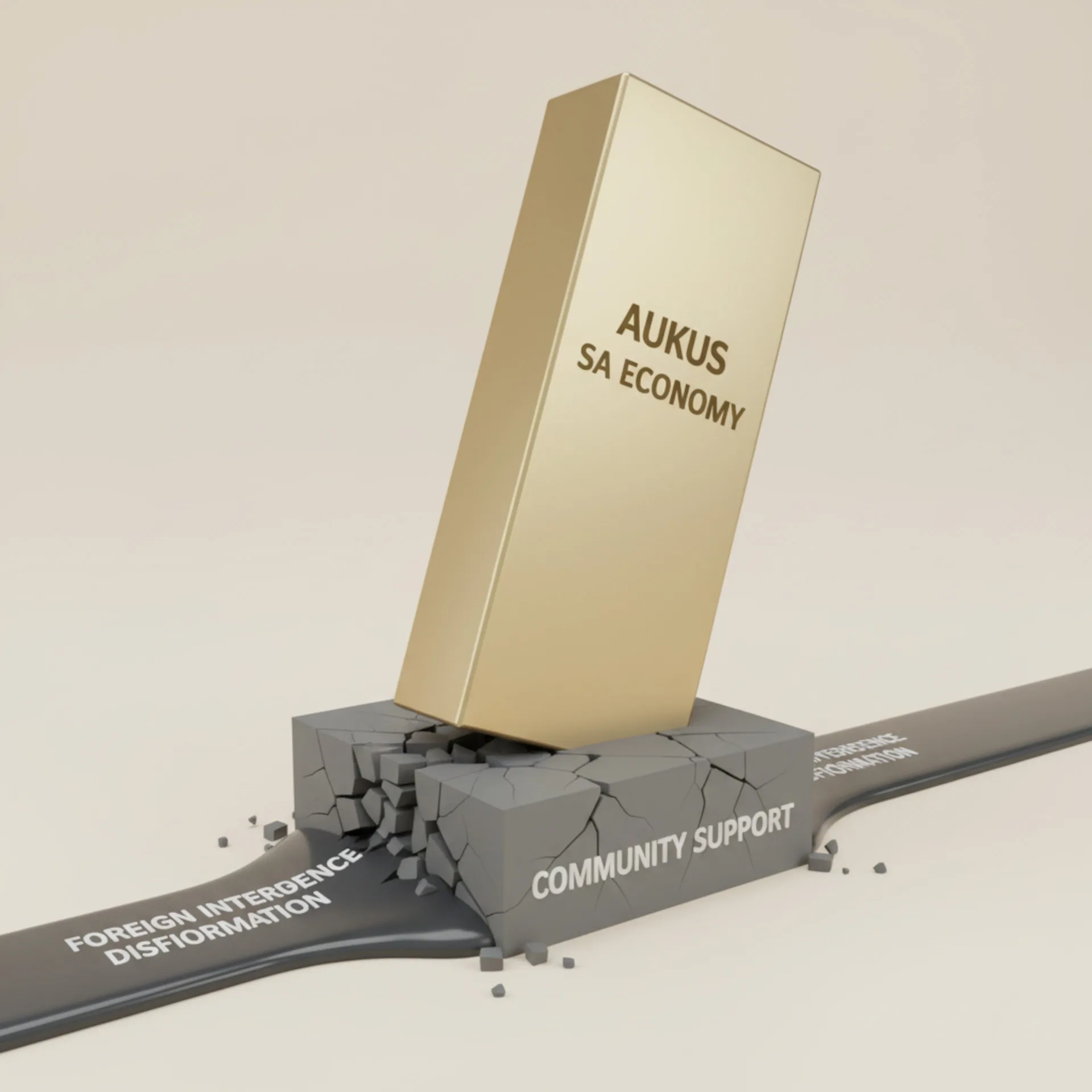
Australian Security Intelligence Organisation (ASIO) intelligence confirms a long-term strategic threat to AUKUS from foreign interference focused on “undermining community support”, a non-traditional social attack vector. This threat is distinct from espionage and targets the high concentration of economic and workforce reliance in South Australia (SA).
Australian Security Intelligence Organisation (ASIO) intelligence confirms a long-term strategic threat to AUKUS from foreign interference focused on “undermining community support”, a non-traditional social attack vector. This threat is distinct from espionage and targets the high concentration of economic and workforce reliance in South Australia (SA).
This state-level threat uses cost-of-living narratives and state-backed disinformation to erode the project’s “social license to operate.” The government’s recent legislative push to expand ASIO’s coercive powers to include “sabotage” and “promotion of communal violence” is the direct, pre-emptive response to this newly identified social threat.
This redefinition of the AUKUS threat from purely technical to social has profound implications, best understood across three related dimensions:
State-Level Threat: A cornerstone of national industrial and security policy (AUKUS) is being targeted by foreign state actors (e.g., China, Russia) via a non-traditional social attack. The state is now being forced to respond by building a domestic, “whole-of-society” counter-disinformation and social hardening strategy.
Legislative Response: This intelligence provides the direct justification for the ASIO Amendment (No. 2) Bill 2025. The government’s push to acquire new coercive powers to counter “sabotage” and the “promotion of communal violence” is the legislative correlate to this identified threat, and reflects how quickly the regulatory response is being prepared to counter a social, not just a physical, threat to national infrastructure.
Social Capital Vulnerability: The adversary’s strategy is to attack the social and sentiment foundations underpinning the project’s public support. By leveraging the low-cost, asymmetric tactic of disinformation to amplify a genuine domestic grievance (cost-of-living), state actors can foment social division and erode the project’s “social license to operate,” achieving a strategic failure without high-risk kinetic action.
The key facts are as follows:
- ASIO has differentiated the AUKUS threat into current espionage (“collect on the capabilities”) and a future foreign interference threat (“undermine community support”).
- South Australia’s (SA) economic future is overwhelmingly dependent on AUKUS, with the program underpinning over $30 billion in investment and 8,500+ direct jobs.
- This economic reliance creates a concentrated “social attack surface” for foreign actors.
- The primary narrative weapon for social undermining is the exploitation of “cost-of-living pressures.”
- State-backed bot networks (linked to China) have been identified amplifying social media criticism of AUKUS.
- The ASIO Amendment (No. 2) Bill 2025 is the legislative correlate, seeking new powers to counter “sabotage” and “promotion of communal violence.”
The real story here is a phased adversary strategy. ASIO projects a temporal pivot in the attack plan: from technical espionage now (2025) to a social undermining campaign by 2030, when the project’s centre of gravity shifts to its highly visible economic and political cost.
- SA Economic Singularity: South Australia’s near-total reliance on AUKUS for its future industrial base creates an “economic singularity.” This is a single, concentrated regional attack surface where the entire state’s economic well-being can be held hostage to the program’s success.
- Low-Cost, High-Impact Asymmetry: Adversaries are leveraging low-cost, deniable disinformation (bot campaigns) to amplify a genuine domestic grievance (cost-of-living) and link it directly to AUKUS spending.
- Eroding Social License: The strategic objective is to erode the project’s “social license to operate.” This is a far more sophisticated threat than traditional espionage.
Balanced View: On the surface, this is an intelligence assessment of a future threat. However, the analysis reveals it as the core justification for the government’s current, controversial legislative pivot. ASIO has identified that the long-term success of AUKUS is structurally dependent not on its technical execution, but on the sustained social and political will of the South Australian public, a factor ASIO now defines as a primary, non-traditional security vulnerability.
- For SA Investors & Developers: Investment in AUKUS-adjacent supply chain businesses located in South Australia now carries a heightened, non-commercial risk. The success of these investments is tied to the potential success of foreign-backed social undermining campaigns.
- For Risk & Sentiment Analysts: A high-frequency sentiment monitoring mandate must be established for South Australia, specifically tracking the “AUKUS vs. Cost-of-Living” narrative. This is the primary leading indicator for early threat detection.
- For Government (Counter-Strategy): This intelligence confirms a high-volume, state-backed disinformation attack that has yet to be publicly matched by a coherent, domestic counter-disinformation strategy. This is a critical national security gap.
- For Defence & Industry: The new generation of up to 9,500 AUKUS-dependent workers in SA represents a key target demographic for foreign interference. Their job security and economic well-being can be directly weaponised against the project.
The analysis and information contained in this analysis are for general informational and strategic purposes only and do not constitute financial, investment, legal, or any other form of professional advice. The Australian Property Network (APN) is a strategic intelligence organisation and is not a licensed financial advisor.
This analysis is based on APN research, data, and information believed to be reliable; however, APN provides no warranty as to its accuracy, currency, or completeness. Images used in this analysis are for illustrative and conceptual purposes only and do not represent real persons, properties, or events. Property values and market conditions can go down as well as up.
Before making any property or investment decisions, you must conduct your own thorough research and seek independent professional advice tailored to your specific circumstances.