
The Structural Shortfall: Deconstructing the Collision Between Migration and Housing Capacity
APN ANALYSIS: A-250923-AUS44
Executive Summary
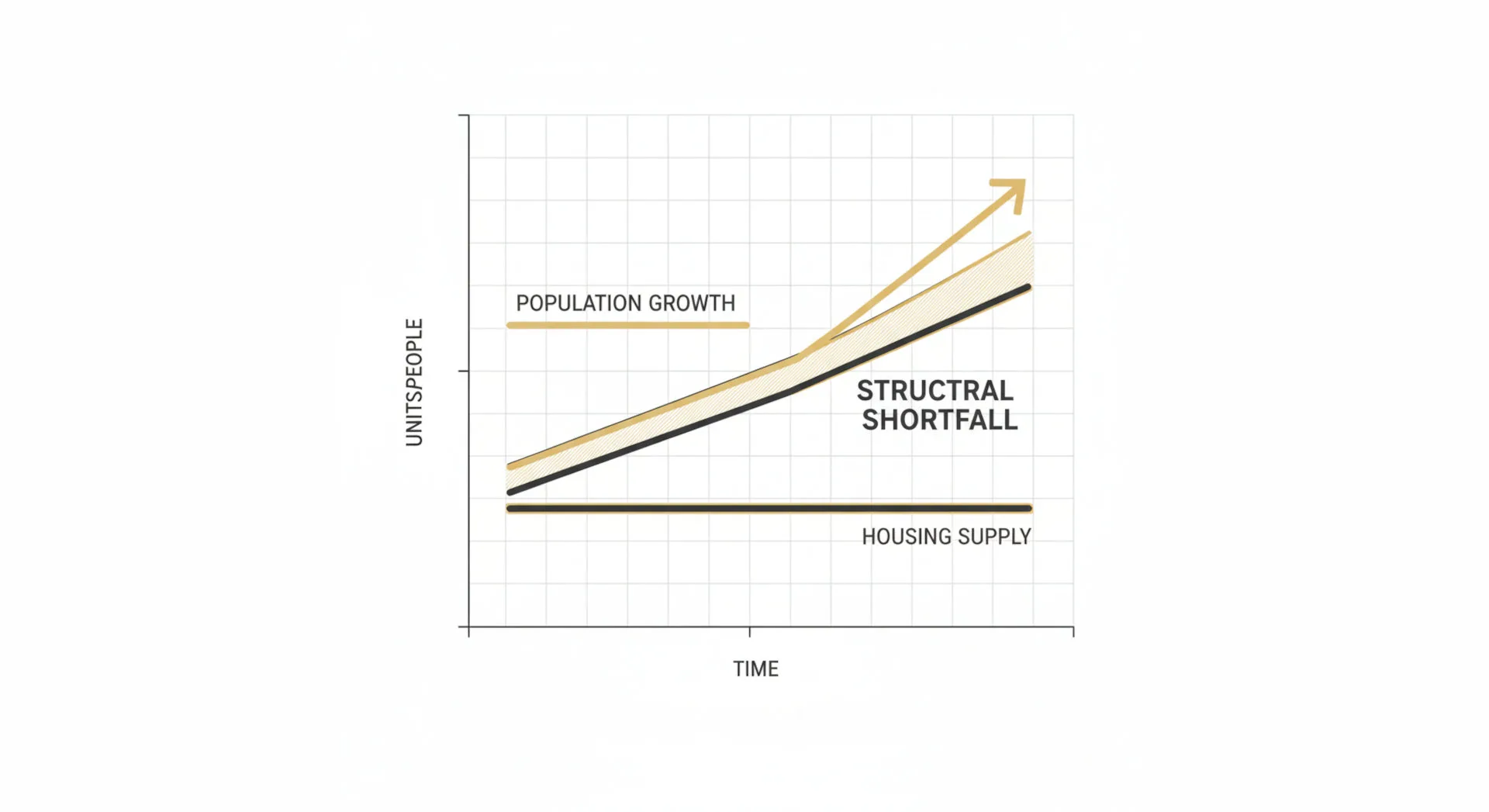
The fundamental drivers of the Australian housing crisis have been laid bare by the latest official data. Surging net overseas migration is adding population at double the pre-pandemic rate, while the construction industry is falling dramatically short of the National Housing Accord’s targets, forecasting a shortfall of over 200,000 new homes by 2029. This collision between supercharged demand and chronically constrained supply has driven rental vacancy rates to near-record lows and is placing immense pressure on the entire housing market.
For property professionals, this data confirms that the operating environment for the foreseeable future will be defined by a structural housing deficit. The key takeaway is that the federal government’s high-growth demographic strategy is dangerously decoupled from the physical and financial capacity of the construction sector to deliver the required housing. This creates a high-pressure, high-risk environment where navigating supply-side constraints, rather than stimulating demand, is now the central strategic challenge.
Background & Strategic Context
The data from the ABS and HIA provide a clear, quantitative measure of a crisis that APN has been tracking across multiple intelligence frameworks.
- The Physical Limit (Carrying Capacity): This is the most direct and powerful illustration of the Carrying Capacity project. The HIA’s forecast shortfall of over 200,000 homes against the national target is a hard number that defines the physical limits of our construction sector. The report correctly identifies the well-known constraints, land supply, planning, costs and skills that define this limited capacity.
- State Policy Failure (Project Overlord): This situation is a clear example of a Project Overlord-level policy failure. It reveals a profound disconnect between federal policy (which controls migration intake) and the state/local government policies (which control land release and planning) responsible for housing supply. The result is a national strategy that is fundamentally incoherent, driving population growth without a viable plan to house it.
- The Rental Crisis (APN Social Capital Index): The immediate consequence of this supply/demand imbalance, as noted by SQM Research, is a severe rental crisis with vacancy rates below one per cent in most cities. This has a corrosive effect on the APN Social Capital Index, increasing housing stress, inequality, and public discontent, which in turn creates a volatile environment for political and regulatory risk.
Deconstruction of the realestate.com.au report
The real estate.com.au report effectively synthesises multiple data sources to paint a clear picture of the crisis.
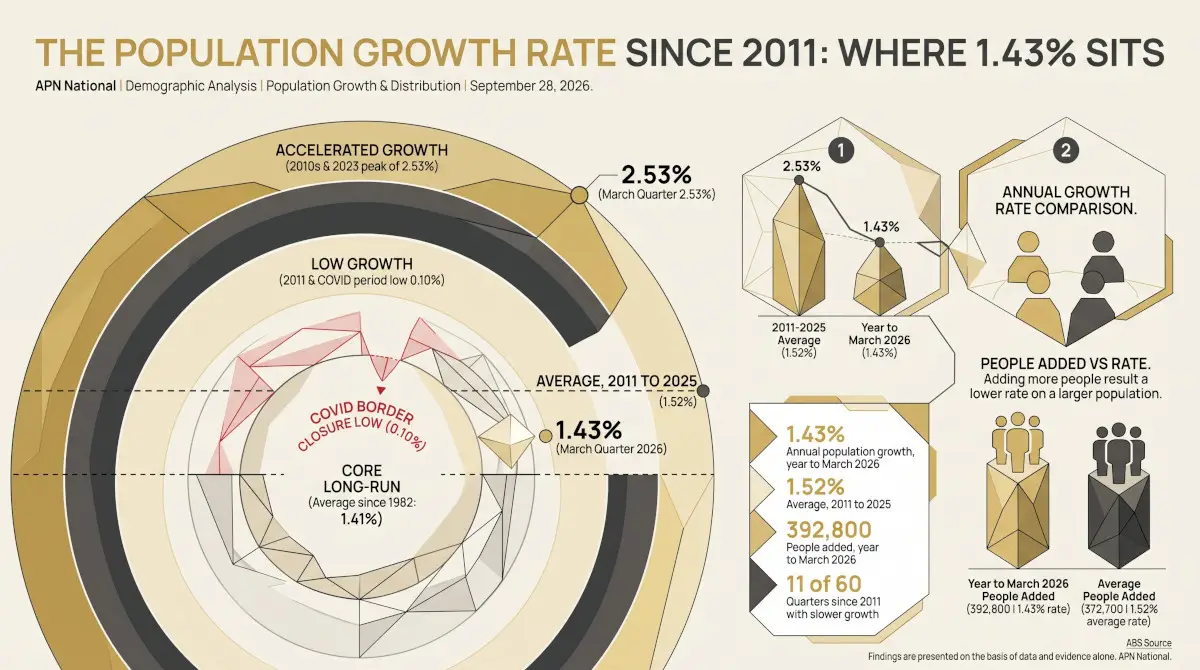
- The Demand Shock: The brief details the latest ABS data showing net overseas migration accounted for three-quarters of Australia’s population growth, running at double the pre-pandemic quarterly average.
- The Supply Failure: It contrasts this with HIA data showing only 168,050 dwelling commencements occurred nationally in the 2024 calendar year. This pace puts Australia on track to fall over 200,000 homes short of the five-year National Housing Accord target.
- The Immediate Impact: The analysis points to SQM Research data showing near-record low vacancy rates of under one per cent in most cities as the immediate consequence of this imbalance.
- The Constraints: The brief lists the structural constraints on the building industry as identified by the HIA: constrained land supply, slow and complex planning systems, rising costs, skill shortages, and material costs.
Critical Analysis & Balanced View
The central issue, as framed by critics like the Institute of Public Affairs, is that this imbalance is not an accident but the result of a deliberate government strategy to use high migration to drive headline economic growth, with the ensuing housing crisis viewed as a secondary, manageable consequence. This frames the problem as one of political priorities, where demographic expansion has been prioritised over housing affordability and liveability.
The counter-argument is that high migration, particularly of skilled workers, is an economic necessity. It fills critical labour shortages, including in the construction sector itself, and drives consumption and economic activity. From this perspective, the problem isn’t the migration level, but the long-term, structural failures on the housing supply side (primarily restrictive state and local planning systems) that predate the current migration surge. Cutting migration would treat the symptom, not the cause, and would risk harming the broader economy.
Strategic Implications for Property Professionals
- For Developers: The environment of chronic undersupply provides a powerful and persistent tailwind for demand. However, the constraints identified by the HIA are the primary operational risks that now define the business. The key strategic challenge is navigating these supply-side barriers. Innovative construction methods like prefabrication are no longer a niche but a potential necessity for delivering projects on time and on budget.
- For Investors (Build-to-Rent): This data provides the strongest possible bull case for the Build-to-Rent (BTR) sector. A systemic, long-term rental shortage driven by a structural mismatch between population growth and housing supply underpins the viability and future rental growth potential of large-scale BTR assets.
- For Valuers: Valuations must now be heavily weighted towards the reality of this structural supply-demand imbalance. The traditional cyclical view of the market is less relevant than the understanding that a high-demand, low-supply environment is now the baseline condition for the foreseeable future.
- For Planners & Policy Advocates: The data provide irrefutable evidence for the urgent need for radical reforms to planning and land release systems. The HIA and other industry bodies now have the official data to prosecute the case that the current systems are failing to meet the nation’s demographic reality.
This article is based on a report from www.realestate.com.au titled “Housing crisis: What new migration data reveals about Australia”. You can find the original article here: https://www.realestate.com.au/news/housing-crisis-what-new-migration-data-reveals-about-australia/
Given the current mismatch between migration-driven demand and housing supply, what innovative financing and construction models can be implemented to rapidly increase affordable housing stock without compromising quality or sustainability?
Disclaimer
The analysis and information contained in this deconstruction are for general informational and strategic purposes only and do not constitute financial, investment, legal, or any other form of professional advice. The Australian Property Network (APN) is a strategic intelligence organisation and is not a licensed financial advisor.
This analysis is based on data and information from third-party sources believed to be reliable; however, APN provides no warranty as to its accuracy, currency, or completeness. Images used in this analysis are for illustrative and conceptual purposes only and may not represent real persons, properties, or events. Property values and market conditions can go down as well as up.
Before making any property or investment decisions, you must conduct your own thorough research and seek independent professional advice tailored to your specific circumstances.