
The Victorian Property Tax Ledger: Land Tax Has Quadrupled Since 2015–16, and the Threshold Is Now an Election Issue
Tax Laws (21310), Australia −0.0934σ 2024–25
State Price-to-Earnings (21820), Victoria −0.1226σ Q2 2026
Scope and Purpose
Victoria holds a state election on Saturday 28 November 2026 (Victorian Electoral Commission), and the land tax threshold is a property setting on which each major party has published a commitment.This output sets out the ledger behind that debate: what Victoria raises from land tax and conveyance duty, how that has changed since 2015–16, how it compares with the other states and territories, and what the 2026–27 Budget expects. It then records the parties’ published commitments in their own terms. It does not rate or compare them.
The revenue figures come from the Australian Bureau of Statistics (ABS) Taxation Revenue, Australia, 2024–25, which reports each state’s taxes on a common classification, and from the 2026–27 Victorian Budget Papers of the Department of Treasury and Finance. Population is from the ABS National, state and territory population, March 2026. Land tax is an annual tax on the unimproved value of land a person holds, with the home and primary production land exempt; conveyance duty, often called stamp duty, is paid once when property changes hands. The instruments that impose both in each jurisdiction are mapped in Land Tax and Duty in the Statute Book.
A Tax That Has Grown Faster Than the Rest
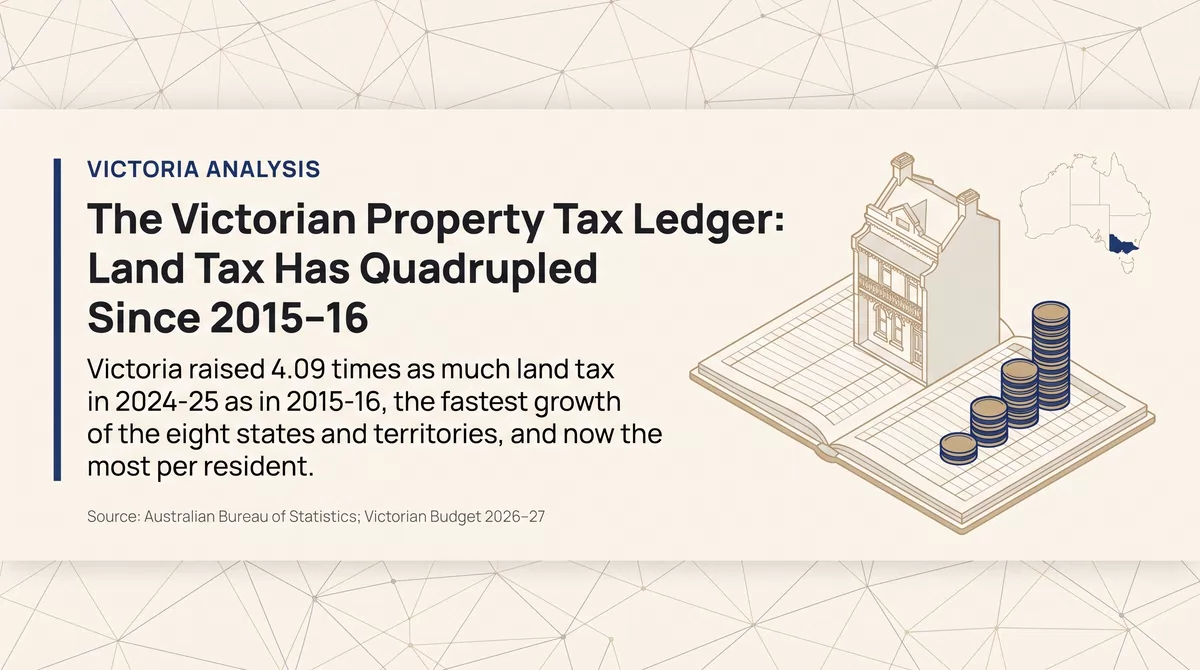
Victoria raised $1,771 million in land taxes in 2015–16 and $7,246 million in 2024–25, 4.09 times as much. Over the same years New South Wales’ land taxes rose 3.00 times, from $2,747 million to $8,251 million, and Queensland’s 2.33 times. No other state or territory’s land taxes grew as fast. In 2024–25 Victoria raised 88% of New South Wales’ land tax revenue, from total state and local taxation equal to 85% of New South Wales’.
Land Tax Revenue, Victoria and New South Wales, 2015–16 to 2024–25, $ Million
APN chart based on Australian Bureau of Statistics data: Taxation Revenue, Australia, 2024-25, Tables 2 and 3. Land taxes, state and local government, current prices. Each point is the financial year ending 30 June of the year shown.
The growth came in steps rather than evenly. Land taxes rose by more than a quarter in 5 of the nine years: 2016–17, 2018–19, and each of the three years from 2021–22 to 2023–24. The last of these, an increase of $1,727 million (32.2%), is the first financial year in which the COVID Debt Repayment Plan applied. From the 2024 land tax year the general threshold fell from $300,000 to $50,000, holdings of $50,000 to under $100,000 pay $500 and holdings of $100,000 to under $300,000 pay $975, and the rates above $300,000 rose. The State Revenue Office lists these rates for the 2024 to 2033 land tax years. In 2024–25 land taxes rose 2.1%.
As a share of the state’s own taxes, leaving out council rates, land taxes rose from 8.8% in 2015–16 to 18.3% in 2024–25, having reached 18.9% the year before. Conveyance duty moved the other way. It reached $10,722 million in 2021–22 and in 2024–25 was 12.0% below that level. Taken together, the two property taxes supplied 38.8% of state taxation in 2015–16 and 42.1% in 2024–25: the mix changed more than the total. Payroll taxes, the other large state tax, rose 2.15 times over the period, and total state and local taxation 1.87 times.
| Financial year | Land taxes | Conveyance duty | State taxation excluding council rates | Land taxes’ share |
|---|---|---|---|---|
| 2015–16 | 1,771 | 6,008 | 20,030 | 8.8% |
| 2016–17 | 2,501 | 6,350 | 21,566 | 11.6% |
| 2017–18 | 2,586 | 7,197 | 23,089 | 11.2% |
| 2018–19 | 3,509 | 6,292 | 23,827 | 14.7% |
| 2019–20 | 3,447 | 6,387 | 23,374 | 14.7% |
| 2020–21 | 3,234 | 6,622 | 23,905 | 13.5% |
| 2021–22 | 4,135 | 10,722 | 31,010 | 13.3% |
| 2022–23 | 5,367 | 8,998 | 32,823 | 16.4% |
| 2023–24 | 7,094 | 8,682 | 37,474 | 18.9% |
| 2024–25 | 7,246 | 9,433 | 39,641 | 18.3% |
APN calculation based on Australian Bureau of Statistics data: Taxation Revenue, Australia, 2024-25, Table 3. Victoria, $ million, current prices. State taxation excluding council rates is total state and local taxation less municipal rates. The share is calculated from the published lines.
Per Resident, the Highest of the Eight
Population growth accounts for only a small part of the rise.Victoria’s estimated resident population grew 14.4% between June 2016 and June 2025, while its land taxes per resident rose from about $287 to about $1,026, 3.6 times. In 2015–16 Victoria raised less land tax per resident than Western Australia, New South Wales and South Australia. In 2024–25 it raised more than any other state or territory, ahead of New South Wales ($961). The Northern Territory levies no land tax.
Land Tax per Resident by State and Territory, 2024–25, $
APN calculation based on Australian Bureau of Statistics data: Taxation Revenue, Australia, 2024-25, Tables 2 to 9. Land taxes divided by estimated resident population at 30 June 2025 (ABS National, state and territory population, March 2026, Table 4). Current prices.
Adding conveyance duty narrows the gap. Land tax and duty together came to about $2,361 per Victorian resident in 2024–25 and about $2,384 per resident of New South Wales, the highest of the eight. Victoria’s position is distinctive for the weight it places on the annual tax rather than for the combined burden. These are averages across all residents: land tax falls on land held beyond the home, so it is paid by a minority of households, and duty by those who buy.
Who Pays Within the New Bracket
The Premier’s office published a profile of the people the lower threshold brought in on 5 October 2026 (New Data Reveals Who Pays Land Tax). It states that more than 250,000 Victorians have a land tax liability and own land valued between $50,000 and $300,000, that 90% of them have one taxable property, that about 2% pay on three or more, and that their median age is 53. The council areas with the most such taxpayers are Melbourne (9,111), Casey (8,311) and Boroondara (7,668). These are holders of a second property, most often one: the bracket is not, on the release’s figures, a group of large portfolios.
What the Budget Expects
The Statement of Finances (Budget Paper No. 5) separates the levy from the underlying tax. In 2026–27 land tax, including the Absentee Owner Surcharge and the Vacant Residential Land Tax, is forecast at $6,456 million and the COVID Debt Levy on landholdings at $1,197 million, together $7.7 billion, or 17.7% of forecast state taxation. The levy is about 16% of land taxes in each year to 2029–30, when land taxes reach $8,857 million. Land transfer duty is forecast to fall 5.6% to $10.0 billion in 2026–27, before rising to $12,404 million in 2029–30. The budget also carries the Emergency Services and Volunteers Fund levy ($1,609 million in 2026–27) and the windfall gains tax on value created by rezoning ($97 million).
Victorian Budget: Land Tax and the COVID Debt Levy on Landholdings, 2025–26 to 2029–30, $ Million
APN chart based on Victorian Department of Treasury and Finance data: 2026-27 Budget Paper No. 5, Statement of Finances, 2026-27 Budget and forward estimates, Table 4.2. Years end 30 June; 2025-26 is the revised estimate. The land tax line includes the Absentee Owner Surcharge and the Vacant Residential Land Tax.
The Department of Treasury and Finance describes the risks in its own terms. Budget Paper No. 2 states that taxation revenue has been revised down by an average of $598 million a year from 2026–27 to 2028–29, “largely due to downgrades in property taxes in the context of higher interest rates”, and lists “the relative affordability of Victorian dwellings” among the upside risks to property-related taxes. Net debt is forecast at $175.6 billion at June 2027 (24.9% of gross state product), rising to $199.3 billion at June 2030. The COVID Debt Levy on landholdings is legislated to apply until 30 June 2033.
What the Parties Have Committed To
Victorian Labor and the Liberal Party have each committed to returning the general threshold to $300,000, on different timetables. Labor’s release of 4 October 2026 (Labor Will Cut Land Tax to Help with the Cost of Living) sets out steps of $25,000 a year from 2027/28. The Liberal commitment is on the Hansard record of the Budget debate (Legislative Assembly, 13 May 2026). The Nationals commit to restoring the threshold, and the Australian Greens Victoria propose to replace duty on most owner-occupied homes with a higher land tax on large investment holdings. The table records each commitment as published.
| Party | Where published | Commitment, as published |
|---|---|---|
| Victorian Labor | Media release, 4 October 2026 (viclabor.org.au) | Raise the threshold by $25,000 a year from 2027/28, and keep raising it until $300,000 is restored at the end of 2033/34. Stated cost: $230 million over five years. Stated effect: more than 250,000 people removed from land tax. |
| Liberal Party | Nicole Werner MP (Warrandyte), Legislative Assembly, 13 May 2026 | “Lifting the threshold back to $300,000 over five years”. |
| The Nationals | Policies page, read 27 October 2026 | Restore the $300,000 land tax-free threshold, described elsewhere on the page as progressively increasing it. Abolish stamp duty for first home buyers on properties up to $1 million. Replace the emergency services levy with the earlier Fire Services Property Levy. |
| Australian Greens Victoria | Media release, 9 July 2026 | Abolish stamp duty on owner-occupied homes up to $1.1 million, with reduced duty on a sliding scale up to $1.6 million. Raise land tax to 5.3% for investors holding more than $5 million in residential investment property, projected to raise $6.4 billion over the decade. |
Commitments as each party published them, in its own terms; none has been costed here, and none is law. Sources: Victorian Labor; Parliament of Victoria, Hansard; The Nationals Victoria; Australian Greens Victoria. Read 27 October 2026.
A change to the threshold acts on the flat $500 and $975 charges that fall on holdings below $300,000; it does not by itself alter the levy’s higher rates above $300,000, which the threshold commitments as published do not address. The ledger above is the base against which any of them would be measured once it is legislated and costed in a budget.
Where Price Sits
Land tax sits upstream of price: it is a cost of holding land beyond the home, and so of supplying rental housing and holding development sites. Victoria’s dwelling prices are, on one measure, the least stretched of the eight states and territories. State Price-to-Earnings (21820) reads 8.65 years of full-time earnings for the average Victorian dwelling in the June quarter 2026, −0.1226σ against the state’s own 2011 to 2025 average, a position of 42.9, ranked against 57 quarters. Victoria is the only state or territory reading below its own average. The figures show the two together; they do not show that one caused the other. Prices also reflect population, income, interest rates and the supply of new dwellings, which the desk examines separately (APN Victoria: What the Desk Covers and What It Will Report).
Nationally, Tax Laws (21310) reads conveyance duty collected across all states as a share of the value of the dwelling stock. For 2024–25 it reads −0.0934σ, an indicative position of 46.3: empirical ranking begins at 20 observations, and there are currently 14. Duty covers all property transfers while the denominator is the residential stock only, so the reading is a trend index and cannot be split by state or by type of property. It reads duty close to its average burden; the Victorian figures above show that the movement in Victoria has been in land tax.
What the Figures Cannot Separate
- Residential and other land. The ABS land tax line covers all taxable land, including commercial and industrial holdings. The figures cannot say how much of the rise falls on residential investors.
- Rates and values. Revenue moves with land values as well as with rates and thresholds. The figures do not separate the effect of the 2024 changes from valuation growth.
- The levy within the ABS line. The ABS publishes land taxes as one line. Only the budget papers separate the COVID Debt Levy, and they do so from 2025–26.
- Two coverages. The ABS figures are state and local government on a national classification; the budget figures are the Victorian general government sector. Levels differ between them and are not joined here.
- Prices. All figures are in current prices and are not adjusted for inflation.
APN Analytical Synthesis
The weight of evidence supports the interpretation that Victoria has moved more of its tax base onto land held beyond the home than any other state, and that it did so in steps over a decade, not only through the COVID Debt Repayment Plan. Land taxes grew 4.09 times between 2015–16 and 2024–25, faster than in any other state or territory, and per resident they are now the highest of the eight. Conveyance duty, by contrast, is below its 2021–22 level, so the combined property tax take per resident remains a little below New South Wales’.
Current conditions are structurally consistent with a state that relies on land tax for close to a fifth of its own taxes while forecasting it to keep growing, and in which both major parties propose to remove the flat charges on holdings below $300,000. This output speaks only to the structural conditions the cited data can independently support. It makes no forecast and expresses no view on the merits of any commitment. The next data points are the parties’ costings, if published before 28 November 2026, the Department of Treasury and Finance’s 2026–27 Budget Update, and the ABS Taxation Revenue release for 2025–26, whose date has not been announced.
- Australian Bureau of Statistics (Reference period: 2024-25) Taxation Revenue, Australia [https://www.abs.gov.au/statistics/economy/government/taxation-revenue-australia/2024-25], ABS Website, accessed 27 October 2026.
- Australian Bureau of Statistics (Reference period: March 2026) National, state and territory population [https://www.abs.gov.au/statistics/people/population/national-state-and-territory-population/mar-2026], ABS Website, accessed 27 October 2026.
- Australian Greens Victoria (Reference period: 9 July 2026) Greens unveil bold housing plan to bring down the cost of buying a home by abolishing stamp duty [https://greens.org.au/vic/news/media-release/greens-unveil-bold-housing-plan-bring-down-cost-buying-home-abolishing-stamp], accessed 27 October 2026.
- Office of the Premier of Victoria (Reference period: 5 October 2026) New Data Reveals Who Pays Land Tax [https://www.premier.vic.gov.au/new-data-reveals-who-pays-land-tax], accessed 27 October 2026.
- Parliament of Victoria (Reference period: 13 May 2026) Hansard, Legislative Assembly, Appropriation (2026–2027) Bill 2026, second reading [https://www.parliament.vic.gov.au/parliamentary-activity/hansard/hansard-details/HANSARD-2145855009-35606], accessed 27 October 2026.
- State Revenue Office Victoria Land tax (current rates) [https://www.sro.vic.gov.au/about-us/rates-and-statistics/current-rates/land-tax-current-rates], accessed 27 October 2026.
- The Nationals Victoria Policies [https://vic.nationals.org.au/policies/], accessed 27 October 2026.
- Victorian Department of Treasury and Finance (Reference period: 2026-27 Budget) 2026-27 Budget Paper No. 2, Strategy and Outlook [https://s3.ap-southeast-2.amazonaws.com/vicbudgetfiles2026.27vicbudget/2026-27+State+Budget+-+Strategy+and+Outlook.pdf], accessed 27 October 2026.
- Victorian Department of Treasury and Finance (Reference period: 2026-27 Budget) 2026-27 Budget Paper No. 5, Statement of Finances [https://s3.ap-southeast-2.amazonaws.com/vicbudgetfiles2026.27vicbudget/2026-27+State+Budget+-+Statement+of+Finances.pdf], accessed 27 October 2026.
- Victorian Electoral Commission (Reference period: 20 August 2026) 100 days until the 2026 Victorian State election [https://vec.vic.gov.au/about-us/media/media-releases/100-days-until-the-2026-victorian-state-election—what-you-need-to-know], accessed 27 October 2026.
- Victorian Labor (Reference period: 4 October 2026) Labor Will Cut Land Tax to Help with the Cost of Living [https://www.viclabor.org.au/news/labor-will-cut-land-tax-to-help-with-the-cost-of-living], accessed 27 October 2026.
ABS material is used under a Creative Commons Attribution 4.0 International licence. Calculations, standardisations and index readings are APN’s and are not attributable to the ABS.
Victorian Budget Papers © State of Victoria (Department of Treasury and Finance), used under a Creative Commons Attribution 4.0 licence; figures are quoted and recalculated as stated above.
Disclaimer
The analysis and information contained in this publication are for general informational and strategic purposes only and do not constitute financial, investment, legal, or any other form of professional advice. Australian Property Network is not a licensed financial advisor. Property values and market conditions can go up or down. Before making any property or investment decisions, you must conduct your own thorough research and seek independent professional advice tailored to your specific circumstances. Images are for illustrative purposes only. E.&O.E.
Findings are presented on the basis of data and evidence alone.