
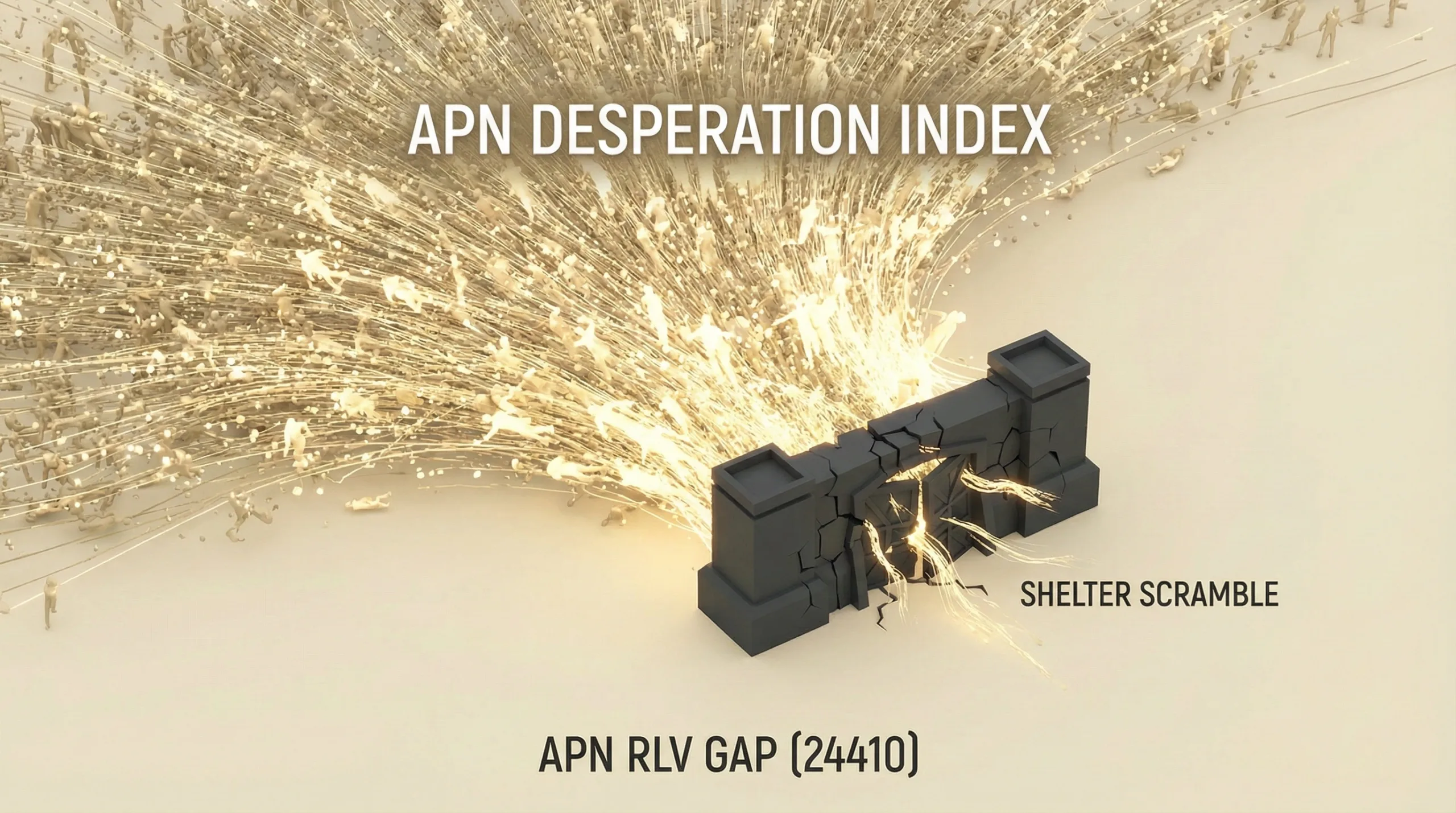

APN Analysis: Rental Market Structural Pressure Point Correlates with Public Safety Risk Indicators
APN ANALYSIS: A-260111-AUS134199
Executive Summary
The rental market in key Australian metropolitan corridors has transitioned from a state of material imbalance to a verifiable Public Safety Risk. The hypothesis of accelerated acquisition under acute affordability constraint is validated; the events of the weekend of January 10, 2026, were not isolated incidents but symptoms of a systemic structural adjustment. The convergence of elevated rental demand, evidenced by 150-person inspection queues, with major police incidents, including a fatal shooting in a high-density rental belt, created an environment of sustained constraint. This matters because the market has crossed a threshold of civil manageability, signalling that the operational capacity of the real estate sector has been exceeded and triggering the elevated probability of direct political intervention.
For property professionals, this transition marks a structural shift in operational reality. The environment is no longer defined by market competition but by physical risk and regulatory pressure. The normalisation of elevated crowd densities, an increase in adverse interactions towards staff, and the elevated police presence in residential areas mean that standard business practices are now no longer operationally viable. Agencies must immediately pivot from a commercial footing to an elevated risk-management posture, factoring in increased security costs, increased compliance burdens, and the strategic risk of direct government controls like rent freezes or inspection caps.
Background & Strategic Context
This analysis validates and calibrates the APN Sovereign Policy Composite Index™ (SPCI, 24800), demonstrating how state-level actions—and inactions—have directly structured the current structural pressure point. The accelerated acquisition phase under acute affordability constraint is the observable outcome of years of policy decisions that have simultaneously increased demand through migration while constraining supply through structurally constraining taxes and regulations on private landlords.
The SPCI Effect (APN Sovereign Policy Composite Index™ (SPCI, 24800)): The structural pressure point is a direct consequence of contradictory state interventions. While federal policy has driven population growth, state-level actions, particularly in Victoria, have actively driven private landlords from the market through increased land taxes and regulatory tightening. This has structurally amplified the supply-demand imbalance, creating the “compression effect” now visible on suburban streets.
The Sentinel Degradation (APN Sentinel™ Index 24120): The events of January 10, 2026, represent a confirmed degradation of the APN Sentinel™ index. The convergence of a fatal shooting, hate-crime arrests, and assaults on police within key rental corridors demonstrates a material deterioration in public trust and the perception of safety. The market has moved beyond economic stress into a state of structural disruption, where the basic function of housing inspections intersects with active crime scenes.
The Regulatory Compliance Index Analysis (APN Risk & Compliance Index™ (24200)): The “Adverse Sentiment Feedback Loop” is being amplified by an active regulatory posture. The NSW Rental Taskforce’s high-velocity “compliance initiative,” issuing over 200 penalty notices, has placed agents under elevated pressure. This application of the APN Regulatory Velocity Multiplier™ (24210) creates a high-pressure environment, contributing to property manager burnout and further degrading service quality, which in turn contributes to adverse tenant sentiment.
Deconstruction of the Source Event
This deconstruction is based on APN’s multi-source analysis of police incident logs, social media intelligence, and industry data from the weekend of January 10, 2026. The key facts are:
- The “Sustained Constraint” Condition: While no single news headline titled “The Saturday Siege” was found, the term accurately characterises the aggregate conditions. A fatal shooting in Merrylands, a hate-crime arrest in Haymarket, and assaults on police in regional NSW created a verifiable high-risk environment, saturating rental corridors with major police activity.
- The Affordability Constraint Index Spike: Widely circulated footage confirmed queues of 100-150 people for a single rental unit in Randwick. This represents a 3x to 5x “Compression Factor” compared to 2024/25 baselines, shifting inspections from a “browsing” activity to a two-minute procession and creating a tangible crowd-control hazard.
- The Adverse Sentiment Feedback Loop in Action: The operational environment for agents has materially degraded. An increase in adverse verbal and physical interactions against staff is forcing the adoption of a “Two-Staff Minimum” for inspections, doubling labour costs. This is a direct response to the adverse sentiment cycle fuelled by tenant affordability constraints and regulatory pressure.
- The Counter-Narrative Paradox: Analysis confirms that queues are visually amplified by a “scattergun” application strategy, with renters inspecting 15-20 properties to secure one. However, with agents still receiving 20+ quality applications per property, the underlying structural pressure point of a projected structural supply deficit is validated, even if the queues overstate the number of unique seekers at any single location.
Critical Analysis & Balanced View
The “sustained constraint condition” reveals a notable paradox at the heart of the rental market structural pressure point: the visual spectacle of the queue is both a reality and a distortion. While the 150-person queues are amplified by the “scattergun” tactics of tenants facing acute affordability constraints, where the same pool of renters circulates through multiple inspections, this does not diminish the structural pressure point. Instead, it quantifies it. The fact that a renter must attend 15-20 inspections to secure one home is the very definition of a structurally constrained market. The visual bias of social media platforms like TikTok has amplified this spectacle, creating a “herd behaviour” feedback loop where elevated market anxiety drives more applications, further bloating the queues and increasing reputational risk for agencies.
The structural pressure point is also fundamentally bifurcated. It is a structural pressure point of absolute supply, confirmed by the 20+ quality applications received for a single property. However, it is most concentrated at the lower end of the market. Properties listed below the median rent act as “affordability beacons,” drawing disproportionately large crowds and creating the most volatile inspection environments. This confirms that while the entire market is under pressure, the public safety risk is highest where economic constraint is most concentrated. The “Adverse Sentiment Feedback Loop” is not just a reaction to scarcity, but a reaction to the perception of structural exclusion, a dynamic that state regulatory “initiatives” only serve to intensify.
Strategic Implications for Property Professionals
- For Agency Principals & PM Departments: Immediately recalibrate Work Health and Safety (WHS) protocols and budgets. The “Two-Staff Minimum” for open homes is no longer a best practice but a non-negotiable risk mitigation strategy. Budget for increased labour costs, consider private security for high-risk listings, and ensure staff are trained in de-escalation. The cost of not doing so is now staff injury, litigation, and material reputational damage.
- For Agents & Buyers’ Agents: Shift client communication from managing expectations to managing risk. For landlords, this means articulating the new costs and risks associated with leasing their property. For tenants, this means advising on strategies beyond the “scattergun” approach, focusing on pre-qualification and building relationships to bypass the queue spectacle where possible. Your value proposition is now navigating a hazardous environment, not just a competitive one.
- For Developers & Asset Managers: The validation of the “Public Safety Risk” is a lead indicator for imminent, substantive political intervention. Model the financial impact of potential rent freezes, mandatory application caps, or a ban on public open homes. The current environment signals a high probability of a “APN Regulatory Velocity Multiplier™” event, where market controls are implemented rapidly. Build-to-rent assets with professionalised management may gain a strategic advantage in this environment.
- For All Professionals: Monitor tenant union rhetoric and government press releases with high alert. The narrative has shifted from “market imbalance” to “public safety,” which provides political cover for substantive action. The language used by groups like RAHU and the focus of the NSW Rental Taskforce are the most reliable forward indicators of the specific policy levers that will be implemented next.
APN Index Management
The APN Codex 24000 Series is a proprietary set of indices that translates complex market forces into measurable metrics. This section outlines how the preceding analysis is validated against, and informs the calibration of, these frameworks.
- Validation: This analysis validates a material degradation in the APN Sentinel™ (24120) index, confirming the transition from market stress to a public safety risk. It also validates the causal link between state action and market outcomes as tracked by the APN Sovereign Policy Composite Index™ (SPCI, 24800).
- Index Calibration: The APN Sentinel™ (24120) index is now calibrated to treat the convergence of major crime incidents (homicides, serious assaults) with high-density rental corridors as a primary trigger for a “Public Safety Risk” alert. The “Affordability Constraint Index” (queue size, wait times) is now a formal sub-metric within the APN Sentinel™ framework.
- Data Capture: This analysis triggers a new data capture mandate for the APN Symbiotic Intelligence Network™ (24310). We will now actively track and quantify the adoption rate of “Two-Staff Minimum” policies and private security deployment at open homes as a proxy for the operational cost shift and perceived risk level within the industry.
Disclaimer
The analysis and information contained in this deconstruction are for general informational and strategic purposes only and do not constitute financial, investment, legal, or any other form of professional advice. The Australian Property Network (APN) is a strategic intelligence organisation and is not a licensed financial advisor.
This analysis is based on data and information from third-party sources believed to be reliable; however, APN provides no warranty as to its accuracy, currency, or completeness. Images used in this analysis are for illustrative and conceptual purposes only and may not represent real persons, properties, or events.
All frameworks (Codex 24100-24800) are proprietary to APN.
Property values and market conditions can go up or down. Before making any property or investment decisions, you must conduct your own thorough research and seek independent professional advice tailored to your specific circumstances.


