

Australian Real Estate Services: Practitioner Headcount Growth Diverges from Transaction Velocity
APN ANALYSIS: A-260628-AUS140083
Executive Summary
The Australian real estate professional services sector is experiencing a period of structural adjustment, defined by a quantifiable divergence between human capital expansion and the physical velocity of property transactions. Analysis of sovereign data, regulatory registers, and peak industry metrics reveals a state of structural overservice: a record number of licensed practitioners are competing for a transaction pool that has been materially constrained by macroprudential credit rationing and reduced listing volumes.
For property professionals, this imbalance signals an imminent and sustained phase of market consolidation. The data indicates that practitioner viability is increasingly dependent on operational scale, established referral networks, and the capacity to absorb escalating compliance costs. This environment structurally favours entrenched, well-capitalised operators and presents a material barrier to entry and sustainability for new and marginal participants. The likely outcome is a contraction in the overall number of active practitioners as the market returns to a more sustainable equilibrium.
Background & Strategic Context
This analysis validates and calibrates APN’s core thesis on the transmission of macroprudential policy into market-level structural friction. The findings demonstrate how sovereign regulatory settings, designed to ensure financial stability, directly influence the operational viability of the professional services ecosystem by constraining the flow of executable credit, which functions as the sector’s primary revenue source.
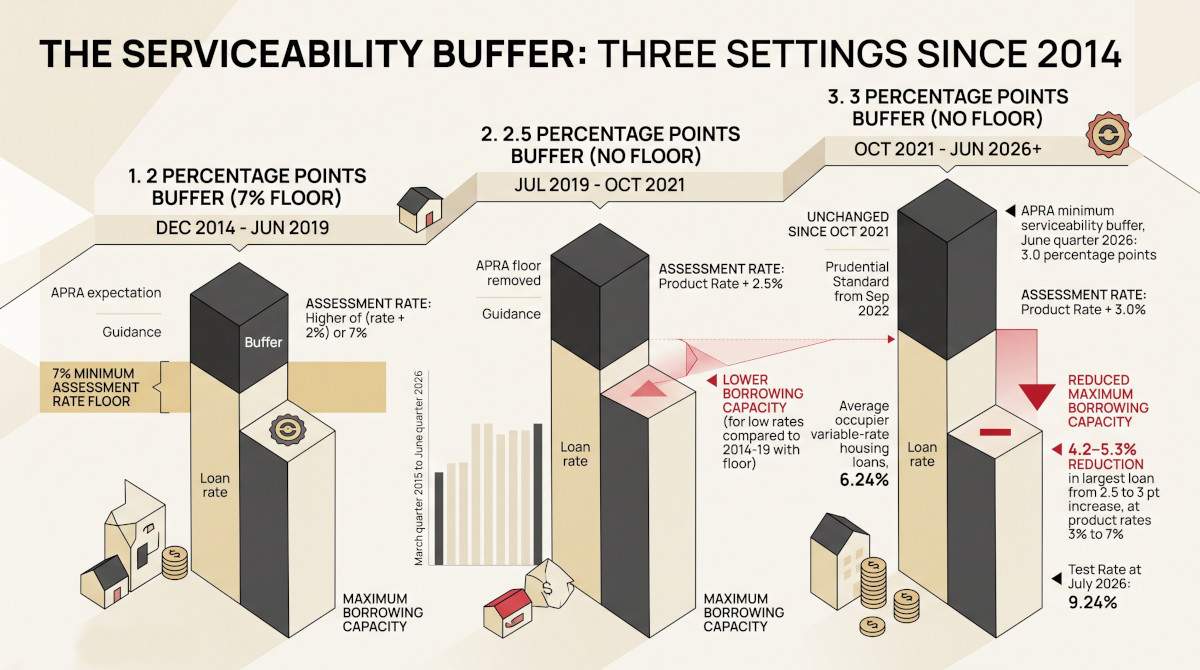
A Structurally Constrained Revenue Pool (APN Credit Rationing Index™ [24230]): The Australian Prudential Regulation Authority’s (APRA) 3.00 percentage point serviceability buffer functions as a ‘Credit Exclusion Mechanism’. This mechanism mathematically restricts segments of prospective buyers from market participation, directly suppressing the total addressable market available to the expanded professional workforce and capping the sector’s revenue potential irrespective of practitioner numbers.
Escalating Operational Friction (APN System Friction Index™ [24220]): A material increase in regulatory oversight from bodies like ASIC and state-level Fair Trading authorities, including the Best Interests Duty for brokers, has elevated baseline compliance costs. This increases operational friction, eroding the margins of all practitioners and systematically displacing operators who lack the scale or resources to manage the heightened compliance overhead.
The Lagging Indicator of Human Capital (APN Professional Sentiment Index™ [24300]): Practitioner headcount expansion is a lagging indicator of market conditions, propelled by the historical momentum and sentiment of the preceding asset accumulation cycle. The current record headcounts reflect the market of 2021, creating a structural misalignment with the present-day reality of constrained credit and lower transaction volumes.
Deconstruction of the Source Event
This deconstruction is based on APN’s analysis of sovereign data, regulatory registers, and peak industry metrics from 2019 to 2026. The key facts are:
- Practitioner Headcount Expansion: The number of licensed practitioners has expanded to historical highs across all monitored cohorts. The mortgage broker population reached a record 22,265 in late 2024, while licencing registers confirm record practitioner counts in major states, including over 64,000 licences in New South Wales and 49,694 in Queensland.
- Transaction Volume Contraction: The revenue pool for which practitioners compete has materially shrunk. National rolling annual sales transactions contracted by approximately 18 per cent from a cyclical peak of around 650,175 in 2021 to approximately 531,573 in 2024, establishing a lower revenue ceiling for the entire sector.
- Degrading Conversion Efficiency: The productivity of practitioners is declining. The loan application conversion rate for mortgage brokers fell from a high of 87.3 per cent in mid-2022 to 76.1 per cent in late 2024, indicating that practitioners are processing a significantly higher volume of unsuccessful work, which directly erodes operational margins.
- Quantifiable Consolidation Signals: Leading indicators of market consolidation are present across all cohorts. These include sustained high rates of practitioner inactivity (15 per cent of brokers), a material reallocation of broker capacity toward commercial lending, and the documented liquidation of the volume-based buyers agency Dashdot, which carried over $10.5 million in client liabilities.
Critical Analysis & Balanced View
A central paradox defines the current market: mortgage brokers have achieved record market share (74.6 per cent of all new residential loans) at the precise moment their operational efficiency is declining. This demonstrates that market dominance does not guarantee profitability when the underlying credit market is being actively rationed by regulators. The growth in the total value of loans settled per broker is largely a function of asset price inflation, masking the reality that practitioners are working harder to convert fewer transactions. This creates a revenue illusion, where headline values obscure a material erosion of per-unit profitability.
The data also reveals a structural bifurcation of the professional services workforce. The market is increasingly dividing into two tiers: established, high-performing practitioners insulated by entrenched referral networks (which account for 72 per cent of their new business), and a larger tier of new or marginal operators facing a structural barrier to sustainable income. This is not a temporary cyclical downturn but a sorting mechanism. The migration of experienced representatives in Western Australia to full licencing and the failure of volume-based business models like Dashdot are empirical manifestations of this structural shift toward consolidation around established, capital-resilient operators.
Strategic Implications for Property Professionals
- For Agency Principals & Aggregators: The strategic focus must shift from growth to resilience. Business models require stress-testing against sustained lower transaction volumes and higher compliance friction. Priority should be given to retaining top-performing practitioners and investing in technology and processes that maximise operational efficiency.
- For Mortgage Brokers: The material reallocation of capacity toward commercial lending is a rational response to residential market saturation. For those remaining focused on residential, viability is now contingent on client retention and the cultivation of deep referral networks rather than new lead acquisition.
- For Sales & Buyers Agents: The value proposition must be clearly articulated beyond simple transaction facilitation. With fewer transactions available, competition will intensify, favouring agents who can provide sophisticated advisory services. For buyers agents, the Dashdot liquidation serves as a critical lesson on the structural risks of high-volume, low-margin business models.
- For New Entrants & Marginal Operators: The barriers to achieving sustainable income are now structurally elevated. Without access to a significant existing referral network or a highly differentiated and defensible service niche, the probability of attrition is material. The ‘growth’ phase of the cycle that enabled broad-based entry has concluded.
APN Index Management
The APN Codex 24000 Series is a proprietary set of indices that translates complex market forces into measurable metrics. This section outlines how the preceding analysis is validated against, and informs the calibration of, these frameworks.
- Validation: This analysis validates the APN Credit Rationing Index™ (24230) by empirically demonstrating how a static macroprudential serviceability buffer directly reduces loan conversion rates (from 87.3% to 76.1%) and constrains the total addressable market for credit-dependent services.
- Index Calibration: The APN System Friction Index™ (24220) is calibrated to incorporate the financial impact of unsuccessful work, weighting the broker loan conversion rate as a primary input for measuring the operational cost of regulatory tightening.
- Data Capture: This triggers a new data capture mandate for the APN Professional Sentiment Index™ (24300) to track the rate of practitioner diversification into adjacent sectors (e.g., commercial lending) as a leading indicator of residential market saturation.
Full Research Brief
The full evidence base for this analysis, including its data tables and sources, is set out in the APN Research Brief Structural Overservice in Australian Real Estate. The brief is part of the Structural Overservice Research Hub, which gathers the five-part series.
Disclaimer
The analysis and information contained in this deconstruction are for general informational and strategic purposes only and do not constitute financial, investment, legal, or any other form of professional advice. The Australian Property Network (APN) is a strategic intelligence organisation and is not a licensed financial advisor.
This analysis is based on data and information from third-party sources believed to be reliable; however, APN provides no warranty as to its accuracy, currency, or completeness. Images used in this analysis are for illustrative and conceptual purposes only and may not represent real persons, properties, or events.
All frameworks (Codex 24100-24800) are proprietary to APN.
Property values and market conditions can go up or down. Before making any property or investment decisions, you must conduct your own thorough research and seek independent professional advice tailored to your specific circumstances.