
APRA Deploys ‘Protection Gap’ as a Regulatory Instrument: Capital Consequences Activated for Climate-Exposed Mortgages
APN ANALYSIS: A-251119-AUS130745
Executive Summary
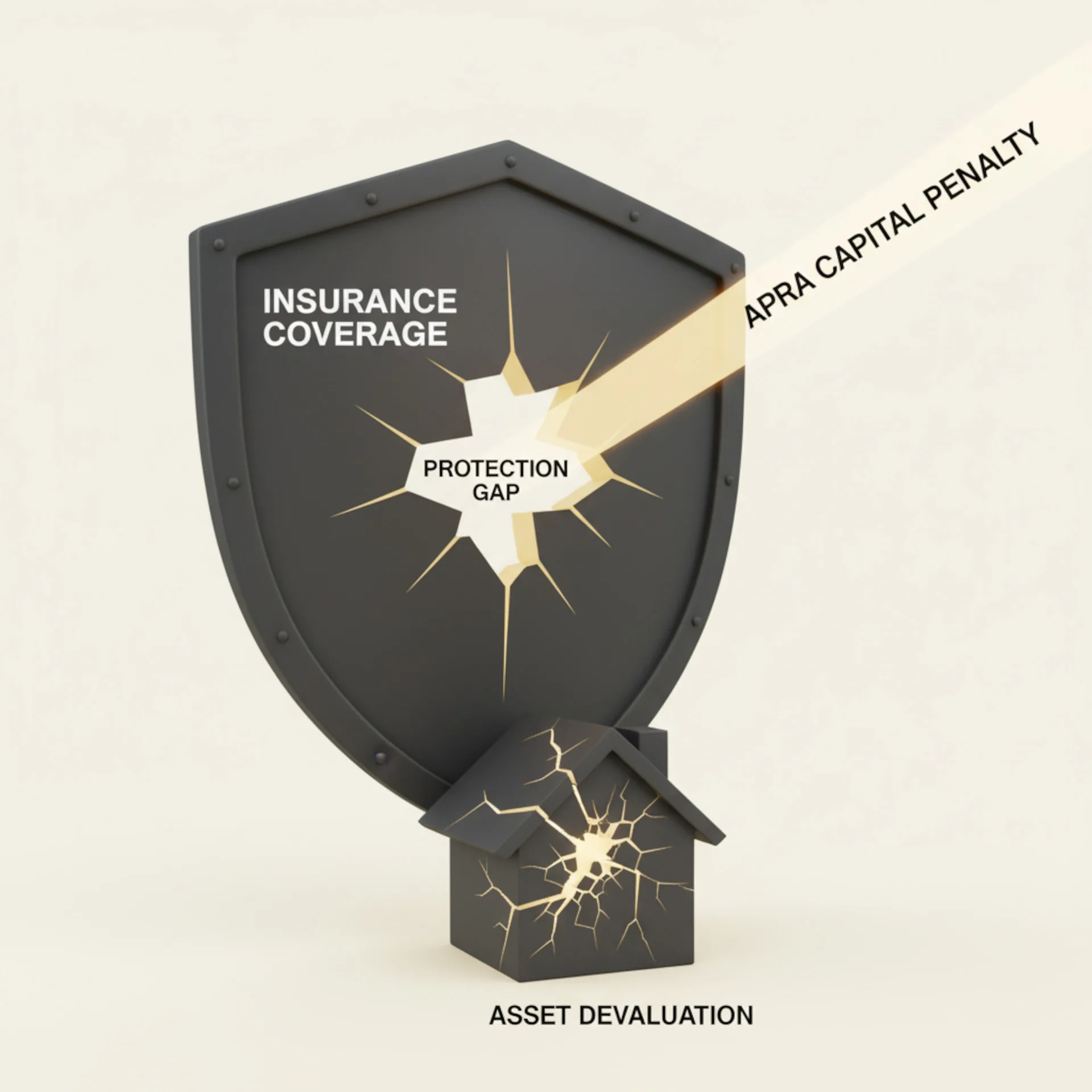
The Australian Prudential Regulation Authority (APRA) has executed a substantive pivot in its supervision of climate risk, moving from passive disclosure frameworks to active, interventionist enforcement. APRA has officially elevated the ‘household insurance protection gap’, the growing uninsurability of properties in high-risk zones, to a top-tier strategic priority. This is not a theoretical exercise; it is a structural change to how the regulator views financial stability. By defining the lack of insurance as a proxy for impaired collateral quality, APRA has created a mechanism to impose direct capital consequences on banks holding these high-risk mortgages, effectively deploying the protection gap as a regulatory instrument.
For property professionals, this regulatory shift directly translates into a new period of credit tightening and asset devaluation. The period of uniform lending criteria is over. Banks are already pre-emptively ‘bluelining’ high-risk zones by tightening Loan-to-Value Ratios (LVRs) and signalling a potential withdrawal of credit. This will accelerate the creation of a two-tiered property market, where postcodes with demonstrable climate resilience attract capital and value, while those in the ‘protection gap’ face a quantifiable, regulator-driven decline in both liquidity and price.
Background & Strategic Context
This development is a primary validation of APN’s core macro-theses, particularly the APN Sovereign Policy Composite Index™ (SPCI, 24800), which posits that state-level actors are the dominant force shaping property market outcomes. APRA’s pivot is a clear demonstration of a regulator moving from market observation to direct market creation, establishing new rules that will structurally reallocate capital. It also calibrates our understanding of the APN Risk & Compliance Index™ (24200), as the regulator shifts from guidance to active enforcement, signalling a significant increase in the velocity and impact of its interventions.
The State as Market-Maker (APN Sovereign Policy Composite Index™ (SPCI, 24800)): APRA’s decision to amend Prudential Standard CPS 220 is a classic SPCI (24800) intervention. By moving climate risk from discretionary guidance (CPG 229) to enforceable law, the regulator is no longer suggesting market behaviour; it is mandating it. This action directly creates a new capital cost for holding uninsurable assets, forcing a market-wide repricing of risk.
Enforcement Velocity Increasing (APN Risk & Compliance Index™ (24200)): The explicit commitment to amend CPS 220, combined with the established precedent of imposing capital overlays for non-financial risk failures, signals a significant increase in regulatory force. This validates a higher reading on the APN Regulatory Velocity Multiplier™ (APN RVM™), as this provides APRA with the enforcement mechanism required to regulate the protection gap.
Quantifying the Uninsurable (APN Climate-Risk Asset Devaluation Index™ (24500)): The Insurance Climate Vulnerability Assessment (CVA) and Hazards Insurance Partnership (HIP) are the state-sanctioned data engines that will quantify the protection gap. This provides the raw data needed to calculate an asset’s APN Financial Climate Sensitivity™ (24510), turning a conceptual climate risk into a measurable financial discount that will directly impact valuations and lending decisions.
Resilience as a Moat (APN Substrate™ (24150)): By forcing capital to retreat from high-risk areas, APRA’s actions will create a material value distinction between locations. Areas with high climate resilience and adaptive capacity—as measured by the APN Substrate™ index—will attract a ‘safety premium’, while exposed areas will be subject to a quantifiable, regulator-induced devaluation.
Deconstruction of the Source Event
This deconstruction is based on APN’s analysis of the Australian Prudential Regulation Authority’s (APRA) 2024-25 Corporate Plan, associated regulatory disclosures, and major bank climate reports. The key facts are:
- Strategic Pivot Formalised: APRA’s 2024-25 Corporate Plan officially elevates the ‘Protection gap for household insurance’ to a standalone strategic priority, separating it from general sustainability goals and defining it as an immediate risk to financial stability.
- Enforcement Mechanism Identified: The primary enforcement mechanism is the planned amendment of Prudential Standard CPS 220 (Risk Management). This moves climate risk from guidance to enforceable law, giving APRA the legal authority to impose Pillar 2 capital overlays on banks with inadequate risk management.
- Regulatory Application of Data Confirmed: The ongoing Insurance Climate Vulnerability Assessment (CVA), with results due in H2 2025, is designed to create a granular ‘heat map’ of uninsurable postcodes. This data will provide the evidentiary basis for APRA to challenge bank capital adequacy.
- Bank Retreat is Pre-emptive: Major banks, led by ANZ, are already reacting to the regulatory signal. They are actively tightening Loan-to-Value Ratios (LVRs) and articulating strategies for credit withdrawal from zones facing insurance retreat, a phenomenon APN identifies as ‘Bluelining’.
Critical Analysis & Balanced View
The strategic elegance of APRA’s approach lies in its precise nature. By utilising the discretionary power of Pillar 2 supervisory adjustments, the regulator bypasses the politically contentious and time-consuming process of legislating a standardised Pillar 1 ‘green weighting’ or ‘brown penalty’. This allows for faster, more targeted intervention. However, this creates a significant paradox. While intended to manage systemic risk by forcing an orderly retreat, the very act of formalising ‘uninsurable’ zones could trigger a disorderly structural disruption. The ‘Bluelining’ phenomenon, if it accelerates, risks creating regional property market contractions, constraining existing mortgage holders in negative equity and stranding assets to a degree not previously recorded in Australia.
Furthermore, the entire framework hinges on the data produced by the Insurance CVA. While this provides a powerful evidentiary basis for regulatory action, it also creates a single point of failure. The models, climate scenarios, and affordability assumptions underpinning the CVA will become a new focus for industry lobbying and legal challenges. APRA’s strategy assumes it can orchestrate a managed repricing of risk across the national property market. The elevated risk is that by highlighting the protection gap, it inadvertently triggers elevated market anxiety that leads to the very financial instability it seeks to prevent.
Strategic Implications for Property Professionals
- For Developers: Your site acquisition due diligence must now include a formal ‘insurability assessment’. Feasibility studies for projects in coastal, bushfire, or flood-prone regions must model not only construction costs but also the future availability and cost of end-user insurance, as this will directly impact project finance and sales velocity.
- For Agents & Buyers’ Agents: The ‘protection gap’ is now a material fact that impacts value and financeability. You have a professional obligation to advise clients on the insurance status and associated costs for a property. Expect insurance availability to become a primary negotiation point and be prepared for valuations to be explicitly discounted in high-risk zones.
- For Valuers: Your valuation methodology must evolve immediately. The historical assumption of full insurance coverage is no longer valid in all locations. Valuations must now incorporate a quantifiable risk premium or direct discount based on insurance availability and cost, as evidenced by market ‘Bluelining’ and forthcoming CVA data. Failure to do so exposes you to significant professional indemnity risk.
- For Mortgage Brokers & Lenders: The period of uniform national LVRs is ending. Your credit assessment process must become geographically granular. Expect to manage a complex matrix of varying LVR limits and serviceability buffers based on postcode-level climate risk data. This represents a substantive shift from product-based to location-based credit risk management.
APN Index Management
The APN Codex 24000 Series is a proprietary set of indices that translates complex market forces into measurable metrics. This section outlines how the preceding analysis is validated against, and informs the calibration of, these frameworks.
- Validation: This analysis provides primary validation for the APN Sovereign Policy Composite Index™ (SPCI, 24800) and the APN Risk & Compliance Index™ (24200), confirming that regulatory intervention is the primary driver of the new climate-risk landscape. It also validates the core thesis of the APN Climate-Risk Asset Devaluation Index™ (24500), which posits that climate risk will be monetised via financial regulation.
- Index Calibration (APN Substrate™ (24150)): The APN Substrate™ index is recalibrated to increase the weighting of insurance availability and affordability as a key forward-looking indicator of a location’s climate resilience and social stability. The output from the Insurance CVA will become a primary data feed for this index.
- Index Calibration (APN Climate-Risk Asset Devaluation Index™ (24500)): The APN Financial Climate Sensitivity™ (24510) metric is now calibrated to directly model the capital impact of Pillar 2 overlays and LVR restrictions in ‘protection gap’ zones. The ‘Bluelining’ phenomenon is now a tracked variable within the index, serving as a live measure of market retreat.
- Data Capture: This triggers a new data capture mandate to monitor and map bank-specific LVR restrictions by postcode. Tracking the real-world implementation of ‘Bluelining’ is a primary data input for the APN Climate-Risk Asset Devaluation Index™ (24500), serving as a leading indicator of market retreat.
Disclaimer
The analysis and information contained in this deconstruction are for general informational and strategic purposes only and do not constitute financial, investment, legal, or any other form of professional advice. The Australian Property Network (APN) is a strategic intelligence organisation and is not a licensed financial advisor.
This analysis is based on data and information from third-party sources believed to be reliable; however, APN provides no warranty as to its accuracy, currency, or completeness. Images used in this analysis are for illustrative and conceptual purposes only and may not represent real persons, properties, or events.
All frameworks (Codex 24100-24800) are proprietary to APN.
Property values and market conditions can go up or down. Before making any property or investment decisions, you must conduct your own thorough research and seek independent professional advice tailored to your specific circumstances.