
Are Farm Margins Under Pressure from Dry Seasons and Costs? A Bendigo Bank Agribusiness Statement Tested Against ABARES
NIL RETURN
Scope and Purpose
On 5 May 2026 Bendigo Bank Agribusiness reported that the national median farmland price reached a new record of $10,516 a hectare in 2025, up 2.8% and the slowest rise in a 12-year run of consecutive growth, with 6.3 million hectares traded (Australian Farmland Values Report 2026). Its Senior Manager, Industry Insights, Eliza Redfern, said that “a dry seasonal outlook and higher operational costs are putting pressure on margins”. The ABARES Agricultural Commodities report of September 2026 forecasts average broadacre farm finances for 2026–27 and describes the season to date, which allows that statement to be put against a government forecast made four months later. The statement holds with a qualification: farm profit is forecast to fall by about two-fifths, but the cause is lower revenue rather than rising costs, and the seasonal picture is mixed rather than dry.
Proposition One: Pressure on Margins
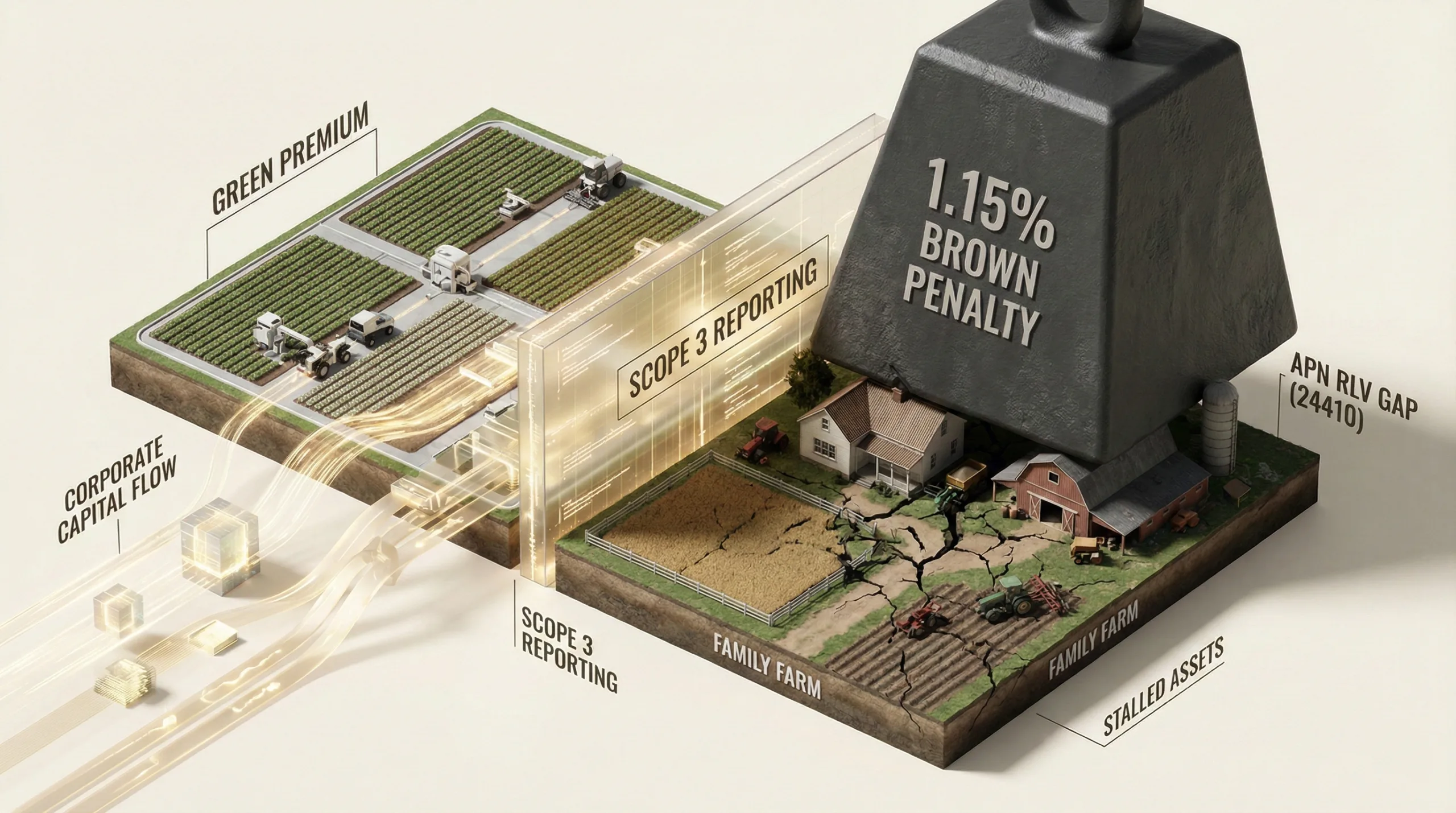
ABARES forecasts that average broadacre farm business profit will fall 39% in 2026–27, by $86,000 in real terms, from $219,000 per farm in 2025–26 to $133,000 (ABARES, Agricultural Commodities, September 2026, Table 1.2). The 90% range for the forecast runs from $72,000 to $204,000, so even the upper bound is below the 2025–26 estimate. Farm cash income falls 17.6%, from $431,000 to $355,000. The claim holds: farm business profit is forecast to fall by about two-fifths, and farm cash income falls from 36.9% of receipts to 32.6% (APN calculation).
Change in Average Broadacre Farm Finances, 2025–26 to 2026–27, $ Thousand per Farm
APN chart based on ABARES data: Agricultural Commodities, September quarter 2026, Table 1.2, average broadacre farm, change from the 2025–26 estimate to the 2026–27 forecast, in 2025–26 dollars. A negative bar is a fall; costs are forecast $3,000 lower.
Proposition Two: Higher Operational Costs
Costs are high and little changed in real terms. ABARES expects total cash costs of $734,000 per farm in 2026–27 in 2025–26 dollars, $3,000 below the 2025–26 estimate of $737,000, and describes them as “elevated”: fuel prices remain high and fodder use increases, while fertiliser costs are forecast to fall. Input prices rose considerably in the second half of 2025–26 and are expected to ease in real terms, though they remain high historically. The fall in profit comes mainly from revenue: total cash receipts are forecast to fall $80,000, or 6.8%, on lower crop and livestock volumes and lower real prices for most livestock. ‘Higher operational costs’ holds only in level, not in direction: costs are historically high and, in real terms, flat, and the margin squeeze in 2026–27 is a revenue squeeze.
Proposition Three: A Dry Seasonal Outlook
The seasonal picture has changed since May and varies by region. ABARES itself describes a poor seasonal outlook at the end of autumn, so the May statement was consistent with the outlook at the time. ABARES reports average to above average winter rainfall across most south-eastern growing regions, which has lifted soil moisture and led to an upward revision of winter crop production; conditions have been very favourable in South Australia, Victoria and southern New South Wales. In northern New South Wales and Queensland, winter rainfall has supported only delayed establishment and below average yield expectations. For spring, the rainfall outlook for September to November 2026 indicates that large areas of eastern and southern Australia are expected to be drier than average, with a current El Niño; ABARES notes that the effect is highly uncertain and that crops in the south-east are less reliant on spring rain this year. The claim holds in part: the north is dry, the south has had a good winter, and the spring outlook is drier. Gross value of agricultural production is forecast to fall 5% to $99.4 billion in 2026–27, still the second highest in nominal terms.
The Tests at a Glance
| Statement (Bendigo Bank Agribusiness, 5 May 2026) | Test | Result |
|---|---|---|
| A dry seasonal outlook and higher operational costs are putting pressure on margins | ABARES forecast of average broadacre farm business profit, 2026–27 | Holds: profit forecast to fall 39% to $133,000 a farm |
| Higher operational costs | ABARES total cash costs per farm | Holds in level, not in direction: $734,000, $3,000 below 2025–26 |
| A dry seasonal outlook | ABARES seasonal conditions, September 2026 | Holds in part: dry north, favourable south-east winter, drier spring outlook |
| Growth in the farmland market will continue to level off in 2026 | No 2026 sales data published | Not testable |
Sources: Bendigo Bank Agribusiness, Australian Farmland Values Report 2026 (release of 5 May 2026); ABARES, Agricultural Commodities, September 2026; APN calculation.
Not Tested
The report’s national median of $10,516 a hectare is a private index of sales, and the release does not state its sales sources or how the median is computed. Farmland values for 2026 are not yet published by the publishers cited, so the statement that growth will continue to level off in 2026 cannot be tested. Farm profit is not farmland value: a fall in expected profit bears on what buyers will pay, but this test does not measure that link.
What Would Show Which Way It Is Going
Signposts
| Signpost | Next release | What it would show |
|---|---|---|
| ABARES Agricultural Commodities, next quarterly edition | Not announced | Whether the profit forecast moves with the spring season and input prices |
| Bendigo Bank Agribusiness, Australian Farmland Values Report | Next annual edition, not announced | The 2026 median price and transaction volume |
Neither publisher has announced a date.
APN Analytical Synthesis
Bendigo Bank Agribusiness’s May statement holds in its central point and is partly overtaken in its stated causes. ABARES forecasts a 39% fall in average broadacre farm business profit in 2026–27, to $133,000, driven mainly by a $80,000 fall in receipts. Costs remain high and are forecast to be flat in real terms, the seasonal outlook has divided into a favourable south-east and a dry north, and the spring rainfall outlook is drier than average across large areas of eastern and southern Australia. Farmland values reached a record median in 2025 on the bank’s index; whether a year of falling farm profit shows up in prices will be visible in the 2026 sales data, which is not yet available.
This test speaks only to the structural conditions the cited data can independently support; it does not constitute a view on future property values, commodity prices or government policy, and no such view is expressed or implied.
- Australian Bureau of Agricultural and Resource Economics and Sciences (ABARES) (Reference period: September quarter 2026) Agricultural Commodities: September Quarter 2026, Overview [https://www.agriculture.gov.au/abares/research-topics/agricultural-outlook/september-2026], accessed 31 October 2026.
- Bendigo Bank Agribusiness (Reference period: 2025) Australian farmland values hit new record, but growth cools to 12-year low (media release, 5 May 2026) [https://www.bendigobank.com.au/media/bendigo-bank-agribusiness-australian-farmland-values-hit-new-record-but-growth-cools-to-12-year-low/], accessed 31 October 2026.
ABARES material is used with attribution; calculations are APN’s and are not attributable to ABARES.
Figures are quoted from the publisher’s published releases and remain the property of the publisher.
Disclaimer
The analysis and information contained in this publication are for general informational and strategic purposes only and do not constitute financial, investment, legal, or any other form of professional advice. Australian Property Network is not a licensed financial advisor. Property values and market conditions can go up or down. Before making any property or investment decisions, you must conduct your own thorough research and seek independent professional advice tailored to your specific circumstances. Images are for illustrative purposes only. E.&O.E.
Findings are presented on the basis of data and evidence alone.