
Since 1 July 2026, real estate agents, buyer’s agents and property developers who sell their own stock have been regulated by AUSTRAC under the anti-money laundering law, in what AUSTRAC’s 2024 risk assessment called the most substantial phase of reforms to it. By 17 September, 18,350 real estate businesses had enrolled, more than any other newly covered industry. That assessment rated real estate’s money laundering vulnerability “very high”, and identified the absence of these rules as a gap: agents, lawyers and conveyancers who handle property sales were outside the law.
AUSTRAC is Australia’s financial intelligence agency and anti-money laundering regulator. The rules apply to businesses providing designated services; they are not a tax or a fee on buyers.
What changed on 1 July 2026
On 29 November 2024 Parliament passed amendments to the Anti-Money Laundering and Counter-Terrorism Financing Act 2006 that extend it to businesses that had not been covered: real estate professionals, lawyers, conveyancers, accountants, trust and company service providers, dealers in precious metals and stones, and some virtual asset services. They have been regulated by AUSTRAC since 1 July 2026 (AUSTRAC, about the reforms).
For real estate, the law covers two kinds of service. The first is brokering the sale, purchase or transfer of real estate for someone else as a business, which is what seller’s and buyer’s agents do. The second is selling or transferring real estate as a business without an independent agent, which captures developers selling house and land packages, off-the-plan apartments and new subdivision lots through their own sales staff (AUSTRAC, real estate designated services).
| Covered | Not covered |
|---|---|
| Seller’s agents and buyer’s agents who broker a sale, purchase or transfer, for a fee, as a business | Leases of 30 years or less |
| Developers and other businesses selling house and land packages, off-the-plan apartments or new subdivision lots without an independent agent | Private sales of a home, and a business selling its own premises incidentally |
| Transfers without payment, such as a parent transferring the family home to a child, where a regulated business handles them | Easements, restrictive covenants and mortgagee interests |
| Leases of more than 30 years, such as ACT 99-year leases, and crown and pastoral leases | Dwellings on land the owner only leases for 30 years or less, such as many caravan parks and some retirement villages |
Source: AUSTRAC, “Real estate designated services” (updated 31 August 2026). The table summarises AUSTRAC’s guidance; the Act and the guidance give the full conditions.
What agents and developers must now do
| Obligation | What it means for a real estate business |
|---|---|
| Enrol | Apply to AUSTRAC no later than 28 days after first providing a covered service |
| Governance | Name a governing body, a senior manager who approves the program, and a compliance officer |
| AML/CTF program | A written assessment of the business’s money laundering risks, and policies and controls to manage them |
| Know the customer | Identify and verify customers before providing the service; for an agent, both the seller and the buyer are customers |
| Report | Suspicious matters; transactions involving $10,000 or more in cash; an annual compliance report |
| Keep records | Program, customer and transaction records, usually for seven years |
Source: AUSTRAC, “Your obligations” (updated 15 October 2026) and “Enrol with us overview” (updated 14 October 2026).
The obligation that buyers and sellers will notice is the identity check. When an agent acting for a seller brokers a sale, AUSTRAC treats both the seller and the buyer as the agent’s customers. The agent begins providing the service to the seller when the agency agreement is signed, and to the buyer when it is reasonably expected that the sale will proceed, typically when an offer is accepted and the contract signed. At auctions, where the buyer is known only when the hammer falls, the checks may be completed afterwards if doing them first would disrupt the sale.
Why real estate
AUSTRAC’s Money Laundering in Australia National Risk Assessment 2024 assessed the domestic real estate sector as posing a “very high and stable” money laundering vulnerability, the highest rating on its scale. It describes real estate as widely exploited because of the market’s stability, its rising values and the income it produces, and lists the methods seen: manipulating property values, reselling in quick succession at a higher price, paying for renovations with illicit funds before selling, using rental payments to make income look legitimate, and buying through complex legal structures that hide who owns the property.
From 2020–21 to 2022–23, more than $55 million of residential and more than $7 million of commercial real estate was forfeited at the end of court proceedings. The assessment notes that most states do not collect information on who ultimately owns a property, and that the agents, lawyers and conveyancers who enable property purchases were, at the time, outside the anti-money laundering law.
Enrolments so far
Businesses enrolled with AUSTRAC as new reporting entities, by industry, 17 September 2026
APN chart based on AUSTRAC data: “Enrol with us overview”, as of 17 September 2026. Businesses enrolled with AUSTRAC as new reporting entities, by industry.
By 17 September 2026, 18,350 real estate businesses had enrolled with AUSTRAC, 45% of the 40,630 enrolments from the newly covered industries. A business must apply no later than 28 days after it first provides a covered service, and AUSTRAC updates the counts as enrolments continue.
What the APN index reads
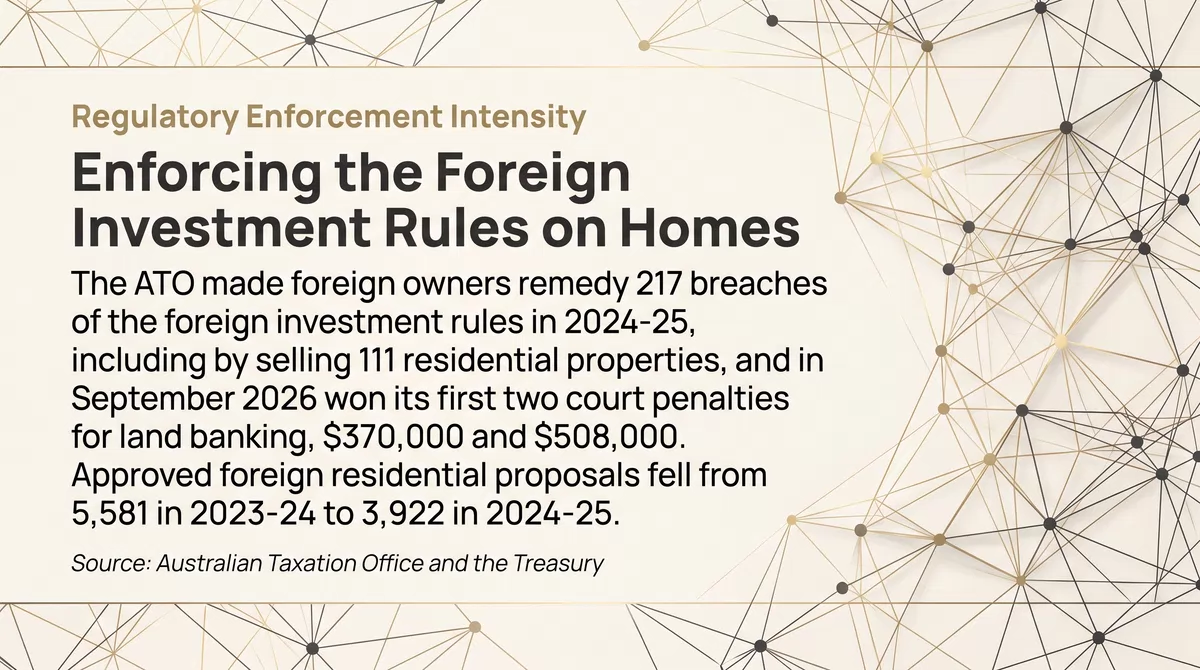
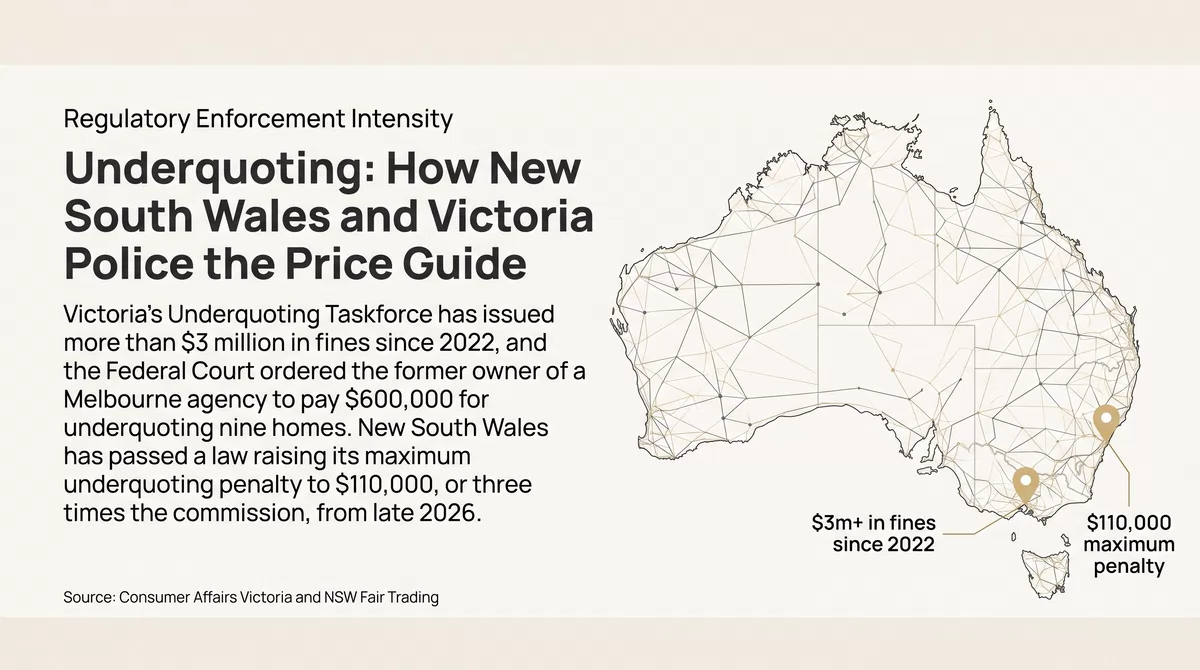
Regulatory Enforcement Intensity (24721), part of the APN Investment Conditions Index™, reads +1.1006σ, March quarter 2026, position 97.8, ranked against 46 quarters. Its inputs are the investigations the Australian Securities and Investments Commission begins and the enforceable undertakings the Australian Prudential Regulation Authority accepts; AUSTRAC’s supervision of real estate is not among them. Companion articles set out how New South Wales and Victoria enforce the underquoting rules and how the ATO enforces the foreign investment rules on homes.
What this does not show
The new rules are three and a half months old. AUSTRAC has published enrolment counts but no figures on reports made by real estate businesses or on any enforcement against them, so this article describes obligations, not breaches. The risk assessment’s forfeiture figures describe criminal cases that reached the end of court proceedings, not the total amount laundered through property, which AUSTRAC says is difficult to estimate.
- AUSTRAC (Reference period: enrolments as of 17 September 2026) Enrol with us overview [https://www.austrac.gov.au/new-austrac/enrol-us/enrol-us-overview], accessed 15 October 2026.
- AUSTRAC About the reforms [https://www.austrac.gov.au/industry-and-business/about-amlctf-reforms/about-reforms], accessed 15 October 2026.
- AUSTRAC Money Laundering in Australia National Risk Assessment 2024 [https://austrac.gov.au/sites/default/files/2024-07/2024%20AUSTRAC%20Money%20Laundering%20NRA.pdf], accessed 15 October 2026.
- AUSTRAC Real estate designated services [https://www.austrac.gov.au/new-austrac/designated-services-newly-regulated-entities/real-estate-designated-services], accessed 15 October 2026.
- AUSTRAC Your obligations [https://www.austrac.gov.au/industry-and-business/obligations-and-guidance/your-obligations], accessed 15 October 2026.
AUSTRAC’s National Risk Assessment is © Commonwealth of Australia 2024, licensed under a Creative Commons Attribution 4.0 International licence.
Other AUSTRAC material: © AUSTRAC for the Commonwealth of Australia, licensed under a Creative Commons Attribution 4.0 International licence.
Disclaimer
The analysis and information contained in this publication are for general informational and strategic purposes only and do not constitute financial, investment, legal, or any other form of professional advice. Australian Property Network is not a licensed financial advisor. Property values and market conditions can go up or down. Before making any property or investment decisions, you must conduct your own thorough research and seek independent professional advice tailored to your specific circumstances. Images are for illustrative purposes only. E.&O.E.
Findings are presented on the basis of data and evidence alone.