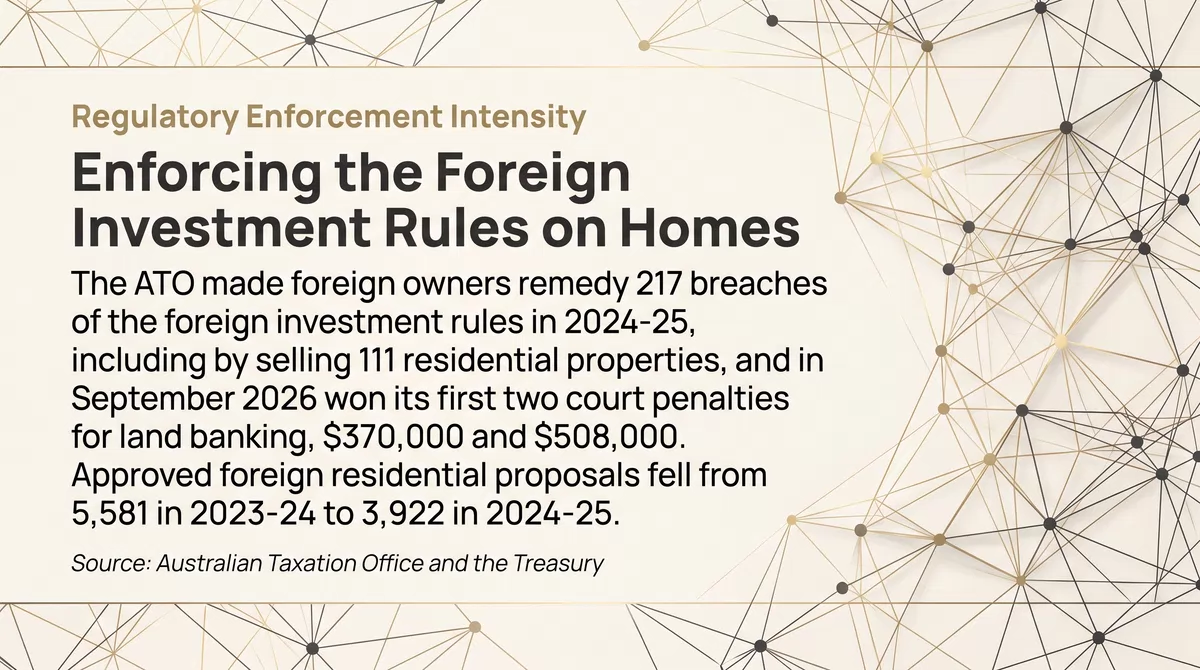

The Australian Taxation Office made foreign owners remedy 217 breaches of the foreign investment rules in 2024–25, including by selling 111 residential properties, and in September 2026 it won its first two court penalties for land banking: $370,000 and $508,000 against foreign buyers who did not build on vacant land within four years. At the same time, approvals for foreign purchases of homes have fallen, from 5,581 in 2023–24 to 3,922 in 2024–25, the year a ban on foreign purchases of established dwellings began.
Foreign persons must have approval to buy residential land in Australia, and the approval carries conditions. The Australian Taxation Office administers and enforces the rules for residential property.
The rules being enforced
A foreign person generally needs approval under the Foreign Acquisitions and Takeovers Act 1975 before buying residential land in Australia, and the approval comes with conditions. A buyer of vacant land must generally build a dwelling within four years. Foreign owners must lodge a vacancy fee return each year and pay a fee if the home is not lived in or rented out for long enough. And from 1 April 2025 foreign persons, including temporary residents and foreign-owned companies, have generally been banned from buying established dwellings; in the 2026–27 Budget the Government extended the ban to 30 June 2029, with exceptions including investments that significantly increase housing supply (ATO, 12 May 2026). A companion article sets out how the Commonwealth rules on foreign home purchases have changed since 2011.
Since the Australian Taxation Office took on residential foreign investment, it has screened applications and enforced the conditions. The figures below are its own.
How the ATO finds breaches
The ATO describes three main tools: data matching with other agencies, including ASIC, Home Affairs, AUSTRAC, local councils and state revenue offices; reviews, often prompted by that matching or by tip-offs; and audits. It is auditing every foreign investment approval that requires residential land to be developed. Once it finds a breach it can direct the owner to fix it, issue an infringement notice or penalty, order the owner to sell, revoke an approval obtained on false information, or go to court (ATO, compliance approach, updated 21 September 2026).
In 2024–25 it forced the remedy of 217 breaches, including the disposal of 111 residential properties (ATO, 29 September 2026).
The court cases
| Decided | Case | Breach | Penalty | Status |
|---|---|---|---|---|
| April 2022 | Commissioner of Taxation v Balasubramaniyan | Bought four properties without approval and held two established dwellings | $250,000 | Decided |
| September 2026 | Guno Handojo | Did not build on vacant land within four years | $370,000 | Under appeal |
| September 2026 | Fengqin Li | Did not build on vacant land within four years | $508,000 | Under appeal |
Sources: Australian Taxation Office, media releases of 11 April 2022, 17 September 2026 and 29 September 2026, and “Our approach to foreign investment compliance”.
The earlier court penalty, in 2022, was against a foreign buyer who had bought four properties without approval and held two established dwellings: $250,000. The two cases of September 2026 both arose from the land banking audit. In each, the buyer had approval to buy vacant land on condition of building within four years and did not build; the Federal Court froze the land during the proceedings so it could not be sold, and in the second case the ATO also registered a charge over the land to secure unpaid vacancy fees on another property the buyer held. Both buyers have appealed (17 September 2026; 29 September 2026).
Fewer approvals since the ban
Approved foreign residential real estate proposals, by quarter, January–March 2025 to January–March 2026
Source: The Australian Government—the Treasury, Quarterly Report on Foreign Investment, January–March 2025 to January–March 2026. Approved residential real estate proposals in each quarter, as published in each quarter’s report; later reports may revise earlier quarters.
Treasury’s quarterly reports count the residential proposals approved for foreign buyers. There were 5,581 in 2023–24 and 3,922 in 2024–25, 30% fewer, and 2,326 in the first three quarters of 2025–26. In the March quarter 2026 there were 663, the fewest of the five quarters shown. The count is of approvals, not purchases: an approval may never be used (the Treasury, 29 May 2026).
| Source of investment | 2023–24 | 2024–25 | 2025–26 to March |
|---|---|---|---|
| China | 1,998 | 1,355 | 638 |
| India | 550 | 509 | 177 |
| Taiwan | 395 | 463 | 285 |
| Hong Kong | 409 | 284 | 127 |
| Vietnam | 363 | 383 | 237 |
| Nepal | 321 | 286 | 78 |
| Singapore | 268 | 254 | 91 |
Source: The Australian Government—the Treasury, Quarterly Report on Foreign Investment, 1 January to 31 March 2026, Table 4. Number of approved residential real estate proposals. The table lists the ten sources with the highest value of approvals in the March quarter 2026; shown are the seven of them with the most approvals in 2023–24.
Approvals for buyers from China fell from 1,998 in 2023–24 to 1,355 in 2024–25, a fall of 32%, and to 638 in the first three quarters of 2025–26. China remained the largest source in every period.
What the APN index reads
Regulatory Enforcement Intensity (24721), part of the APN Investment Conditions Index™, reads +1.1006σ, March quarter 2026, position 97.8, ranked against 46 quarters. Its inputs are the investigations the Australian Securities and Investments Commission begins and the enforceable undertakings the Australian Prudential Regulation Authority accepts; the ATO’s foreign investment enforcement is not among them. APN’s Foreign Investment Policy (21340) records the rules themselves and the extra cost they impose on a foreign buyer. A companion article sets out how New South Wales and Victoria enforce the underquoting rules.
What this does not show
The ATO reports its enforcement as annual totals and individual cases, so there is no series showing whether breaches are becoming more or less common. The disposals it reports were made as part of remedying breaches; the figures do not say how many were ordered and how many were voluntary. The approval counts are of proposals, not purchases, and the quarterly figures are as each report published them, before later revision.
- Australian Taxation Office ‘Land banking’ foreign investor busted by ATO (17 September 2026) [https://www.ato.gov.au/media-centre/land-banking-foreign-investor-busted-by-ato], accessed 15 October 2026.
- Australian Taxation Office ATO secures second civil penalty against residential land bankers (29 September 2026) [https://www.ato.gov.au/media-centre/ato-secures-second-civil-penalty-against-residential-land-bankers], accessed 15 October 2026.
- Australian Taxation Office Foreign investment – extending the ban on foreign purchases of established dwellings [https://www.ato.gov.au/about-ato/new-legislation/in-detail/international/banning-foreign-purchases-of-established-dwellings], accessed 15 October 2026.
- Australian Taxation Office Our approach to foreign investment compliance [https://www.ato.gov.au/individuals-and-families/investments-and-assets/foreign-resident-investments/foreign-investment-in-australia/how-we-ensure-compliance-by-a-foreign-person/our-approach-to-foreign-investment-compliance], accessed 15 October 2026.
- The Australian Government—the Treasury (Reference period: January 2025 to March 2026) Quarterly Report on Foreign Investment, 1 January to 31 March 2026, and earlier quarterly reports [https://foreigninvestment.gov.au/news-and-reports/reports-and-publications/quarterly-report-jan-mar-2026], accessed 15 October 2026.
Based on The Australian Government the Treasury data, licensed under a Creative Commons Attribution 4.0 licence.
Australian Taxation Office material: © Australian Taxation Office for the Commonwealth of Australia, used under its copyright notice.
Disclaimer
The analysis and information contained in this publication are for general informational and strategic purposes only and do not constitute financial, investment, legal, or any other form of professional advice. Australian Property Network is not a licensed financial advisor. Property values and market conditions can go up or down. Before making any property or investment decisions, you must conduct your own thorough research and seek independent professional advice tailored to your specific circumstances. Images are for illustrative purposes only. E.&O.E.
Findings are presented on the basis of data and evidence alone.