

Australian Real Estate Sector Navigates Structural Overservice Amidst Constrained Transaction Volumes
A structural misalignment between a historically large practitioner workforce and constrained transaction volumes is creating significant operational friction in the Australian real estate sector. APN analysis quantifies this overservice, revealing an implied national average of 3.32 transactions per agent per annum, a ratio that is accelerating commission compression, regulatory intervention, and industry consolidation.

APN Deconstruction Ep. 14 – The Regulatory Cascade
What happens when 62% of investors want house prices to fall? We deconstruct the $12.77 trillion paradigm shift, and how incoming tax reforms could accidentally freeze the entire housing market.

Australian Real Estate Services: Practitioner Headcount Growth Diverges from Transaction Velocity
A structural divergence is reshaping the Australian real estate professional services sector. APN analysis identifies a material oversupply of practitioners, with record headcounts across broking and agency cohorts competing for a transaction pool that has been constrained by macroprudential credit rationing and reduced listing volumes.

A System Under Compression – 21000 Series Node Composite: Q2 2026
The cost of capital and the cost of production are simultaneously elevated above their historical baselines, while the demand-side inputs that sustained the preceding expansion are in measured retreat.

The New Contract: What Australia’s Structural Sentiment Shift Means for the Property Market from 2027
The implicit sovereign guarantee underwriting three decades of Australian property values has structurally expired. This editorial maps the transition — the turbulent threshold ahead, the capital reallocation problem, and the operating environment that will define the market from 2027 onward.
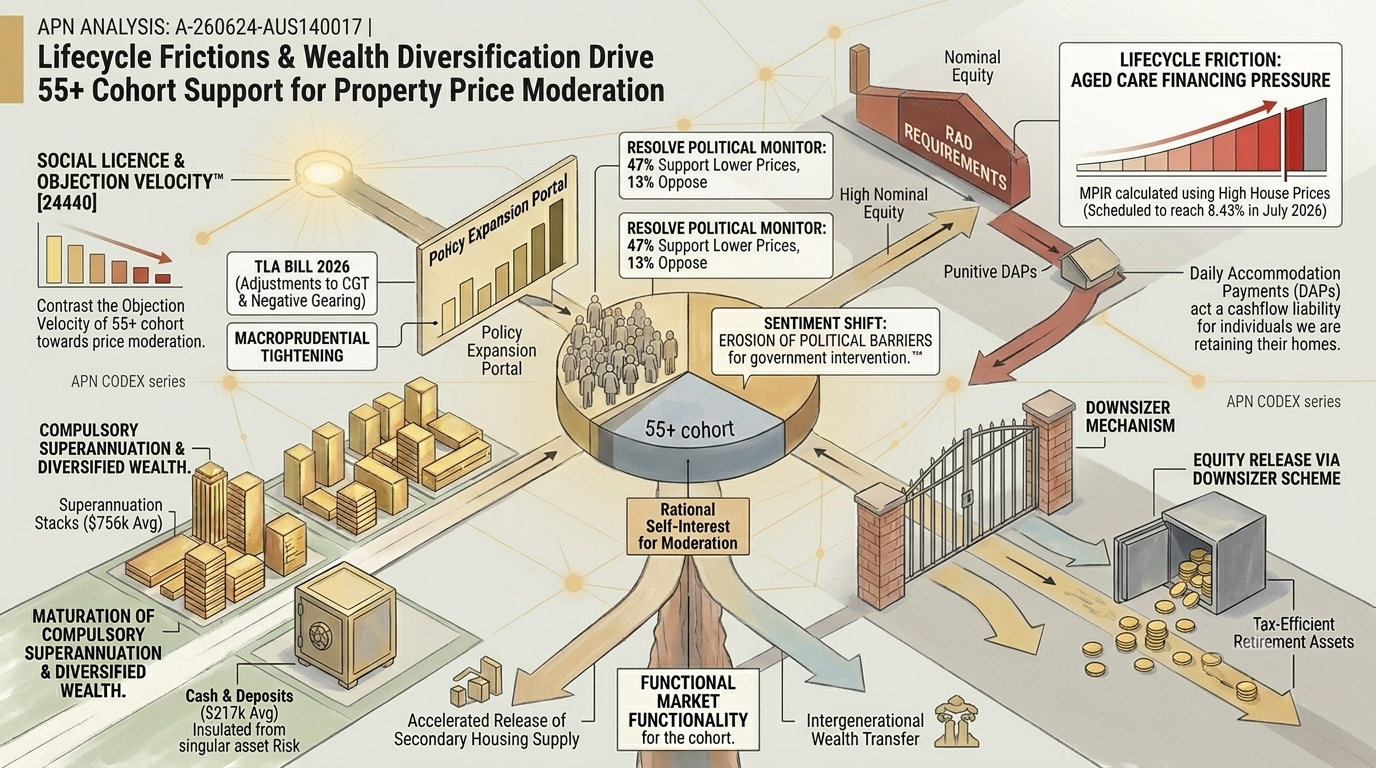
Lifecycle Frictions and Wealth Diversification Drive 55+ Cohort Support for Property Price Moderation
A structural shift in sentiment among Australia’s 55+ demographic is recalibrating the political calculus of the residential property market. APN analysis identifies that this cohort’s support for property price moderation is driven by rational, structural factors including wealth diversification through superannuation, intergenerational equity concerns, and lifecycle frictions related to the financing of aged care, creating a durable social licence for government policy intervention.
