
Compound Structural Pressures Concentrate Displacement Risk in Social Capital Framework
APN ANALYSIS: A-260429-AUS139050
Executive Summary
As of Q1 2026, five active deviations from the certified 15-year baseline — spanning interest rates, inflation, employment composition, construction costs, and consumer sentiment — are transmitting compound pressure into the social architecture of Australian residential property. This is analytically significant because these inputs are creating measurable pressure within the APN Social Capital Index™ (24100) framework, a leading indicator of asset value resilience, before this pressure has registered in lagging indicators such as median price or transaction volumes.
For property professionals, this analysis provides a forward-looking map of emerging risk. It identifies the specific causal pathways through which macroeconomic pressures translate into localised social friction and quantifies the concentration of this risk in the APN Acute Vulnerability Index™ (24126). The findings signal that the preconditions for demographic displacement are now structurally present in exposed localities, requiring a recalibration of risk assessment away from historical price data and towards leading indicators of social capital integrity.
Background & Strategic Context
This analysis validates and calibrates APN’s core macro-thesis on the primacy of social capital in determining long-term residential asset valuation. The convergence of five structural pressures on the APN Social Capital Index™ (24100) branch demonstrates how discrete economic inputs translate into measurable social friction, which precedes and informs future price adjustments. The event is analytically significant because it confirms the framework’s function as a forward-looking instrument, detecting structural pressure before it becomes visible in lagging transactional data.
A System Under Pressure — APN Social Capital Index™ (24100) This composite index was designed to quantify the long-term economic viability of a residential location based on the resilience of its underlying social architecture. It integrates five structural pillars into a single framework, providing a more complete view of value than price and yield alone.
Pillar 1: The Foundation of Community Cohesion — APN Bedrock™ (24110) This pillar measures the stability of a locality’s resident base, including homeownership rates and labour market participation. It operates on the premise that cohesive, stable communities generate positive externalities that sustain property values. The current pressures are acting to destabilise tenure, a primary input for this index.
Pillar 2: The Leading Indicator of Social Stress — APN Sentinel™ (24120) This pillar measures the perception of safety and security, which often functions as a more immediate market driver than statistical crime rates. Its subordinate instrument, the APN Acute Vulnerability Index™ (24126), is specifically designed to detect the precursors to demographic displacement, making it the most sensitive instrument in the current environment.
Pillar 3: The Education Value Premium — APN Meridian™ (24130) This pillar measures the education value of a location, tracking both the objective academic performance of local institutions and the market’s willingness to price access to them into residential asset values. It distinguishes between theoretical and realised catchment premiums — the latter being sensitive to buyer capacity and confidence, both of which are under structural constraint in the current environment.
Pillar 4: Amenity & Access — APN Agora™ (24140) This pillar measures the richness of the lived experience: walkability, social infrastructure density, public transport utility, digital connectivity, and proximity to essential daily services. APN Agora™ is exposed to current conditions via two pathways — the pipeline delivery constraint from elevated construction costs, and the commercial viability pressure on local social infrastructure from record-low consumer sentiment.
Pillar 5: Climate Resilience — APN Substrate™ (24150) This pillar measures physical climate resilience — flood and bushfire exposure, insurability, and adaptive capacity. APN Substrate™ treats climate risk as a material financial variable. In the current environment, the construction cost constraint is widening the gap between regulatory climate-resilience standards and the sector’s capacity to deliver compliant stock, producing a flat-to-negative trajectory in high-exposure localities.
Deconstruction of the Source Event
This deconstruction is based on APN’s analysis of the Q1 2026 Delta-Analysis matrix, which documents five confirmed deviations from the certified 15-year baseline concluding December 2025.
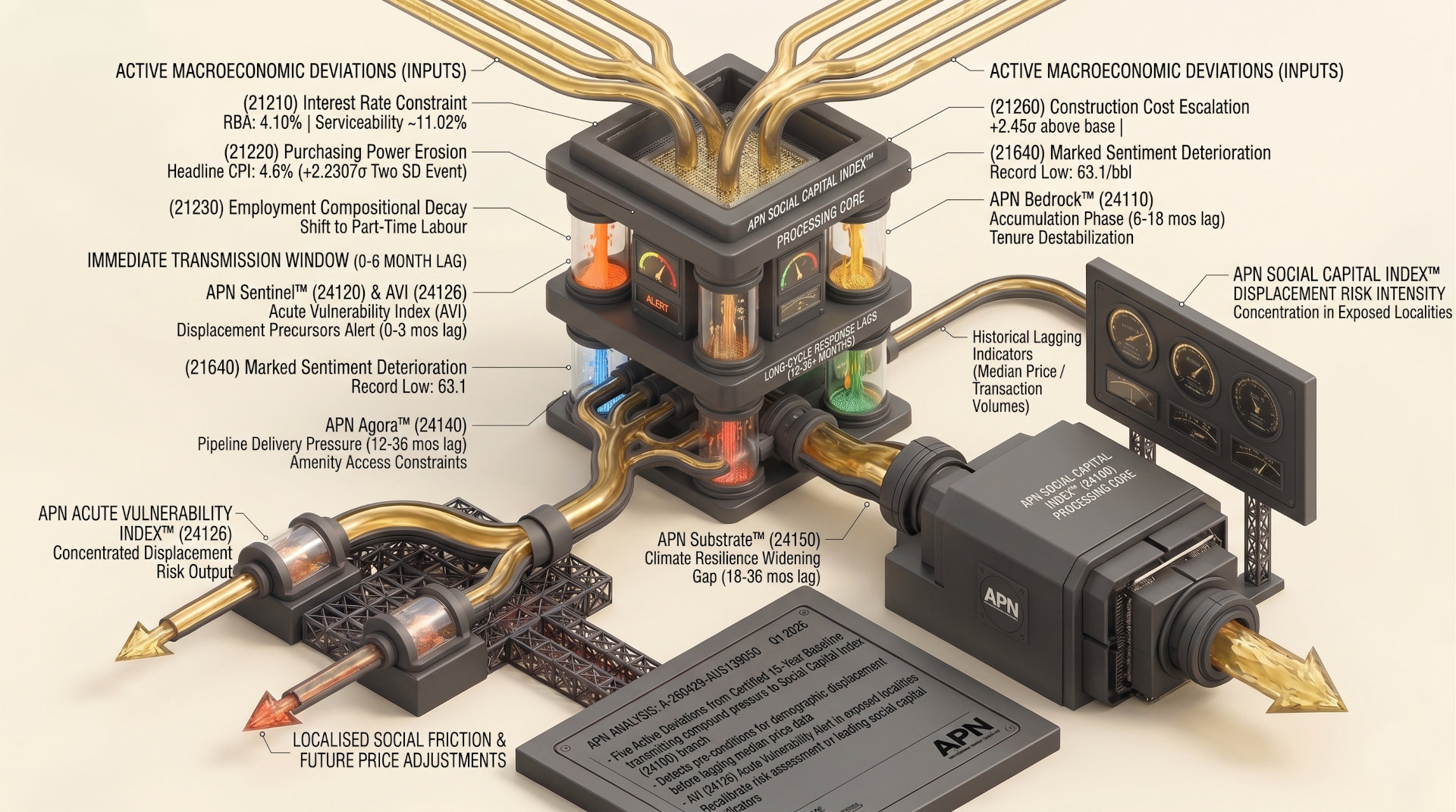
Interest Rate Constraint: The RBA Official Cash Rate reached 4.10% on 18 March 2026, following two upward adjustments from the terminal Q4 2025 baseline of 3.60%. This pushes theoretical mortgage serviceability assessment rates towards 11.02% under APRA’s mandatory buffer methodology. This structurally limits refinancing capacity and suppresses transactional activity for marginal mortgage holders.
Purchasing Power Erosion: Headline CPI reached 4.6% in the 12 months to March 2026 — the highest annual reading since September 2023 — with a recalibrated Z-Score of +2.2307σ against the 15-year baseline, confirming a verified Two Standard Deviation Event. Housing-specific inflation recorded 6.5%. Electricity costs are 25.4% above year-ago levels following the expiry of government rebates. The trimmed mean held at 3.3%, confirming that underlying inflation is structurally persistent independent of the fuel component. The rising cost of non-discretionary items is contracting real household purchasing power across all owner-occupier cohorts.
Employment Compositional Decay: A national unemployment rate of 4.3% masks a material shift from full-time to part-time labour participation. This deteriorates income consistency and borrowing capacity for affected cohorts — a factor not visible in headline employment metrics but material to mortgage serviceability assessment.
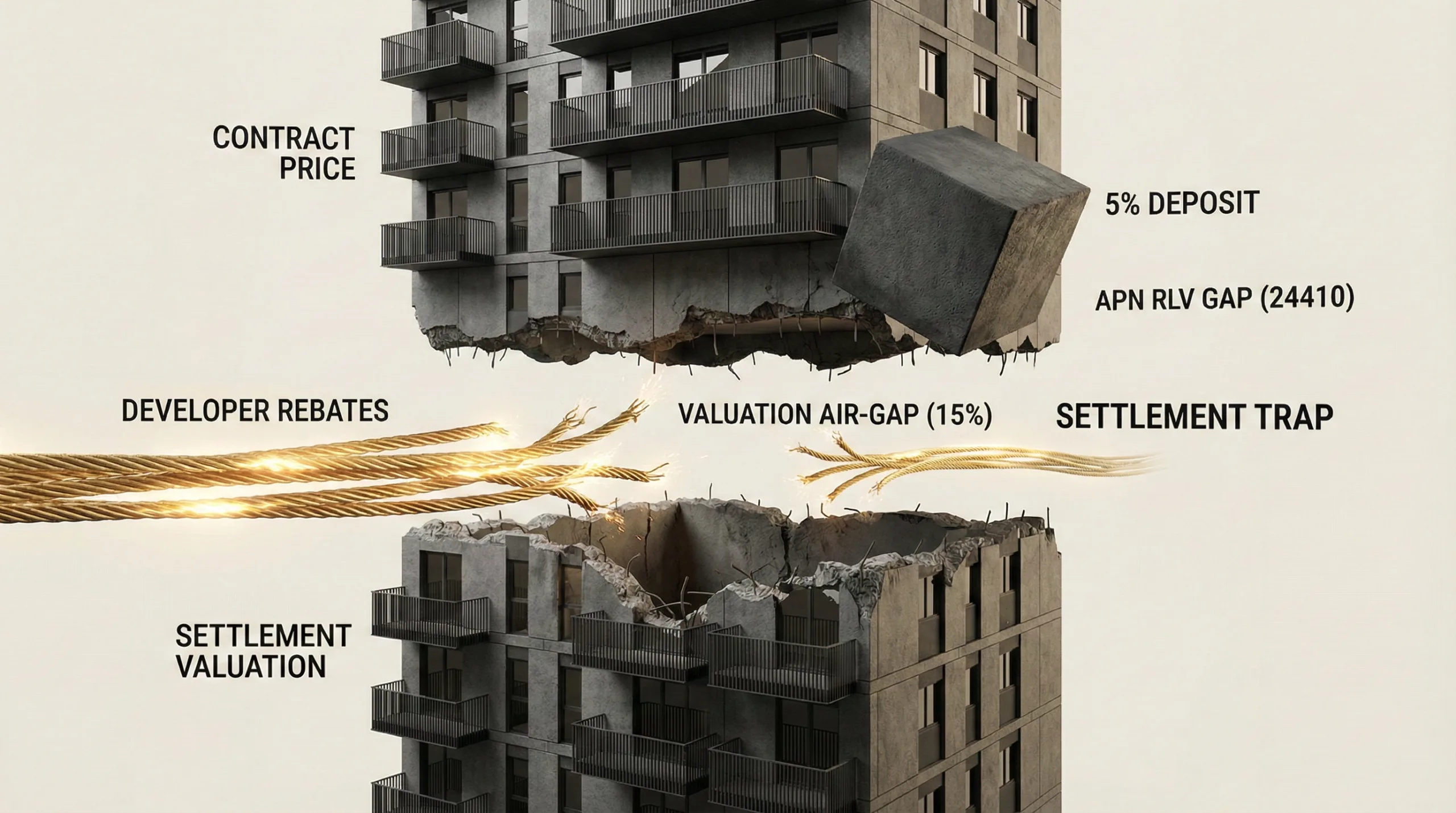
Construction Cost Escalation: Construction costs are recorded at +2.45σ above the 15-year baseline, compounded by energy cost escalation with Brent crude at US$105/bbl as the accepted new normal and a Q1 2026 peak of US$119/bbl. This functions as an indiscriminate inflationary multiplier across materials, logistics, and subcontractor margins, constraining the physical delivery of new residential supply and widening the APN Replacement Cost Gap™ (24450).
Marked Sentiment Deterioration: The Westpac-Melbourne Institute Consumer Sentiment Index recorded a record low of 63.1 in March 2026. This extreme negative deviation has decoupled from observed transaction behaviour, creating a fragile market condition where psychological deterioration is running ahead of behavioural response.
Critical Analysis & Balanced View
The convergence of these five structural pressures creates two critical second-order effects not immediately apparent from the individual data points.
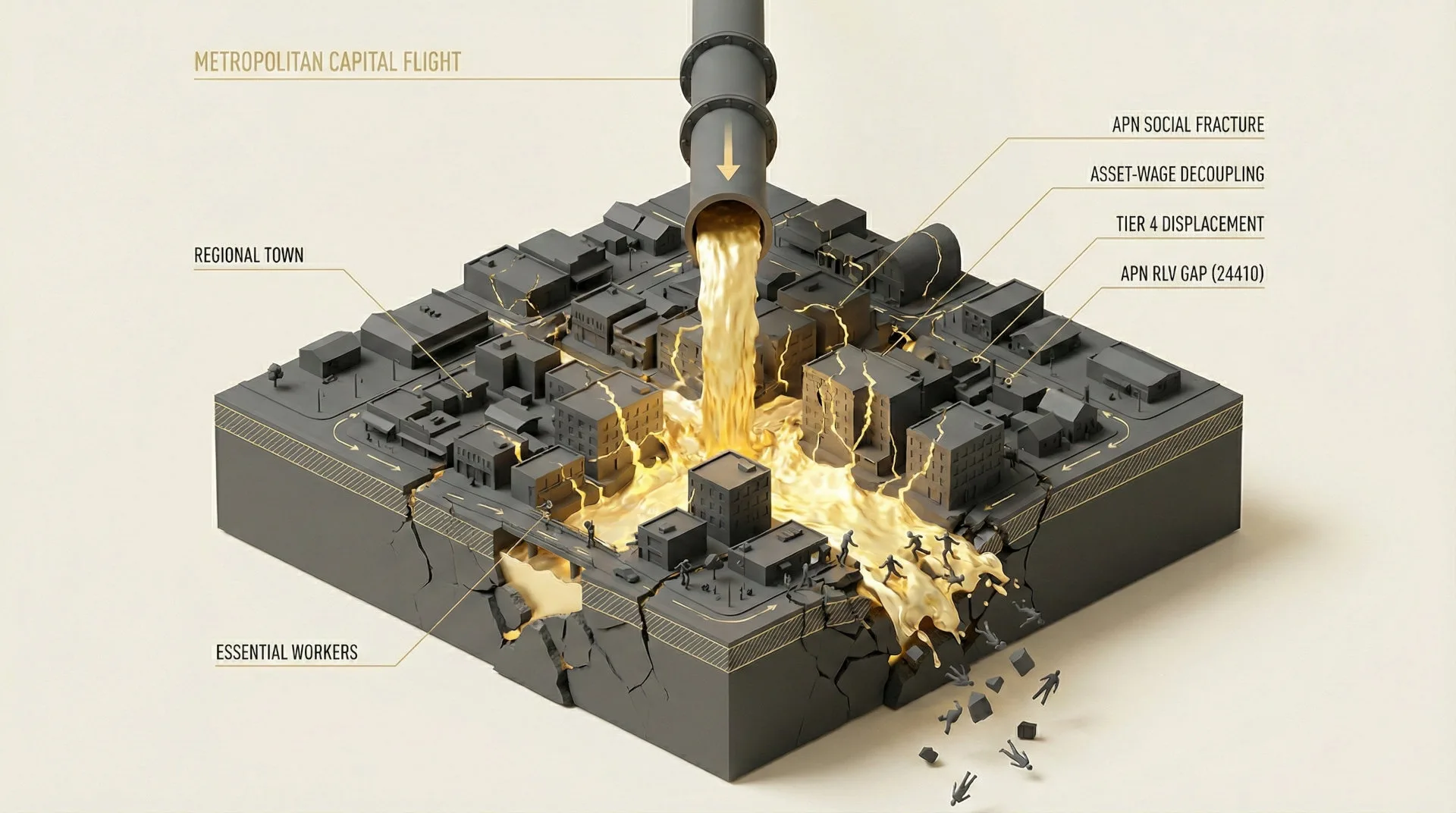
The Compound Structural Condition: The five active deviations are not operating in isolation — they are interacting and producing a non-linear outcome. A household facing refinancing constraints (21210) is simultaneously experiencing real income contraction due to inflation (21220) and may have less stable employment (21230). This household is displaced into a rental market where new supply is constrained by construction costs (21260), all while their psychological resilience is at minimum from record-low sentiment (21640). This is not five separate pressures but a single compound structural condition that the APN Acute Vulnerability Index™ (24126) is specifically calibrated to detect. The combined effect is materially greater than the sum of the individual parts.
The Significance of the Lag Structure: The analysis reveals a structured sequence of pressure transmission across the APN Social Capital Index™ (24100) branch — not a uniform deterioration. The APN Sentinel™ (24120) and its AVI sub-node (24126) are operating in the immediate transmission window (0–6 months and 0–3 months respectively), functioning as the system’s primary lead indicators. APN Bedrock™ (24110), which measures deeper social cohesion, is in an accumulation phase, with deterioration expected to register over a 6–18 month horizon. APN Meridian™ (24130) and APN Agora™ (24140) are on 12–24 and 12–36 month lags respectively. APN Substrate™ (24150) carries the longest cycle at 18–36 months.
This temporal sequencing is a key finding. It allows professionals to see not just what is forming now, but what is structurally likely to follow — providing a window for strategic adjustment before the full effects manifest in transaction data.
Strategic Implications for Property Professionals
Investors & Asset Managers: The analysis indicates a need to stress-test portfolio assets against social capital metrics, not just financial ones. Assets in localities showing elevated APN Acute Vulnerability Index™ (24126) pressure face a higher risk of tenant instability and suppressed capital growth, even if current yields appear stable.
Developers: The combination of elevated construction costs (21260) and deteriorating consumer sentiment (21640) materially constrains the feasibility of new projects targeting the owner-occupier market. A strategic pivot towards build-to-rent or other tenure models that cater to displaced ownership cohorts may be warranted in pressure-exposed sub-markets.
Lenders & Valuers: Reliance on historical sales data — a lagging indicator — for valuation and lending assessment carries elevated risk in this environment. The analysis supports incorporating leading indicators of social capital pressure, particularly from the APN Sentinel™ (24120) and APN Acute Vulnerability Index™ (24126), to produce more robust, forward-looking risk assessments.
Property Managers: The structural pressures point towards an increase in rental demand driven by displacement from ownership, but also an increase in tenant-side fiscal stress. This requires a dual focus on maximising occupancy while proactively managing arrears risk and tenant support mechanisms.
Disclaimer
The analysis and information contained in this deconstruction are for general informational and strategic purposes only and do not constitute financial, investment, legal, or any other form of professional advice. The Australian Property Network (APN) is a strategic intelligence organisation and is not a licensed financial advisor.
This analysis is based on data and information from third-party sources believed to be reliable; however, APN provides no warranty as to its accuracy, currency, or completeness. Images used in this analysis are for illustrative and conceptual purposes only and may not represent real persons, properties, or events.
All frameworks (Codex 24100-24800) are proprietary to APN.
Property values and market conditions can go up or down. Before making any property or investment decisions, you must conduct your own thorough research and seek independent professional advice tailored to your specific circumstances.