
The 131% Signal: APN Verifies Structural Contraction of Rental Affordability for Low-Income Cohorts
APN ANALYSIS: A-251125-AUS131097
Executive Summary
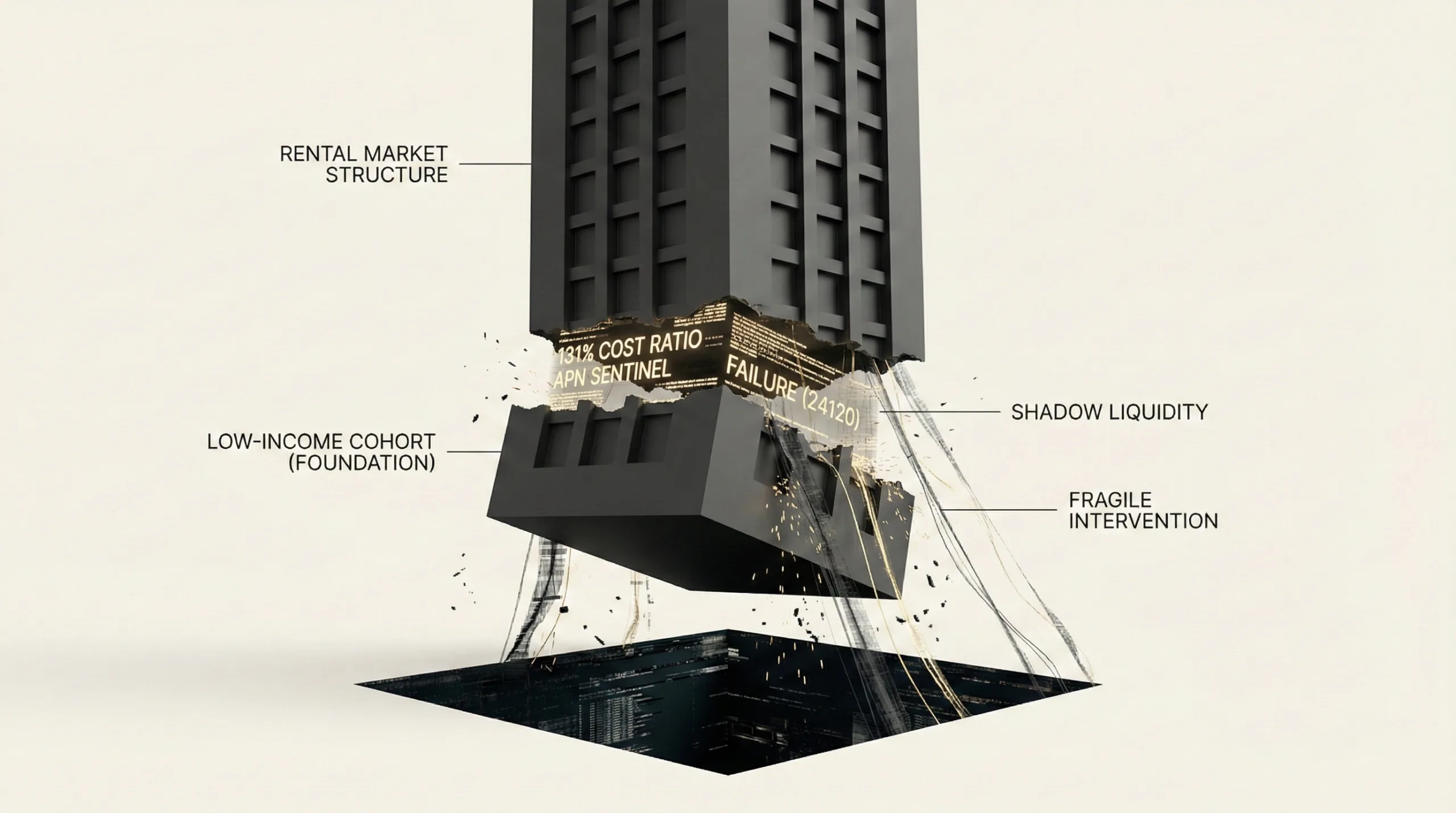
APN has validated an elevated market failure signal: rent for a single person on JobSeeker in Sydney now consumes 131% of their total income, including Commonwealth Rent Assistance. This finding, cross-referenced against data from SGS Economics, the Productivity Commission, and Homelessness Australia, confirms that the private rental market has shifted from a state of ‘stress’ to one of ‘structural exclusion’ for the lowest income quintile. This is not a cyclical downturn but a fundamental decoupling of housing costs from the social security system, rendering independent living mathematically unfeasible and creating an inconsistency with a core tenet of Australia’s social contract.
For property professionals, this signals a permanent alteration of the rental market’s foundations. The bottom of the market is now systemically dependent on ‘shadow liquidity’, unrecorded funds from debt, the informal economy, or family support, to remain housed. This creates a new, hidden layer of systemic risk that traditional analysis will miss. The emergence of ‘cluster evictions’ and the proven failure of policy levers like CRA mean that asset managers, developers, and valuers must now account for a permanent ‘un-housable’ cohort, with material implications for social housing demand, regulatory risk, and the stability of rental income in lower-quartile assets.
Background & Strategic Context
This event validates and calibrates APN’s core APN Sovereign Policy Composite Index™ (SPCI, 24800) thesis, demonstrating how state-level policy settings, specifically the inadequate indexation of welfare payments relative to rental inflation, have directly structured a state of market failure. The outcome is an elevated manifestation of structural capital asymmetry, where the bottom of the market has been functionally disconnected from the housing market, creating a cohort with sustained structural disadvantage and negligible prospect of upward mobility through traditional market mechanisms.
An Elevated Failure Signal (APN Sentinel™): The 131% metric represents a structurally significant failure event for the APN Sentinel™ (24120) index. It moves beyond sentiment or perception of safety to a mathematical verification of social instability and systemic exclusion. The signal confirms that for the lowest income cohort, the private rental market has ceased to function as a provider of shelter, becoming a primary driver of homelessness.
Degradation of Social Cohesion (APN Bedrock™): The market’s response to elevated unaffordability, material overcrowding and the rise of unstable ‘cluster tenancies’ in hotspots like Fairfield-Liverpool directly degrades the APN Bedrock™ (24110) score. This indicates a fundamental breakdown in social cohesion and resident stability, replacing community with brittle, transient housing arrangements that are prone to sudden contraction, disproportionately impacting local services.
The State as a Determinant of Exclusion (APN Sovereign Policy Composite Index™ (SPCI, 24800)): The proven inability of Commonwealth Rent Assistance (CRA) to bridge the affordability chasm is an evident example of the APN Sovereign Policy Composite Index™ (SPCI, 24800) in action. The policy’s flawed indexation mechanism is a state-level decision that has demonstrated an inability to adapt to market realities. This inaction is not neutral; it is the principal factor that has legislated a segment of the population out of the housing market, making the state a key determinant of this structural exclusion.
Deconstruction of the Source Event
This deconstruction is based on an internal APN intelligence briefing, which audited multiple data sources to verify the ‘Sentinel-Stress’ signal. The key facts are:
- The 131% Metric Verified: For a single person on JobSeeker in Greater Sydney, the median rent for a one-bedroom unit consumes 131% of their total income (including maximum CRA). This figure, from the SGS RAI report, creates a ‘negative residual income’ of $138 per week before food, energy, or transport costs.
- Persistent Stress Becomes Structural: Productivity Commission data confirms that 60.2% of low-income renters in housing stress have remained in that state for over two years. This is a structural hardening from a historical baseline of ~40%, indicating the market’s ‘churn’ and pathways out of stress have ceased.
- Homelessness Drivers Have Shifted: For the first time in a decade, ‘financial stress related to housing’ has surpassed ‘domestic and family violence’ as the primary driver for presentations to homelessness services in key metropolitan hotspots, signalling a shift to homelessness driven by pure economic exclusion.
- Private Market Data Reveals a More Constrained Reality: PropTrack’s median asking rent for a Sydney unit ($720/week) reveals the SGS figure ($580/week) is conservative. For a new market entrant, the affordability ratio is a recorded 162%. This gap creates a ‘Churn Penalty’, constraining existing tenants in precarious situations to avoid re-entering the open market.
Critical Analysis & Balanced View
The core paradox raised by the 131% metric is how these tenancies can exist at all. The analysis reveals the market at this level is being propped up by ‘Shadow Liquidity’, unrecorded financial flows from unsustainable sources. This includes debt-financed consumption (using BNPL for groceries to free up cash for rent), participation in the informal economy, and inter-household wealth transfers. This creates a hidden fragility: the rental market appears stable, but it is underpinned by a highly volatile and opaque shadow economy. A shock to these liquidity sources, such as a credit tightening or a crackdown on cash-in-hand work, could trigger a sudden and significant increase in evictions that current risk models would not predict.
Furthermore, the market’s adaptation to this pressure through ‘cluster tenancies’ (multiple unrelated individuals sharing a lease) creates a new risk multiplier. The financial failure of one individual in the cluster triggers a ‘cluster eviction’, displacing multiple people simultaneously and disproportionately impacting local crisis services. This masks the true scale of housing precarity, as several individuals are counted as ‘housed’ until the moment of structurally significant, collective failure. This dynamic, coupled with the inversion of market signals where high yields for investors now directly correlate with insolvency for tenants, points to a structurally unstable and vulnerable social system in Australia’s major cities.
Strategic Implications for Property Professionals
- For Developers & Institutional Investors: The structural exclusion of the bottom quintile from the private market solidifies the business case for social and affordable housing models. Standard Build-to-Rent priced at a market premium will not address this cohort; the opportunity lies in developing products that can attract government subsidies or new financing mechanisms to serve this now-permanent ‘un-housable’ demographic.
- For Agents & Property Managers: The rise of ‘shadow liquidity’ and ‘cluster tenancies’ significantly increases operational risk in lower-quartile rental portfolios. Tenant screening must evolve to identify signs of unsustainable debt or overcrowding. Expect higher rates of arrears, disputes, and sudden vacancies. The ‘Churn Penalty’ also means existing tenants will resist moving, potentially leading to longer but more volatile and high-maintenance tenancies.
- For Buyers’ Agents & Valuers: The identified ‘hotspots’ (e.g., Fairfield, Wyndham, Logan) are now high-risk zones. While rents are rising, the underlying social fabric is degrading, increasing regulatory risk (e.g., council crackdowns on overcrowding) and reputational risk. Valuations must now factor in the degradation of APN Bedrock™ social cohesion, which can precede a fall in demand from more stable tenant cohorts and impact long-term capital growth.
- For Policy Analysts & Government Affairs: The 131% metric provides a critical data point to advocate for structural reform. The failure of CPI-linked indexation for Commonwealth Rent Assistance is now mathematically proven. This analysis supports arguments for a material, one-off rebasing of CRA and JobSeeker, as incremental increases will be absorbed by the market without closing the structural deficit.
APN Index Management
The APN Codex 24000 Series is a proprietary set of indices that translates complex market forces into measurable metrics. This section outlines how the preceding analysis is validated against, and informs the calibration of, these frameworks.
- Validation: This analysis provides elevated validation for the APN Sentinel™ (24120) index, confirming a ‘structural exclusion’ signal has been breached. It also validates the degradation of the APN Bedrock™ (24110) index in identified hotspots due to overcrowding and the contraction of stable tenancy structures.
- Index Calibration: The APN Sentinel™ (24120) index is now calibrated to treat a rent-to-income ratio exceeding 100% for any statutory income cohort as a ‘Code Red’ systemic failure event, not merely ‘stress’. The APN Bedrock™ (24110) will now incorporate ‘cluster eviction’ risk as a negative weighting in its social cohesion model for relevant urban postcodes.
- Data Capture: This triggers a new data capture mandate for the APN Symbiotic Intelligence Network™ (24310) to monitor secondary indicators of ‘Shadow Liquidity,’ including BNPL default rates, food bank demand, and pawn shop activity in postcodes with a Rental Affordability Index (RAI) score below 30.
Disclaimer
The analysis and information contained in this deconstruction are for general informational and strategic purposes only and do not constitute financial, investment, legal, or any other form of professional advice. The Australian Property Network (APN) is a strategic intelligence organisation and is not a licensed financial advisor.
This analysis is based on data and information from third-party sources believed to be reliable; however, APN provides no warranty as to its accuracy, currency, or completeness. Images used in this analysis are for illustrative and conceptual purposes only and may not represent real persons, properties, or events.
All frameworks (Codex 24100-24800) are proprietary to APN.
Property values and market conditions can go up or down. Before making any property or investment decisions, you must conduct your own thorough research and seek independent professional advice tailored to your specific circumstances.