

Rate Hikes Bite, But Negative Gearing Shields Landlords From Mass Sell-Off
Australian property investors experienced a significant contraction in rental profits during the 2022–23 financial year, although negative gearing tax benefits appear to have prevented a widespread sell-off, as reported by ABC News.
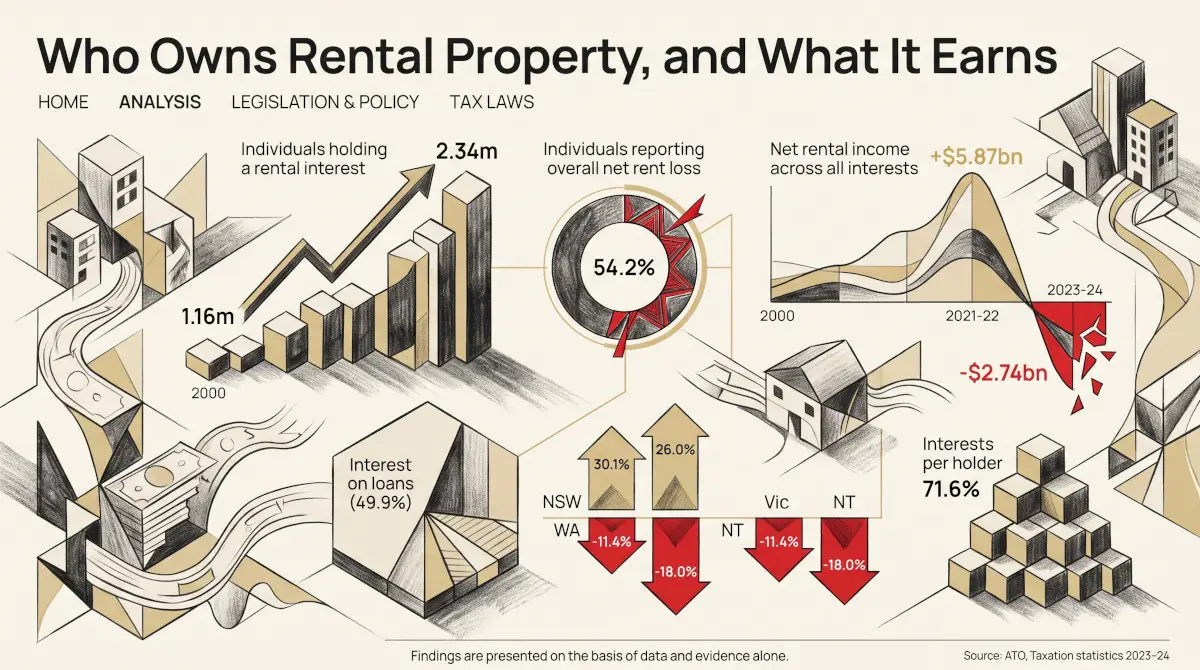
Data from the Australian Taxation Office (ATO) reveals that net rental income for investors plummeted by 73 per cent, falling from nearly $5.9 billion in 2021–22 to less than $1.6 billion in 2022–23. Despite this dramatic decline in profitability, the number of investors and rental properties decreased by less than one per cent, suggesting that tax advantages continue to incentivise property investment.
This trend presents a complex scenario for property professionals, including agents, managers, and financial advisors, who must navigate the interplay of rising interest rates, rental market dynamics, and taxation policies.
The Profitability Plunge: A Perfect Storm
Curtin University economics professor Rachel Ong ViforJ attributes the sharp fall in rental profitability to a combination of factors: surging interest rates, rising rental management costs and increased repair expenses. Reserve Bank of Australia (RBA) figures indicate that the average interest rate on variable-rate loans for property investors reached 5.7 per cent in 2022–23, a considerable increase from 3.4 per cent in 2021–22. This level represents the highest interest burden for investors since 2018–19.
The impact of these rising costs was felt most acutely by “mega landlords” – those with 19 or more properties. ATO data indicates that this group was the only one to experience an average rental loss in 2022–23, both on an individual investor and individual rental basis. This suggests that while smaller investors may have been able to absorb some of the increased costs, larger portfolios were more vulnerable to the impact of higher interest rates.
Negative Gearing: A Safety Net or a Distortion?
Professor Ong ViforJ argues that negative gearing, which allows investors to offset rental losses against their personal income tax, and the 50 per cent capital gains tax (CGT) discount, are key factors preventing a mass sell-off. These tax breaks, she says, reduce the risk associated with property investment, even in a high-interest rate environment.
Independent economist Saul Eslake suggests that some investors may have even “welcomed” rental losses, as they maximise the tax benefits of negative gearing. He also points out that the ATO data indicates that mega landlords were the only group to report average losses throughout the COVID-19 period of record-low interest rates, highlighting the importance of negative gearing to wealthier investors.
According to Eslake, the data undermines the argument that negative gearing is primarily used by “mums and dads trying to get ahead.” He argues that the primary beneficiaries are often the wealthiest investors, a point supported by ATO data showing that 18.8 per cent of individuals in the top tax bracket report net rental losses, compared to just 6.3 per cent of those not in the top tax bracket.
Policy Implications and Market Dynamics
A Parliamentary Budget Office (PBO) analysis estimates that in 2025–26, the bottom 10 per cent of wage earners in Australia will receive just $152 million from negative gearing and the CGT discount, while the top 10 per cent will receive over $2.9 billion. The analysis also reveals that negative gearing led to lost tax revenues of $3.5 billion in 2022–23, an increase of $1.4 billion from the previous year. The PBO predicts that the amount of tax income lost to negative gearing will continue to rise significantly in the coming years, reaching an estimated $14.1 billion per annum by 2035–36.
Australia Institute chief economist Greg Jericho argues that the falling rental profitability revealed in the ATO data indicates that negative gearing is becoming “a much more common situation” and that investors are “winning both ways.” He suggests limiting negative gearing to one or two rental properties per investor, a move that he says would not affect approximately 90 per cent of current investors.
However, Property Investment Professionals of Australia (PIPA) chair Lachlan Vidler argues against changes to negative gearing, claiming that it would disincentivise investment, leading to fewer rental properties and reduced house building. He believes that even if the majority of investors would be unaffected, such changes would still damage sentiment across the sector. Vidler also questions why increased government spending always leads to discussions about increasing taxes, suggesting that greater efficiency with existing revenues should be explored.
Opportunities and Challenges for Property Professionals
The current market dynamics present both opportunities and challenges for property professionals. For real estate agents, understanding the impact of interest rate fluctuations and tax policies on investor behaviour is crucial for advising clients effectively. Property managers need to focus on strategies to maximise rental income and minimise expenses in order to maintain profitability for landlords. Financial advisors must provide tailored advice to investors, taking into account their individual circumstances and risk profiles.
The debate surrounding negative gearing and CGT discounts is likely to continue, creating uncertainty in the market. Property professionals need to stay informed about potential policy changes and their potential impact on the investment landscape. The focus on affordability and rental supply also presents opportunities for developers to explore innovative housing solutions and for governments to implement policies that encourage investment in affordable housing.
Cotality chief analyst Tim Lawless notes that the significant rise in rents from mid-2020 was primarily driven by demand and supply factors, rather than interest rate expenses. He points to a surge in rental demand, coupled with a supply shock, as the main drivers of rental growth. This highlights the importance of understanding the underlying market dynamics in addition to the impact of interest rates and tax policies.
Ultimately, navigating the complexities of the Australian property market requires a deep understanding of economic trends, taxation policies, and market dynamics. By staying informed and providing expert advice, property professionals can help investors make informed decisions and navigate the challenges and opportunities that lie ahead.
The ATO data reveals that the vast majority of investors (just over 1.6 million) own one rental property, while a little over 423,000 investors own two. Approximately one in 10 investors own three or more properties, and this group owns about a quarter of all rentals in the country. There are 2,529 investors who each have interests in 10 or more properties, owning or part-owning more than 32,600 rentals.
It is important to note that the ATO data has limitations, as it does not capture rentals held in companies and trusts. Data from property investment advisories suggests that the ATO data may be missing up to a third of rentals, as roughly 70–75 per cent of clients hold their rentals under their personal name, while the rest hold rentals in trusts, companies or self-managed super funds. Amanda Turner, director of Opulence Property Group, says trusts are sometimes preferred because they protect the asset if, for example, the investor is thinking of handing property down to children.
This article is based on a report from www.abc.net.au titled “Higher interest rates smashed landlord profits, but negative gearing means few sold up”. You can find the original article here: https://www.abc.net.au/news/2025-08-09/interest-rates-smashed-mega-landlords-few-sold/105615242
Given the increasing concentration of rental properties in the hands of a small number of investors leveraging tax benefits like negative gearing and capital gains discounts, how can policy be designed to incentivise diverse housing supply and affordability without disproportionately impacting small-scale investors or exacerbating the rental crisis?
Disclaimer
The information contained in this article is for general informational purposes only and does not constitute financial, investment, or legal advice. The Australian Property Network (APN) is not a licensed financial advisor. The content is based on data from third-party sources and is provided without any warranty as to its accuracy, currency, or completeness. Property values can go down as well as up. Before making any property or investment decisions, you should conduct your own research and consider seeking independent professional advice tailored to your specific circumstances.