

Property Tax Frameworks: Why a Phased CGT Reduction is Now the Most Probable Outcome
APN ANALYSIS: A-260301-AUS137834
Executive Summary
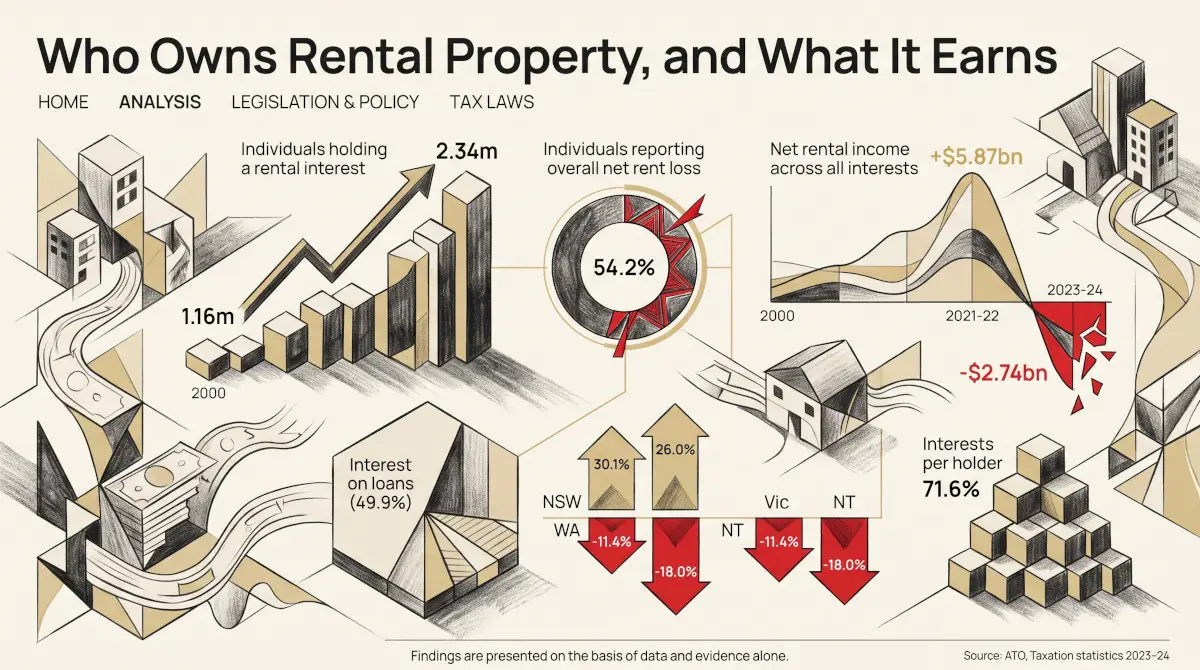
The national debate over negative gearing and the Capital Gains Tax (CGT) discount has escalated into the defining policy structural contest of the 2024–2026 electoral cycle. Two distinct positions have emerged: a powerful incumbent lobby of property industry bodies maintaining the status quo by deploying supply-side risk perception, and a coalition of think tanks and progressive media demanding substantive reform by highlighting elevated fiscal unsustainability and intergenerational inequity. This matters because the outcome will fundamentally alter the financial architecture of Australian residential investment, with the federal government balancing a projected $247 billion revenue shortfall against the political risk of triggering a media-amplified period of elevated market anxiety.
For property professionals, this escalation of competing policy frameworks creates both significant risk and tactical opportunity. The elevated uncertainty is a powerful lead generation tool for advisors, but the most probable long-term outcome is neither the status quo nor total abolition, but a politically palatable compromise. Professionals must prepare for a future defined by a reduced CGT discount (likely to 25%) and restrictions on negative gearing (likely quarantined to new builds), a structural shift that will re-weight investment strategies away from speculative capital growth and towards sustainable rental yield.
Background & Strategic Context
This event validates and calibrates APN’s core macro-theses, demonstrating how direct state intervention dictates market outcomes (APN Sovereign Policy Composite Index™ (SPCI, 24800)). The debate over tax concessions is a structural contest to control the mechanisms that determine which cohorts benefit from state-sanctioned wealth transfers. The entire structural contest is a manifestation of Australia’s rigid socio-economic structure, as mapped by The Glass House (Net State Position), where the financial interests of distinct economic ‘cohorts’ are in direct opposition.
APN Sovereign Policy Composite Index™ (SPCI, 24800): The incumbent lobby’s strategy to pivot the debate from tax reform to a supply structural pressure point is a classic application of the APN Sovereign Policy Composite Index™ (SPCI, 24800), where powerful actors seek to shape legislation to protect their economic territory. By indicating a potential contraction in construction and leveraging the government’s 1.2 million home target, they are attempting to make demand-side reform politically difficult.
APN Net State Position™: The structural contest is a proxy structural contest between the Tiers of The Glass House. The lobby maintains the interests of Tier 1 (The Architects) and Tier 3 (The Protected Asset Nobility), framing it as a maintenance of the middle class position. The challengers advocate for Tier 4 (The Host) and Tier 5 (The Inventory), arguing the current system reallocates from the PAYG tax base to subsidise asset holders—a dynamic measured by the APN Asset-Wage Decoupling Index™ (24610).
The Supply Illusion in Action (The Supply Illusion): The lobby’s claim that tax concessions are vital for new housing supply is directly contradicted by AHURI data showing over 80% of investment flows to established homes. This perfectly illustrates The Supply Illusion, in which political narratives about supply are decoupled from the mathematical reality of capital allocation, which is driven by speculative gain rather than productive construction.
Deconstruction of the Source Event
This deconstruction is based on an internal APN intelligence briefing which synthesises public submissions to the Senate Select Committee on the Operation of the Capital Gains Tax Discount, alongside media analysis and think tank modelling. The key facts are:
- The Policy Contest: The core structural contest is over two tax concessions: Negative Gearing (the ability to offset rental losses against wage income) and the 50% Capital Gains Tax (CGT) discount for assets held over 12 months.
- The Incumbent Position (The Lobby): A coalition including the HIA, MBA, and PCA argues that these are not ‘concessions’ but standard tax principles. They claim any changes will trigger capital reallocation, cause a sustained delivery constraint in new housing, and create structurally significant pressure on the rental market.
- The Challenger Position (The Analysts): Think tanks like the Grattan Institute and The Australia Institute argue the concessions are fiscally materially adverse, costing the budget an estimated $247 billion over a decade, and primarily benefit the wealthiest cohorts while distorting the market towards unproductive speculation on existing homes.
- The Compromise Proposal: The most detailed reform proposal, advanced by the Grattan Institute, involves halving the CGT discount to 25% and quarantining negative gearing losses. Their modelling suggests this would have a minimal impact on prices and rents (an estimated 1% to 2% drop) while raising approximately $5.3 billion to $7 billion in annual revenue.
- The Government’s Position: The Albanese government, facing a structural budget deficit, has directed Treasury to model reform scenarios, including capping negative gearing and reducing the CGT discount, signalling a serious consideration of change despite the immense political risks.
Critical Analysis & Balanced View
The central paradox of this debate is that both sides are operating with rational, but mutually exclusive, models of the market. The Incumbent Lobby’s stated prospect of capital withdrawal is credible, not because its economic model is inherently correct, but because a critical mass of investors believes it is correct. Decades of marketing have conditioned retail investors to see these concessions as a right, meaning any change, regardless of its true economic impact, could trigger a sentiment-driven period of elevated market anxiety. The narrative promoted by the Data Duopoly, casting retail investors as a primary solution to the rental structural pressure point, is a form of psychological positioning that makes a rational policy discussion difficult.
Conversely, the Analysts’ greatest strength—their rigorous, dispassionate modelling—is also their greatest political weakness. While their data indicates the concessions are inefficient and inequitable, their proposed solutions do not fully account for the market sentiment dynamics that govern market behaviour. The Grattan Institute’s forecast of a sub-2% price drop is mathematically sound but politically incomplete; it ignores the potential for a self-fulfilling prophecy of market contraction amplified by conservative media and wealth creation advocates. The primary structural contest is not over economic efficiency, but over narrative control. The side that can more effectively frame the future, as either a structurally significant contraction or a fair rebalancing, will win the policy outcome.
Strategic Implications for Property Professionals
- For Developers: The most probable reform path, restricting negative gearing to new builds, presents a significant strategic advantage. Prepare to pivot marketing and financing models to explicitly target investors seeking this new, exclusive tax shelter. This will create a two-tiered investment market and a competitive moat for new construction projects.
- For Agents & Buyers’ Agents: The period of uncertainty leading up to the 2026 decision is a prime opportunity. Deploy the policy risk to create urgency for both buyers and sellers. For buyers, the narrative is “buy now before the rules change.” For potential vendors (especially older investors), the narrative is “sell now to lock in the 50% discount before it’s gone.”
- For Financial Planners & Mortgage Brokers: Your strategic value will shift from simply facilitating transactions to providing structural portfolio advice. Clients will need guidance on rebalancing away from a pure capital growth strategy towards a hybrid model that incorporates yield. Modelling the impact of a 25% vs 50% CGT outcome on retirement timelines will become a critical service.
- For Build-to-Rent (BTR) Operators: The potential crowding out of speculative retail investors who can no longer rely on CGT-driven capital gains is a positive structural factor for the BTR sector. A reduction in the CGT discount makes the stable, long-term yields of BTR mathematically more competitive, potentially unlocking institutional capital that has been sidelined.
APN Index Management
The APN Codex 24000 Series is a proprietary set of indices that translates complex market forces into measurable metrics. This section outlines how the preceding analysis is validated against, and informs the calibration of, these frameworks.
- Validation: This analysis validates the core thesis of the APN Sovereign Policy Composite Index™ (SPCI, 24800), confirming that federal legislative intervention is the primary driver of market structure. It also validates the APN Net State Position™ (24600), as the debate is a clear structural contest between the economic interests of the ‘Protected’ asset-holding class and the ‘Host’ PAYG tax base.
- Index Calibration: The APN Regulatory Velocity Multiplier™ (24210) is calibrated to track the increasing momentum of Treasury modelling and Senate inquiry outputs as leading indicators of legislative change. The APN Asset-Wage Decoupling Index™ (24610) will be recalibrated to model the potential compression effect of a reduced CGT discount on asset price growth relative to wages.
- Data Capture: This analysis triggers a new data capture mandate for the APN Symbiotic Intelligence Network™ (24310). We will now systematically track and quantify the narrative alignment of key commentators and organisations to measure the ‘share of voice’ and influence of the competing narrative frameworks, feeding this into the APN Professional Sentiment Index™ (24300).
Disclaimer
The analysis and information contained in this deconstruction are for general informational and strategic purposes only and do not constitute financial, investment, legal, or any other form of professional advice. The Australian Property Network (APN) is a strategic intelligence organisation and is not a licensed financial advisor.
This analysis is based on data and information from third-party sources believed to be reliable; however, APN provides no warranty as to its accuracy, currency, or completeness. Images used in this analysis are for illustrative and conceptual purposes only and may not represent real persons, properties, or events.
All frameworks (Codex 24100-24600) are proprietary to APN.
Property values and market conditions can go up or down. Before making any property or investment decisions, you must conduct your own thorough research and seek independent professional advice tailored to your specific circumstances.