

Victorian Cultural Heritage Reform: Stealth Intervention to Close RLV Gap in Housing and Renewables
APN ANALYSIS: A-251106-AUS59
Executive Summary
The Victorian Government’s $5 million cultural heritage reform package is a verified “Project Overlord” stealth intervention. Its primary stated objective is economic: to make planning “simpler and faster” and provide “certainty earlier” for “new housing” and “renewable energy developments.”
The core mechanism, a “nation-leading” online mapping tool, directly attacks development feasibility. It converts a high-cost, high-uncertainty cultural heritage risk into a quantifiable upfront input, thereby mechanically narrowing the Residual Land Value (RLV) Gap and boosting the APN Future Development Pipeline Index™ (24400).
Background & Strategic Context
This surgical, low-profile reform is a sophisticated manoeuvre to accelerate key policy goals, and its strategic implications are best understood through our core intelligence frameworks:
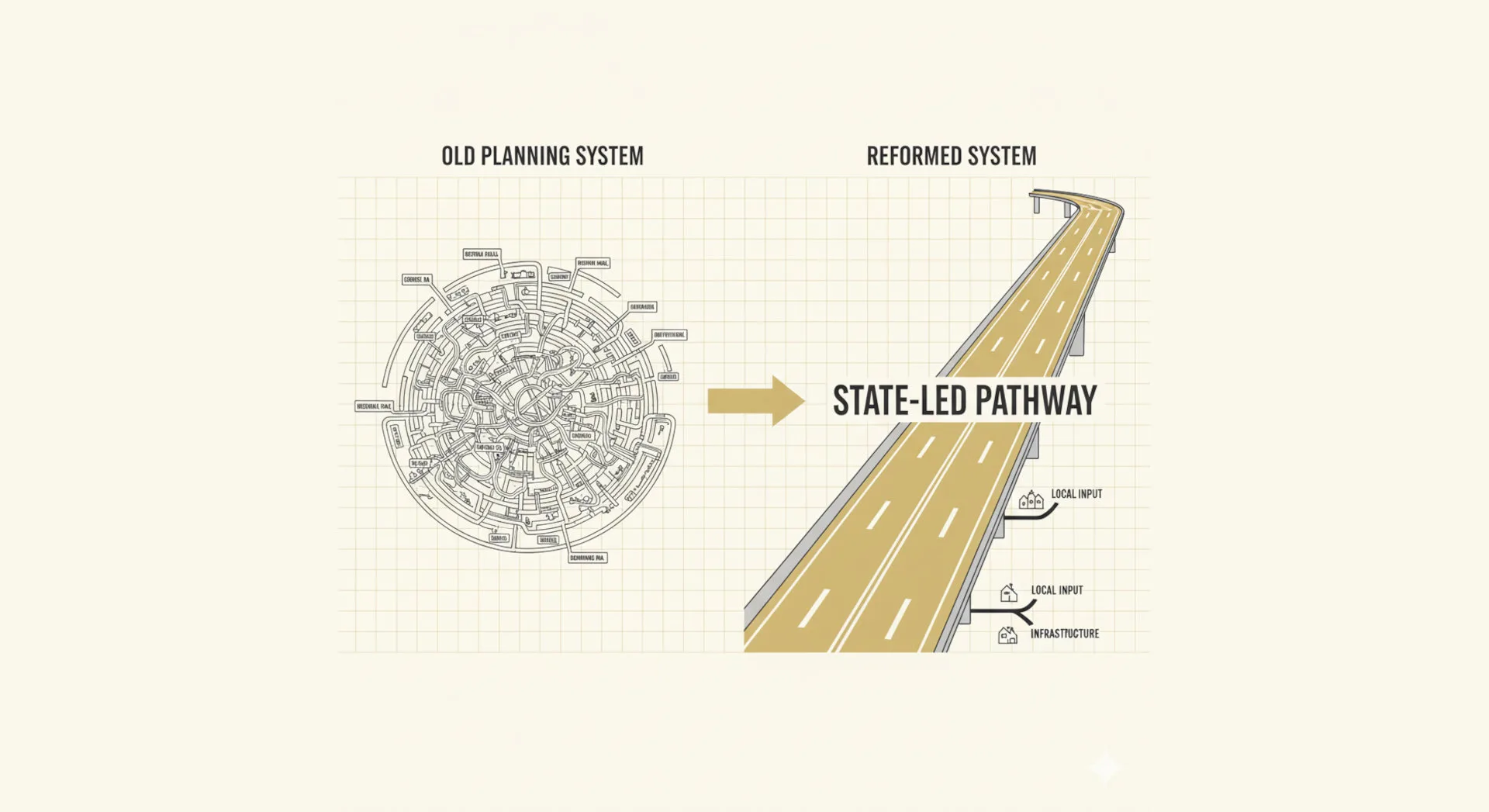
State-Led Intervention (Project Overlord): This is a “stealth” Project Overlord intervention. The government is using a $5 million, highly targeted technical reform to address a major logistical bottleneck that impedes its two highest-priority political goals: housing supply and the 2035 renewable energy target. The reform’s “stealth” nature, launched amidst larger, headline-grabbing policies, is a deliberate “causal misattribution” design.
RLV Gap Reduction (APN Future Development Pipeline Index™ (24400)): This reform is a textbook intervention to mechanically reduce the Residual Land Value (RLV) Gap and accelerate Codex 24400. The online mapping tool slashes the “Risk/Contingency” component of Total Development Costs (TDC), while streamlined guidelines reduce “Soft Costs” (e.g., holding costs). By lowering TDC, the Residual Land Value (RLV) mechanically increases, moving more projects toward commercial feasibility.
Deconstruction of the Source Event
This deconstruction is based on an internal APN intelligence briefing. The key facts are:
- The reform is a $5 million package announced on November 6, 2025, to address “pressures on construction and approval processes.”
- It is explicitly targeted at accelerating “new housing” and “renewable energy developments.”
- The core mechanism is a “nation-leading online mapping tool” highlighting heritage areas to “improve planning and site selection” and provide certainty upfront.
- The government’s own problem definition is the “risk of unexpected costs and delays,” which directly widens the RLV Gap.
- The initial rollout is a pilot covering Melbourne’s CBD, northern suburbs, Bendigo, and Daylesford.
- A notable absence of public reaction from key stakeholders (Property Council, Urban Development Institute of Australia (UDIA), Clean Energy Council (CEC)) confirms the “stealth” nature of this reform.
Critical Analysis & Balanced View
The “real” story here is that the objective of this reform is economic velocity, while its subject is cultural heritage. The policy language is dominated by verbs like “simpler and faster” and “save time and money,” confirming its primary function is to accelerate the development pipeline.
- Causal Misattribution Design: The government deliberately launched this surgical reform simultaneously with larger policies (Housing Statement, Victorian Grid (VicGrid) Transmission Plan). This ensures the reform’s benefit (e.g., faster Cultural Heritage Management Plan (CHMP) approvals) will be misattributed by the market to the larger reforms, proving the intervention was designed to be overlooked.
- Targeted Intervention: This is not a generic red-tape cleanup. It is a highly targeted intervention focused solely on the government’s two highest-priority, politically sensitive sectors, Housing and Renewables, underscoring its strategic importance.
- Internal Review as Policy Driver: The reform originated from an “internal review” that identified logistical friction, not from external cultural advocacy. This confirms the government’s own bureaucracy sourced the solution for a systemic bottleneck that was impeding its top policy goals.
Balanced View: On the surface, this is a minor, $5 million bureaucratic update. However, the analysis reveals it as a sophisticated, “stealth” Project Overlord intervention. It is designed to surgically remove a key supply-side constraint (cultural heritage uncertainty) to mechanically close the RLV Gap and accelerate the government’s two most critical economic platforms, all while avoiding the political cost of a major public reform.
Strategic Implications for Property Professionals
- For Developers (Pilot Zones): If you are operating within the pilot zones (Melbourne North, Bendigo, Daylesford), you can immediately reduce the risk premium component of your project financing and contingency budgets. The heritage risk is now quantified and largely avoidable upfront.
- For Land Acquisition Teams: You must mandate the use of this new online mapping tool to secure a competitive advantage. The ability to de-risk sites pre-acquisition allows you to make a higher Residual Land Value (RLV) offer than competitors who are still pricing in the old contingency.
- For Risk & Sentiment Analysts: To quantify the true impact of this “Stealth Reform,” future valuation models must disaggregate planning velocity data within the pilot zones (e.g., Bendigo) against external control zones to isolate this Project Overlord effect from confounding statewide reforms.
- For Government & Policy: The successful, low-profile mitigation of this cultural heritage friction provides a scalable model for surgically removing other non-obvious, technical supply-side constraints (e.g., utility connections) without incurring major political cost.
Disclaimer
The analysis and information contained in this analysis are for general informational and strategic purposes only and do not constitute financial, investment, legal, or any other form of professional advice. The Australian Property Network (APN) is a strategic intelligence organisation and is not a licensed financial advisor.
This analysis is based on internal APN intelligence, data, and information believed to be reliable; however, APN provides no warranty as to its accuracy, currency, or completeness. Images used in this analysis are for illustrative and conceptual purposes only and may not represent real persons, properties, or events. Property values and market conditions can go down as well as up.
Before making any property or investment decisions, you must conduct your own thorough research and seek independent professional advice tailored to your specific circumstances.