
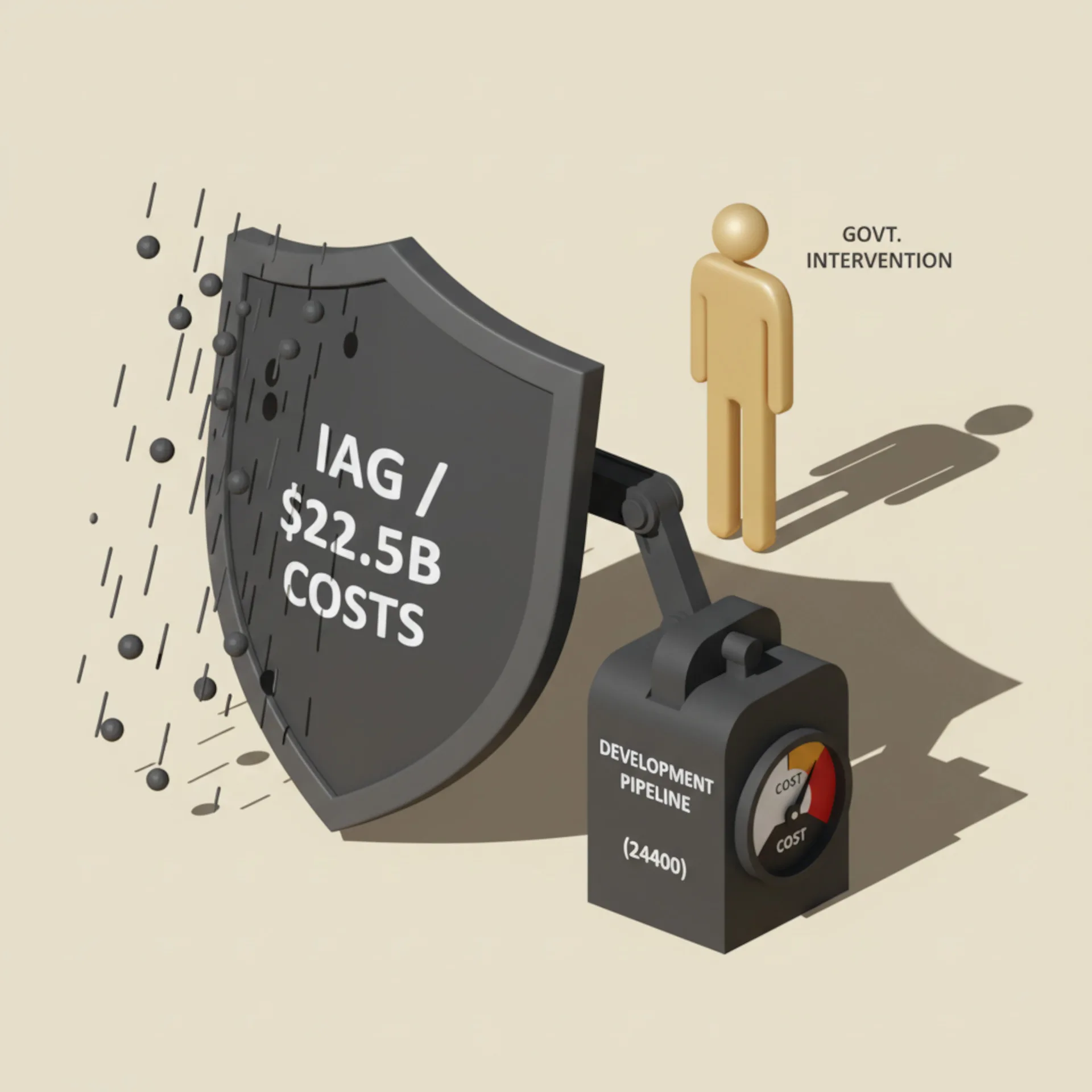

IAG Climate Data: Hail Risk Doubles, Justifying Permanent Cost Headwinds and Insurability Crisis
APN ANALYSIS: A-251106-AUS57
Executive Summary
Insurance Australia Group’s (IAG) November 2025 climate report confirms that large-to-giant hail risks are “increasing at the fastest pace” over the Brisbane-Sydney-Melbourne corridor, with the observed frequency of metro hail events doubling in the last decade (2015-2024).
This escalating physical hazard, which has driven a 67% increase in extreme weather costs to $22.5 billion over the last five years, is being leveraged by IAG to justify permanent, structural cost headwinds for development via “improving building standards” and “reducing building in high-risk areas.” This validates the APN Climate-Risk Asset Devaluation Index™ (24500) and signals an accelerating insurability crisis.
Background & Strategic Context
This confirmation of a rapidly escalating, high-cost hazard from a primary claims payer has profound implications for the built environment, and its strategic implications are best understood through our core intelligence frameworks:
Climate Risk Devaluation (APN Climate-Risk Asset Devaluation Index™ (24500)): This report is a quantitative validation of Codex 24500. It identifies a specific, rapidly escalating hazard (large-to-giant hail) and maps it directly to the most economically valuable and populated corridor in Australia. This confirms that physical hazard and high-value asset exposure are compounding, accelerating the devaluation schedule.
Future Pipeline Cost Headwind (APN Future Development Pipeline Index™ (24400)): IAG is explicitly using this scientific data as justification for permanent, structural cost headwinds on the APN Future Development Pipeline Index™ (24400). The advocacy for “improving building standards” translates directly to higher mandatory construction costs (an RLV Gap driver), while “reducing building in high-risk areas” will collapse the viability of projects in those zones.
Government Intervention Risk (Project Shield & Project Overlord): The report reveals a critical corporate risk. IAG’s corporate filings, in contrast to its public report, classify “Government Intervention in Insurance Markets” as a material threat. This confirms a Project Shield analysis: IAG fears that political pressure from unaffordable premiums will trigger a Project Overlord intervention (e.g., price caps, state-backed pools), which is the insurer’s primary existential risk.
Deconstruction of the Source Event
This deconstruction is based on an internal APN intelligence briefing, citing IAG and Insurance Council of Australia (ICA) data. The key facts are:
- Insured costs for extreme weather events reached $22.5 billion over the past five years (2020-2025), a 67% increase on the previous five years.
- “Large-to-giant hailstone risks” are “increasing at the fastest pace” over the Brisbane-Sydney-Melbourne corridor.
- The 2015–2024 period recorded “more than double the number of metro hail events” compared to any other 10-year period since 1985.
- The CEO of Insurance Australia Group (IAG) is explicitly advocating for “improving building standards” and “reducing building in high-risk areas.”
- IAG’s corporate filings classify “Government Intervention in Insurance Markets” as a material risk that could “reduce the size of the private insurance market.”
Critical Analysis & Balanced View
The “real” story here is twofold: the validation of a new cost baseline for the development pipeline, and IAG’s “strategic deflection” of the insurability crisis.
- Strategic Deflection: IAG’s public report strategically avoids the term “uninsurable.” Instead, it points stakeholders toward the government’s National Climate Risk Assessment (NCRA), which does explicitly address risks like “unaffordable premiums” and insurers “withdraw[ing] coverage altogether.”
- Corporate Risk Revelation: The most critical risk, that “political pressure” from premium hikes will lead to “government intervention” that harms IAG’s market, is found only in corporate and financial filings. This confirms a significant disparity between IAG’s public communications and its private material risk disclosure.
- Data-Driven Cost Mandate: IAG is laying the data-driven groundwork for permanent cost increases. The explicit calls for mandatory, improved building standards will act as a leading indicator for legislative and regulatory cost increases that will directly impact the RLV Gap.
Balanced View: On the surface, this is a climate science report confirming hail is a growing problem. However, the analysis reveals it as a strategic manoeuvre by a primary claims payer. IAG is using this data to justify a permanent increase in construction costs (Codex 24400) and land-use restrictions, all while strategically deflecting the “insurability crisis” and privately flagging “government intervention” as its single biggest financial threat.
Strategic Implications for Property Professionals
- For Developers & Builders: You must price in the certainty of mandatory building code changes and higher construction costs. These are no longer a “risk” but an imminent cost headwind. Insurability is now a core viability metric that must be confirmed at the project’s inception.
- For Risk & Sentiment Analysts: All assets in the Brisbane-Sydney-Melbourne corridor now face an accelerated devaluation schedule in the APN Climate-Risk Asset Devaluation Index™ (24500) due to the confirmed doubling of this high-loss hail hazard.
- For Land Bankers & Planners: You must anticipate increasing restrictions on land-use planning in coastal and peri-urban zones. IAG’s advocacy, backed by this data, will empower local and state governments to restrict development in high-risk areas.
- For Government & Policy: The insurance sector is now a high-political-risk target. The growing gap between private premiums and public affordability creates a political imperative for Project Overlord intervention (e.g., state-backed insurance pools, price caps) to socialise the climate risk.
Disclaimer
The analysis and information contained in this analysis are for general informational and strategic purposes only and do not constitute financial, investment, legal, or any other form of professional advice. The Australian Property Network (APN) is a strategic intelligence organisation and is not a licensed financial advisor.
This analysis is based on internal APN intelligence, data, and information believed to be reliable; however, APN provides no warranty as to its accuracy, currency, or completeness. Images used in this analysis are for illustrative and conceptual purposes only and may not represent real persons, properties, or events. Property values and market conditions can go down as well as up.
Before making any property or investment decisions, you must conduct your own thorough research and seek independent professional advice tailored to your specific circumstances.