
Coalition Policy Pivot: Bragg Abandons “Super for Housing” for “Laser Focus” on Supply
APN ANALYSIS: A-251109-AUS60
Executive Summary
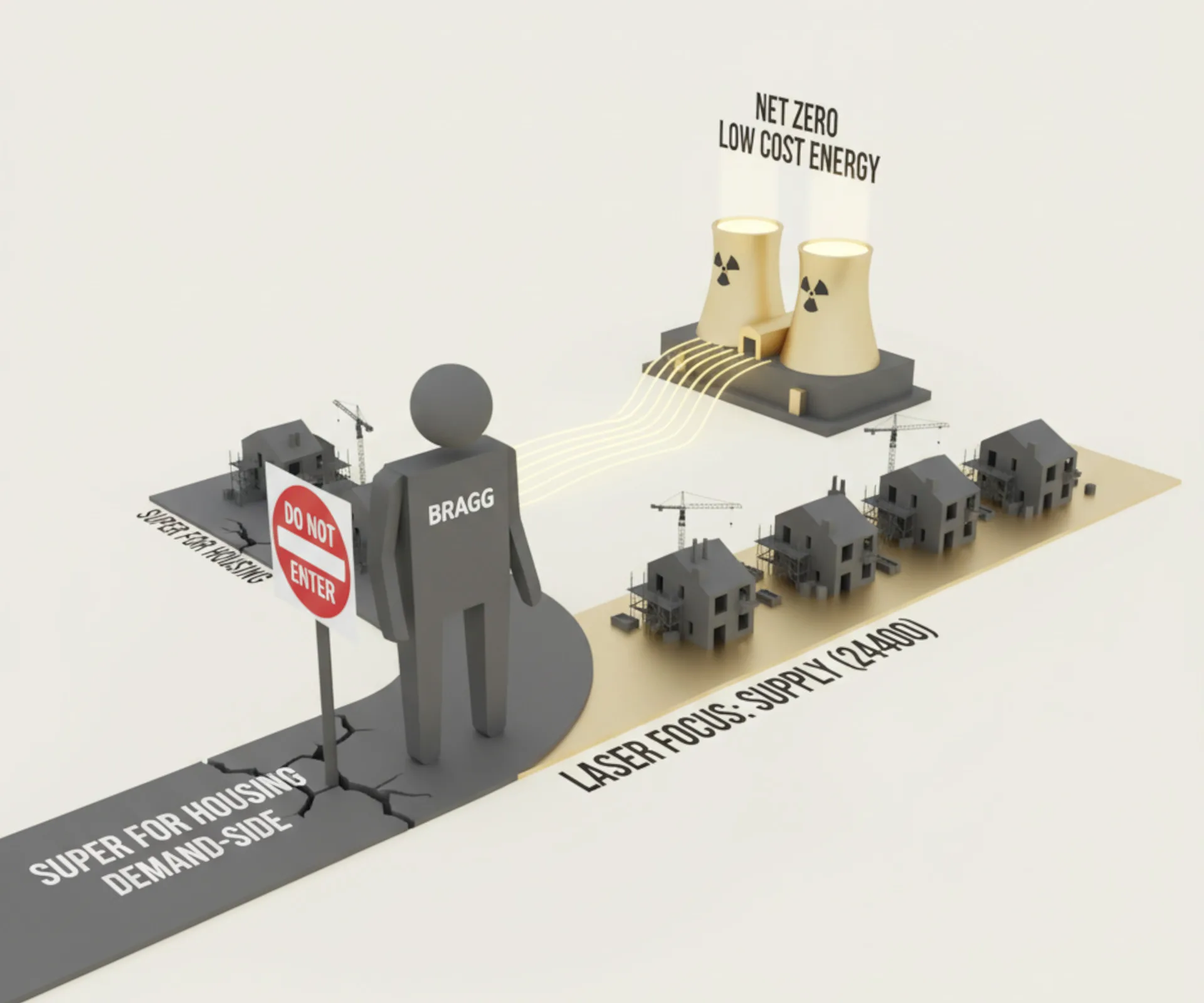
In a significant policy pivot, Shadow Housing Minister Andrew Bragg has signalled the Liberal Party will abandon its “Super for Housing” policy, stating it is “unlikely we would continue with that exact policy.” This shift terminates the party’s demand-side focus.
Bragg has recalibrated the Coalition’s platform to a “laser focus” on housing supply, arguing that Labor’s policies, specifically their “reckless” changes to the 5% deposit scheme, have “failed to build supply” and instead fuelled price rises. This pivot explicitly adopts the APN Future Development Pipeline Index™ (24400) thesis that “supply is the main game” and that demand-side measures in isolation “make the problem worse.”
Background & Strategic Context
This public policy shift by the Shadow Minister has validated our core thesis on supply-side constraints and has profound implications for the market, which are best understood through our core intelligence frameworks:
Supply-Side Focus (APN Future Development Pipeline Index™ (24400)): This is a direct political adoption of the Codex 24400 thesis. Bragg’s statement that the party must be a “party of supply, development, and home ownership” and that “supply is the main game” is a complete reversal. It signifies that both major parties are now forced to compete on their ability to solve the RLV Gap and accelerate the future development pipeline, moving political risk from intervention to execution.
Policy Conflict (Project Overlord): Bragg’s climate comments reveal a core Project Overlord conflict. He attempts to separate the goal of Net Zero (which he supports) from its implementation (which he blames for high prices). By advocating for nuclear, gas, and extended coal life, he is signalling a policy of lower energy input costs for the economy. This is a direct (though unstated) strategy to lower development costs (TDC) and ease RLV Gap friction.
Deconstruction of the Source Event
This deconstruction is based on an internal APN intelligence briefing of Andrew Bragg’s ABC Insiders interview. The key facts are:
- Housing Supply: Bragg stated the party’s “laser focus” must be on increasing housing supply, claiming the previous government “built 200,000 houses a year” while the current government built only “170,000.”
- “Super for Housing” Policy: He stated it is “unlikely we would continue with that exact policy,” effectively abandoning the flagship demand-side measure.
- Critique of Labor: He claims Labor’s “reckless” uncapping of the 5% deposit scheme directly “increased prices by 1.2% in one month alone.”
- House Prices: He explicitly stated that “entry-level houses” are “too high” and that he wants them “to fall.”
- Climate Policy: He firmly argued the party must “stay in Paris” and “maintain a commitment… to net zero,” framing it as the “international standard.”
- Energy Policy: He argued that high power prices are not caused by the Net Zero goal, but by “Labor’s disastrous energy policies,” specifically “trying to do this without nuclear.”
Critical Analysis & Balanced View
The “real” story here is a strategic repositioning of the Liberal Party on the two key drivers of the property market: housing supply and energy costs.
- Housing: The Supply Pivot: The most significant move is abandoning the “Super for Housing” policy. This is a political admission that demand-side policies “in isolation… make the problem worse.” By shifting to a “laser focus” on supply, Bragg is attempting to claim the development and construction sector as a core constituency, positioning Labor as the party of “rubbish bureaucracy” that fails to build.
- Energy: The Input Cost Argument: Bragg’s climate argument is sophisticated. He neutralises the internal party debate by agreeing with the Net Zero goal (the “international standard”) while simultaneously weaponising its implementation. By blaming Labor’s “disastrous” policies (no nuclear, no gas) for high prices, he is building a narrative to justify a “technology agnostic” approach (including nuclear) as the only way to achieve Net Zero without crippling the economy.
Balanced View: On the surface, this is a Shadow Minister outlining policy preferences. However, the analysis reveals a fundamental pivot. The Coalition is moving away from demand-side housing stimulus and toward a supply-side, “party of development” narrative. Simultaneously, it is framing the energy debate not as “climate vs. no climate,” but as “pragmatic, low-cost Net Zero (with nuclear)” vs. “ideological, high-cost Net Zero (renewables only).” This dual strategy targets the RLV Gap from both sides: promising more supply and lower energy input costs.
Strategic Implications for Property Professionals
- For Developers & Lenders: This political pivot is a major positive signal. Both major parties are now competing on supply-side execution, which increases the likelihood of bipartisan support for reforms that accelerate the APN Future Development Pipeline Index™ (24400) and close the RLV Gap.
- For Risk & Sentiment Analysts: The abandonment of the “Super for Housing” policy removes a significant demand-side volatility risk from future market models. The political consensus is now firmly that “supply is the main game.”
- For Energy & Infrastructure: Bragg’s linkage of “disastrous” energy policy to economic harm, and his explicit push for nuclear power, signal that energy input costs will be a central battleground. This creates a long-term, high-stakes political risk for any development (e.g., in manufacturing, data centres) reliant on the current “renewables-only” energy transition model.
- For First Home Buyers: Bragg’s explicit statement that he wants entry-level prices “to fall” is a major rhetorical shift. It signals that affordability is now a politically acceptable outcome of supply policy, rather than a problem to be masked with demand-side grants.
Disclaimer
The analysis and information contained in this analysis are for general informational and strategic purposes only and do not constitute financial, investment, legal, or any other form of professional advice. The Australian Property Network (APN) is a strategic intelligence organisation and is not a licensed financial advisor.
This analysis is based on internal APN intelligence, data, and information believed to be reliable; however, APN provides no warranty as to its accuracy, currency, or completeness. Images used in this analysis are for illustrative and conceptual purposes only and may not represent real persons, properties, or events. Property values and market conditions can go down as well as up.
Before making any property or investment decisions, you must conduct your own thorough research and seek independent professional advice tailored to your specific circumstances.