

The Concordia Mega-Project: A State-Led Gamble on Master-Planned Supply
APN ANALYSIS: A-250905-SA1
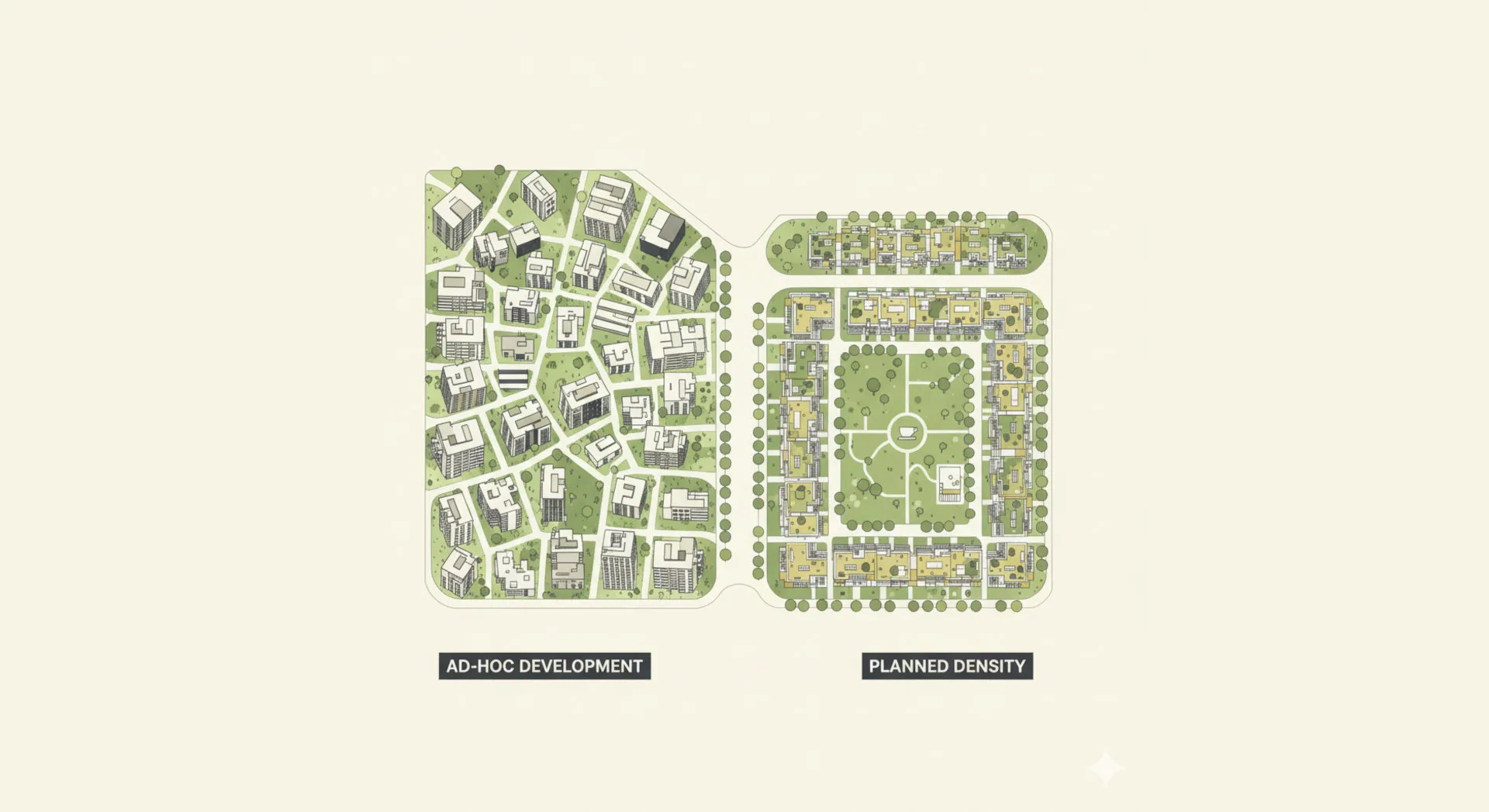
The South Australian government’s advancement of the 10,000-home Concordia mega-project represents a critical escalation in state-level intervention to address Australia’s systemic housing supply crisis. The approval of a draft infrastructure scheme for the site north of Adelaide is not merely a procedural step; it signals a strategic shift towards centralised, master-planned communities intended to deliver housing and infrastructure at a scale private developers cannot achieve alone. For property professionals, Concordia is the national test case for this top-down model. The key strategic takeaway is that while this approach presents a generational opportunity for those who can navigate its complexity, it is also laden with significant execution risk. The project’s success or failure will hinge on the state’s ability to bridge the immense gap between a compelling blueprint and the fiscal reality of funding and delivering core infrastructure.
This development is more than just a housing project; it’s an attempt to actively reshape market dynamics and demographic settlement patterns in response to population pressures. Its innovative infrastructure coordination scheme aims to solve the classic problem of fragmented development but introduces new dependencies on government competency and funding. The strategic implications will ripple across the entire property ecosystem, from land valuation and development finance to long-term asset management and regional market stability. Concordia is a bellwether, and its trajectory demands close scrutiny.
Background & Strategic Context
To understand the significance of Concordia, one must view it not as an isolated event, but as a direct consequence of multiple strategic trends APN has been tracking for years. The decision to pursue a state-led mega-project is a culmination of market failures, demographic shifts, and evolving political imperatives.
- The State as Central Actor (Project Overlord): Concordia is a textbook example of the core thesis of our “Project Overlord” analysis, the increasing necessity for the state to act as the ultimate guarantor and director of market outcomes when private mechanisms fail. Decades of developer-led, piecemeal growth on the urban fringe have proven incapable of matching supply with demand, leading to infrastructure deficits and poor community outcomes. The Concordia model, with its state-appointed Scheme Coordinator, represents a deliberate move to reclaim central control over the planning, sequencing, and delivery of an entire urban region. It is a calculated intervention designed to force a solution where the market could not or would not provide one.
- Demographic Reshuffling (Housing Portability): The project is a direct response to the demographic pressures detailed in our “Housing Portability” intelligence. South Australia, and Adelaide in particular, has been a significant beneficiary of interstate migration from higher-cost states like Victoria and New South Wales, a trend accelerated by the post-pandemic normalisation of remote work. This influx has strained Adelaide’s existing housing stock and infrastructure. Concordia is an attempt to absorb this population growth in a planned manner, preventing the chaotic price inflation and infrastructure collapse seen in other fast-growing corridors. However, it also bets on this demographic trend continuing, a significant variable in the project’s long-term success.
- The Inescapable Constraints (Water Security): Situated near the Barossa Valley, the Concordia site exists within a sensitive and vital watershed. While the source article focuses on roads and utilities, our “Water Security” project analysis identifies water as the single most critical long-term constraint on large-scale development in this corridor. The viability of housing 30,000 new residents hinges entirely on securing a long-term, sustainable water supply, a factor that is notoriously complex and politically charged. The infrastructure plan’s ultimate success will be measured not by the quality of its roads, but by the resilience of its water and wastewater systems.
- Reshaping the Entry Point (The Wealth Funnel): Concordia’s inclusion of “affordable options” is a direct, if ambiguous, attempt to address the socio-economic pressures identified in our “Wealth Funnel” deconstruction. The project aims to widen the entry point to home ownership for a new generation. However, the sheer scale of the development will also create enormous, concentrated wealth for the incumbent landowners and principal developers. The critical question is whether the state can structure the project to achieve both outcomes: delivering genuine affordability at the base while managing the massive value uplift at the top. The risk is creating a master-planned community that, within a decade, becomes just as unaffordable as the markets it was designed to relieve.
Deconstruction of the Source Article
The source article reports on a key administrative milestone for the Concordia development. Its central claims and data points are:
- Core Event: The draft outline of the Concordia Basic Infrastructure Scheme has been approved for public consultation.
- Project Scale: The development is projected to deliver over 10,000 new homes for a population of 25,000 to 30,000 residents.
- Mechanism: The Infrastructure Scheme is a novel, state-led coordination tool designed to manage development across multiple landholders and deliver essential services like roads, bridges, and utilities concurrently with housing.
- Governance: An independent Scheme Coordinator will be appointed to oversee the process.
- Proposed Features: The development plan includes a town centre, retail precincts, diverse and affordable housing, significant open space, an employment zone, and environmental rules for tree protection and planting.
- Acknowledged Risk: The article quotes Minister Champion, who notes that the finalisation of infrastructure requirements, costs, funding arrangements, and timing remains a future dependency.
Critical Analysis & Balanced View
While the source article accurately reports the government’s announcement, a deeper analytical lens reveals significant underlying challenges and alternative interpretations.
- Critique of the Model, The Execution Deficit: The article celebrates the innovative coordination scheme, but this praise is premature. The scheme is a plan to coordinate, not a plan to fund. As our “Project Overlord” analysis has repeatedly shown, large-scale government projects in Australia often suffer from a severe “execution deficit,” where the ambition of the blueprint far outstrips the state’s capacity for timely, on-budget delivery. The article glosses over the fact that the most difficult aspect, securing hundreds of millions, if not billions, in infrastructure funding, is unresolved. This is not a minor detail; it is the project’s central vulnerability.
- The Affordability Mirage: The term “affordable options” is used without definition or commitment. This is a recurring issue in housing policy announcements. Does it mean a mandated percentage of social housing? A “build-to-rent” component with subsidised rents? Or simply smaller lot sizes? Without concrete, mandated targets, the term is politically convenient but functionally meaningless. Market forces within a project of this scale will naturally push developers toward higher-margin products, potentially marginalising genuine affordability without firm state directives.
- The Beneficiary Question: A critical perspective not explored in the article is who the primary financial beneficiaries of this state intervention are. The government’s de-risking of the project, by coordinating infrastructure and leading the rezoning process, creates a monumental value uplift for the current landowners, a consortium of varied interests. While the public purpose is to create housing supply, a major second-order effect is the privatisation of publicly created land value. This aligns with our “Wealth Funnel” thesis, where state actions, even with good intentions, can result in the concentration of wealth.
- Balanced View: The South Australian government’s approach to Concordia is both necessary and laudable in its ambition. The housing crisis requires bold, large-scale thinking, and the attempt to solve the infrastructure coordination problem is a genuine policy innovation. However, the project’s announcement phase optimism must be tempered with a pragmatic assessment of the immense fiscal and logistical hurdles ahead. Concordia is best understood as a high-stakes prototype. Its success would create a powerful new model for urban development in Australia. Its failure would serve as a cautionary tale about the limits of state-led planning without guaranteed funding and flawless execution.
Strategic Implications for Property Professionals
- For Developers: Concordia represents a paradigm shift from opportunistic, site-by-site development to operating within a state-controlled master plan. Large-scale developers have an opportunity to secure long-term pipelines of work but will need to demonstrate capacity to partner effectively with a government-appointed coordinator. Smaller, niche developers should look for specialised opportunities within the master plan (e.g., sustainable infill, specific medium-density typologies) that larger players may overlook. Success will require political acumen as much as development expertise.
- For Investors: This is a very long-term proposition. The highest returns have likely already been secured by the initial landowners. For new investors, the key is to analyse the project’s phasing and infrastructure rollout. Premature investment ahead of confirmed infrastructure delivery carries substantial risk. The most viable entry points will be in commercial assets tied to the town centre and key transport nodes, but only once the government’s funding and delivery timelines for that infrastructure are irrevocably confirmed.
- For Planners, Financiers, and Consultants: The project creates significant demand for professional services skilled in public-private partnerships (PPPs), infrastructure financing, and complex stakeholder management. The Concordia scheme is a complex new regulatory and financial environment; those who can master its intricacies will be in high demand both in SA and nationally as other states watch this model closely.
- For Agents and Valuers: In the medium-to-long term (5-15 years), Concordia will fundamentally reset property values and market dynamics across Adelaide’s northern corridor. Agents operating in adjacent suburbs like Gawler must prepare for a major competitive shift. Valuers will need to develop new benchmarks for this greenfield market, with early valuations heavily dependent on the credibility of the state’s infrastructure commitments.
This article is based on a report from glamadelaide.com.au titled “10,000-home Concordia mega development takes major step forward”. You can find the original article here: https://glamadelaide.com.au/10000-home-concordia-mega-development-takes-major-step-forward/
Given the focus on infrastructure coordination and diverse housing options, how can developers and planners ensure long-term community resilience and adaptability within Concordia, considering potential future economic and environmental shifts?
Disclaimer
The information contained in this article is for general informational purposes only and does not constitute financial, investment, or legal advice. The Australian Property Network (APN) is not a licensed financial advisor. The content is based on data from third-party sources and is provided without any warranty as to its accuracy, currency, or completeness. Property values can go down as well as up. Before making any property or investment decisions, you should conduct your own research and consider seeking independent professional advice tailored to your specific circumstances.