
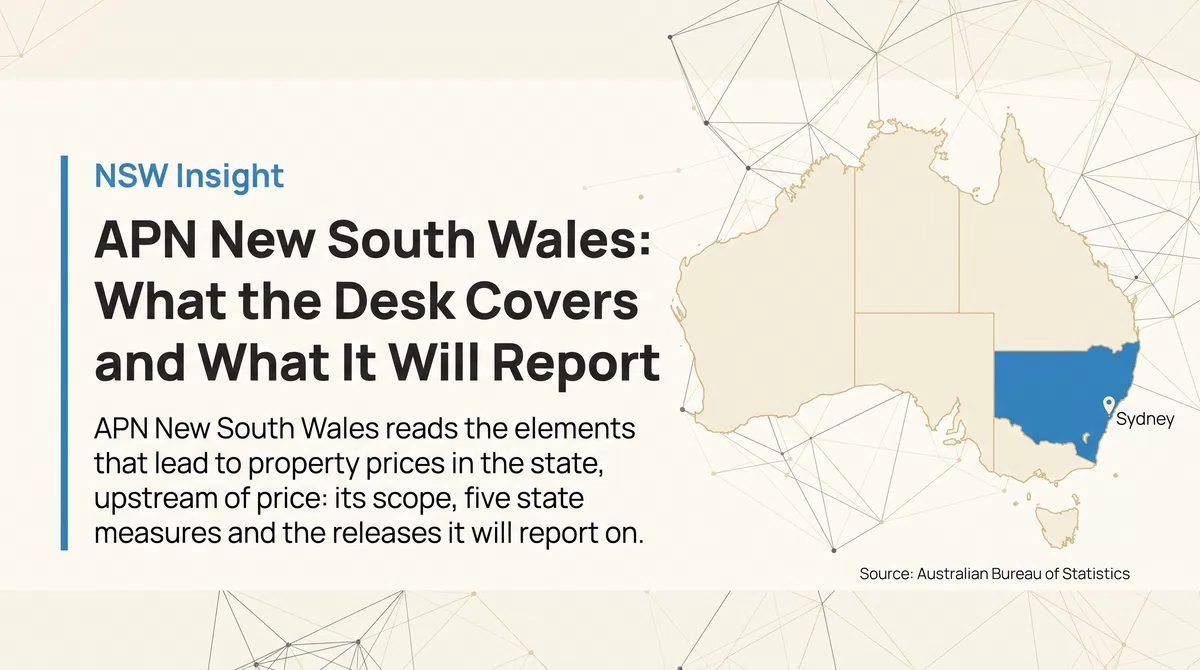

APN New South Wales: What the Desk Covers and What It Will Report
State Labour Conditions (21234), New South Wales +0.5916σ Q2 2026
Public Investment Intensity (21810), New South Wales +0.4655σ Q2 2026
State Price-to-Earnings (21820), New South Wales +0.8410σ Q2 2026
State Supply Adequacy (21830), New South Wales +0.3504σ Q1 2026
State Completion Lag (21840), New South Wales −1.1775σ Q2 2026
Scope and Purpose
APN New South Wales is Australian Property Network’s desk for the state. It examines what lies behind the prices at which homes in New South Wales sell and the rents at which they let: the conditions that come before a sale or a lease, from the cost of credit and the growth of the population to the release of land, the cost of building and the rules that govern each. It reports on each as the evidence develops.
Those elements form a chain. Money and credit set what buyers and builders can borrow. People, through population, migration, households, jobs and incomes, set the demand for homes. Land, the cost to build, tax and regulation, and public investment set what can be built and at what cost. The supply pipeline turns approvals into completed homes. Behaviour, including the mix of investors and owner-occupiers, shapes who buys. Price and rent are read last, as the result of the eight links before them.
Most of the upstream levers in that chain are held by state governments: planning approval and land release, transfer duty and land tax, tenancy law, building regulation and most infrastructure. That is why each state and territory has its own desk. The table sets out where the New South Wales Government holds each lever.
| Link | What it covers | Where the state holds the lever |
|---|---|---|
| 1. Money and credit | interest rates, lending and the terms on which buyers and builders borrow | Shared: interest rates are set nationally; the state guarantees some pre-sale finance for developers |
| 2. People | population, migration, households, jobs and incomes | Partly: migration is a Commonwealth power; the state shapes where people can live |
| 3. Land | zoning, rezoning, land release and land values | The state: planning law, state significant development and land release through Landcom |
| 4. Cost to build | materials, labour, productivity and the cost of finance during construction | Partly: building regulation and the state’s own infrastructure program, which competes for the same trades |
| 5. Tax and regulation | transfer duty, land tax, surcharges, tenancy law and building law | The state: transfer duty, land tax, surcharges, first-home-buyer concessions, tenancy law and the building regulator |
| 6. Public investment | transport, water, schools, hospitals and the enabling works that make land usable | Largely the state: transport, water and wastewater servicing, schools and hospitals |
| 7. Supply pipeline | approvals, commencements, dwellings under construction and completions | The state sets targets and approval pathways; private builders deliver most homes |
| 8. Behaviour | sentiment, the mix of investors and owner-occupiers, and finance taken up | Partly: duty and concession settings change who buys |
| 9. Outcome | price and rent, read as the result of the eight links before it | No direct lever; the outcome of the links above |
APN summary of the division of powers as it bears on housing. “Shared” and “partly” mark links where the Commonwealth or the market also acts.
The Bodies the Desk Follows
- NSW Treasury, which prepares the budget and the Half-Yearly Review, and whose 2026–27 Budget Papers set out the housing measures and the outlook for property tax revenue.
- Revenue NSW, which collects transfer duty, land tax and surcharges and administers first-home-buyer assistance.
- The Department of Planning, Housing and Infrastructure, which sets planning policy and the council housing targets and publishes the housing supply dashboard; the Housing Delivery Authority recommends state significant housing proposals.
- Landcom, the state land and development agency.
- Homes NSW, the social housing landlord.
- Building Commission NSW, the building regulator.
- NSW Fair Trading, which holds rental bonds and publishes rental bond data, and the NSW Rental Commissioner.
- The Audit Office of New South Wales, whose performance audits test how state programs are delivered.
Where New South Wales Stands
Five APN measures read each state against its own history; they are set out on the State & Territory Conditions (21800) page. Each is expressed in standard deviations from the state’s 2011 to 2025 average, and its position ranks the latest quarter against every earlier quarter with full data.
New South Wales: Five State Measures Against the State’s Own History
APN calculation based on Australian Bureau of Statistics data. Each reading is in standard deviations from the state’s own 2011 to 2025 average: State Labour Conditions, higher means a tighter labour market; Public Investment Intensity, higher means more public investment relative to the state economy; State Price-to-Earnings, higher means dwellings dearer relative to earnings; State Supply Adequacy, higher means population growing faster than the dwelling stock; State Completion Lag, higher means completion lags lengthening. June quarter 2026, except State Supply Adequacy (21830), March quarter 2026. Gold bars are above the state’s average and slate bars below.
Four of the five New South Wales readings sit within one standard deviation of the state’s own average. State Labour Conditions (21234) reads +0.5916σ at the June quarter 2026, position 74.6, ranked against 60 quarters: the employed share of the labour force was 96.04% and the job vacancy rate 1.93%. Public Investment Intensity (21810) reads +0.4655σ, position 57.3, ranked against 165 quarters: public investment was 5.36% of state final demand over the four quarters to June 2026. State Supply Adequacy (21830) reads +0.3504σ at the March quarter 2026, position 59.3, ranked against 55 quarters: population grew 1.13% over the year and the dwelling stock 1.17%, so the stock grew marginally faster than the population.
State Price-to-Earnings (21820) reads +0.8410σ, position 66.1, ranked against 57 quarters. The mean dwelling in New South Wales cost 11.90 years of full-time adult ordinary-time earnings at June 2026, the highest of the eight jurisdictions, against 12.00 years a year earlier. Prices grew more slowly than earnings over the year, by 0.84 percentage points. The level is the highest in the country, and it did not rise over the year.
Years of Full-Time Earnings to Buy the Mean Dwelling, June Quarter 2026
State Price-to-Earnings (21820). APN calculation based on Australian Bureau of Statistics data. Mean dwelling price from ABS Total Value of Dwellings divided by a year of full-time adult ordinary-time earnings from ABS Average Weekly Earnings, seasonally adjusted; earnings for June 2026 are those of May 2026. The dot marks New South Wales.
The fifth reading departs from the state’s history. State Completion Lag (21840) reads −1.1775σ, position 7.5, ranked against 161 quarters, the lowest position since the September quarter 2019. Dwellings under construction in New South Wales equalled 19.0 months of completions at June 2026, down from 21.3 months a year earlier. Completions over the four quarters to June 2026 were 49,545, 16.0% more than in the previous four quarters, and commencements were 51,807, 10.1% more. New South Wales and the Northern Territory are the only jurisdictions where the pipeline shortened over the year; it lengthened most in Western Australia, the Australian Capital Territory and Queensland.
Change in Months of Pipeline over the Year to June 2026
State Completion Lag (21840). APN calculation based on Australian Bureau of Statistics data. Dwellings under construction at the end of the quarter divided by a month of completions averaged over four quarters, from ABS Building Activity, Tables 38 and 77, original; June 2026 less June 2025. Gold bars are lengthening pipelines and slate bars shortening ones. The dot marks New South Wales.
Taken together, New South Wales holds the highest price relative to earnings among the states, while its price-to-earnings ratio did not rise over the year and its pipeline of homes under construction shortened by more than in any year since 2019. What lies behind that combination is the first question the desk will report on.
Five Questions Every State Is Working On
Five housing questions appear in the published documents of every state and territory: delivery against a housing target, planning reform, tenancy law, social housing, and first-home-buyer settings. Each state answers them through its own instruments. In New South Wales:
- Delivery against the target. The state’s share of the National Housing Accord is 377,000 homes by 2029, written into five-year completion targets for 43 councils (housing targets). The state’s housing supply dashboard recorded 92,270 dwellings completed from 1 July 2024 when it was updated on 12 October 2026.
- Planning reform. The Planning System Reforms Act 2025 created a Development Coordination Authority and wrote the Housing Delivery Authority into law. The Housing Delivery Authority had declared 484 proposals state significant by July 2026, and the Low and Mid-Rise Housing Policy has allowed terraces, townhouses and apartments within 800 metres of 171 nominated centres and stations since 28 February 2025.
- Tenancy law. Since 19 May 2025 a landlord must give a valid reason to end a lease, and rent increases are limited to once a year (NSW Government release, 25 March 2025).
- Social housing. The Audit Office of New South Wales found in June 2025 that the application and allocation processes were “inefficient and inequitable”, with 56,332 households on the Housing Register at June 2024. The Homes for NSW Strategy 2025–2035 sets a target of 8,400 new social homes by 2031.
- First-home-buyer settings. First home buyers pay no transfer duty on a home up to $800,000 and a concessional rate up to $1 million, and the 2026–27 Budget Statement records the state’s transfer duty and land tax revenue revised down by $8.4 billion over the four years to 2029–30 since the Half-Yearly Review.
What the Desk Reads
The desk works from three bodies of evidence. The first is the Australian Bureau of Statistics (ABS), whose state tables cover building activity and approvals, the national accounts by state, population, the labour force, earnings, lending and prices. The second is the state’s own publications: budget papers, planning and supply data, revenue statistics, rental bond data, regulator and audit reports, and the reports of the state’s Productivity and Equality Commission. The third is APN’s own state measures, shown above.
Questions the Desk Will Take Up
Beyond the five measures, the desk will report on these questions about New South Wales:
- Councils against their targets. How dwellings lodged, approved and completed in each of the 43 councils compare with its five-year target, from the state’s housing supply dashboard.
- The planning reforms. Whether the reforms of 2025 are moving approvals into commencements, reading the state’s approvals data, Housing Delivery Authority declarations and ABS approvals together.
- Rents and tenancy law. Rents on new leases from rental bond lodgements, read beside the tenancy rules in force at each date.
- Social housing. Demand and supply from the Productivity Commission’s and the Australian Institute of Health and Welfare’s annual reports, which put every state on one basis.
- Building costs and trade capacity. How the cost of building moves as the state’s own infrastructure program draws on the same trades, a link the state’s productivity commission has drawn.
- Building quality. Building Commission NSW’s 2025 strata defects research found 53% of surveyed buildings with one or more serious defects; the desk will follow the Commission’s further reports.
- Infrastructure contributions. What the Housing and Productivity Contribution, which replaced the Western Sydney special infrastructure contributions on 1 July 2026, collects and where. Its receipts are not yet published as a series.
- Where population growth comes from. The ABS publishes the growth of each state’s population by its three sources, natural increase, overseas migration and interstate migration, every quarter. The desk will report the New South Wales split with each release.
Forward Agenda
The desk will report on these releases as they are published.
| Date | Release | Reference period | What the desk will look at |
|---|---|---|---|
| 28 October 2026 | Consumer Price Index, Australia (ABS) | September quarter 2026 | Sydney rents and new-dwelling purchase prices in the capital-city indexes |
| 30 October 2026 | Producer Price Indexes, Australia (ABS) | September quarter 2026 | Output prices of house construction in Sydney |
| 2 November 2026 | Building Approvals, Australia (ABS) | September 2026 | Dwelling approvals in New South Wales, the first test of whether approvals move into commencements |
| 11 November 2026 | Lending Indicators (ABS) | September quarter 2026 | New loan commitments in New South Wales by owner-occupiers, investors and first home buyers |
| 19 November 2026 | Labour Force, Australia (ABS) | October 2026 | Employment and unemployment |
| 1 December 2026 | Total Value of Dwellings (ABS) | September quarter 2026 | Mean dwelling price |
| 2 December 2026 | Australian National Accounts: National Income, Expenditure and Product (ABS) | September quarter 2026 | State final demand and public investment |
| 17 December 2026 | National, state and territory population (ABS) | June quarter 2026 | Population at June 2026 |
| 13 January 2027 | Building Activity, Australia (ABS) | September quarter 2026 | Commencements, completions and dwellings under construction |
| 25 February 2027 | Average Weekly Earnings, Australia (ABS) | November 2026 | Earnings for November 2026 |
Release dates as listed on each Australian Bureau of Statistics release page, read on 26 October 2026, and on the state’s own published timetable where one exists. The ABS lists both 2 and 9 November 2026 for the September issue of Building Approvals.
It also reads the NSW Half-Yearly Review 2026–27 from NSW Treasury, whose date has not yet been published, for revisions to property tax revenue and to the housing and capital programs.
The desk’s regular pieces:
- The New South Wales Pipeline Ledger follows each ABS Building Activity release, reading completions, commencements and dwellings under construction against the Accord share. The next is due after 13 January 2027.
- The New South Wales Price-to-Earnings Reading follows each ABS Total Value of Dwellings release, reading the level and pace of price against earnings. The next is due after 1 December 2026.
- A Quarterly Conditions Statement follows each ABS national accounts release, setting the state’s five measures side by side. The next is due after 2 December 2026.
- The Approvals Monitor examines approvals, declarations and commencements.
- The New South Wales Renter’s Quarter reads bond-lodgement rents and the tenancy rules in force.
- State budget reviews of the Half-Yearly Review and the 2027–28 Budget, reading the housing, tax and capital measures.
What the Desk Does Not Do
The New South Wales desk does not forecast prices, rents or any other figure, and it states no expected direction for any release in its agenda. It makes no recommendation to buy, sell or hold property or any other asset. It reports what governments, regulators and organised interests say and do, with the source, and does not attribute motive to any of them. Where a figure is not published, it says so and does not estimate it.
- Audit Office of New South Wales Social housing (performance audit, 24 June 2025) [https://www.audit.nsw.gov.au/our-work/reports/social-housing], accessed 26 October 2026.
- Australian Bureau of Statistics (Reference period: August 2026) Building Approvals, Australia [https://www.abs.gov.au/statistics/industry/building-and-construction/building-approvals-australia/latest-release], ABS Website, accessed 26 October 2026.
- Australian Bureau of Statistics (Reference period: June 2026) Australian National Accounts: National Income, Expenditure and Product [https://www.abs.gov.au/statistics/economy/national-accounts/australian-national-accounts-national-income-expenditure-and-product/jun-2026], ABS Website, accessed 26 October 2026.
- Australian Bureau of Statistics (Reference period: June 2026) Building Activity, Australia [https://www.abs.gov.au/statistics/industry/building-and-construction/building-activity-australia/jun-2026], ABS Website, accessed 26 October 2026.
- Australian Bureau of Statistics (Reference period: June quarter 2026) Lending Indicators [https://www.abs.gov.au/statistics/economy/finance/lending-indicators/latest-release], ABS Website, accessed 26 October 2026.
- Australian Bureau of Statistics (Reference period: June quarter 2026) Total Value of Dwellings [https://www.abs.gov.au/statistics/economy/price-indexes-and-inflation/total-value-dwellings/jun-quarter-2026], ABS Website, accessed 26 October 2026.
- Australian Bureau of Statistics (Reference period: March 2026) National, state and territory population [https://www.abs.gov.au/statistics/people/population/national-state-and-territory-population/mar-2026], ABS Website, accessed 26 October 2026.
- Australian Bureau of Statistics (Reference period: May 2026) Average Weekly Earnings, Australia [https://www.abs.gov.au/statistics/labour/earnings-and-working-conditions/average-weekly-earnings-australia/may-2026], ABS Website, accessed 26 October 2026.
- Australian Bureau of Statistics (Reference period: September 2026) Labour Force, Australia [https://www.abs.gov.au/statistics/labour/employment-and-unemployment/labour-force-australia/latest-release], ABS Website, accessed 26 October 2026.
- Building Commission NSW 2025 Strata Defects Research Report [https://www.nsw.gov.au/departments-and-agencies/building-commission/building-and-construction-resources/2025-strata-defects-research-report], accessed 26 October 2026.
- Department of Planning, Housing and Infrastructure Housing and Productivity Contribution: Special Infrastructure Contribution transition, frequently asked questions (June 2026) [https://www.planning.nsw.gov.au/sites/default/files/2026-06/housing-and-productivity-contribution-special-infrastructure-contribution-transition-faq.pdf], accessed 26 October 2026.
- Department of Planning, Housing and Infrastructure Housing supply dashboard (updated 12 October 2026) [https://www.planning.nsw.gov.au/data-and-insights/housing-supply], accessed 26 October 2026.
- Department of Planning, Housing and Infrastructure Housing targets [https://www.planning.nsw.gov.au/policy-and-legislation/housing/housing-targets], accessed 26 October 2026.
- Department of Planning, Housing and Infrastructure Low and Mid-Rise Housing Policy [https://www.planning.nsw.gov.au/policy-and-legislation/housing/low-and-mid-rise-housing-policy], accessed 26 October 2026.
- Department of Planning, Housing and Infrastructure NSW Planning System Reform Bill passes Parliament (12 November 2025) [https://www.planning.nsw.gov.au/news/nsw-planning-system-reform-bill-passes-parliament], accessed 26 October 2026.
- Homes NSW Homes for NSW Strategy 2025–2035 (22 October 2025) [https://www.nsw.gov.au/sites/default/files/noindex/2025-10/homes-for-nsw-strategy-2025-2035.pdf], accessed 26 October 2026.
- NSW Government Housing Delivery Authority builds pipeline for 150,000 new homes (ministerial release, 7 July 2026) [https://www.nsw.gov.au/ministerial-releases/hda-pipeline-new-homes], accessed 26 October 2026.
- NSW Government Minns Labor Government delivers on rental reform by ending no grounds evictions on 19 May 2025 (ministerial release, 25 March 2025) [https://www.nsw.gov.au/ministerial-releases/minns-labor-government-delivers-on-rental-reform-by-ending-no-grounds-evictions-on-19-may-2025], accessed 26 October 2026.
- NSW Productivity and Equality Commission Review of housing supply challenges and policy options for New South Wales (August 2024) [https://www.nsw.gov.au/sites/default/files/noindex/2025-09/nsw-pec-report-review-of-housing-supply-challenges-and-policy-options-for-nsw.pdf], accessed 26 October 2026.
- NSW Treasury NSW Budget 2026–27, Budget Paper No. 1, Budget Statement (23 June 2026) [https://www.nsw.gov.au/sites/default/files/noindex/2026-06/bp1-budget-statement-nsw-budget-2026-27.pdf], accessed 26 October 2026.
ABS material is used under a Creative Commons Attribution 4.0 International licence. Calculations, standardisations and index readings are APN’s and are not attributable to the ABS.
Disclaimer
The analysis and information contained in this publication are for general informational and strategic purposes only and do not constitute financial, investment, legal, or any other form of professional advice. Australian Property Network is not a licensed financial advisor. Property values and market conditions can go up or down. Before making any property or investment decisions, you must conduct your own thorough research and seek independent professional advice tailored to your specific circumstances. Images are for illustrative purposes only. E.&O.E.
Findings are presented on the basis of data and evidence alone.
