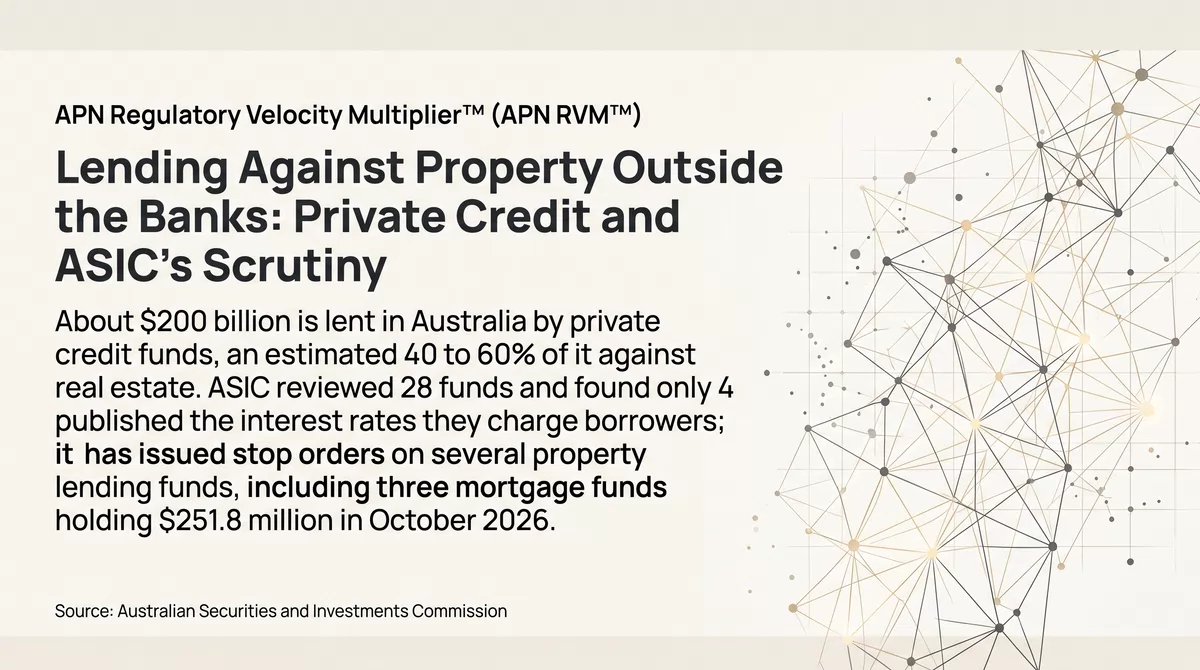

About $200 billion is now lent in Australia by private credit funds rather than banks, and an estimated 40 to 60% of it is lent against real estate, much of it to construction and development. When the Australian Securities and Investments Commission reviewed 28 of these funds, it found that only 4 published the interest rates they charge borrowers, and that fewer than half had detailed written policies for managing bad loans. It has since issued stop orders on several funds that lend against property, including, in October 2026, three mortgage funds holding $251.8 million, and has made poor private credit practices one of its enforcement priorities for 2026.
Private credit is lending by funds rather than banks, financed by investors rather than deposits. Its loans are not traded on public markets.
What private credit is
Private credit is lending by investment funds and other non-bank lenders, financed by investors’ money rather than deposits, with loans that are not traded on public markets. Investors, from superannuation funds to retail investors buying units, receive the interest borrowers pay, less what the manager keeps. ASIC says the market grew rapidly in the 18 months to late 2025, driven by superannuation savings seeking yield, more retail participation, and a moderation in bank lending to higher-risk real estate ventures; domestic private credit funds account for about 70% of loans outstanding (ASIC, Report 820).
How much of it is property
| Segment | What it covers | Estimated share |
|---|---|---|
| Real estate | Residential, commercial and office property, including construction and development finance | 40–60% |
| Corporate and commercial | Mostly direct loans to businesses, often owned by private equity | 20–40% |
| Asset-backed and securitised | Structured lending against pools of mortgages and consumer receivables | 10–30% |
Source: Australian Securities and Investments Commission, Report 814, Private credit in Australia, 2024, section 7. The report’s estimate of the market’s composition, from various sources.
A report commissioned by ASIC, published in September 2025, estimated the market at around $200 billion in 2024 and put real estate lending, including construction and development finance, at 40 to 60% of it (ASIC, Report 814). That is what links private credit to the housing market: where bank lending to a project is constrained, a private credit fund may lend instead, on terms its investors may not see in detail.
The Reserve Bank’s October 2026 Financial Stability Review describes Australian private credit funds as “typically concentrated in real estate lending, including for construction and development”, which makes them more exposed to stress in the property sector. It judges that the market is too small to threaten the financial system: non-bank lenders account for around 6% of financial system assets, and private credit for around 10% of business debt and less than 2% of financial system assets. Banks’ exposure is small. Its concern is investors: the opaque practices of some funds can expose them to risks they do not know about (RBA, Financial Stability Review, October 2026).
What ASIC found
Private credit funds showing selected practices, share of those reviewed by ASIC, October 2024 to August 2025
APN calculation based on Australian Securities and Investments Commission data: Report 820, Private credit surveillance: retail and wholesale funds, October 2024 to August 2025. Share of the funds reviewed that showed each practice; ASIC reviewed 20 retail and 8 wholesale funds. Counts as ASIC reports them; shares are APN calculations.
From October 2024 to August 2025 ASIC reviewed 28 private credit funds, 20 open to retail investors and 8 wholesale. It found practices “inconsistent and not always executed well”. Only 4 of the 28 published the interest rates charged to borrowers. Only 2 retail funds quantified the interest and borrower fees earned and disclosed what the manager kept; in one case the manager kept an interest margin of 7.5%. Fewer than half the funds had detailed written credit, impairment and default policies. The funds reported defaults of 0 to 6% of their loan books, but defined “default” differently, and ASIC was concerned that reporting may not show investors the true level of non-performing loans. Only 2 of the 8 wholesale funds stress-tested their liquidity.
Stop orders on property lending funds
| Year | Fund | Lends against | Order on | Outcome |
|---|---|---|---|---|
| 2025 | La Trobe Australian Credit Fund (12 Month and 2 Year accounts) | Loans secured by registered first mortgages | Target market determination | Revoked 24 September 2025 after amendments |
| 2025 | RELI Capital Mortgage Fund | Mortgage fund | Target market determination | Revoked 29 September 2025 after amendments |
| 2026 | Wealthon Vault Development Fund (Stratfund) | Secured loans for property developments | Target market determination | Revoked 20 July 2026 after amendments |
| October 2026 | ASCF Premium Capital, Select Income and High Yield funds | Short-term mortgages over Australian property; $251.8 million | Product disclosure statement | Interim; submissions open |
Sources: ASIC media releases 25-206MR, 25-208MR, 26-142MR and 26-234MR. Only orders on funds that ASIC describes as lending against property, or that are named as mortgage funds, are shown.
Most of ASIC’s orders on private credit funds have been about who the funds were being sold to. Under the design and distribution rules, an issuer must define the investors a product suits in a target market determination; ASIC stopped sales where funds lending against property were described as suitable for investors seeking to preserve their capital, or as a core part of a portfolio. In each of the first three cases the issuer changed the document and ASIC revoked the order. The October 2026 order on Australian Secure Capital Fund’s three mortgage funds is different: it concerns the disclosure document itself, which ASIC said did not clearly disclose the loan portfolio or its diversification and may contain a misleading statement. It is an interim order, and the issuer can respond before ASIC decides on a final one (26-234MR).
ASIC’s enforcement priorities for 2026 include “poor private credit practices”, and in Report 820 it said it had begun enforcement investigations into the more serious conduct.
What the APN index reads
APN Regulatory Velocity Multiplier™ (24210) combines ASIC’s count of investigations commenced with the enforceable undertakings the Australian Prudential Regulation Authority accepts. It reads +1.1006σ, March quarter 2026, position 97.8, ranked against 46 quarters, close to the top of its history. It counts investigations of every kind; private credit is one of the areas ASIC has named as a priority for them. A companion article sets out how often ASIC opens an investigation.
What this does not show
There is no official series on private credit. The $200 billion and the 40 to 60% are estimates drawn from various sources, and the report prepared for ASIC notes how hard definitive data are to obtain. ASIC’s review describes 28 funds, not the whole market, and its findings describe practices, not losses: it does not say how many investors have lost money. A stop order is a judgment about a product’s documents, not a finding that its loans are failing.
- Australian Securities and Investments Commission 25-206MR ASIC issues DDO stop orders against La Trobe Australian Credit Fund [https://asic.gov.au/about-asic/news-centre/find-a-media-release/2025-releases/25-206mr-asic-issues-ddo-stop-orders-against-la-trobe-australian-credit-fund/], accessed 15 October 2026.
- Australian Securities and Investments Commission 25-208MR ASIC issues DDO stop order against RELI Capital Mortgage Fund [https://asic.gov.au/about-asic/news-centre/find-a-media-release/2025-releases/25-208mr-asic-issues-ddo-stop-order-against-reli-capital-mortgage/], accessed 15 October 2026.
- Australian Securities and Investments Commission 26-142MR ASIC issues DDO stop orders against Stratfund’s Australian Fixed Income Fund [https://www.asic.gov.au/about-asic/news-centre/find-a-media-release/2026-releases/26-142mr-asic-issues-ddo-stop-orders-against-stratfund-s-australian-fixed-income-fund], accessed 15 October 2026.
- Australian Securities and Investments Commission 26-234MR ASIC halts offers in mortgage schemes managed by Australian Secure Capital Fund [https://asic.gov.au/about-asic/news-centre/find-a-media-release/2026-releases/26-234mr-asic-halts-offers-in-mortgage-schemes-managed-by-australian-secure-capital-fund], accessed 15 October 2026.
- Australian Securities and Investments Commission ASIC enforcement priorities [https://asic.gov.au/about-asic/asic-investigations-and-enforcement/asic-enforcement-priorities/], accessed 15 October 2026.
- Australian Securities and Investments Commission Report 814: Private credit in Australia (22 September 2025) [https://download.asic.gov.au/media/z2tnnasb/rep814-published-22-september-2025.pdf], accessed 15 October 2026.
- Australian Securities and Investments Commission Report 820: Private credit surveillance: retail and wholesale funds (5 November 2025) [https://www.asic.gov.au/regulatory-resources/find-a-document/reports/rep-820-private-credit-surveillance-report-retail-and-wholesale-surveillance], accessed 15 October 2026.
- Reserve Bank of Australia Financial Stability Review, October 2026: 3. Resilience of the Australian Financial System [https://www.rba.gov.au/publications/fsr/2026/oct/resilience-of-the-australian-financial-system.html], accessed 15 October 2026.
© Australian Securities & Investments Commission: Reproduced with permission. ASIC material is licensed under a Creative Commons Attribution 4.0 International licence.
Reserve Bank of Australia material used under the Reserve Bank’s copyright terms.
Disclaimer
The analysis and information contained in this publication are for general informational and strategic purposes only and do not constitute financial, investment, legal, or any other form of professional advice. Australian Property Network is not a licensed financial advisor. Property values and market conditions can go up or down. Before making any property or investment decisions, you must conduct your own thorough research and seek independent professional advice tailored to your specific circumstances. Images are for illustrative purposes only. E.&O.E.
Findings are presented on the basis of data and evidence alone.