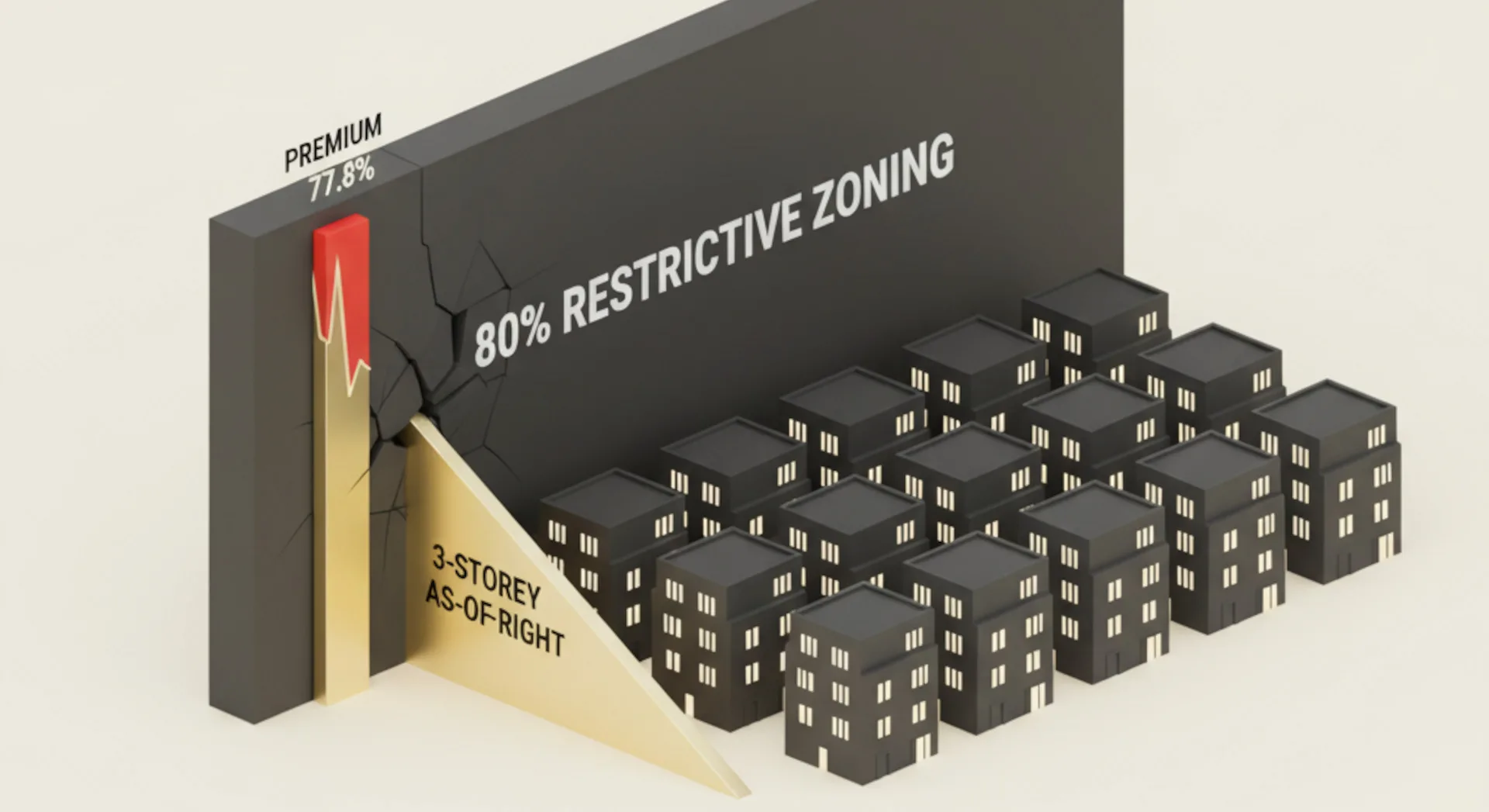


The State Strikes Back: Deconstructing Victoria’s Forceful Rezoning of Melbourne’s Leafy Suburbs
APN ANALYSIS: A-250911-VIC4
Executive Summary
The Victorian government’s release of draft rezoning maps for 25 of Melbourne’s middle-ring suburbs is a politically charged and decisive move to confront the city’s housing supply crisis. The key strategic takeaway is that the state is overriding local councils to force densification in high-value, low-growth areas. By fast-tracking approvals for apartment towers up to 16 storeys and removing appeal rights for compliant projects, the government is creating a significant, state-sanctioned development opportunity. For developers and landowners, this is a clear signal that the planning calculus in these prized locations has fundamentally changed.
This analysis deconstructs the government’s strategy as a direct assault on the planning gridlock that has long constrained Melbourne’s housing supply. We’ll examine the power dynamics at play, the critical mechanism of removing VCAT appeals, and the strategic implications for a property market that is now subject to a more forceful, centralised planning doctrine.
Background & Strategic Context
This policy shift is a direct intervention designed to reshape Melbourne’s urban form and is best understood through our core intelligence frameworks.
- The State Seizes Control (Project Overlord): This is a classic “Project Overlord” power play. The state government has identified local councils and resident opposition as the primary obstacles to its strategic housing goals. In response, it is centralising planning control in designated zones, effectively overriding local opposition to execute a state-level imperative.
- Creating the “Missing Middle” (Housing Portability): This policy is a direct attempt to create more housing, from the “missing middle” of 4-6 storeys to high-density options, in established suburbs that already have high-quality transport and social infrastructure. This is designed to combat costly urban sprawl and provide housing options closer to the city centre.
- State-Sanctioned Value Uplift (The Wealth Funnel): The act of rezoning is a direct injection of potential wealth into these specific locations. This government action will create a massive, state-sanctioned value uplift for owners of well-located land within the designated “core” and “inner catchment” areas, fundamentally altering the high end of the “Wealth Funnel.”
Deconstruction of the Source Event
The initial report from The Guardian details the key facts of the government’s plan:
- The Allan government has released draft maps proposing new height limits for 25 of its 50 designated activity centres.
- The plan involves the state seizing planning control from local councils in “core” areas near train and tram stops.
- Proposed maximum building heights are up to 16 storeys in suburbs like Hampton, Kew, and along Sydney Road in Coburg and Brunswick.
- Crucially, eligible buildings in these “core” areas will be “deemed to comply” and will not be subject to challenges at VCAT, dramatically speeding up approvals.
Critical Analysis & Balanced View
This is a bold strategy, but its success and consequences require critical examination.
- Targeting the NIMBY Strongholds: The most critical insight is the political nature of this move. The government is deliberately targeting affluent, established suburbs within local government areas like Bayside and Boroondara, which have seen population growth as low as 30% over the last three decades, compared to 400% in outer suburbs. This is a direct confrontation with the “NIMBY” (Not In My Back Yard) sentiment that has historically blocked densification.
- The “Neutering” of VCAT: The key mechanism that makes this policy so powerful for developers is the removal of third-party appeal rights at the Victorian Civil and Administrative Tribunal (VCAT) for compliant projects. This eliminates the primary tool used by objectors to stall or block developments, significantly de-risking the planning process.
- The Affordability Question: While the government frames this as a plan to help young people and improve affordability, a critical view must question the outcome. Without specific mandates for affordable or social housing components, there is a significant risk that developers will simply use this opportunity to build high-end, high-margin apartments. This would increase supply, but may do little to address the housing needs of those at the lower end of the market.
- Balanced View: This is a necessary, albeit politically confrontational, move by the state government to address Melbourne’s structural housing supply issues. It creates an unprecedented development opportunity in some of the city’s most prized locations. However, its ultimate success will be measured not just by the number of new apartments built, but by its ability to deliver a diverse and genuinely more affordable range of housing options.
Strategic Implications for Property Professionals
- For Developers: This is a green light for site acquisition and feasibility studies in the 25 designated activity centres. The removal of VCAT risk for compliant projects is a game-changer that dramatically improves planning certainty and project timelines.
- For Landowners: Owners of well-located properties within the “core” (up to 16 storeys) and “inner catchment” (4-6 storeys) zones, particularly larger blocks over 1,000 sqm, will experience a significant, overnight uplift in the theoretical value of their land.
- For Valuers: Valuation methodologies for properties within these designated zones must be immediately updated to reflect their new, much higher development potential. Historical sales data will quickly become an obsolete guide to a site’s true value.
- For Agents: This provides a powerful new narrative for selling property in these suburbs. The conversation will now shift from a property’s current state to its “future development potential” under the new state-led planning controls.
This article is based on a report from www.theguardian.com titled “Victorian Labor targets affluent Melbourne suburbs for rezoning to allow 16-storey apartment towers | Victoria”. You can find the original article here: https://www.theguardian.com/australia-news/2025/sep/10/victorian-labour-targets-affluent-melbourne-suburbs-for-rezoning-to-allow-16-storey-apartment-towers
Given the government’s focus on increasing housing supply and affordability, how can developers ensure that new developments in these activity centres genuinely cater to diverse income levels and housing needs, rather than solely focusing on high-end apartments?
Disclaimer
The information contained in this article is for general informational purposes only and does not constitute financial, investment, or legal advice. The Australian Property Network (APN) is not a licensed financial advisor. The content is based on data from third-party sources and is provided without any warranty as to its accuracy, currency, or completeness. Property values can go down as well as up. Before making any property or investment decisions, you should conduct your own research and consider seeking independent professional advice tailored to your specific circumstances.