

Highfields’ $1M Price Threshold Initiates Demand Displacement to Plainland
APN ANALYSIS: A-260207-AUS136945
Executive Summary
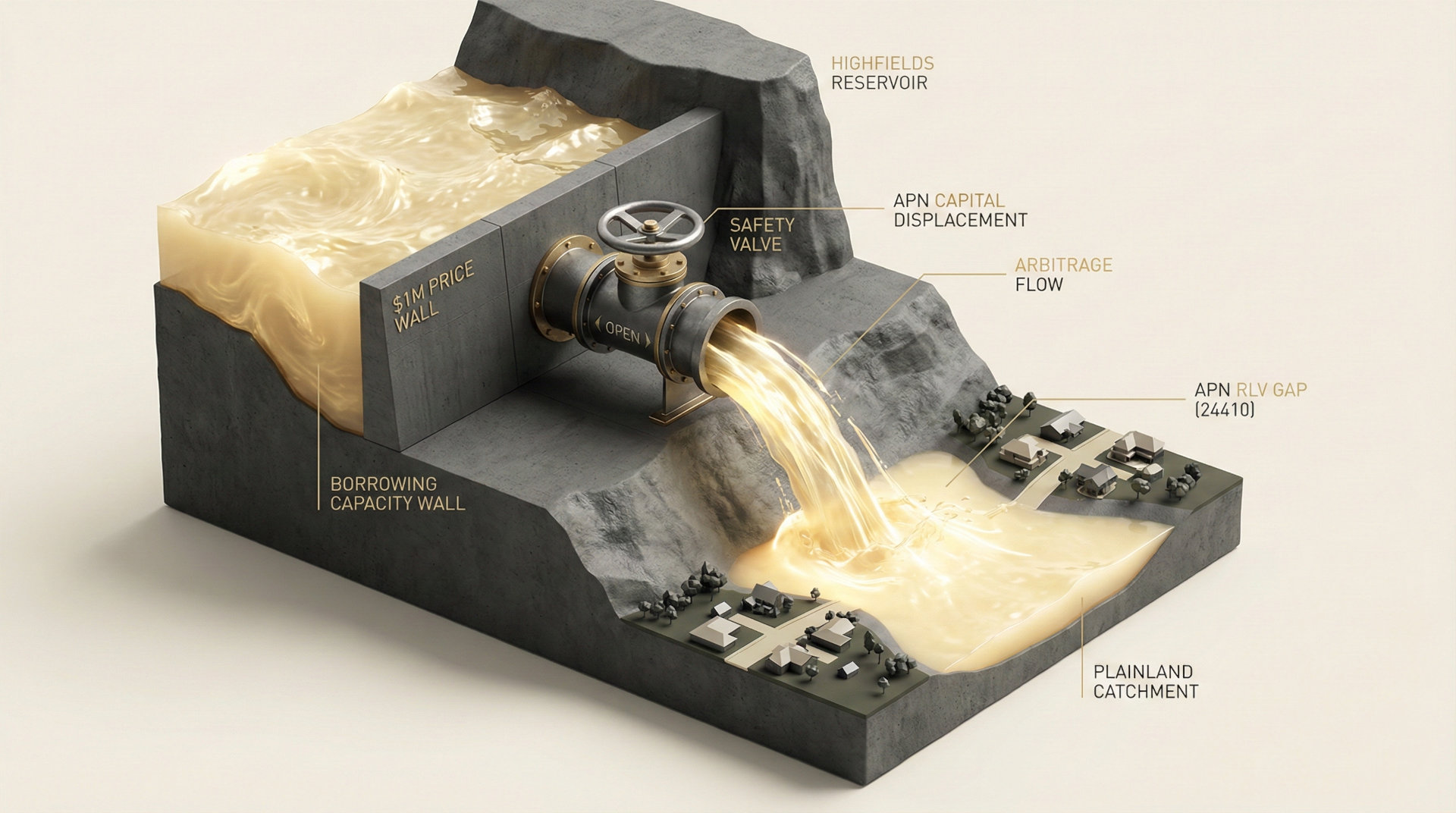
The Highfields (4352) property market has structurally breached the $1,000,000 median house price, transitioning from a regional affordability node to a premium, capital city proxy market. This price point has established a borrowing capacity constraint for the ‘working capital’ demographic, families and investors with budgets typically capped around $850,000. This analysis confirms that capital is not experiencing a material reduction; it is being redirected via a demand displacement mechanism. Demand is displacing eastward to the Plainland/Lockyer Valley corridor, which offers comparable lifestyle utility at a significant discount.
For property professionals, this structural shift creates a distinct arbitrage opportunity. The capital displacement is not speculative but a displacement of demand driven by pricing exclusion. The current price differential in Plainland is a function of two key factors: a temporary commute friction caused by major Warrego Highway roadworks, and a widening ‘Replacement Cost Gap’, where existing housing stock is trading at a material discount to the sustained escalation in the cost of new construction. Acquiring assets in Plainland before these frictions resolve represents a strategic position to anticipate the projected price convergence with its primary driver node.
Background & Strategic Context
This event validates and calibrates APN’s core macro-theses, demonstrating how state-level forces (APN Sovereign Policy Composite Index™ (SPCI, 24800)) and structural market mechanics create distinct value pathways. The Highfields price threshold and subsequent Plainland displacement are a clear illustration of how structural constraints redirect capital flows, creating predictable secondary displacement corridors. The key frameworks at play are:
The Structural Inflation Driver (APN Replacement Cost Gap™): The analysis confirms the APN RCG™ (24450) is widening. A $116.8 billion state infrastructure pipeline is acting as a labour absorption mechanism, contributing to a state-specific shortage of approximately 18,200 tradespeople annually, peaking in the 2026–27 window and structurally inflating residential construction costs. This provides a ‘Replacement Cost Moat’ around existing stock in Plainland, making it a defensive asset class trading below its intrinsic replacement value.
The Credit Exclusion Mechanism (APN Credit Rationing Index™): The $1M Highfields median activates the Credit Exclusion Mechanism. The APN Credit Rationing Index™ (24230) tracks how rising prices, combined with static serviceability buffers, mathematically exclude entire cohorts of buyers. The ‘Working Capital’ cohort, despite being creditworthy, is now structurally excluded from Highfields, prompting its displacement to the next viable node.
The Social Capital Transition (APN Social Capital Index™): Highfields’ evolution is reflected in its high IRSAD score (1064) and dominant owner-occupier base (84%), indicating high social cohesion and holding power (APN Bedrock™ 24110) that reinforces its new premium status. Conversely, Plainland is now absorbing the demographic cohort essential for economic function (essential service workers, young families), recalibrating its own social capital profile and building a new foundation for future growth.
Deconstruction of the Source Event
This deconstruction is based on an internal APN intelligence briefing synthesising market data, infrastructure reports, and demographic analysis. The key facts are:
- The $1M Price Threshold: Highfields’ median house price has surpassed $1,010,000, with annual growth of approximately 19%. This is not an anomaly driven by acreage, as the median for a standard 4-bedroom house is now $991,500.
- The Plainland Discount: The median price for standard residential stock in Plainland is confirmed at $787,000, representing a ~23% discount to Highfields and creating the primary affordability arbitrage that fuels the displacement.
- Structural Labour Scarcity: A $242 billion infrastructure pipeline is contributing a projected national construction worker shortage of 300,000 by 2027, including an elevated Queensland-specific gap of 67,000 workers, with a transient 1.5% vacancy rate in Plainland reflecting a +0.4pp lift from new stage completions. This structurally inflates the replacement cost of new housing.
- Material Inventory Constraint: Highfields is experiencing a material inventory constraint, with only 0.3% stock on market and 1.07 months of supply. This elevated scarcity reinforces the price floor and prevents any near-term price correction.
- The Commute-Related Friction: Major roadworks on the Warrego Highway, with staged completions throughout 2026, are creating temporary travel friction. This is suppressing Plainland’s full value potential and creating a tactical buying window.
Critical Analysis & Balanced View
The strategic opportunity identified rests on the interplay between permanent structural shifts and temporary market frictions. The $1M price threshold in Highfields and the labour absorption effect on construction costs are long-term, structural realities that are not projected to reverse. In contrast, the commute friction imposed by the Warrego Highway upgrades is a temporary friction with a defined end date in mid-2026. The core arbitrage lies in acquiring assets in Plainland while the market is pricing in the temporary friction, not the permanent uplift from completed infrastructure and displaced demand.
A balanced view must, however, address the 4.89% vacancy rate anomaly detected in Plainland. While our primary assessment attributes this to transient absorption friction from new housing stages completing simultaneously, it constitutes a micro-risk requiring on-the-ground due diligence. If this figure were to represent a structural demand issue rather than a temporary supply increase, it would challenge the thesis. Investors must verify real-time rental demand at a street and estate level. Furthermore, while Plainland’s 4.5% yield is superior to Highfields’ 3.6%, both are compressing under capital growth pressure, indicating the window for securing materially cash-flow-positive assets is also narrowing.
Strategic Implications for Property Professionals
- For Buyers’ Agents & Mortgage Brokers: The structural exclusion of clients with borrowing capacity under $900,000 from Highfields detached housing suggests a proactive redirection of this ‘working capital’ cohort to the Plainland corridor, articulating the ~$223,000 arbitrage and superior yield profile as a data-backed value proposition.
- For Developers & Builders: The APN Replacement Cost Gap™ (24450) is your primary risk and opportunity metric. The feasibility of new house-and-land packages in Plainland is contingent on end-sale prices rising to meet escalating construction costs. Acquiring strategic land holdings is viable, but delivering finished product profitably requires pricing to converge towards the emerging $950,000+ replacement cost threshold.
- For Sales Agents & Property Managers (Lockyer Valley): A pivot in marketing narrative is indicated. Frame Plainland not as a lower-cost alternative but as the ‘smart capital’ destination, absorbing the economic engine of SEQ’s median-income households. For property management, highlight the 4.5%+ yields and underlying demand from Brisbane/Ipswich commuter migration to attract investors, while being prepared to explain transient vacancy increases from new stage releases.
- For Valuers & Risk Analysts: Valuation models should account for the widening APN Replacement Cost Gap™. Existing residential stock in Plainland, currently trading at a median of $787,000, is valued at a material discount when compared to the $950,000+ required to deliver an equivalent new-build product in the current inflationary environment. This $163,000 equity buffer represents a “Replacement Cost Moat” for existing assets.
Furthermore, the commute-related friction—driven by the Warrego Highway upgrades—should be quantified as a temporary discount factor rather than a structural loss of utility. Analysts should apply a forward-looking uplift to terminal values, anticipating a resolution of this friction and price convergence once staged infrastructure completions conclude in late 2026.
APN Index Management
The APN Codex 24000 Series is a proprietary set of indices that translates complex market forces into measurable metrics. This section outlines how the preceding analysis is validated against, and informs the calibration of, these frameworks.
- Validation: This analysis validates the APN Replacement Cost Gap™ (24450) as a primary driver of asset price floors in a supply-constrained, high-inflation environment. It also confirms the predictive power of the APN Credit Rationing Index™ (24230) in identifying market exclusion points that trigger capital displacement.
- Index Calibration: The APN Infrastructure Uplift Multiplier™ (24420) will be calibrated to include a ‘Friction Discount’ variable, quantifying the temporary price suppression caused by active construction phases before the full uplift is realised. The Highfields-to-Plainland price differential of ~23% will serve as a new benchmark for Tier 1 to Tier 2 satellite displacement.
- Data Capture: This analysis triggers a new data capture requirement via the APN Symbiotic Intelligence Network™ (24310) to monitor the absorption rate of new rental stock in Plainland post-stage completion, to differentiate between transient absorption friction and genuine demand weakness.
Disclaimer
The analysis and information contained in this deconstruction are for general informational and strategic purposes only and do not constitute financial, investment, legal, or any other form of professional advice. The Australian Property Network (APN) is a strategic intelligence organisation and is not a licensed financial advisor.
This analysis is based on data and information from third-party sources believed to be reliable; however, APN provides no warranty as to its accuracy, currency, or completeness. Images used in this analysis are for illustrative and conceptual purposes only and may not represent real persons, properties, or events.
All frameworks (Codex 24100-24800) are proprietary to APN.
Property values and market conditions can go up or down. Before making any property or investment decisions, you must conduct your own thorough research and seek independent professional advice tailored to your specific circumstances.
