

The Australian Anomaly: Why Global Depopulation is a Systemic Threat to the Property Market
APN ANALYSIS: A-250914-AUS17
Executive Summary
Australia’s high-growth economic model, underpinned by a world-leading immigration program, is on a direct collision course with a global megatrend: depopulation. While developed and key developing nations face demographic decline, Australia remains an outlier, importing growth to fuel its economy. The key strategic takeaway is that our nation’s prosperity, and particularly the stability of our highly leveraged property market, is structurally dependent on a shrinking global pool of human capital. This creates a profound, long-term vulnerability that challenges the foundational assumptions of Australian real estate investment.
This analysis deconstructs the core tenets of the global depopulation thesis and contrasts them with Australia’s unique demographic trajectory. It reveals that the external conditions that have enabled our growth model for decades are now reversing, creating a future of intense competition for talent that could represent a systemic shock to the property market’s primary demand driver.
Background & Strategic Context
This looming demographic shift highlights a critical strategic dependence at the heart of Australia’s economy.
- A State Strategy Dependent on Outsiders (Project Overlord): Australia’s high Net Overseas Migration (NOM) policy is a deliberate state strategy to engineer economic growth. The primary vulnerability of this strategy is that it’s entirely dependent on external factors, namely, the global supply of mobile human capital, which is outside of the Australian government’s control.
- The Fuel for the Funnel (The Wealth Funnel): Perpetual, high population growth is the primary fuel for our property-centric “Wealth Funnel”. It ensures a constant stream of new demand that underpins asset prices, supports the construction industry, and backstops the mortgage books of our major banks. The global depopulation trend threatens to turn off this fuel supply.
Deconstruction of the Strategic Landscape
The source intelligence report establishes a clear dichotomy between the global trend and the “Australian Anomaly.”
- The Global Trend (Depopulation): The foundational driver is a global collapse in fertility rates. A vast and growing number of nations have fallen below the 2.1 replacement level, including nearly all of Europe, the United States (approx. 1.6), and critically, major developing nations like China (approx. 1.2) and India (now below 2.0). This inevitably leads to aging populations and shrinking workforces, creating significant economic headwinds.
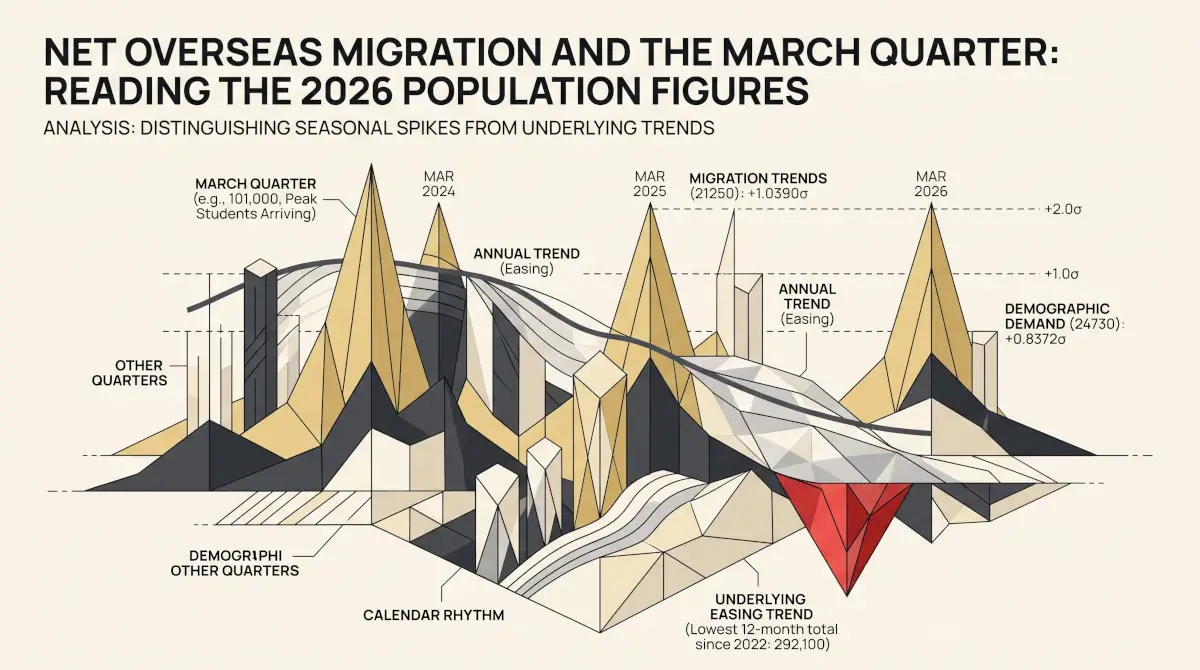
- The Australian Anomaly (Imported Growth): In stark contrast, Australia’s population grew by 2.5% in the year to March 2024. This growth is almost entirely synthetic; Net Overseas Migration (NOM) accounted for a staggering 83% of the total increase. Australia’s own fertility rate sits at approximately 1.7, well below replacement level. We are not growing naturally; we are importing our growth.
- The Future Conflict (A War for Talent): The report projects a future of intense global competition for a shrinking pool of skilled migrants. As other developed nations age and major source countries see their own populations decline, Australia’s ability to simply “turn on the immigration tap” to fuel growth will diminish.
Critical Analysis & Balanced View
The intelligence leads to a critical reassessment of Australia’s perceived demographic strength.
- A Position of Dependence, Not Strength: The most critical insight from the intelligence is that the “Australian Anomaly” should not be viewed as a position of strength, but as one of high-stakes strategic dependence. Our economic model has effectively outsourced its demographic future and, by extension, the stability of our property market.
- The Market’s Foundational Assumption is at Risk: The entire Australian property ecosystem is built on one foundational assumption: that a continuous, high rate of population growth will always support or increase asset prices. The core thesis of global depopulation directly challenges this assumption.
- The Nature of the Shock: A significant, externally-forced reduction in NOM would not be a cyclical downturn for the property market; it would be a systemic shock that invalidates its core premise. With the primary driver of new housing demand removed, the market would be exposed to a severe structural correction.
- Balanced View: For decades, Australia has successfully leveraged a high-migration model to fuel its prosperity. This strategy is not inherently flawed. However, the changing global demographic landscape now presents a fundamental challenge to its long-term sustainability. The key vulnerability is that the external conditions that made our strategy possible are now in a state of reversal.
Strategic Implications for Property Professionals
- For Long-Term Investors & Developers: The foundational assumption of perpetual high population growth must now be treated as a variable risk, not a given. Long-term (20+ year) feasibility studies and investment models should begin to stress-test scenarios with significantly lower NOM.
- For Economic Forecasters & Valuers: Property valuation models that heavily weight historical population growth trends may be overstating long-term future values. A new risk factor, “global talent competition,” needs to be considered as a potential constraint on future housing demand.
- For Government & Policy Makers: This analysis highlights an urgent need to foster sources of domestic productivity and economic growth that are independent of high population growth. Reducing our strategic dependence on a diminishing global resource is a critical national security issue.
Disclaimer
The analysis and information contained in this deconstruction are for general informational and strategic purposes only and do not constitute financial, investment, legal, or any other form of professional advice. The Australian Property Network (APN) is a strategic intelligence organisation and is not a licensed financial advisor.
This analysis is based on data and information from third-party sources believed to be reliable; however, APN provides no warranty as to its accuracy, currency, or completeness. Images used in this analysis are for illustrative and conceptual purposes only and may not represent real persons, properties, or events. Property values and market conditions can go down as well as up.
Before making any property or investment decisions, you must conduct your own thorough research and seek independent professional advice tailored to your specific circumstances.