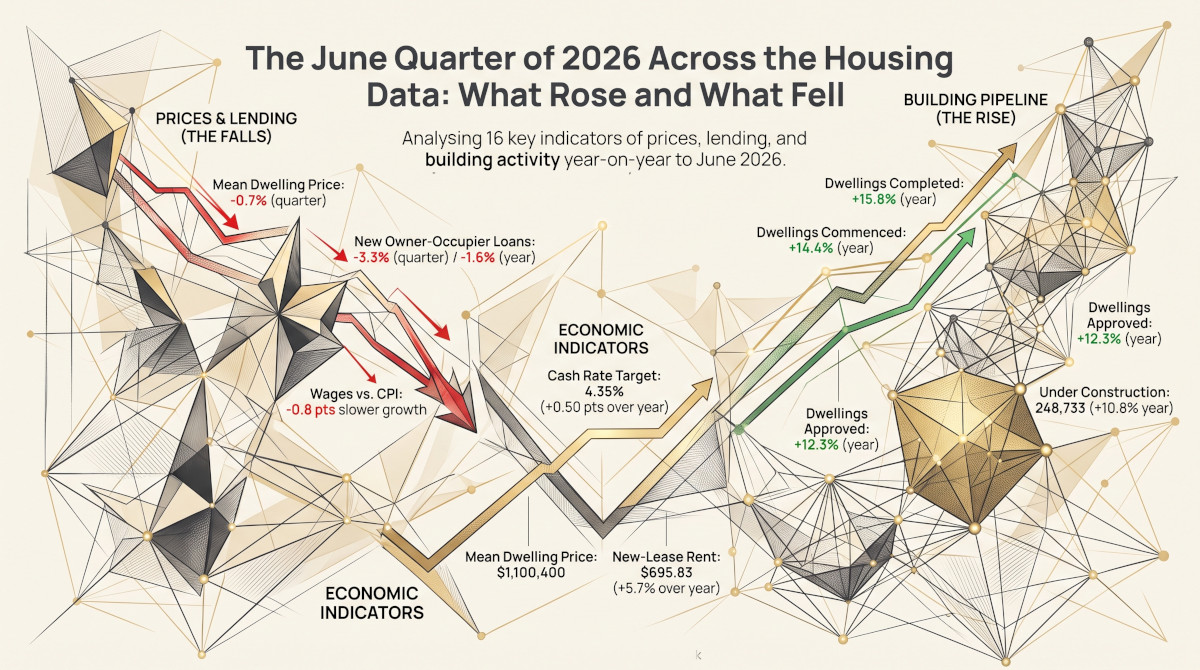


Based on findings from the APN Research Report: The Australian Property Market: Economic Driver or Diversification Drag?
From soaring city skylines to sprawling suburban estates, Australia’s construction sector visibly shapes our landscape and powerfully drives our economy. It’s a major source of jobs, a significant contributor to GDP, and intrinsically linked to the nation’s wealth through property development. However, a recent APN Research Report, “The Australian Property Market: Economic Driver or Diversification Drag?”, suggests that beneath the surface of this economic powerhouse lie significant structural challenges. Despite its scale, the report indicates the sector struggles with innovation, flexibility, and resource constraints, potentially limiting its ability to efficiently meet Australia’s pressing housing needs and boost national productivity.
The Economic Powerhouse
There’s no denying the construction sector’s immense economic footprint. The APN report highlights its significance, noting that building and construction work done was equivalent to a substantial 10.5% of Australia’s GDP in the year ending June 2023 (Section II.A, ref 5). Other estimates consistently place its contribution around 10% historically (Section II.A, ref 6). In the 2022-23 financial year alone, the industry generated a massive $568 billion in total income and contributed $163 billion in industry value added, ranking it as the third largest industry by this measure (Section II.A, ref 7).
Beyond dollars, it’s a jobs giant. As of November 2023, 1.35 million people worked in construction, accounting for 9.4% of all jobs nationwide (Section II.A, ref 5). It stands as the fourth largest employing industry, notable for providing a high proportion of full-time work (Section II.A, ref 7, 5). Its activity also creates significant demand across related industries, from manufacturing to logistics and professional services (Section II.A, ref 8).
Stuck in Low Gear? The Innovation and Productivity Lag
Despite its economic weight, the report points to concerning signs regarding the sector’s dynamism. Compared to the broader economy, the construction industry appears to lag significantly in adopting innovation and new technologies. One study cited indicated an innovation take-up rate of just 31.9% in 2020/21, well below the all-industries average of 45.4% (Section II.A, ref 10). Furthermore, much of this innovation was described as incremental rather than transformative. This relative slowness in adopting new methods, materials, or digital tools can hinder productivity growth, potentially keeping costs higher and limiting efficiency gains.
Hitting Bottlenecks: Costs, Labour, and Supply Responsiveness
The sector’s ability to respond effectively to market demands is further hampered by persistent constraints. The APN report notes that the industry has faced significant input price pressures and labour shortages in recent years (Section II.A, ref 7). These bottlenecks directly impact project timelines and costs, making it harder to ramp up activity quickly.
Adding to this is a potential structural issue: housing supply responsiveness. Research mentioned in the report suggests that the Australian housing market, and by extension the construction sector supplying it, may have limited ability to rapidly increase output even when prices rise (Section II.A, ref 13). This inflexibility, potentially linked to the fragmented nature of the industry (dominated by many small businesses, Section II.A, ref 5) alongside regulatory hurdles and the aforementioned constraints, means supply struggles to keep pace with demand surges.
Can Construction Deliver? Implications for Housing Targets and Affordability
These internal challenges have critical external consequences. Australia has ambitious national goals, such as building 1.2 million new homes over five years, aimed squarely at addressing the housing affordability crisis (Section II.A, ref 12). However, the APN report implies that the construction sector’s limitations – its slow innovation uptake, susceptibility to cost and labour pressures, and potentially sluggish supply response – act as significant hurdles to achieving such targets (Section II.A, ref 10, 12).
If the sector cannot build enough homes quickly and efficiently, it inadvertently contributes to the very housing shortages and affordability problems that policies are trying to solve (Section II.A, ref 10). The engine, while powerful, may not have the capacity or efficiency to deliver at the required speed.
Conclusion: Tuning Up the Engine for Future Needs
The Australian construction sector is undeniably vital, a cornerstone of the economy, providing essential infrastructure and employment. Yet, the APN Research Report suggests it’s an engine operating with constraints. Low innovation, persistent bottlenecks in costs and labour, and structural inflexibility limit its potential and hinder its ability to respond effectively to critical national challenges like housing affordability.
Meeting Australia’s future needs will require more than just relying on the sector’s current momentum. It necessitates a focus on boosting productivity through greater innovation adoption, addressing skills shortages through targeted training and migration, streamlining processes, and tackling supply chain vulnerabilities. Enhancing the capacity and efficiency of this crucial sector is not just an industry concern; it’s fundamental to achieving broader economic goals and improving housing outcomes for all Australians.
Disclaimer: This article is based on interpretations and findings presented in the “APN Research Report: The Australian Property Market: Economic Driver or Diversification Drag?”. Readers are encouraged to consult the full report for detailed analysis and references.