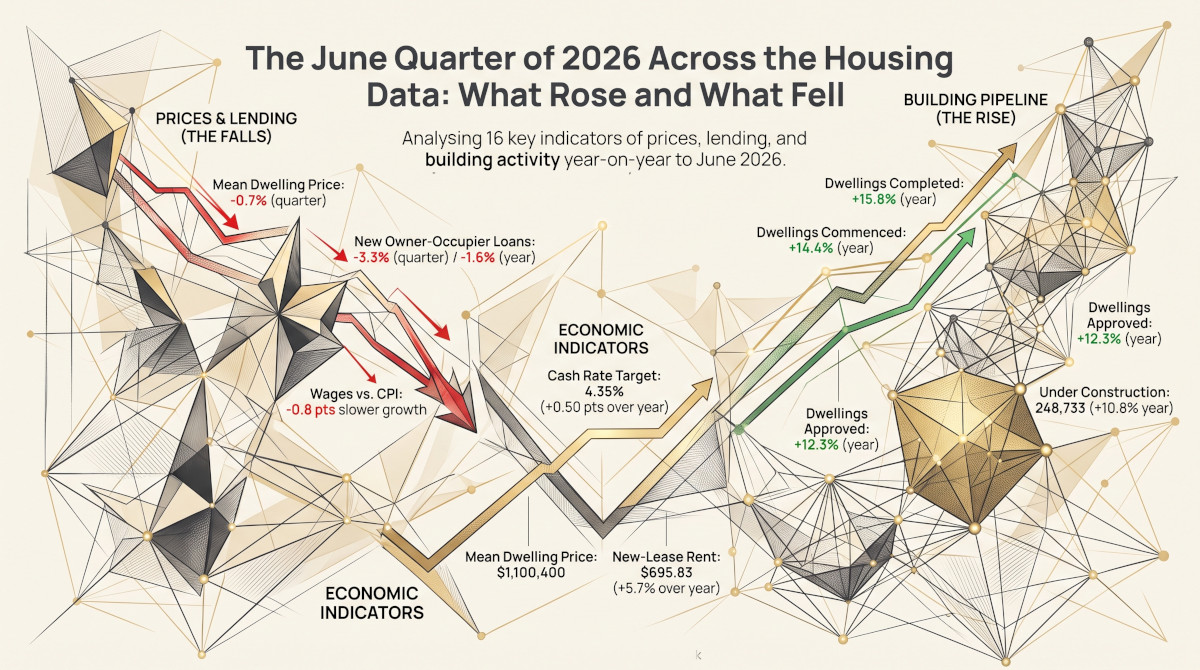


Over the past several discussions, we’ve delved into five critical facets of the Australian property market and its broader economic impact: the dynamics of the construction sector, the complexities of the wealth effect and its contribution to inequality, the profound linkages between the financial system and housing, the delicate balancing act faced by the Reserve Bank of Australia, and the overarching issue of Australia’s economic complexity. As we’ve examined each thread individually, a powerful realisation emerges: these are not isolated issues but rather deeply intertwined elements in a complex tapestry that defines the Australian property market’s influence and its long-term implications for the nation. Understanding these interconnections is crucial for navigating the challenges and opportunities that lie ahead.
The limitations within our construction sector form a critical first thread. As we discussed in the first article, ‘The $270 Billion Question: Building Our Future or Bottling Our Potential? – A Founder’s Perspective on Australian Construction,’ the inherent inefficiencies and slow adoption of innovation contribute to the persistent undersupply of housing across the nation. This undersupply, in turn, fuels rising property prices, directly reinforcing the wealth effect we explored in the second article, ‘The Illusion of Prosperity? Unpacking the Long-Term Implications of the Housing Wealth Effect – A Founder’s Analysis.’ As asset values inflate, existing homeowners feel wealthier, potentially increasing consumption. However, this cycle also exacerbates affordability issues for those trying to enter the market, contributing to the growing wealth inequality we highlighted in that analysis. Furthermore, the financial system’s strong focus on mortgage lending, as detailed in the third article, ‘Beyond the Mortgage Mountain: Rebalancing Finance for Australia’s Long-Term Innovation and Growth – A Founder’s Insight,’ might inadvertently hinder the necessary innovation and investment within the construction sector itself if capital flows are disproportionately directed towards established housing finance rather than transformative industry advancements.
The wealth effect, driven by escalating property values, further entrenches the financial system’s preference for mortgage lending. As outlined in ‘Beyond the Mortgage Mountain,’ the perceived security and profitability of housing loans, particularly when underpinned by rising asset prices, make them a dominant feature of bank portfolios. This self-reinforcing loop can have significant consequences for the broader economy. The sheer volume of capital directed towards housing may divert funds from other sectors, including small and medium enterprises and emerging industries that are vital for enhancing Australia’s economic complexity, as discussed in the fifth article, ‘The Complexity Conundrum: Australia’s Long-Term Economic Future Beyond Bricks and Resources – A Founder’s Strategic View.’ This potential ‘crowding out’ effect can stifle innovation and limit the diversification of our economic base, leaving us more vulnerable in the long run.
Caught in the middle of this intricate web is the Reserve Bank of Australia. As we analysed in the fourth article, ‘Navigating the Rate Maze: The Long-Term Implications of the RBA’s Balancing Act on Australia’s Housing Future – A Founder’s Analysis,’ the RBA’s efforts to control inflation are significantly complicated by the prominent role of housing costs within the CPI and the heightened sensitivity of a market inflated by the wealth effect and readily available mortgage finance. The very tool the RBA uses – adjusting interest rates – has a profound impact on the construction sector (as discussed in the first article), exacerbating wealth inequality by affecting mortgage affordability (as explored in the second), and potentially further entrenching the financial system’s focus (as detailed in the third). This delicate balancing act highlights the systemic interconnectedness and the challenges of using broad monetary policy to address issues within a single, albeit significant, sector.
Ultimately, the dominance of the property market, supported by the financial system and the wealth effect, may be hindering Australia’s long-term economic diversification. As we explored in ‘The Complexity Conundrum,’ our low and declining economic complexity suggests a reliance on a narrow base of exports, primarily resources. The strong gravitational pull of property, attracting significant capital and talent, may be drawing resources away from the very sectors needed to build a more sophisticated and resilient economy. The limitations in construction innovation (from the first article), the potential for capital misallocation within the financial system (from the third), and the policy challenges faced by the RBA (from the fourth) all contribute to this broader issue, reinforcing a cycle that favours established strengths over the development of new, complex industries (as highlighted in the fifth).
Breaking this cycle requires a fundamental shift towards a more integrated and long-term national strategy. Policies aimed at boosting innovation and efficiency within the construction sector (as per our first discussion) could simultaneously address supply constraints and potentially attract more diverse investment. Re-evaluating incentives within the financial system to encourage greater lending to SMEs and emerging industries (as per the third article) could foster diversification and enhance economic complexity (as discussed in the fifth). A more holistic approach to housing affordability, beyond solely relying on monetary policy (as per the fourth article), is also crucial. By recognising the interconnectedness of these issues, we can begin to formulate more effective and sustainable solutions that address multiple threads simultaneously, paving the way for a more balanced and resilient future.
As the founder of the Australian Property Network, I believe it is our collective responsibility to understand these intricate connections. The future of Australia’s property market is inextricably linked to the future of our national economy. By recognising the tangled web of forces at play, we can move towards weaving a new narrative ~ one where the property sector contributes to national prosperity without hindering diversification, innovation, and long-term economic resilience, ensuring a stronger and more complex Australia for generations to come.
Based on findings from the APN Research Report: The Australian Property Market: Economic Driver or Diversification Drag?