
Australian Gas Policy: Systemic Conflict Between Exports, Climate Targets, and National Wealth
APN ANALYSIS: A-251103-AUS51
Executive Summary
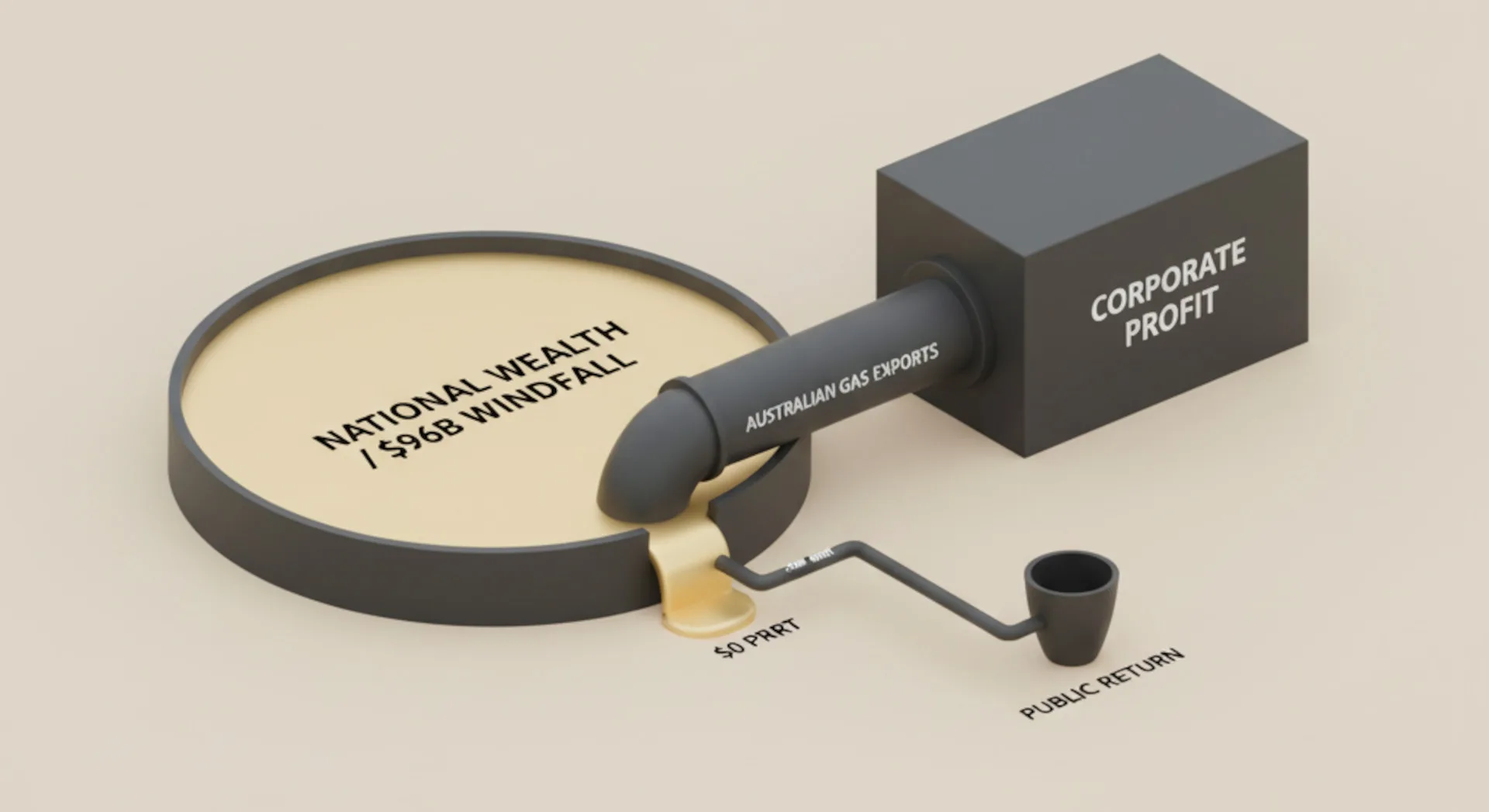
Australian gas export policy has resulted in a structural failure that triples domestic gas prices and directly conflicts with legislated climate targets. This is compounded by a failed resource tax system, which allowed Liquefied Natural Gas (LNG) exporters to realise a ~$96 billion windfall profit (2022-2024) with zero Petroleum Resource Rent Tax (PRRT) paid.
This failure is a definitive, large-scale validation of The Wealth Funnel thesis, representing a structural model of privatised profit and socialised cost. The government’s actions, such as granting 45-year license extensions, are a Project Overlord intervention that actively undermines national energy security and climate goals.
Background & Strategic Context
This structural failure of national policy has profound economic and environmental implications, and its strategic implications are best understood through our core intelligence frameworks:
Resource Mismanagement (Project Overlord): This is a systemic failure of Project Overlord. The state has actively enabled a “structural policy decoupling,” allowing the rapid depletion of the cheapest gas reserves for export, which “negligently undermines Australia’s energy security.” Simultaneously, resource policy (e.g., Woodside’s 2070 license extension) is in direct, public conflict with legislated climate policy (Net Zero by 2050), creating significant sovereign risk.
Wealth Funnel Quantification (The Wealth Funnel): This is one of the clearest, most quantifiable examples of The Wealth Funnel in the national economy. The failure of the Petroleum Resource Rent Tax (PRRT) to capture a single dollar from a $96 billion windfall profit is a structural design failure. It prioritises returns for corporate shareholders over public capture of a finite national resource, socialising the costs (high domestic prices, climate liability) while privatising the profit.
Deconstruction of the Source Event
This deconstruction is based on an internal APN intelligence briefing, inspired by The Australia Institute research. The key facts are:
- The volume of gas exported in the last five years is equivalent to 22 years of Australia’s total domestic gas demand.
- Wholesale East Coast gas prices have tripled since large-scale Liquefied Natural Gas (LNG) exports began in 2015.
- Woodside’s North West Shelf facility has been granted a 45-year operational license extension until 2070, two decades beyond the national 2050 Net Zero target.
- LNG exporters realised an estimated ~$96 billion in windfall profits between 2022 and 2024.
- Zero Petroleum Resource Rent Tax (PRRT) has ever been paid by any LNG exporter, even during this windfall period.
- The Australian Competition and Consumer Commission (ACCC) finds that government interventions have “not materially improved outcomes for gas users.”
Critical Analysis & Balanced View
The “real” story here is the “Climate Policy Contradiction.” Government climate modelling forecasts a 66-68% drop in gas/LNG exports by 2050, while its resources policy actively promotes the long-term expansion of the industry. This creates a significant, unpriced sovereign risk.
- Entrenched Inflationary Channel: The market linkage to global prices has created a structural channel for inflationary shocks to enter the domestic economy. With 71% of businesses anticipating rising energy costs, this is a critical headwind for the Australian industry.
- Stranded Asset Risk: The long-term rationale for new Australian LNG is compromised. A projected 75%+ demand fall by 2050 in key Asian markets (Japan/Korea) is set to coincide with a massive supply glut from the United States (US) and Qatar, exposing higher-cost Australian projects to significant stranded asset risk.
- Structural Failure: The ACCC’s finding that interventions have not worked confirms the policy is structurally decoupled from the national interest. It prioritises export volumes over domestic energy security and affordability.
Balanced View: On the surface, this is a story of a successful export industry. However, the analysis reveals it as a systemic policy failure on three fronts: it has created a structural inflationary channel by tripling domestic gas prices, it has directly contradicted national climate targets, and it has failed to capture any meaningful public return on a $96 billion windfall, representing a catastrophic validation of The Wealth Funnel.
Strategic Implications for Property Professionals
- For Government & Policy: The $0 PRRT collected on a $96 billion windfall mandates immediate, comprehensive reform of the resource taxation mechanism. This is a critical matter of public confidence and fiscal sovereignty.
- For Industrial & Manufacturing Sectors: The high domestic gas prices, driven by export parity, are a direct threat to your viability (attributed to 1,240 job losses). The policy is forcing “disproportionately deeper and more costly emissions cuts” onto your sectors to meet national targets.
- For Energy & Resources (Investors): The 2031-2035 contract expiry window is the key inflexion point. You must anticipate that this window will be leveraged to impose regulatory changes (e.g., domestic reservation). Re-signing long-term contracts beyond this period is a direct act of policy conflict with the 2035/2050 climate targets.
- For All Businesses: You must factor in entrenched energy cost inflation as a structural headwind for the medium term, as government interventions to date have been proven ineffective by the ACCC.
Disclaimer
The analysis and information contained in this analysis are for general informational and strategic purposes only and do not constitute financial, investment, legal, or any other form of professional advice. The Australian Property Network (APN) is a strategic intelligence organisation and is not a licensed financial advisor.
This analysis is based on internal APN intelligence, data, and information believed to be reliable; however, APN provides no warranty as to its accuracy, currency, or completeness. Images used in this analysis are for illustrative and conceptual purposes only and may not represent real persons, properties, or events. Property values and market conditions can go down as well as up.
Before making any property or investment decisions, you must conduct your own thorough research and seek independent professional advice tailored to your specific circumstances.