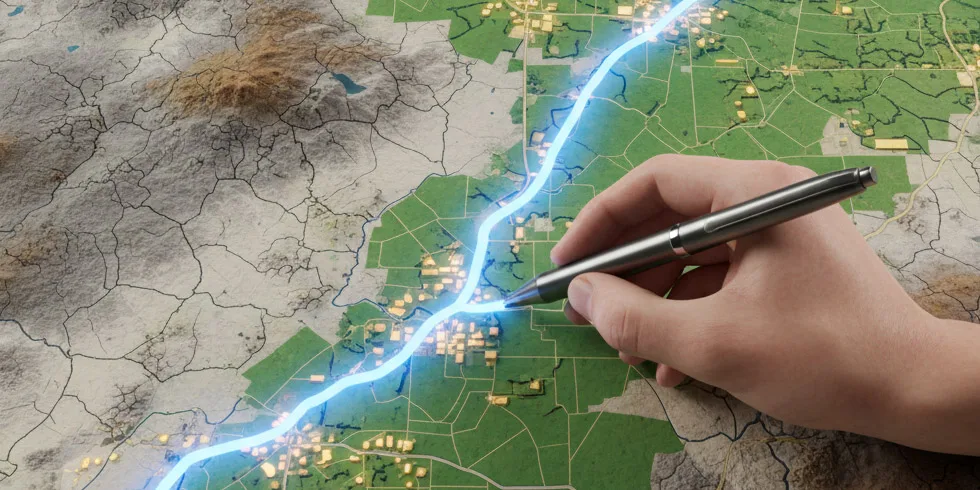


The New Power Grid: Deconstructing the NSW REZ Rollout and its Land Value Impact
APN ANALYSIS: A-251003-NSW61
Executive Summary
The NSW government’s approval of the Central West Orana Renewable Energy Zone (REZ) transmission lines is a landmark event that is actively reshaping the rural property landscape through a combination of strategic investment and compulsory acquisition. While essential for Australia’s energy transition, the rollout is creating significant friction with landowners, exposing deep flaws in the compensation process and setting a contentious precedent for future infrastructure projects.
The strategic implication for property professionals is that a new, specialised field of valuation and negotiation is rapidly emerging. The REZ is not just an energy project; it is a state-backed intervention that creates clear winners and losers. Navigating the complex interplay of land devaluation from transmission lines, value uplift from economic activity, and the high-stakes process of compulsory acquisition will become a critical skill set for professionals operating in these designated corridors.
Background & Strategic Context
The government’s decision to approve this major infrastructure despite local opposition is a strategically critical event that highlights the tension between national objectives and individual property rights, a dynamic best understood through our core intelligence frameworks.
- The Greater Good (Project Overlord): The REZ rollout is a clear Project Overlord initiative, where the state is exercising its power to push through transformative infrastructure for a long-term, national-interest goal—the renewable energy transition. This action deliberately subordinates individual landowner interests to a broader economic and environmental objective, fundamentally altering land use and value in the process.
- The Flawed Shield (Project Shield): The reported experiences of landowners highlight a significant failure of Project Shield, the set of processes designed to ensure fair compensation and protect citizens from the overreach of state power. Farmers feeling “forced to sign with a gun to [their] head” and initial compensation offers being a fraction of independent valuations suggest the shield is not providing adequate protection, creating a trust deficit with long-term consequences.
Deconstruction of the abc.net.au Report
The abc.net.au report details the NSW government’s approval for the construction of over 200km of transmission lines for the Central West Orana REZ, despite ongoing community and landowner concerns. The key points are:
- Project Approval: The Central West Orana REZ is the first in Australia to receive planning consent for such extensive powerline infrastructure, with construction to begin later this year for a 2028 completion.
- Landowner Agreements: While 97 per cent of affected landowners have reportedly signed in-principle agreements, some felt coerced and pressured.
- Compensation Disputes: One farmer reported that EnergyCo’s initial compensation offer tripled only after he obtained his own independent valuation, suggesting systemic undervaluation.
- Local Opposition: Farmers have raised significant concerns about the project running through “good agricultural land,” highlighting a conflict between energy and food production priorities.
- Economic Activity: The project is expected to be an economic stimulus, creating demand for worker accommodation and potentially attracting new energy-intensive industries to the region.
Critical Analysis & Balanced View
The most critical insight is that the REZ rollout is exposing a “process deficit” in how Australia handles large-scale infrastructure projects. The government and its agencies are focused on the engineering and energy outcomes but are failing on the social and negotiation fronts. The fact that a landowner’s compensation can triple after an independent valuation is not a sign of a successful negotiation; it is evidence of a flawed and potentially predatory initial process. This approach creates deep-seated resentment and makes every subsequent infrastructure project harder by destroying social license.
While the project is undoubtedly a vital step towards a decarbonised grid and will bring jobs and investment to the region, the method of execution is creating a legacy of mistrust. The argument that worker camps will be “well-located” does little to appease a farmer whose multi-generational property is being devalued or bisected by high-voltage power lines. The government is winning the planning battle but may be losing the community war.
Balanced View: The Central West Orana REZ is a necessary and economically significant project for NSW and the nation. However, the heavy-handed approach to land acquisition and compensation is a strategic failure that undermines the project’s overall success. Property professionals must now operate on the assumption that these major infrastructure rollouts will be highly contentious. The greatest value they can provide is in ensuring a fair and transparent process for their clients, whether they are landowners facing acquisition or investors navigating the new economic landscape.
Strategic Implications for Property Professionals
- For Valuers: A new specialisation in valuing land impacted by energy infrastructure is now critical. You have a vital role in providing independent assessments for landowners to ensure they receive fair compensation, as the initial offers appear to be systematically low.
- For Rural Agents: You must become the source of truth for your clients. Maintain an up-to-date understanding of the REZ timeline, the specific routes of the transmission lines, and the rights of landowners. Transparency will be key to maintaining trust with both buyers and sellers.
- For Developers: The short-term demand for worker accommodation presents a clear, albeit temporary, development opportunity. The long-term opportunity lies in identifying sites for industrial development that can leverage the improved energy infrastructure.
- For Landowners: Do not accept the first offer. The evidence strongly suggests that seeking independent, expert valuation advice is essential to achieving a fair compensation outcome. Engage professional representation early in the process.
This article is based on a report from www.abc.net.au titled “Renewable Energy Zone transmission lines in NSW Central West to go ahead, despite community concerns”. You can find the original article here: https://www.abc.net.au/news/2024-06-27/renewable-energy-transmission-lines-go-ahead-central-west-nsw/104028854
Given the reported concerns of landowners feeling pressured into agreements, how can property professionals ensure truly equitable and transparent negotiations in future renewable energy infrastructure projects to avoid perceived coercion and fairly value potential land devaluation?
Disclaimer
The analysis and information contained in this deconstruction are for general informational and strategic purposes only and do not constitute financial, investment, legal, or any other form of professional advice. The Australian Property Network (APN) is a strategic intelligence organisation and is not a licensed financial advisor.
This analysis is based on data and information from third-party sources believed to be reliable; however, APN provides no warranty as to its accuracy, currency, or completeness. Images used in this analysis are for illustrative and conceptual purposes only and may not represent real persons, properties, or events. Property values and market conditions can go down as well as up.
Before making any property or investment decisions, you must conduct your own thorough research and seek independent professional advice tailored to your specific circumstances.