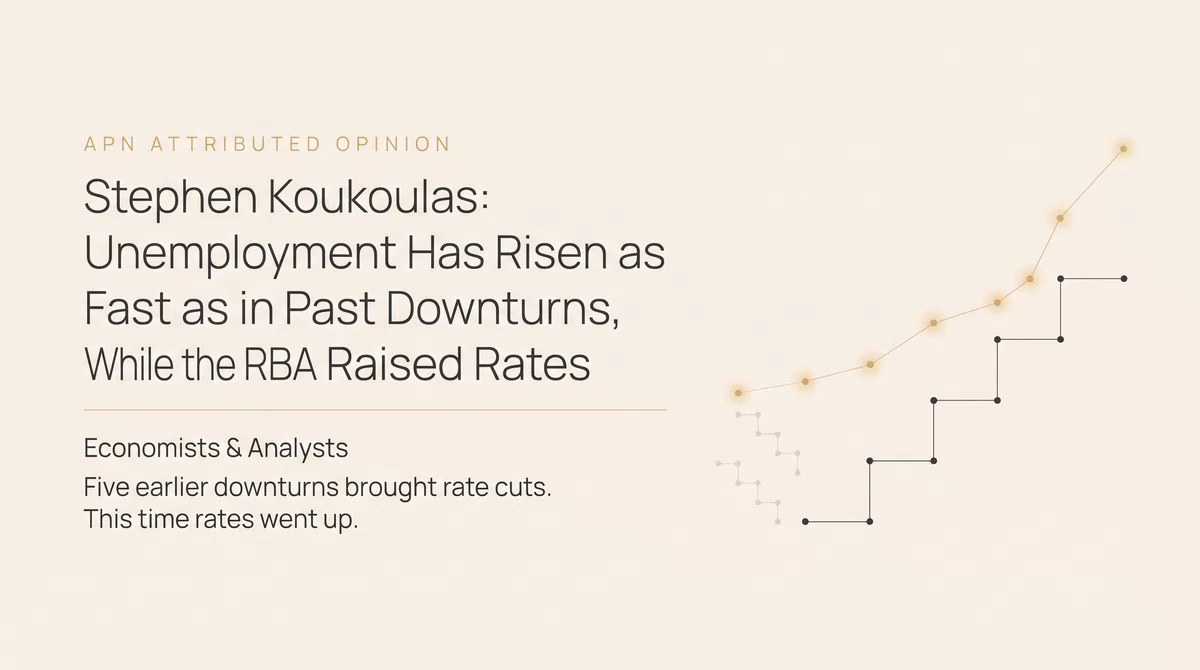

Stephen Koukoulas: Unemployment Has Risen as Fast as in Past Downturns, While the RBA Raised Rates
ABS Labour Force figures for October 2026, released on 19 November 2026: employment fell for a second month and the unemployment rate rose to 4.9%
Has unemployment risen fast enough to call for lower interest rates, and how has the Reserve Bank responded to rises of this size before?
Labour Market Tightness (21231) +0.5983σ June quarter 2026 · position 83.6, ranked against 123 quarters
Interest Rates (21210) +0.9807σ June quarter 2026 · position 96.6, ranked against 30 quarters
Inflation (21220) +2.0007σ September quarter 2026 · position 95.5, ranked against 23 quarters
23000 Series — Scope & Inclusion Criteria
The Australian Property Network’s (APN’s) 23000 Series is the attributed opinion layer of the APN Codex. It presents the recorded perspective of an identified practitioner whose observations bear on active node conditions, without constituting APN’s own analytical position. This perspective is drawn from two videos by Stephen Koukoulas, managing director of Market Economics, published on 19 and 20 November 2026: “Unemployment disaster signals RBA incompetence”, recorded as the ABS released its October labour force figures, and “Unemployment & the RBA – why 2026 is a monetary policy disaster”, a longer reading of the same figures the following day. Both were read in full. His statements are presented as his own attributed argument, not as verified fact; the figures he states are checked against published series below.
Attributed Perspective — Stephen Koukoulas, Market Economics
He reads the October figures as a turn in the labour market. Employment fell by about 44,000 in October and by about 80,000 over two months, and the unemployment rate rose to 4.9%, from 4.1% in January. He notes that the weakness was broad: the share of the population in work fell, participation fell and hours worked weakened. In his view a rise of this size in under a year places the labour market in recessionary territory, and because labour markets do not turn quickly, more weakness is likely. The rate rises of late September and November have yet to work through the economy, and falling house prices are reducing household wealth.
He sets the rise against history. On the ABS figures, he says, the unemployment rate has risen by 0.8 percentage points or more in nine months only five times in the past 50 years: in the early 1980s recession, the early 1990s recession, the 2001 downturn, the global financial crisis and the pandemic. In each, he argues, the Reserve Bank cut rates: by around 900 points in the early 1990s, 100 points in 2001, 125 points in 2009, and to 0.1% in the pandemic, alongside bond purchases and term funding for banks. In the early 1980s, before the cash rate target, the bank bill rate fell by about 600 to 700 points.
So, in each of the five prior episodes … the RBA has been slashing interest rates.
Stephen Koukoulas, video of 20 November 2026.
In 2026, he argues, the Bank did the reverse. It began raising the cash rate almost exactly when unemployment reached its low, he says, and has raised it by 125 points as unemployment rose by 0.8 points, taking it to the highest level in 18 years. He regards that as inconsistent with a mandate that includes full employment, and disputes the Bank’s view that the labour market is still tight.
Look at the unemployment rate. Look at what’s happening in the economy.
Stephen Koukoulas, video of 19 November 2026.
He disputes the inflation measure behind the rises. The trimmed mean, the Bank’s preferred measure of underlying inflation, still includes prices the Bank cannot influence, he argues: petrol, which follows the oil price; electricity, where the end of household rebates lifted the annual rate to about 20% although prices have fallen since January, so the annual rate will drop sharply once data for January and February 2027 arrive; and tobacco excise. In his view the Bank should look through these and set policy on the prices that demand affects. He also notes that a year ago the Bank expected unemployment to peak at 4.3%.
He expects the Bank to reverse course in 2027. With commodity prices falling, he expects inflation to return to the target band by around the middle of 2027, and the cash rate then to move back to a neutral level, which he puts at about 100 points below the current rate. He considers cuts of 100 to 200 points during 2027 plausible as unemployment continues to rise, and expects the rate rises to bring inflation down at a cost in jobs and in business failures.
Source: Stephen Koukoulas, “Unemployment disaster signals RBA incompetence”, YouTube, 19 November 2026 (youtu.be/u4X29jWjA1I), and “Unemployment & the RBA – why 2026 is a monetary policy disaster”, YouTube, 20 November 2026 (youtu.be/0laHy8XpvW8). Close paraphrase throughout, with direct quotations as marked; quotations are taken from the videos’ transcripts, with spoken hesitations removed and omissions marked by an ellipsis. The videos are the authoritative record of exact wording.
Checks Against Published Series
The October figures reproduce. On the ABS seasonally adjusted estimates (ABS, Labour Force, Australia), employment fell by 43,500 in October and by 79,900 over September and October. The unemployment rate was 4.9% in October, up from 4.1% in January, its low point of the past year; the unrounded rise is 0.79 points. The share of the population in work fell from 63.6% to 63.3%, participation from 66.8% to 66.6% (and from 67.0% in August), and monthly hours worked fell 0.2%.
Unemployment rate and cash rate, January 2024 to October 2026
APN chart based on Australian Bureau of Statistics data: Labour Force, Australia, October 2026, January 2024 to October 2026, unemployment rate, persons, seasonally adjusted. Cash rate: Reserve Bank of Australia, cash rate target, monthly average of the daily target; the rise to 4.85% took effect on 4 November 2026.
The historical count holds on published rates. Measuring each month’s rate, at the one decimal place the ABS publishes, against the lowest rate of the preceding nine months, the ABS series from February 1978 shows five earlier episodes of a rise of 0.8 points or more, counting each downturn once: from February 1982, June 1990, April 2001, January 2009 and April 2020, the five he names. October 2026 is the sixth. On unrounded rates the current rise, at 0.79 points, sits at the threshold, and a rise of 0.78 points in early 1987, outside any recession, is just below it.
Rises in unemployment of 0.8 points or more in nine months, and the cash rate
| Episode | Rise first reached 0.8 points | Cash rate response, as he states it | Reserve Bank cash rate target |
|---|---|---|---|
| 1981–83 | February 1982 | Bank bill rate fell by about 600–700 points | Not tested: the cash rate target begins in 1990 |
| 1990–92 | June 1990 | About 900 points | 17.00–17.50% (January 1990) to 4.75% (August 1993): more than 1,200 points, 925 of them from August 1990 |
| 2001 | April 2001 | 100 points | 6.25% to 4.25% over 2001: 200 points, 125 of them by April |
| 2008–09 | January 2009 | 125 points in 2009 | 7.25% (September 2008) to 3.00% (April 2009): 425 points, 125 of them in 2009 |
| 2020 | April 2020 | Cut to 0.1%, with bond purchases and term funding | 0.75% to 0.10% by November 2020: 65 points |
| 2026 | October 2026 | Raised 125 points | 3.60% to 4.85%, February to November 2026: up 125 points |
APN calculation based on Australian Bureau of Statistics data: Labour Force, Australia, October 2026, February 1978 to October 2026, unemployment rate, persons, seasonally adjusted, at one decimal place. Rise measured from the lowest rate of the preceding nine months. Cash rate: Reserve Bank of Australia, cash rate target.
The cash rate responses were mostly larger than he states. On the Reserve Bank’s cash rate target (RBA, cash rate), the 2009 figure is the cuts made in that calendar year; the full easing in the global financial crisis was 425 points from September 2008 to April 2009. In 2001 the Bank cut by 200 points over the year, not 100, of which 125 points came by April. The early 1990s easing was more than 1,200 points from January 1990, and 925 points from August 1990, when the target was first set as a single figure: his “about 900” is the smaller measure. In the pandemic the Bank cut from 0.75% to 0.10%. The direction of his comparison holds in every episode the data cover: the Bank lowered the cash rate each time.
The 2026 rises reproduce. The cash rate target rose by 0.25 points five times in 2026, effective 4 February, 18 March, 6 May, 30 September and 4 November, from 3.60% to 4.85%: 125 points. The first took effect the month after January’s low in unemployment. At 4.85% the target is the highest since November 2008, when it stood at 5.25%: his 18 years.
The electricity point holds; the annual rate has already fallen. In the ABS monthly Consumer Price Index (ABS, Consumer Price Index, Australia), electricity prices rose 18.5% in January 2026 as rebates ended, and the annual rate was above 20% in each month from January to June, and highest in February, at 37.0%. Electricity prices have since fallen 0.8% from January to September, and the annual rate was 12.8% in September, when headline inflation was 4.3%. The January 2026 rise leaves the annual rate in January 2027, as he says. Tobacco prices rose 8.3% over the year to September and contributed 0.17 points to the annual inflation rate.
The Bank forecast 4.3% to 4.4%. The August 2025 Statement on Monetary Policy forecast a quarterly unemployment rate of 4.3% from December 2025 to December 2027 (RBA, Table 3.1, August 2025), the figure he cites. The November 2025 Statement raised it to 4.4% (RBA, Table 3.1, November 2025) and assumed the cash rate would ease to 3.3% by December 2026. The September quarter 2026 averaged 4.6%. His point holds: unemployment has risen above the forecast, and the cash rate has risen, not fallen.
Not tested here: the Bank’s current assessment of labour market tightness, which rests on its own statements; the fall in commodity prices; the timing of a return to the inflation target and the neutral level of the cash rate; and the size of any cuts in 2027, which are forecasts.
APN Clinical Reframing
The videos are delivered in the register of informal commentary, and include personal criticism of the Reserve Bank and its officials that is not reproduced here. One remark is quoted to show that register:
This is an extraordinary sign of incompetence …
Stephen Koukoulas, video of 19 November 2026.
In APN’s register, the argument is that the Reserve Bank has given more weight to inflation, and to a measure of it that includes prices outside its influence, than to a rise in unemployment that, by its speed, has occurred only in downturns, and that the cash rate should now be expected to fall. The certified readings bear on both sides. Labour Market Tightness (21231) read +0.5983σ in the June quarter 2026, position 83.6 of 123 quarters: still tighter than usual, before the July to October rise. On the October figure, its labour force input alone would read about +0.29σ, against +0.76σ in June. Inflation (21220) read +2.0007σ in the September quarter 2026, position 95.5 of 23 quarters, and Interest Rates (21210) +0.9807σ in the June quarter, position 96.6 of 30. The data record a labour market loosening quickly while inflation stays well above its 2011–2025 average; whether the Bank should weigh the first more heavily is the judgement the economist makes.
This perspective is an exploration candidate for Labour Market Tightness (21231). No figure or characterisation in this piece may be treated as an APN-certified position for any 21000, 22000 or 24000 Series node.
- Australian Bureau of Statistics (Reference period: October 2026) Labour Force, Australia [https://www.abs.gov.au/statistics/labour/employment-and-unemployment/labour-force-australia/latest-release], ABS Website, accessed 20 November 2026.
- Australian Bureau of Statistics (Reference period: September 2026) Consumer Price Index, Australia [https://www.abs.gov.au/statistics/economy/price-indexes-and-inflation/consumer-price-index-australia/latest-release], ABS Website, accessed 20 November 2026.
- Koukoulas, Stephen (YouTube, 19 November 2026) Unemployment disaster signals RBA incompetence [https://youtu.be/u4X29jWjA1I], accessed 20 November 2026.
- Koukoulas, Stephen (YouTube, 20 November 2026) Unemployment & the RBA – why 2026 is a monetary policy disaster [https://youtu.be/0laHy8XpvW8], accessed 20 November 2026.
- Reserve Bank of Australia Cash Rate Target [https://www.rba.gov.au/statistics/cash-rate/], accessed 20 November 2026.
- Reserve Bank of Australia Statement on Monetary Policy – August 2025, Table 3.1: Detailed Forecast Table [https://www.rba.gov.au/publications/smp/2025/aug/pdf/forecast-table-2025-08.pdf], accessed 20 November 2026.
- Reserve Bank of Australia Statement on Monetary Policy – November 2025, Table 3.1: Detailed Forecast Table [https://www.rba.gov.au/publications/smp/2025/nov/pdf/forecast-table-2025-11.pdf], accessed 20 November 2026.
ABS material is used under a Creative Commons Attribution 4.0 International licence. Calculations, standardisations and index readings are APN’s and are not attributable to the ABS.
Disclaimer
The analysis, information, and opinions contained in this article are for general informational and strategic purposes only and do not constitute financial, investment, legal, or any other form of professional advice. The Australian Property Network (APN) is a strategic intelligence organisation and is not a licensed financial advisor.
The views, thoughts, and opinions expressed in this text belong solely to the author and do not necessarily reflect the official policy or position of the Australian Property Network (APN).
This content may be based on data from third-party sources believed to be reliable; however, APN provides no warranty as to its accuracy, currency, or completeness.
Property values and market conditions can go down as well as up. Before making any property or investment decisions, you must conduct your own thorough research and seek independent professional advice tailored to your specific circumstances. Images are for illustrative purposes only. E.&O.E.
Findings are presented on the basis of data and evidence alone.