

APN 22000 Series: Thematic Insight: Technological & Innovation Insight
APN INSIGHT: I-260609-139710-HIGH
Evidential Base and Core Metrics
Prior to the presentation of analytical deductions, the underlying sovereign data ledger entries and mathematical baselines are formally declared in accordance with the APN Data Anchoring Requirement:
- Node 21210 (Interest Rates): Official Cash Rate (OCR) sustained at 4.35%, returning a terminal Z-score of +1.37σ based on \(N = 3{,}795\) daily observations.
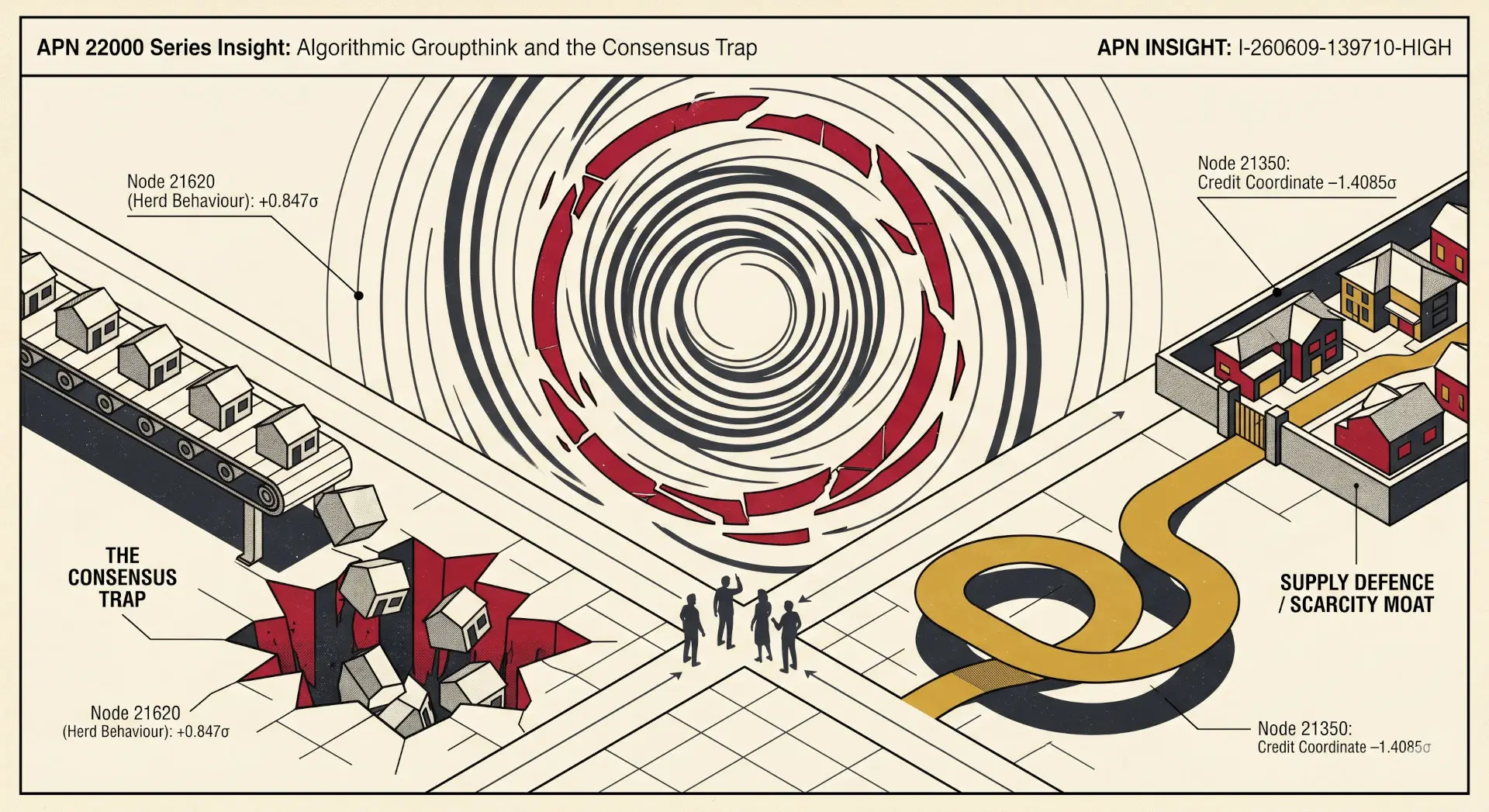
- Node 21350 (Banking & Lending Regulation): APRA serviceability buffer sustained at Epoch 3 (+3.00pp), introducing a contractionary credit coordinate of −1.4085σ.
- Node 21620 (Market Psychology & Herd Behaviour): Behavioural Momentum Index (BMM) tracking at +0.847σ, reflecting elevated spatial concentration vectors.
- Node 22430 (Technological & Innovation Insight Descriptor): Ingested as the active interpretive lens governing the structural implications of predictive systems on transactional execution.
The Consensus Echo Chamber: Systemic Limitations of Generative Modelling
The increasing reliance of market intermediaries and buyers’ agents on commercial PropTech applications and general Large Language Models (LLMs) introduces a documented structural dislocation across the Australian residential asset base, valued in excess of $12 trillion.
In an insightful episode of The Elephant In The Room Property Podcast, co-hosts Veronica Morgan and Chris Bates interrogate the operational boundaries of data application within property ecosystems. Research highlighted in this discussion, conducted by Microburbs founder Luke Metcalfe, establishes that the fundamental mathematical architecture of generic generative tools—which optimises for sequential linguistic probability rather than multi-dimensional economic causality—renders them structurally incapable of navigating cyclical turning points or macroprudential structural interventions.
In a calibrated baseline audit testing seven discrete iterations of generic generative transformers across 17,000 historical suburb profiles over a 38-month historical window, Metcalfe’s data demonstrates that 6 out of 7 models systematically underperformed simple randomised distribution metrics. This systemic predictive deficit incurred an average nominal asset misallocation cost of $13,000 per transaction relative to baseline market momentum. The weight of node evidence supports the interpretation that reliance on uncalibrated consumer-facing automation strips necessary cyclical nuance from spatial risk assessments, converting localised data points into redundant consensus noise. Because LLMs are trained on historical textual repositories dominated by real estate promotional copy and uniform spatial narratives, their outputs represent an automated consolidation of legacy consensus views rather than forward-looking analytical reasoning.
Algorithmic Narrative Amplification and Spatial Purchasing Funnels
The data trajectory in Node 21620 indicates that the widespread deployment of uncalibrated analytical tools by licensed property practitioners accelerates herd behaviour and compresses risk premiums. When multiple buyer agencies deploy identical algorithmic prompts to isolate upcoming growth corridors, the structural implication is a synthetic compression of the spatial purchasing funnel. This process structurally funnels uncorrelated capital into identical local government areas (LGAs) independent of real-time infrastructural capacity or local credit velocity. If current trajectories persist, the structural implication is that participants relying on unverified generic tools are highly likely to pay an unbacked premium to enter congested, consensus-driven market pockets, creating conditions for localised capital contraction when macroeconomic settings shift.
The dialogue between Morgan, Bates, and Metcalfe further identifies a widening divergence between institutional forecasting metrics and ground-level reality. Historical data profiles compiled by the hosts reveal that macro-level forecasting models managed by traditional media pundits return an 85% long-term failure rate over a ten-year horizon, matching the underperformance threshold observed in generic digital tooling. Both human and algorithmic predictive systems rely heavily on woolly suburb median prices, a metric wherein 30% to 40% of observed positive variance is driven by structural additions and renovations rather than actual land value accretion. This distortion follows an asset-shifting pattern: if a cohort transitions from entry-level dwellings to highly improved assets, the median price registers an artificial escalation, masking the stagnation of underlying land values. Consequently, sophisticated risk evaluation requires a transition away from superficial median indicators and toward property-specific, high-resolution resale tracking that mathematically isolates non-discretionary improvement expenditures from structural location values.
Micro-Market Segmentation Layers and Cohesion Metrics
A foundational error of automated forecasting models is the treatment of the residential landscape as a monolithic entity. Micro-data tracking reveals that property markets operate as highly segmented sub-markets operating on discrete friction layers. Cohesion metrics compiled by Metcalfe establish clear data drop-offs:
- National Tier: Merely two-thirds (66%) of observed properties achieve structural alignment or move in the identical directional vector across a given period.
- Suburb Tier: Cohesion expands to approximately 90%, leaving a persistent 1-in-10 property deviation vector where individual assets directly buck the localised trend due to asset-class mismatches (such as a three-bedroom post-war dwelling versus a five-bedroom premium option).
- Street Tier: Cohesion achieves a terminal 97% statistical agreement, establishing that true property sub-markets operate at the street and immediate pocket level rather than the macro suburb grid.
The Paradox of Convenience: Infrastructure Signals vs. Supply Defence
The analysis indicates a distinct negative correlation between superficial liveability metrics and long-term capital growth profiles, highlighting a fundamental blind spot in standard consumer algorithms. General automated models routinely flag commercial infrastructure links—such as new train lines, bus networks, and high-density retail amenities—as positive growth indicators. However, micro-historical tracking reveals that these convenience vectors serve as predictive markers for state government density rezoning initiatives.
The introduction of high-density multi-unit construction creates supply shocks that materially compress local asset values, with data indicating that unit supply shocks depress property value performance metrics up to a 7-kilometre geographic radius. Conversely, the optimised tranquillity index maps a strong positive correlation with superior capital growth. This is driven by a community’s capacity for supply defence; close-knit, high-socioeconomic communities possess the social capital to aggressively resist development and zoning shifts through institutional NIMBY mechanisms, thereby preserving absolute structural scarcity. Counter-intuitive but empirically supported micro-signals further reinforce this scarcity model, showing that proximity to fast-food outlets within a 2-kilometre radius correlates with long-term capital underperformance relative to baseline regional trends.
The Transience of Speculative Capital and Post-Budget Friction
Data science auditing materially challenges the conventional narrative of the long-term, buy-and-hold property investor. Tracking the life-cycle of residential transactions reveals an investor attrition rate structured as an inverse bell curve. The median holding period for an investor is compressed to 5.5 years, compared to 6.5 years for an owner-occupier cohort. Statistically, the investor who has purchased most recently on a given street demonstrates the highest probability of subsequent liquidation, driven by an inability to navigate life shocks, divorce, or cash flow stress.
This transience is actively amplified by the policy shifts introduced in the May 2026 Federal Budget. The structural modification of investor incentives—specifically the compression of negative gearing parameters, tightening land tax frameworks, and alterations to capital gains tax structures—has accelerated the divergence between asset classes. The reduction of credit velocity (Z = −1.4085σ) eliminates the viability of low-yield, tax-optimised residential strategies (such as regional momentum plays or high-density inner-city units).
The prospective trajectory indicates a structural migration of capital away from speculative retail property investment and toward corporate company frameworks, specialised commercial business structures (such as institutional short-term holiday accommodation operators), or direct equity allocation into the primary family home. Because two-thirds of the Australian property ecosystem is comprised of owner-occupiers, long-term capital stability remains heavily insulated within premium, owner-occupier-dominated pockets where emotional, deep-pocketed buyers establish a pricing floor independent of investor cash flow metrics.
Derived Index Movements
| Index Reference | Target Taxonomy | Current Directional Signal | Primary Ingestion Drivers |
|---|---|---|---|
| Node 22430 | Technological & Innovation Insight | Elevated Structural Dislocation | Algorithmic underperformance across 17,000 test nodes; systemic duplication of spatial recommendations; mechanical failure of LLMs during macro policy pivots. |
| Node 21620 | Market Psychology & Herd Behaviour | Accelerated Vector Cohesion | Spatial concentration vectors matching automated PropTech indexing; risk premium compression; synthetic capital pooling into identical localised government areas. |
Source & Audio Asset Provenance
- Primary Source Publication: The Elephant In The Room Property Podcast, Episode: “Luke Metcalfe: Why AI Can’t Pick Property Winners”.
- Hosts: Veronica Morgan (Buyers Agent & Mentor) and Chris Bates (Mortgage Broker).
- Subject Matter Expert: Luke Metcalfe, Founder of Microburbs.
- Episode URL: https://youtu.be/h2MEhzrXHbE?si=mxh927Ic1WLXu2NG
- Retrieval date: 9 June 2026
- Execution Environment: Ingested under the 23200 Industry Voices protocol to establish parallel qualitative discovery layers.
Disclaimer
The analysis, information, and opinions contained in this article are for general informational and strategic purposes only and do not constitute financial, investment, legal, or any other form of professional advice. The Australian Property Network (APN) is a strategic intelligence organisation and is not a licensed financial advisor.
The views, thoughts, and opinions expressed in this text belong solely to the author and do not necessarily reflect the official policy or position of the Australian Property Network (APN).
This content may be based on data from third-party sources believed to be reliable; however, APN provides no warranty as to its accuracy, currency, or completeness. Images used are for illustrative and conceptual purposes only and may not represent real persons, properties, or events.
Property values and market conditions can go down as well as up. Before making any property or investment decisions, you must conduct your own thorough research and seek independent professional advice tailored to your specific circumstances.