

The PropTech Reckoning: Deconstructing RealityAssist’s Struggles and the New Profitability Mandate
APN ANALYSIS: A-250919-AUS39
Executive Summary
The reported financial headwinds facing West Australian firm RealityAssist, which recorded an $8.5 million loss over nine months and is now seeking fresh capital, serve as a case study for a broader, sector-wide challenge: the PropTech profitability crunch. As detailed in the Australian Financial Review, the company’s struggles, attributed to a tough property market, highlight a critical maturation point for the industry. The era of speculative investment and a focus on growth above all else is giving way to a new mandate from investors demanding clear and sustainable pathways to profitability.
For property professionals, this is a crucial development. It signals a shift in the PropTech landscape from a rapidly expanding field of innovators to a period of consolidation and heightened scrutiny. The key takeaway is the need for rigorous due diligence when adopting new technologies. The focus must shift from a platform’s marketing promises to its proven return on investment (ROI) and, critically, its long-term financial viability, which has now emerged as a significant counterparty risk for agencies.
Background & Strategic Context
RealityAssist’s financial difficulties provide a crucial counter-narrative to the prevailing hype around PropTech, illustrating how even well-backed ventures are subject to market fundamentals. This event intersects with several of our core intelligence frameworks.
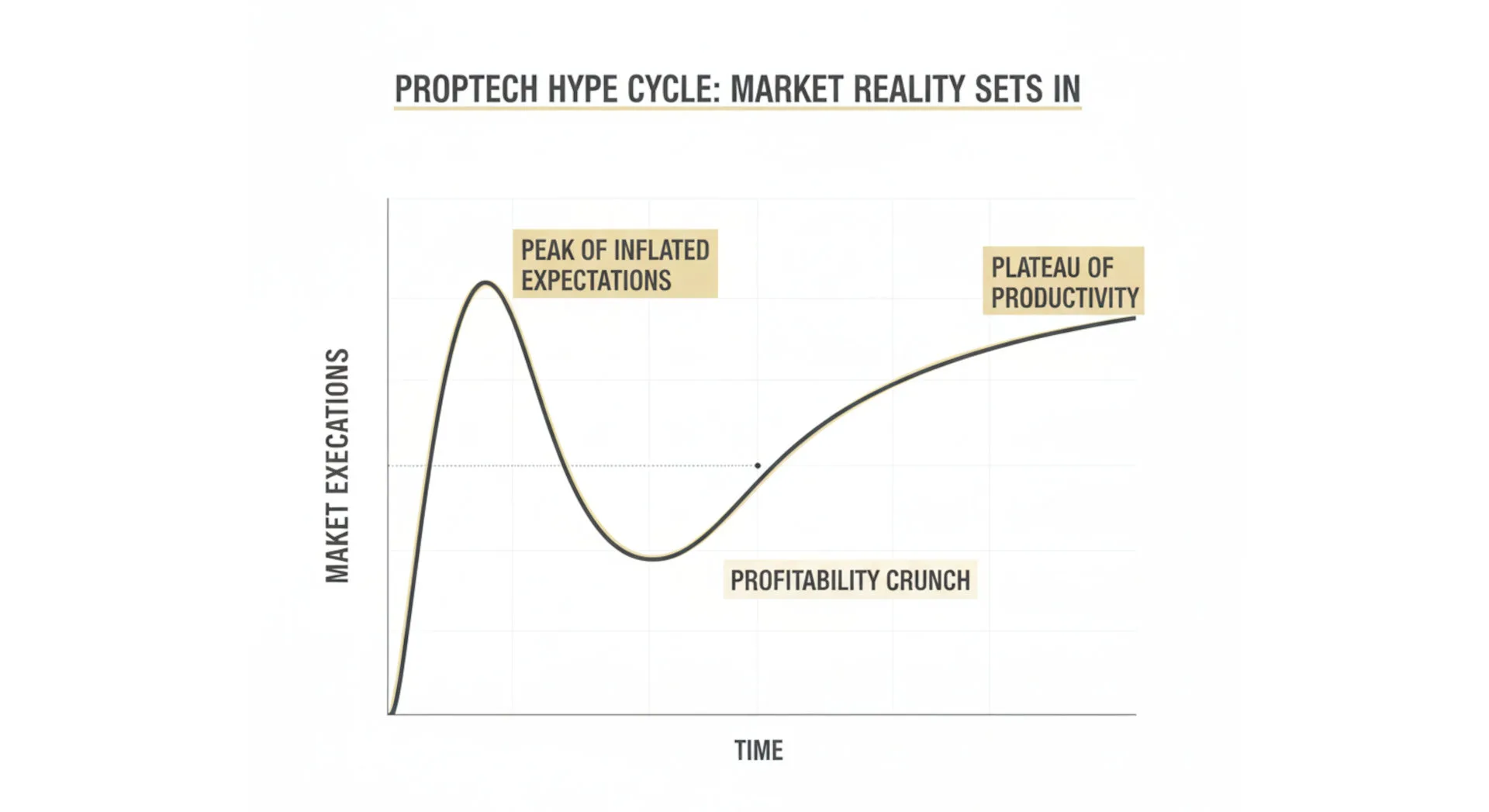
- The Innovation Cycle (Project Overlord): This event represents a classic stage in a Project Overlord technology cycle. After an initial wave of investment and hype, the market enters a consolidation or “reckoning” phase. Capital becomes more discerning, weaker or less profitable players are culled, and investment flows only to those with proven, resilient business models. This is a sign of a maturing market, not necessarily a failing one.
- The Efficiency Paradox (The Wealth Funnel): PropTech platforms like RealityAssist promise to make the Wealth Funnel more efficient for agents. However, this situation highlights the “efficiency paradox”: if the technology doesn’t generate enough tangible value (in time saved or new business generated) to clearly outweigh its subscription cost, it becomes a net drain on an agency’s resources rather than a value creator.
- Carrying Capacity (Corporate): The market’s Carrying Capacity for PropTech solutions is not infinite. With hundreds of platforms competing for a finite pool of agent subscription fees, a shakeout is inevitable. This event is a signal that the market may be approaching its carrying capacity for certain types of transaction management platforms, especially during a market downturn.
Deconstruction of the afr.com Event
The afr.com report from June provides a clear snapshot of the financial pressures facing PropTech firms in a cyclical downturn.
- The Financials: The report details that RealityAssist recorded an $8.5 million loss for the nine months ending March 31.
- The Cause: CEO Tom Kellaway explicitly attributed the downturn to market-wide factors: a contraction in property listings and increased price sensitivity among consumers. This is a critical admission that the firm’s fortunes are directly tied to the same market cycles that affect their traditional agency clients.
- The Backing: The firm is notably backed by a significant institutional player, Metrics Credit Partners. This indicates that even well-funded ventures are not immune to these profitability pressures, a fact that should inform any agency’s risk assessment of its tech partners.
Critical Analysis & Balanced View
RealityAssist’s situation is a symptom of a much broader trend. The global venture capital market has pivoted from rewarding pure user growth to demanding a clear and plausible path to profitability. The era of “cheap money” that funded many speculative tech ventures is over. This puts immense pressure on PropTech firms, which often require significant upfront investment and a long lead time to achieve widespread market adoption and profitability.
The core challenge highlighted by this event is the difficulty of changing agent behaviour. Real estate remains a deeply relationship-driven industry. Many agents are resistant to adopting new technologies that alter their established workflows unless the value proposition is overwhelming, immediate, and easy to implement. A marginal efficiency gain may not be enough to justify the subscription cost and the required investment in training and process change.
However, this should not be misread as a failure of the entire PropTech sector. It is more accurately viewed as a normal and healthy market correction. The platforms with weak business models or unclear value propositions will be culled, while the strong, genuinely valuable platforms will survive and become more entrenched. This is a necessary culling of weaker players, not a terminal crisis for the sector as a whole.
Strategic Implications for Property Professionals
- For Agency Principals (Tech Adoption): This event serves as a mandate for ruthless due diligence. When assessing new PropTech, the focus must shift from “What are its features?” to “What is its measurable ROI, and is the vendor financially viable for the long term?” Vendor stability and the risk of a platform becoming defunct are now primary considerations.
- For Agents (Users): This is a reminder to be cautious of over-reliance on a single, non-essential platform, especially from a newer provider. It’s crucial to ensure that any technology adopted genuinely saves time or generates leads that justify the cost, rather than simply adding another subscription fee and layer of complexity to the workflow.
- For PropTech Founders & Investors: The message from the market is unambiguous: the path to profitability must be the central focus of the business model. Strategies that rely on long periods of loss-making growth, funded by sequential capital raises, are no longer considered viable in the current investment climate.
This article is based on a report from www.afr.com titled “RealityAssist, the Metrics-backed proptech platform, to raise money as losses take toll”. You can find the original article here: https://www.afr.com/street-talk/metrics-backed-realtyassist-to-raise-money-as-losses-take-toll-20250616-p5m7u0
Given RealtyAssist’s struggles despite being a proptech platform, how can property professionals leverage technology to truly enhance value and profitability in a market downturn, rather than simply adding cost?
Disclaimer
The analysis and information contained in this deconstruction are for general informational and strategic purposes only and do not constitute financial, investment, legal, or any other form of professional advice. The Australian Property Network (APN) is a strategic intelligence organisation and is not a licensed financial advisor.
This analysis is based on data and information from third-party sources believed to be reliable; however, APN provides no warranty as to its accuracy, currency, or completeness. Images used in this analysis are for illustrative and conceptual purposes only and may not represent real persons, properties, or events. Property values and market conditions can go down as well as up.
Before making any property or investment decisions, you must conduct your own thorough research and seek independent professional advice tailored to your specific circumstances.