
- Cash holdings are subject to devaluation risk. In the long run, all fiat currencies return to their intrinsic value: zero. Do not hold excess liquidity.
- Debt is a tool. Fixed-rate debt in an inflationary environment represents a transfer of wealth from the lender to the borrower.
- Scarcity is a primary driver of value. Acquire assets that cannot be easily replicated. Land. Prime locations. Quality construction.
The next time a client asks you about the RBA’s 3.85% announcement, do not focus on basis points. Frame the discussion around the Yardstick and Wine analogies to explain the underlying mechanics.
The core analysis indicates currency devaluation, fiscally-driven inflation, and the function of real assets as a store of value in the current environment.
We are the Australian Property Network™. We watch the signal. We ignore the noise.
Why the Price of Money is Rising, but the Value of Money is Falling.
APN STRATEGIC BRIEFING: The Mechanics of Currency Devaluation
APN CODEX REF: 21210: Interest Rates | 21220: Inflation | 21270: Real-Time Credit Velocity | 24600: APN Net State Position™
I. Central Bank Policy and Market Perception
A narrow focus on the Reserve Bank’s next cash rate decision overlooks a more significant underlying structural condition.
Contrary to the market expectation that this was a final adjustment, Governor Bullock has explicitly stated the Board “isn’t ruling anything in or out” for the upcoming May 4-5 meeting. The Governor’s statement indicates a continued focus on policy optionality.
Media commentary will spend the next month dissecting this “Insurance Hike.” It will be framed as “prudent” and “data-dependent.”
This commentary, however, may divert attention from the underlying structural mechanics.
To accurately assess the current market environment, it is necessary to look beyond conventional policy commentary and analyse the structural mechanics of the monetary system.
Yesterday’s hike to 3.85% was not a conventional policy tool; it functions as a tax on liquidity. We are not in a standard business cycle. We are in the late stages of a Long-Term Debt Cycle, compounded by a structural devaluation of the currency.
The price of a house is not rising because the bricks are more valuable. It is rising because the money you use to buy it is worth less.
II. Inflation: Causality and Consequence
It is analytically useful to distinguish between the definition and the symptoms of inflation.
In the 20th century, the definition of “Inflation” was changed in dictionaries. Originally, it meant “an increase in the supply of money and credit.” Today, it is commonly used to mean “rising prices.”
This is not a semantic point. Rising prices are not inflation; they are the symptom of inflation. The cause is the expansion of the monetary supply M2 by the State and the banking sector. The RBA’s latest admission of a Trimmed Mean Inflation figure of 3.4% confirms that the “transitory” narrative is no longer operative. The devaluation is structural.
Think of the Australian Dollar as a yardstick. If you are building a house, and overnight the government decrees that a “metre” is now only 90 centimetres long, your house suddenly measures “larger.” You haven’t added a single room. You haven’t laid a single brick. But numerically, you have more “metres” of house.
This is the Australian property market of the 2020s.
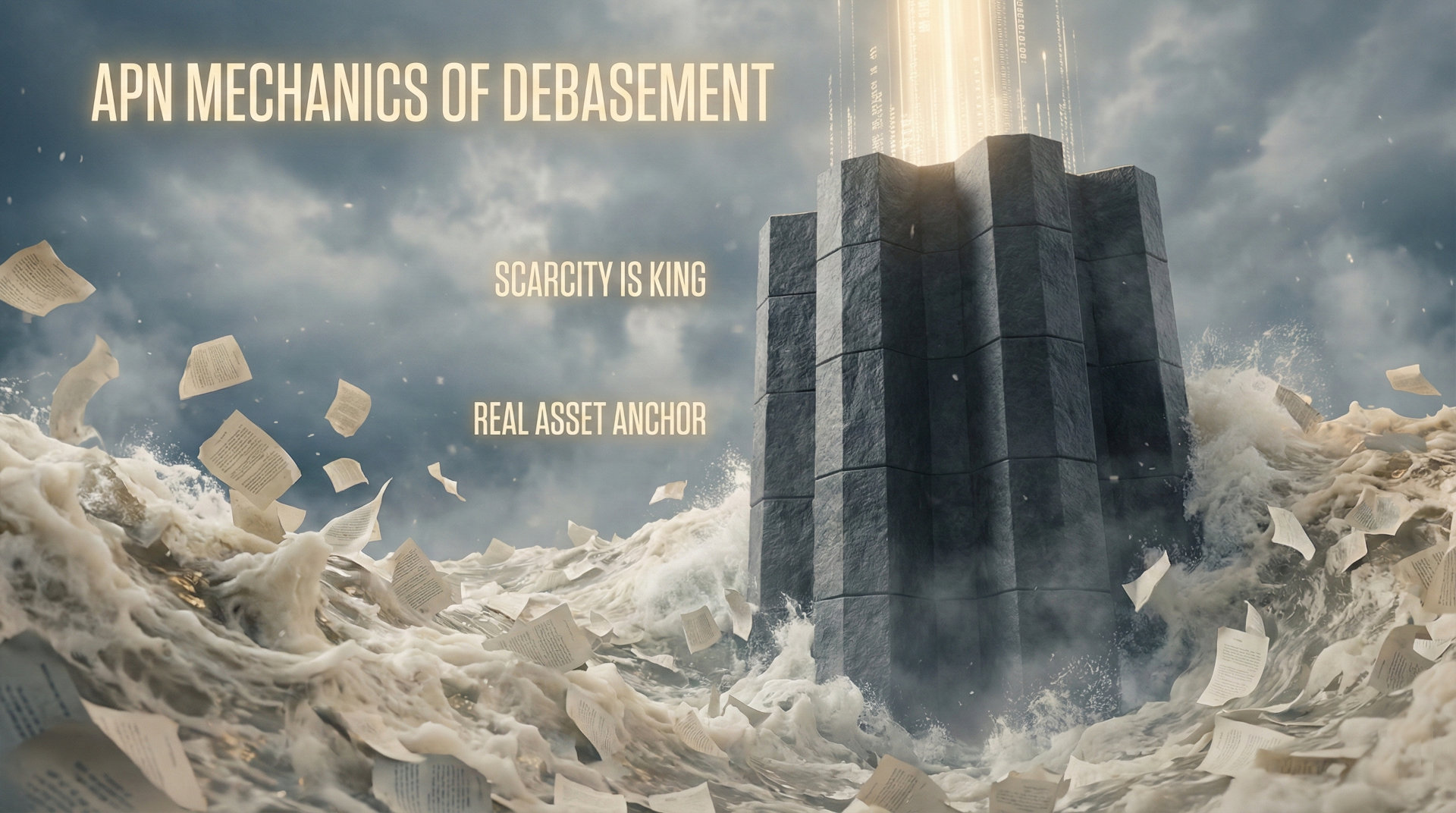
When the government expanded the monetary base by hundreds of billions of dollars during the 2020–2022 period of fiscal stimulus expansion, it did not create wealth. It diluted the existing pool of currency. They took a litre of wine and watered it down to two litres. The resulting mixture looks like wine, but it doesn’t taste like it, and you need to drink twice as much to get the same effect.
The APN View (Codex 21220: Inflation): Inflation is a Hidden Tax. It is a transfer of wealth from those who save in currency (wage earners, pensioners) to those who hold debt and assets (the State, property investors). The State borrows in currency units of a higher value and repays in devalued currency units.
The “cost of living” is more accurately understood as a function of the “cost of fiat currency.”
III. The Structural Limitations of Interest Rate Policy
If inflation is the accelerator, interest rates are intended to be the brake.
Classical economics—the Austrian School—teaches that the interest rate is the Price of Time. If you want money now rather than later, you must pay a premium. In a free market, this rate is set by the supply of real savings.
But we do not operate in an entirely free market (Reference: APN Sovereign Policy Composite Index™ (SPCI, 24800)). We operate in a managed economy where the price of time is administered by a central monetary authority.
For 15 years (2008–2023), central banks held the price of time near zero, maintaining a zero-bound interest rate environment. Business models, state budgets, and infrastructure pipelines were structured based on the assumption of a sustained low-interest-rate environment.
Now, structural conditions have shifted. The move to 3.85% confirms that the “zero-bound interest rate environment” has concluded.
The market pressures observed today, including insolvent builders, stalled development pipelines (Codex 21500: Construction & Development Pipeline Analysis), and mortgagors under elevated financial pressure, are not unexpected. It is the predictable structural adjustment following a prolonged period of low-cost credit.
The RBA is currently attempting to use interest rates to absorb the elevated volume of liquidity it previously introduced. However, it is constrained.
- If they raise rates to the “true” market level (which would be significantly higher than 3.85%), they risk material pressure on the Federal Government’s fiscal position. Recent PBO data forecasts national public debt interest payments swelling to 2.1% of GDP by 2028–29. The State cannot service its own debt pile at market-determined rates.
- If they lower rates too soon, inflationary pressures reignite, and the currency risks accelerated devaluation.
The authority faces the challenge of moderating inflation without inducing an accelerated economic contraction.
IV. Competing Policy Frameworks: Fiscal Expansion and Monetary Contraction
Here is the dynamic that every APN member must articulate to their clients. It is the defining economic tension of our time.
The Central Bank (RBA) has its foot on the brake. They are raising rates and draining liquidity to reduce price pressures.
The State (Government) has its foot on the gas. Through infrastructure spending, subsidies, energy caps, and public sector hiring, they are injecting liquidity into the economy.
Why does this matter? Because it creates Stagflationary Friction.
The private sector (your clients) is being materially constrained by monetary tightening. The public sector is stimulated by fiscal expansion. This creates a “two-speed” economy. The public servant with a guaranteed wage indexed to inflation is insulated, while the small business owner facing a 40% jump in invoice default velocity (Codex 21280: B2B Invoice Default Velocity) is facing material viability pressures.
We see this in the per-capita data. While headline GDP limps forward, GDP per capita remains flat at 0.0%. We are in a “Wealth Recession” masked by high migration. Living standards are eroding, yet asset prices hold. Why? Because the State is spending the money the RBA is trying to absorb.
V. Real Estate as a Hedge Against Currency Devaluation
So, where does this leave Australian Property?
Market commentators predicting a material contraction look at the rate hike to 3.85% and forecast a material valuation correction. They apply a simple linear logic: Rates up = Borrowing power down = Prices down.
They are incorrect because they are looking at the price tag, not the money supply.
In a high-inflation, negative-real-interest-rate environment, Real Estate functions as a store of value against currency devaluation.
Consider the APN Replacement Cost Gap™ (Codex 24450: APN Replacement Cost Gap™).
You can create Australian Dollars. You can digitise a billion dollars into existence with a keystroke.
You cannot replicate hardwood timber. You cannot replicate a registered electrician. You cannot replicate a zoned block of land in a capital city.
As the currency is devalued, the nominal cost of the “ingredients” of a house (materials, labour, energy, compliance) experiences material escalation. The “floor” price of property rises because the cost to replace that asset has risen.
If it costs $800,000 to build a basic home today due to material inflation and regulatory friction (Codex 24220: APN System Friction Index™), existing homes selling for $750,000 are not “expensive”—they are trading below replacement cost. They are trading at a discount to their replacement value.
This is the First Principles analytical basis for property as an asset class. It is a claim on real resources in a physical world, denominated in a devaluing currency.
VI. The Cantillon Effect: Why the Gap Widens
History illustrates the Cantillon Effect. Richard Cantillon, an 18th-century economist, observed that when new money enters an economy, it is not distributed evenly.
It enters at the points closest to its creation.
The banks, the government, and the large asset holders get the new money first. They buy assets (houses, stocks) at yesterday’s prices. By the time that money is distributed to the wage-earning cohort in the form of a salary increase, prices have already risen.
This is why wealth inequality is undergoing rapid expansion. It is not an inherent feature of market economies, but a structural consequence of central banking policy.
For the APN professional, this explains the “K-shaped” recovery.
- The Asset Owners: Their debt is being eroded by inflation. If they borrowed $1M in 2020, that $1M is serviceable with devalued currency units in 2026 as nominal wages/rents rise.
- The Wage-Earning Cohort: Their purchasing power is diminishing in real terms. Their savings in the bank are being eroded by negative real rates (Interest rate minus Inflation = Negative Return).
Your role as an advisor is to help your clients move from the second group to the first. To move from holding currency to holding assets.
VII. The Sovereign Policy Factor (SPCI, 24800)
Finally, we must acknowledge the significant influence of the State. At APN, we track APN Regulatory Velocity Multiplier™ (Codex 24210: APN Regulatory Velocity Multiplier™ [APN RVM™]).
Government policy is a primary contributor to the structural housing pressure point. By restricting supply through zoning, by adding layers of environmental regulation (increasing the Codex 24520: APN Regional [Green Premium Uplift™ / Brown Discount™]), and by taxing development, they ensure that supply remains structurally constrained relative to demand.
While this may appear to be an adverse condition for market entry, for the incumbent asset holder, it functions as a material competitive barrier.
The State has structurally constrained the housing market. It has made it so difficult, so expensive, and so slow to bring new stock to market—evidenced by the extension in Codex 21290: Grid Connection Lead-Times—that the value of existing stock is significantly enhanced.
There is a structural incentive to maintain the value of the collateral that underpins the Australian banking system. A systemic contraction in the property market would have material consequences for the state’s fiscal position.
VIII. Conclusion: Focus on Liquidity Dynamics
The current period represents a significant historical economic transition. The shift from the “Zero Interest Rate Policy” era to the “Fiscal Dominance” era is structurally disruptive.
Historical precedent suggests several strategic principles:
- Cash holdings are subject to devaluation risk. In the long run, all fiat currencies return to their intrinsic value: zero. Do not hold excess liquidity.
- Debt is a tool. Fixed-rate debt in an inflationary environment represents a transfer of wealth from the lender to the borrower.
- Scarcity is a primary driver of value. Acquire assets that cannot be easily replicated. Land. Prime locations. Quality construction.
The next time a client asks you about the RBA’s 3.85% announcement, do not focus on basis points. Frame the discussion around the Yardstick and Wine analogies to explain the underlying mechanics.
The core analysis indicates currency devaluation, fiscally-driven inflation, and the function of real assets as a store of value in the current environment.
We are the Australian Property Network™. We watch the signal. We ignore the noise.