

Liberal Net Zero Retreat Creates ‘Regulatory Collision’ and Externalises Trade Risk
APN ANALYSIS: A-251113-AUS010
Executive Summary
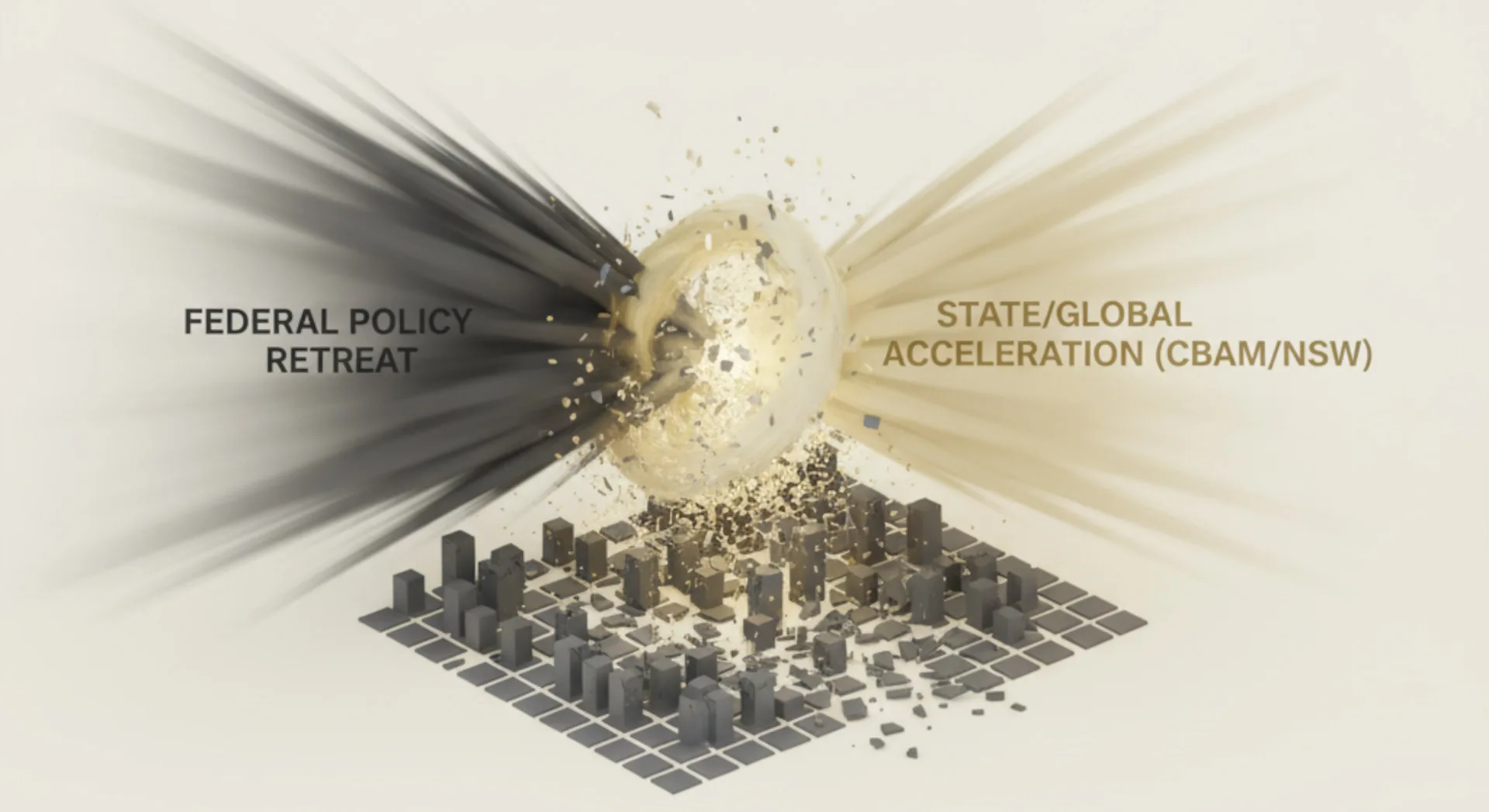
The Liberal Party’s formal abandonment of the 2050 Net Zero target on November 13, 2025, is a market-shattering event. Our analysis confirms this does not eliminate transition risk; it dangerously bifurcates it. The risk is now split into two vectors: 1) immediate, kinetic trade punishment via foreign tariffs (e.g., the EU’s CBAM, starting Jan 1, 2026) and 2) domestic “regulatory fragmentation,” where accelerating state-level regimes (e.g., NSW) directly collide with federal policy inertia.
For property professionals, this creates a “multi-vector regulatory collision” that makes national valuation models obsolete. Assets must now be valued at the state level. This policy externalises risk into punitive foreign tariffs, creating immediate covenant risk for industrial tenants (steel, cement) and stranding “light-green” assets (like 4-star NABERS buildings) whose pro formas (upgrade pathways) relied on federal mechanisms that are now void.
Background & Strategic Context
This analysis identifies a fundamental structural shift in the Australian market. The abandonment of a unified federal policy has created a vacuum now filled by regulatory chaos, a core risk vector for APN’s key frameworks.
- The ‘Multi-Vector Regulatory Collision’ (APN RVM™): This event is a critical test case for the APN Regulatory Velocity Multiplier™ (24210). Our analysis identifies a new, chaotic dynamic. Federal velocity is now zero or negative, while state velocity (e.g., NSW EPA’s 25,000-tonne threshold vs. the federal 100,000-tonne Safeguard Mechanism) is accelerating. This creates a “fragmentation delta” that is now the primary indicator of political and regulatory risk. Furthermore, federal bodies are in conflict: the federal opposition retreats while the federal regulator (ASIC) is still legally bound to move forward on climate reporting (effective Jan 1, 2025).
- Externalising Transition Risk (APN Climate-Risk Asset Devaluation Index™): This is the most critical finding for the APN Climate-Risk Asset Devaluation Index™ (24500). The transition risk has not vanished; it has been “externalised.” It is no longer a manageable, predictable domestic carbon price. It is now an uncapped, punitive, and immediate foreign tariff (EU CBAM, US “Clean Competition Act”). This is a direct financial hit to CBAM-exposed tenants (steel, cement, aluminium), which translates into a new, kinetic covenant risk for industrial and logistics assets.
- A New ‘Stranded Asset’ Class (APN Green Premium / Brown Discount™): This policy shift expands the definition of a “stranded” or “Brown Discount” asset, a key metric for APN Regional Green Premium Uplift / Brown Discount™ (24520). A “stranded asset” is no longer just a coal mine; it is now a “light-green” commercial asset (e.g., a 4-star NABERS building) whose pro forma and upgrade pathway relied on federal grants or other mechanisms that are now void. The “Green Premium” is now the baseline; any asset without a fully funded, non-federally-reliant pathway to Net Zero is now, by definition, “secondary stock.”
Deconstruction of the Source Event
This deconstruction is based on an internal APN intelligence briefing. The key facts are:
- The Policy Shift: On November 13, 2025, the Liberal Party formally abandoned the 2050 Net Zero target.
- The External Tariff: The EU’s Carbon Border Adjustment Mechanism (CBAM) definitive payment regime commences on January 1, 2026. By abandoning the target, Australia loses its “comparable policy” defence, exposing key exports (iron, steel, aluminium, cement) to maximum default tariffs.
- The Internal “Collision”: NSW EPA has proposed prescriptive climate plans for facilities emitting over 25,000 tonnes CO2-e, a threshold far stricter than the federal Safeguard Mechanism’s 100,000 tonnes.
- The Regulator Conflict: ASIC is still legally bound to enforce mandatory climate reporting (effective Jan 1, 2025) and views poor climate disclosure as a key risk, putting it in direct conflict with the federal opposition’s policy.
- Trade Isolation: 90% of Australia’s trade is with net-zero-committed countries, isolating the economy from its primary trade bloc.
Critical Analysis & Balanced View
The “real story” is the shift from a predictable, multi-speed economy to a chaotic and far more expensive “multi-vector regulatory collision.” The idea of a “national” portfolio is now a fiction. The extreme divergence between federal retreat and accelerating state-level regimes (NSW, VIC) makes a single, national valuation model impossible.
The second critical finding is the “externalisation” of risk. The policy does not remove the cost of decarbonisation; it transfers it. It moves the cost from a predictable, manageable domestic policy (like a carbon price) to an unpredictable, punitive foreign tax (CBAM). This is a direct, non-productive subsidy from Australian exporters to foreign (EU) treasuries, and it will be paid by the tenants of Australian industrial assets.
This policy has also created a new, expanded class of “stranded assets.” It’s no longer just heavy emitters. Any “light-green” asset that relied on a federal pro forma for its upgrade pathway is now stranded. The “Green Premium” is no longer an additive for high-performing assets; it is now the baseline requirement for survival. Any asset without a fully funded, non-federally-reliant pathway to Net Zero is, by definition, “secondary stock.”
Strategic Implications for Property Professionals
- For Valuers: “National” portfolios are a fiction. Valuation models must be immediately bifurcated. Assets must be valued based on their specific state-level regulatory regime (e.g., NSW’s 25kt threshold), not the defunct federal one.
- For Industrial & Logistics Owners: You face immediate, kinetic covenant risk. Tenants in CBAM-exposed sectors (steel, aluminium, cement) will be hit with foreign tariffs starting Jan 1, 2026, directly impacting their financial viability and ability to pay rent.
- For Investors: The “Green Premium” is now the baseline. Any asset without a fully funded, non-federally-reliant pathway to Net Zero is “secondary stock.” Global capital will not just flee; it will “reprice” this new, chaotic political risk, demanding a significant premium.
APN Index Management
The APN Codex 24000 Series is a proprietary set of indices that translates complex market forces into measurable metrics. This section outlines how the preceding analysis is validated against, and informs the calibration of, these frameworks.
- Validation: This analysis validates the thesis that “political chaos” (fragmentation, collision) is quantifiably more expensive and higher-risk than “political certainty” (a clear, albeit costly, policy).
- Index Calibration (24500): The APN Climate-Risk Asset Devaluation Index™ (24500) is calibrated to increase the weighting of its “Transition Risk” variable. This analysis provides justification for the view that unpredictable “regulatory fragmentation” and “externalised tariffs” (CBAM) pose a more severe and costly risk than a manageable domestic carbon price.
- Index Calibration (24210): The APN Regulatory Velocity Multiplier™ (24210) is restructured. Its primary metric for climate policy is no longer a single national vector, but the gap between State and Federal velocity (the “Fragmentation Delta”). This delta is now the primary indicator of political risk.
Disclaimer
The analysis and information contained in this deconstruction are for general informational and strategic purposes only and do not constitute financial, investment, legal, or any other form of professional advice. The Australian Property Network (APN) is a strategic intelligence organisation and is not a licensed financial advisor.
This analysis is based on data and information from third-party sources believed to be reliable; however, APN provides no warranty as to its accuracy, currency, or completeness. Images used in this analysis are for illustrative and conceptual purposes only and may not represent real persons, properties, or events.
All frameworks (Codex 24100-24800) are proprietary to APN.
Property values and market conditions can go up or down. Before making any property or investment decisions, you must conduct your own thorough research and seek independent professional advice tailored to your specific circumstances.
