

Blind Creek Solar: A Predictive Model Validating the ‘Overlord/Funnel’, RLV Gap, and Climate Capital Theses
APN ANALYSIS: A-251113-AUS009
Executive Summary
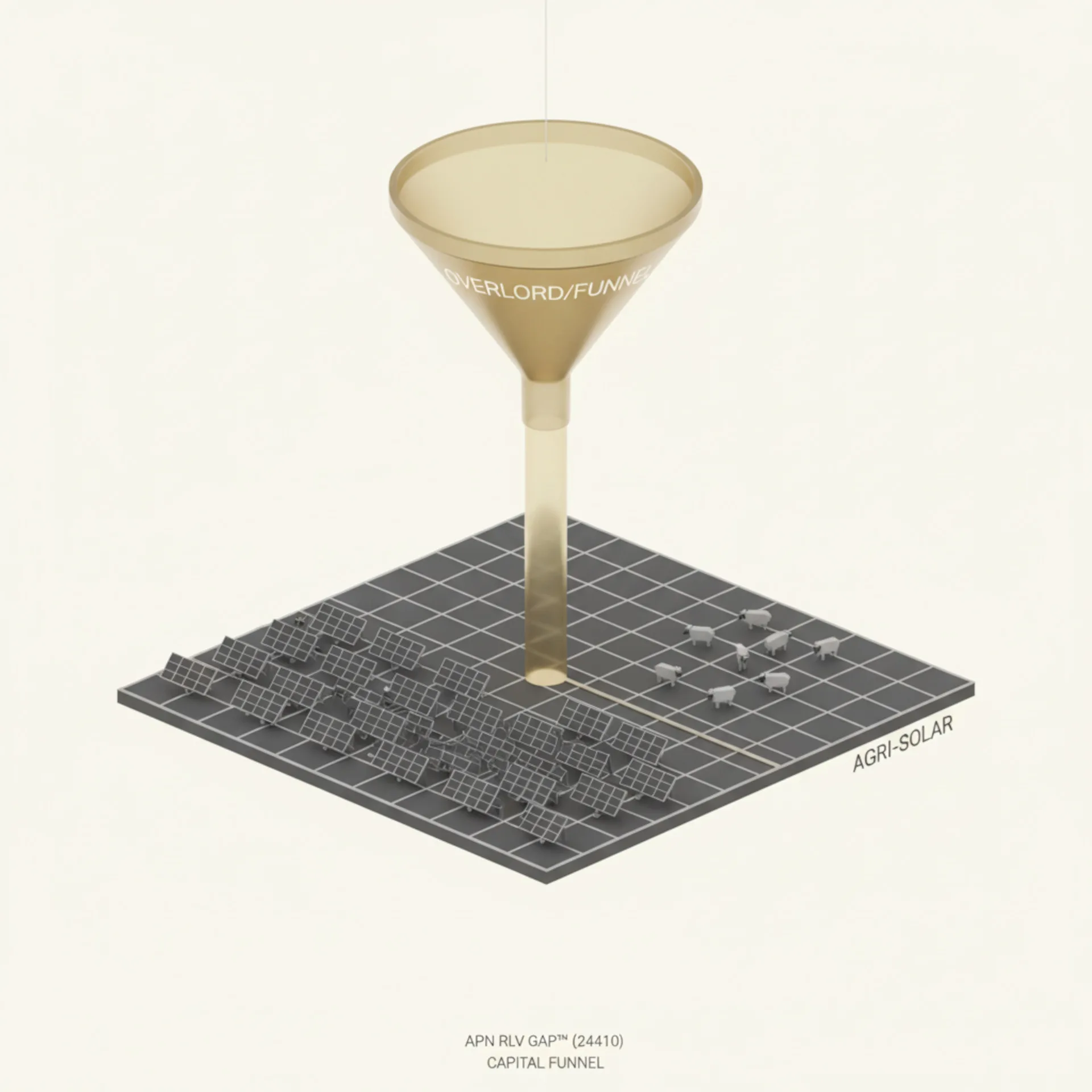
The $900M Blind Creek Solar Farm project is a comprehensive, high-fidelity validation of APN’s core strategic theses. Our analysis confirms it provides a textbook model of the “Overlord/Funnel” in action: state-backed capital (CEFC) and an incumbent (Hostplus) first de-risked the OASIS investment platform, which then acted as a secure “funnel” for subsequent institutional capital (Rest Super).
For property and infrastructure professionals, this is the new bankable template. The project demonstrates that the “agri-solar” model is a necessary financial de-risking tool to address land-use conflicts, a key driver of the APN RLV Gap™ (24410). This platform-level de-risking is the primary mechanism for attracting the programmatic, institutional capital that is structurally shifting into “next generation” infrastructure assets.
Background & Strategic Context
This analysis provides a “perfect microcosm” where three critical APN frameworks converge, validating a predictive model for future institutional-grade asset delivery.
- The ‘Overlord/Funnel’ (Project Overlord): The investment sequence is a flawless validation of this model. The state-backed Clean Energy Finance Corporation (CEFC) provided a “cornerstone commitment” alongside incumbent wealth holder Hostplus. This joint “de-risking” of the OASIS platform created a trusted, investment-grade vehicle that then “funnelled” a subsequent $250M commitment from Rest Super. This confirms the CEFC’s strategic role is not as a simple project lender, but as a “de-risker of platforms.”
- Solving the RLV Gap (APN RLV Gap™): The “true agri-solar model” is the critical finding for the APN RLV Gap™ (24410). This is not a PR gesture; it is a structural, financial de-risking mechanism. By “enabl[ing] sheep grazing to continue” and developing in “close partnership with local landholders,” the project neutralises the primary liability of land-use conflict, transforming a key project-killing risk into a bankable asset (local partnership).
- Programmatic Capital Shift (Codex 24500 Context): The “NIL RETURN” on project-specific quotes from Hostplus and Rest is a critical insight. It confirms they are operating as programmatic capital allocators, not project-by-project financiers. They are investing at the platform level (OASIS) to gain efficient, scalable exposure to the “energy transition,” which they have identified as a “next generation of infrastructure assets.” This is the core financial engine of the “Green Premium” thesis underpinning the APN Climate-Risk Asset Devaluation Index™ (24500).
Deconstruction of the Source Event
This deconstruction is based on an internal APN intelligence briefing. The key facts are:
- The Asset: The $900 million Blind Creek Solar Farm (300MW) and Battery (243MW/486MWh) project in Bungendore, NSW, held within the Octopus Australia Sustainable Investments Fund (OASIS).
- The “Funnel” (Cornerstone): The OASIS fund was launched with “cornerstone commitments” from the state-backed CEFC and incumbent Hostplus.
- The “Funnel” (Follow-on): The de-risked OASIS platform subsequently attracted a “A$250 million commitment from Rest” Super.
- The De-Risking Mechanism: The project is an explicit “true agri-solar model” designed to “enable sheep grazing to continue” and was “Developed in close partnership with local landholders.”
- The Rationale (Rest Super): To gain exposure to the “next generation of infrastructure assets” and capitalise on the “fantastic economic opportunity” of the “energy transition.”
- The Rationale (Hostplus): To link “investment in sustainable infrastructure” to “strong, long-term returns” and advancing the “energy transition.”
Critical Analysis & Balanced View
The “real story” of Blind Creek is that it serves as a “perfect microcosm” where all three of APN’s core theses converge into a single, bankable, and predictive model.
First, the “Overlord/Funnel” is validated. The CEFC (state) + Hostplus (incumbent) de-risking the platform (OASIS) is the proven template for channelling institutional capital. The absence of project-specific quotes from the super funds is the key data point; it proves they are allocating programmatically to the platform rather than picking individual projects to achieve scalable exposure.
Second, the “agri-solar” model is confirmed as a structural, financial solution to the APN RLV Gap™ (24410). This model provides a bankable solution to the most significant non-financial risk in renewable energy development: land-use conflicts and local community opposition. By integrating agriculture, the project neutralises this key liability.
Third, this event shows the institutional capital shift in action. Rest and Hostplus are not buying a solar farm; they are buying de-risked, scalable exposure to the “energy transition” as a “next generation” asset class. This demonstrates the structural demand that creates the “Green Premium” for climate-ready assets, which is the core of the APN Climate-Risk Asset Devaluation Index™ (24500) thesis.
Strategic Implications for Property Professionals
- For Developers (Renewables): The “agri-solar” model is now the institutional-grade standard. To attract programmatic capital from super funds, projects must demonstrate this level of land-use conflict mitigation as a core financial de-risking tool.
- For Fund Managers: The “OASIS model” (State cornerstone + Incumbent cornerstone) is the validated template for creating investment-grade vehicles. This platform-level de-risking, not project-level specifics, is what attracts scalable follow-on capital.
- For Investors: Future analysis of super-fund investment in this sector must focus on platform-level commitments (like to OASIS), as this is the primary mechanism for scalable capital deployment, not project-specific announcements.
APN Index Management
The APN Codex 24000 Series is a proprietary set of indices that translates complex market forces into measurable metrics. This section outlines how the preceding analysis is validated against, and informs the calibration of, these frameworks.
- Validation (Overlord/Funnel): This analysis validates the “Overlord/Funnel” model, where state-backed entities (CEFC) de-risk platforms (OASIS) to channel incumbent capital (Hostplus, Rest) into a target sector.
- Index Calibration (24410): The APN RLV Gap™ (24410) model is calibrated to recognise “agri-solar” as a specific, quantifiable, negative-liability variable (i.e., a de-risking tool). Projects with this model now carry a lower land-use friction coefficient.
- Index Calibration (24500): This analysis informs the APN Climate-Risk Asset Devaluation Index™ (24500) by confirming that the primary capital deployment mechanism for “Green Premium” assets is at the platform level, not the project level.
Disclaimer
The analysis and information contained in this deconstruction are for general informational and strategic purposes only and do not constitute financial, investment, legal, or any other form of professional advice. The Australian Property Network (APN) is a strategic intelligence organisation and is not a licensed financial advisor.
This analysis is based on data and information from third-party sources believed to be reliable; however, APN provides no warranty as to its accuracy, currency, or completeness. Images used in this analysis are for illustrative and conceptual purposes only and may not represent real persons, properties, or events.
All frameworks (Codex 24100-24800) are proprietary to APN.
Property values and market conditions can go up or down. Before making any property or investment decisions, you must conduct your own thorough research and seek independent professional advice tailored to your specific circumstances.
