

The Flight to Quality: Deconstructing the $200M Stamoulis Deal and the Bifurcation of the Melbourne Office Market
APN ANALYSIS: A-250924-AUS56
Executive Summary
In a significant vote of confidence for Melbourne’s premium office market, veteran property investor Harry Stamoulis has acquired the A-grade tower at 357 Collins Street for approximately $200 million. The deal, which my intelligence sweep confirms is now unconditional, represents one of the largest office transactions of the year. It provides a crucial, positive data point for a sector grappling with the headwinds of rising interest rates and post-pandemic work patterns.
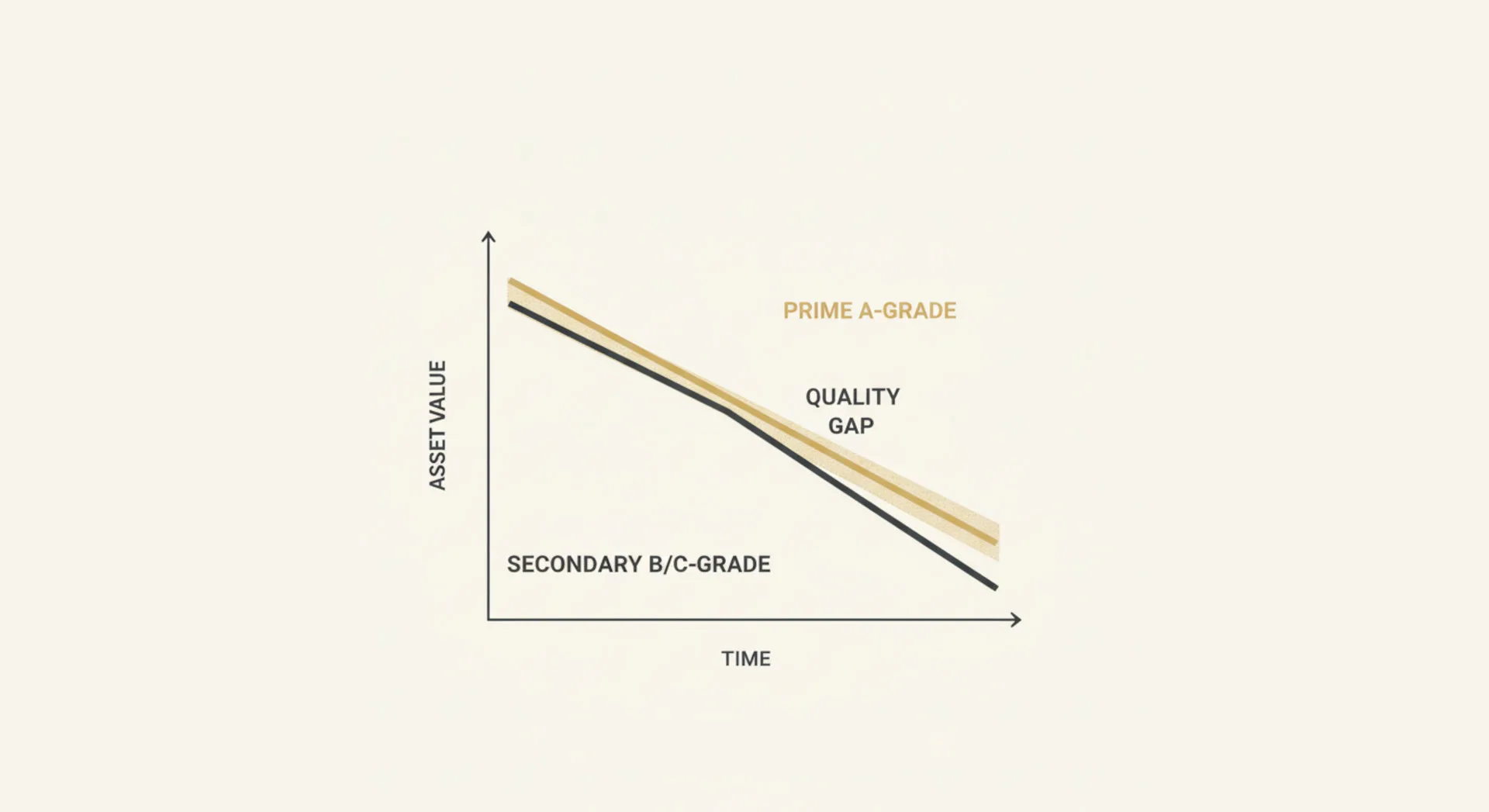
For property professionals, the key takeaway is that the Melbourne CBD office market is not monolithic; it has decisively bifurcated. While secondary assets continue to face significant challenges, this transaction proves there is deep and competitive private capital demand for premium, well-located assets with strong tenant covenants. This “flight to quality” is the defining dynamic of the current market, where the top tier of assets is holding its value far more effectively than the rest.
Background & Strategic Context
In a commercial property market defined by uncertainty and a lack of transactional evidence, the sale of 357 Collins Street provides a rare moment of clarity, illustrating several of our core intelligence frameworks.
- The Two-Tiered Market (Project Overlord): This transaction is a powerful, real-world example of a Project Overlord macro trend: the bifurcation of asset classes. The “flight-to-quality” phenomenon, driven by new working patterns and heightened investor risk aversion, is creating a two-tiered office market. Premium, amenity-rich assets will retain value and attract tenants, while older B-grade and C-grade buildings face functional obsolescence and significant devaluation.
- Counter-Cyclical Investing (The Wealth Funnel): Stamoulis’s acquisition is a classic counter-cyclical play within the Wealth Funnel. By acquiring a premium asset during a period of market softness and reduced competition from institutional players (who are often constrained by redemption queues or negative sentiment), private capital can secure high-quality, long-term assets at favourable pricing, positioning for significant capital appreciation when the market recovers.
- New Money vs. Old Money (APN Social Capital Index): The bidding for the asset, which reportedly involved established property dynasties like the Stamoulis and Lowy families alongside new tech-driven wealth like Ed Craven (Stake.com), highlights an important dynamic. It shows that prime CBD real estate remains a benchmark asset class for both wealth preservation and status, a key component of the APN Social Capital Index for high-net-worth individuals, regardless of the source of their capital.
Deconstruction of the greekherald.com.au Report & Market Intelligence
The greekherald.com.au report, citing The Australian, first signalled the deal, which my subsequent intelligence sweep has confirmed is now unconditional.
- The Deal: Stamoulis Property Group has acquired 357 Collins Street for approximately $200 million.
- The Asset: The building is a 25-storey, A-grade office tower with over 31,000 sqm of lettable area. Its key tenants include Commonwealth Bank and Gartner Australasia.
- The Players: The buyer is veteran private investor Harry Stamoulis. The seller is a Singapore-listed arm of Frasers Property. The bidding process was highly competitive, attracting interest from new tech billionaire Ed Craven and established funds like Growthpoint and Assembly Funds.
- The Strategy: The acquisition is part of a clear counter-cyclical strategy by Stamoulis, following his 2024 purchase of 1 Nicholson Street from Charter Hall for $155 million.
Critical Analysis & Balanced View
This transaction is a significant vote of confidence in the future of the premium Melbourne CBD office market from a highly experienced and successful private investor. In a market starved of transactions, it provides a crucial valuation benchmark and demonstrates that, for the right asset, liquidity and competitive tension still exist. It proves that the narrative of the “death of the office” is overly simplistic and that high-quality, well-located buildings remain a preferred asset class for sophisticated capital.
However, the counter-argument is that this deal is an outlier that actually proves the weakness of the broader market. The fact that the building has sold for approximately $22.5 million less than its 2014 purchase price, despite a major redevelopment in the interim, highlights the significant value destruction that has occurred across the sector due to capitalisation rate expansion. Furthermore, the competitive bidding was limited to a handful of private capital players, with the large institutional REITs notably absent, suggesting a lack of broad-based market recovery.
Strategic Implications for Property Professionals
- For Valuers: This transaction provides a critical, post-interest-rate-hike benchmark for prime Melbourne CBD A-grade assets. However, it also reinforces the need to apply a significant and widening discount for B-grade and C-grade assets, which do not benefit from this “flight-to-quality” dynamic.
- For Commercial Agents & Brokers: The deal confirms that the most active and aggressive capital in the current market is private, high-net-worth individuals and syndicates. Marketing and deal-structuring strategies must be tailored to this specific buyer pool, which often has different return hurdles, risk appetites, and decision-making processes than institutional capital.
- For Owners of Secondary Assets: This is a sobering signal. The clear preference of active capital for premium assets means that owners of B-grade and C-grade buildings face a stark choice: commit significant capital expenditure to upgrade their assets to compete at the A-grade level, or accept a substantial and potentially permanent devaluation.
- For Investors: The strategy is clear: focus exclusively on premium, well-located assets with strong tenant covenants and high-quality amenities. The bifurcation of the market means that “bargain-hunting” in the secondary market is a high-risk strategy, while paying a fair price for quality is the proven defensive play in the current environment.
This article is based on a report from greekherald.com.au titled “Harry Stamoulis set to acquire $200m Collins St tower – The Greek Herald”. You can find the original article here: https://greekherald.com.au/news/harry-stamoulis-set-to-acquire-200m-collins-street-office-tower-in-melbourne/
Given the contrasting investment strategies of traditional property tycoons and cryptocurrency billionaires, how will the increasing involvement of tech-driven wealth reshape the risk assessment and valuation models used in commercial real estate?
Disclaimer
The information contained in this article is for general informational purposes only and does not constitute financial, investment, or legal advice. The Australian Property Network (APN) is not a licensed financial advisor. The content is based on data from third-party sources and is provided without any warranty as to its accuracy, currency, or completeness. Property values can go down as well as up. Before making any property or investment decisions, you should conduct your own research and consider seeking independent professional advice tailored to your specific circumstances.
